Netflix Stock Crash Makes It a Much Better Buy!

- Rendement de la vidéo
- +7,31%
- Appels
- 3
- Achat / Vente
- 3 0
- Publié
Recommandations
L'entrée est le cours de clôture de l'actif à la date de publication. Le cours actuel est la dernière clôture enregistrée.
-
Entrée $68,67 21 juil 2026Actuel $74,13 07 août 2026Résultat +$5,46
when it might be better to buy this
Contexte “when you can also understand when it might be better to buy this.”
-
Entrée $68,67 21 juil 2026Actuel $74,13 07 août 2026Résultat +$5,46
one of the better buys
Contexte “I have put it here like one of the better buys to understand now on the quadrant”
-
Entrée $68,67 21 juil 2026Actuel $74,13 07 août 2026Résultat +$5,46
would make it a buy
Contexte “The growth scenario would make it a buy.”
Transcription Complète
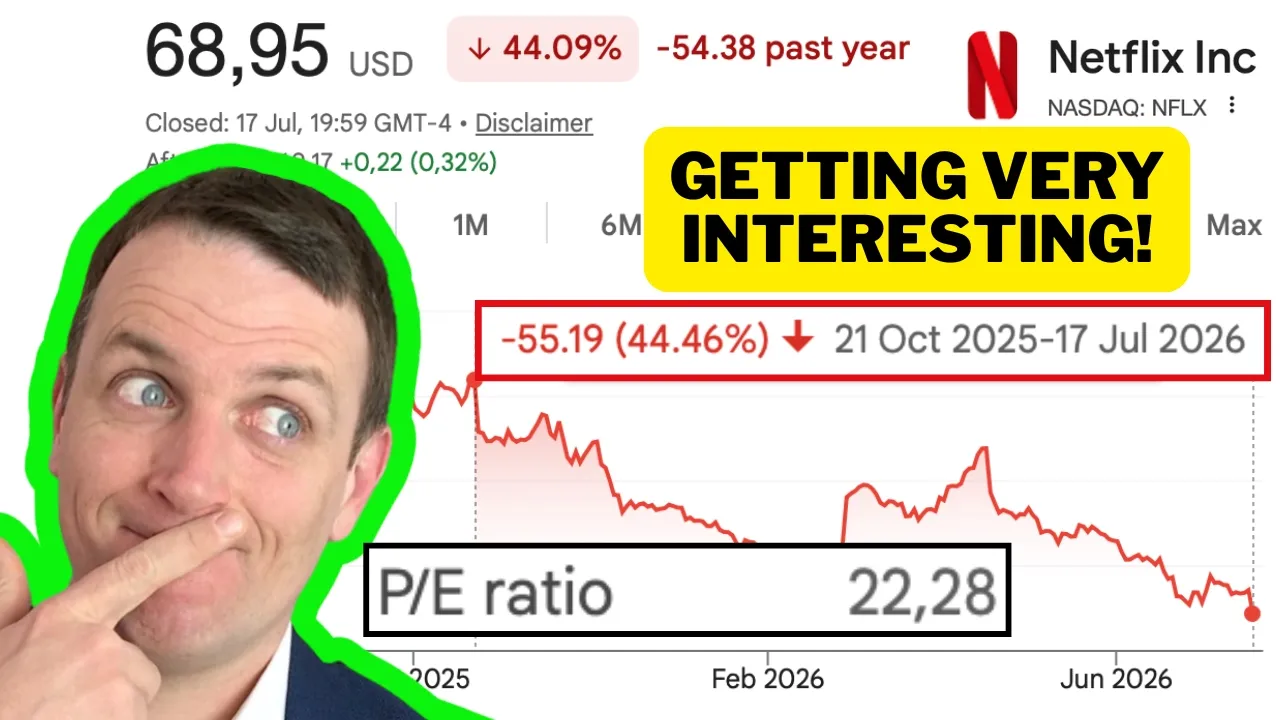
Good day fellow investors. A lot of your suggestions about Netflix also service one. Now let me know your suggestions in the comments. But Netflix is down 44% over the last year. The chart looks ugly but the P ratio 22 for a company still growing at double digits. This is getting interesting. So let's do a standard deep dive the situation the last earnings the business intrinsic value calculation so that you can see at what point it fits your risk and reward put it on the value investing quadrant give the market perspective what are the institutions thinking and then discuss an investing strategy if you like this smash that like button let's start with Netflix business do I have a Netflix subscription yes I do we don't watch much maybe one two episodes of friends here and there. My kid watches some cartoons, but not that much. Will I cancel the subscription? I would like to, but somebody would complain in my family. So, that's not possible. And therefore, it is a sticky business that we are most subscribed, which gives it a very interesting positive because when you're using a business, you know it much better. Let's look at the long-term stock chart. clear compounder and with those compounders these ups and downs on exuberance and panic are very very normal. We are now again exuberance panic and if you can understand the long-term compounding trend you can also understand when it might be better to buy this. Of course, 2022, remember Billman bought, then sold at a loss, and then it was what, uh, 5, 6x, now only a 3x, but that's still great. The situation is the following. Huge growth rates in the past, slowing down a bit after the pandemic boom, then I cannot share my password with my parents, etc. We are back to higher growth. However, the business is now slowing down from 15 to still 12 13% of growth, even higher on the profit side given the buybacks. But the stock market is panicking. The business is still growing, which might be a situation interesting for us value investors. If we look at the P ratio, the bottom was at 17. Next 12 months, now we are still there. Of course, these were the 30% growth rates that were staggering. P ratio has declined. Then again, above 40 and now we are below 20. These are cheap levels, especially from a relative Netflix perspective. If we look at price to sales, we have been lower, but we are still now at the lower end of things. But keep in mind, it can always get lower. If I look at the situation here, compounder good growth with ups and downs that will be normal in the business P ratio now 22 forward much much lower and we'll discuss that later. Let's go into the last earnings. Still 13% growth over the year. Forecasted again growth margin a little bit weaker forecast than expected and yearon-year growth for next quarter just 11.7%. Then there was one hit to the net income versus free cash flow situation but that is because of taxes and what was it the Warner Bros situation. A little bit more of amortization. However, if I look at past numbers, net income, cash flows, the free cash flows are usually at 75 80% of net income. That we'll all discuss in the amortization part. So, we have a good business, a growing business. Their focus is to keep on growing 13 to 14% a little bit slowing down in the next quarter. Add revenue doubling. So 3 billion, some say 10 billion in the next 2 3 years. Good margins, everything looks very interesting. Their businesses is of course creating and selling content. Legends from the UK, 20 million views, 87 million views. And I was looking at this views and the things there. And here is my channel. So, I'm like a bad Netflix show with 5.7 million views in the last 365 days. 25,000 bucks made minus taxes 30% I get around what? 20,000 that's about 18,000 euros. If you look on my website, charity everything is donated. 10,000 to local and we are doing projects in Nepal school by school. We are now finishing project 15. So you can check everything there. The money is donated. Thanks for subscribing and supporting the channel. Monetization improving monetization. There is always so much work on that efficiency and that efficiency keep in mind will always be cyclical in these businesses. However, if we focus at the cash flow approximately 12.5 billion, they spend a little bit more than the amortization on content. So I'm calculating there a little bit more on the cash flow side but you can see here they have been spending as far as I remember around 1820 billion and now with the scale then the profits have exploded so that is very important 13 billion 12 billion cash flows this will be likely 15 billion next 12 months and then 80 75% I have taken 12 billion in cash flow close for my calculations later into intrinsic value. Still growing in the US, passwords, increasing prices, things like that. Every few years they will be able to increase prices. Calculating the stickiness still growing, still growing. Everything looks good despite the slowdown. When it comes to amortization of assets, content assets is key. And then we have the adjustments, addition to content asset, amortization. The addition is still a little bit higher than amortization. There is half a billion of stockbased compensation expense that has to be accounted for. And they also explain in another presentation that they have on their slides the amortization methodology. How are they accounting for it? I will not go into the details. But let's say I would just take their spend on the content and deduct that from the cash flows. That makes it pretty simple. Amortization is a little bit lower. So we will not go for like investment differentiation in the capex. There is some 1 billion on property purchases and equipment. Some acquisitions they didn't go for the big elephant Warner brass. So everything looks good. 12 billion as I said is my calculation on the cash flows and they will use that for likely buybacks and that is something that will be interesting in the growth rate going forward. So 5 billion of buybacks on 300 billion market cap. That's about 1 2% buying back. The key when it comes to business is how valuable is the content? Is this Disney? Is this we will be watching this in 50 years unlikely. I don't know few years ago we watched Sandio that was great for us that was the only one that was good some others just the quality starts declining and people watch less but that's also a business model if you look at this we'll see whether there are booms there are no booms something gets caught bigger growth higher P ratio you can play also on that on the strategy they decided 20 billion per year that should do it as They scale, they become more profitable. So they still grow their buybacks. There are always some extras potentially advertising things like that. 325 million global paid subscribers. That's very very interesting. Still a lot of potential for growth. And let's go to our intrinsic value table. You can download this again in the link in description below. We have Netflix. What did I use? Free cash flow per share. 12 billion of free cash flow divided by the number of shares. Dividend payout ratio zero because they are not paying a dividend. However, they are growing and they are also growing. Let's say if they do 12 billion of 10 billion of buybacks, that's 3% of growth on buybacks plus organic growth, free cash flow per share. If they grow just 10% which is pretty conservative we can say 12 10% average growth P ratio of 20 down the road intrinsic value is 56 still a little bit below 68 for a 10% expected return however if we go to the best case scenario let's say growth rate perhaps I was a little bit 14 let's say 15% 12% going forward P ratio of 25 for such a growth company and then you have it here 85. So Netflix is now undervalued for a 10% return. Likely if I change it 12 12 something% return expected going forward. That is very interesting here. This the growth scenario would make it a buy. However, we are value investors. We have to think of a margin of safety. If the growth rate for whatever reason goes to 8 6% singledigit P ratio to 15 the present value is just 30 for a good return which is still 50% down very unlikely for this to happen let me put it like this 45 45 and 10% so on aggregate Netflix is fairly priced for a good return of 10% which means it's better much better than the market and then if we go on our comparative table you can see here 0.97 10% return into perhaps more riskier due to AI restaurant brands it is there perhaps a bit too exuberant in my calculations accenture risky Alibaba is Alibaba depend on how you want to see it fit your portfolio and then you have all the links there to the videos we made of course You can change the inputs, play around, see how it fits your situation. Now, on the margin of safety, this is not a long-term projections. This is a 10-year projection. And this is where I say, I just need one bad year, one recession, one ugly, one this, one that, and a little bit of panic. Let's say that the market crashes now 25%. people are cancelling Netflix, the growth goes to 5% just for two quarters and then you get this and that's why I always put in the margin of safety scenario then it might get really interesting. So it's not a projection like this will happen and that's something that's a nuance I often hear in the comments like am I crazy? Yes, I am crazy. I would go crazy if I would be normal but that's a different story. By the way, you can download this on value investing for life free stock market investing course and as you are in the description and if you want to have the cheapest global broker to look for the value we are discussing here and on my research platform check interactive brokers by using my links. Thanks for the support. Now we have the next one. The quadrant 10% return 9 10% return. I have put it here. I think it's a very stable business. Will the business be there in 10 years? That's a very likely yes. Competition is there but I think the subscription is very sticky. So I have put it here like one of the better buys to understand now on the quadrant and then we later this is the first analysis for me then I will later update how it goes. Something very important to look at is always the institutional take to see okay what is the market thinking. If I look at Bloomberg they are looking at the gaps in viewership season 2 slumps that simply decline but if we look at analysts most of them are strong buys hold in Wall Street means sell. So there is a big b beforeation in analyst opinions and we can also see that with the price targets some are still more than a double but some say okay this is it fair value which means it can go lower growth has slowed they're trying different things free trials and then we'll see what gets traction the bull teases free cash flow margins strong advertising growth capital discipline so that is there. These are truths. The bare te thesis analysts are waiting for the prove it situation. They want to see the growth and ending of sluggish user engagements. And then when I look at the cuts adjusted valuation just for multiples on slower growth that's situation here with JPM sluggish engagement but analysts should see that we as investors that want to make money we have to be different than analysts. We have to see things ahead and that is the risk and reward that I hope I always share on this channel. Revenue deceleration we'll see on acceleration later. Absence of major content hits an intense sector competition but they might get that change in the next year or two. So that's something interesting. debates will it be just hopes they are always focused on the next two quarter and that will also determine the short-term volatility of the business but on average everyone is still expecting great growth perhaps a deceleration but this is still great growth in that case I would have to change the growth rates higher to what I did perhaps even increase the multiple down the road and then the intrinsic value is much higher when it comes to the strategy of investing in Netflix. Crystal ball. I already told you mine broke a few years ago. So I cannot know where the stock will go. But the question is how can you tolerate volatility? If you open a position now with 2% and then it goes down 40%, the business is still there. You're still subscribed. Everything is good. You can double down. It might come back. And then you manage that position around or you just hold for the very long term. And you wonder, okay, is this a cheap business for the next decade? A lot of things will happen in the next decade. This looks like an opportunity by short-term panic. We'll keep following. You can check also the quadrant update here, my research platform with my positions focused on value investing, low risk, high reward. We'll see whether Netflix gets on the YouTube diversified portfolio that will start working on hard this fall. Subscribe for more and I'll see you in the next
Commentaires 0
Connectez-vous pour rejoindre la discussion.
Se connecterAucun commentaire pour l'instant. Soyez le premier à partager votre avis !