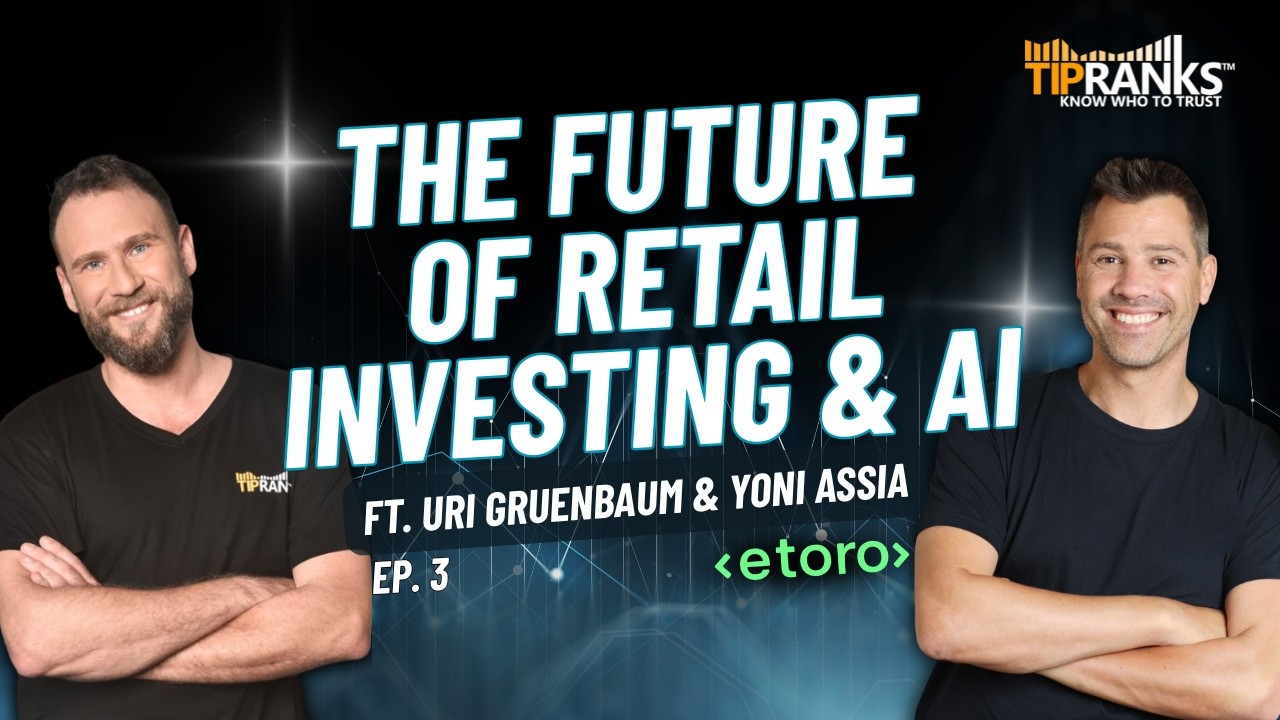
Will AI Agents Outtrade Humans by 2027? The Future of Retail Investing & AI | etoro and TipRanks Ep3

- Rendement de la vidéo
- +16,50%
- Appels
- 2
- Achat / Vente
- 2 0
- Publié
Recommandations
L'entrée est le cours de clôture de l'actif à la date de publication. Le cours actuel est la dernière clôture enregistrée.
-
Entrée $68,53 22 juil 2026Actuel $80,13 28 août 2026Résultat +$11,60
why Netflix is a good investment
Contexte "A few years later I remember him posting something about uh why Netflix is a good investment which I completely disagreed on. But once again he was right and I learned that when Yonyi makes predictions I should uh basically listen."
-
Entrée $68,53 22 juil 2026Actuel $80,13 28 août 2026Résultat +$11,60
do you want to also buy some uh Netflix stocks uh uh as well
Contexte "I see you just uh uh uh renewed your Netflix subscription. uh do you want to also buy some uh Netflix stocks uh uh as well earning you know earnings"
Transcription Complète
Hey everyone, it is Julie here with Tip Ranks and welcome to the latest episode of the future of retail investing and AI. Now AI has been moving quickly. It's gone from helping investors to just research information to now analyzing markets, building portfolios, and even executing trades. So today we are asking how far that shift can go and how it affects everyday investors. I have the pleasure of being joined today by Uri Grumbbomb. He is the CEO and co-founder of Tip Ranks, which of course is a research platform helping investors cut through information overload with datadriven insights and analyst intelligence. And then we also have Yanni Assia. He is the CEO and co-founder of E Toro, which is a social trading and investing platform that's been pushing AI deeper into how people actually trade. Now what's great is that Tip Ranks and E Toro have worked together for about a decade now. It's really fitting to have both perspectives here from research and execution in the same conversation. So gentlemen, thank you so much for joining me today. >> Thank you Julie and uh and thank you Yonyi and and I will say that yeah I've been I know Yonyi for a while and I've been following him for a while. He's probably uh one of the leading voices in uh Fentech and I just want to say that when we started tip ranks 12 years ago, it Toro were already uh very successful and I remember following uh Yonyi and reading a lot of his uh posts about coins which I I didn't understand what is he what was he posting about. It sounds that to me it felt like you know the same discussions I'd had at home with my kids when they were buying uh coins for their mobile uh games. But little did I know uh that it would become a giant industry that Yonyi would pioneer. A few years later I remember him posting something about uh why Netflix is a good investment which I completely disagreed on. But once again he was right and I learned that when Yonyi makes predictions I should uh basically listen. So I'm very excited about today and I can't wait to see what uh Yonyi says about the future. So Yonyi really thank you for joining us. It's such an honor. Thank you very much for having me, Yori. And it's always great to have a podcast with dear longtime uh friends and colleagues in the industry. So this is by the way the most official meeting we've ever been to. That's true. Which makes it uh I bet uh even more exciting for me. Now >> I want to kick things off because right before we started I heard that there were some big announcements in New York for it Toro. If you want to share some updates there for us. >> So we we've officially relatively recently uh launched in uh New York. So very excited about activating our bit license today uh in the US. We've expanded our offering and are looking forward towards our earnings uh in about 3 weeks. So I need to be quiet about what I can talk about right now before uh our earnings. uh but uh as uh we have our uh US offices uh in New York, we're always happy uh to activate our partnership with NASDAQ around Time Square. >> Very exciting. >> So, so what was the reason? What stood behind uh the decision to go through the rebranding that you just did with that included changing the logo and doing all these big announcements. >> So, so I I I split this into two. First of all, on the 7th of July, uh we had a a big event uh in the UK. Actually, I think our biggest probably event to date with about like over 300 people uh in London who uh came from actually across the globe uh to see uh a couple of new things. One of them and and all of them centered around AI. If we talked about predictions in the past, my view is AI is a significant if not the most significant trend I've seen in technology and in investing for the next uh 10 years alongside obviously my very big passion to blockchain and to uh crypto assets and I think those two actually connect and communicate with each other very very well. Uh it Toro's been you know I founded it Toro in 2007 almost 20 years ago feels a bit old uh to say that uh and uh when we started it Toro even the name it Toro it's the electronic bull Toro of the markets I've been a big believer in market since I started trading when I was about 13 and I think the horns in the bull really represented where we started which is trading right we uh uh I've been a trader I've always impacted about capital markets but also followed the likes of Buffett uh uh sort of not only short-term trading but also long-term uh investing uh savings and value investing uh and the bull and the horns uh have always represented that I'd say more young enthusiastic trader looking uh to earn our money to ride the bull. I think as as we grew and matured Toro, you know, from I think that's just the last seven years probably from a billion dollars assets of our customers to now 20 billion of assets. We've also scaled the product suite of the company, the different product categories. So today uh we have for our more active traders and casual traders ability to trade uh stocks from 25 different stock exchanges alongside uh uh crypto assets uh derivatives futures options CFDs now prediction markets even on our Zeno wallet. So we have a wide variety of offering includes 247 trading for our traders. We've expanded to investing is a longer longer term perspective through the innovation of copy trader which now has uh almost uh 5,500 pro investors which are investors from around the world or investors can automatically copy. Uh more than 3,000 of them have actually a five plus year track records. We've expanded that to now 130 smart portfolios which are managed by our chief investment office. Everything from thematic investments to partnership with the likes of Black Rockck and Franklin Templeton or great data and research companies like Tip Ranks where we take some of our 13Fs where you can copy people like uh Bill Aman uh or Stunnley Draen Miller uh uh to uh actually alpha portfolios where we create uh portfolios which are even long short so basically mimic hedge funds around the world and over the last I'd say more recent two years three years expanded into uh savings which have been growing significantly in it Toro. uh so savings is the equivalent of IAS and 401ks in the US where we have both in the UK ISAs in uh Australia superanuation uh in in in France it's actually uh insurance uh rappers so life insurance and our neo banking partnership uh with both Visa where we actually open local currency accounts for our customers both for payments as well as connecting it to their debit card. So as we expanded our product suite, we realized that we're more than just a trading platform. We offer a customers now actually a platform in an ecosystem where we'll talk about AI uh to enable our customers to actually experience a lot of their financial lives. And our customers are no longer the 25 year olds maybe they were when I started it. I was 26. Uh uh I was a bachelor uh uh with no kids. Now I am a a father to five kids uh with a lot of different I'd say risk appetite uh and sort of interest in my financial lives which have changed over the last 20 years. So I would say that rebrand of it Toro uh also of sort of translating the horns into brackets is sort of maturing it Toro into something that's more flexible across trading, investings, savings uh and banking uh uh as well as to uh the I'd say flexibility across different demographics of our customers from the 25 year olds who still join it Toro today uh to uh the uh I'd say older gen wireers like myself and Uri here uh who uh are investing >> young >> yeah [laughter] uh to that are investing across different asset classes of course people in it Toro like our diamond club usually in their 50s and their 60s were suddenly investing hundreds of thousands or millions of dollars with us so we felt it's a great time with actually a launch of our new app so we actually redeveloped our entire app. Uh so we took a million lines of code and actually reverse engineered them with AI and wrote the entire application from scratch uh uh which is the new it Toro AI app uh to actually also create the new brand of e Toro uh which was all launched together on the 7th of July uh earlier this >> congratulation it's very exciting and it's uh it's also exciting to uh to look from the side and see how the company matured from a trading platform for uh millennials into a full uh wealth management platform and perhaps the next Charles Schwab. That's definitely the north star. I always uh say I hear I I I interviewed people from Schwab in the past to Toro and somebody told me I think that was when when Schwab was 84 he was still coming into the office and going around people and telling them I told people 10 years ago you were supposed to do this. So hopefully that that's mean 40 year. >> It definitely sounds like a lot of the past couple decades there. Now Yanni, you've also said that investing is becoming AI first rather than just AI being bolted on to an existing platform. So what does that distinction actually look like in practice? I think when you think of the financial needs across by the way trading, investing, savings and banking, uh there is no doubt like I have zero doubt that AI is already today you know a PhD level in economics and financial engineering and quantitative trading uh in finance. So when you think of that power in the hands of all of the customers in it Toro because Tori today is based on Grock 4 and a half which means every customer of it Toro has a frontier model in their hands and that's probably alongside the fact that they also have a subscription to Claude or to Chip or to Brock on their own which means that you have access to levels of intelligence that people couldn't even imagine. they'd have uh 2 years ago. But that intelligence is really unlocked by how do you train that intelligence to be able to do the missions and the goals that uh you want to achieve. Over the last six months, I've probably spent more than 10,000 hours uh uh with AI. I speak to I speak more to agents today probably than to people. Um and what you learn working with AI is it's all about the training right uh but suddenly now when you think of AI first is where is the first place you approach right as a customer of VTORo what's your first interaction a are you asking a friend are you asking your account manager or are you asking AI are you going to the UX at first or are you asking AI is your AI knowledgeable of your entire portfolio and uh in it Toro or not only in it Toro. So when AI has familiarity with uh yourself through your KYC with your trading history with your preferences with potentially your family status uh with your risk appetite as well as the same level of knowledge of everybody else in it Toro, right? Which is why we call it collective intelligence. uh which is why the rebrand also is about no better is we believe that we're able to build AI that's that will be able to personalize the investment experience the financial uh uh experience of every customer in it Toro through interaction not only of you with your AI agent in it Toro but of every other customer including the thousands of pro investors in it Toro interacting with our AI. So AI first is really about how do you interact with an AI that you know consistently and every day learns how to improve itself to give you better service and better answers to your needs. >> And how is the engagement that you're currently seeing with the AI and your platform? Is it above your expectations or >> I I I'd say it's you know my expectations are always extremely high. So it's very hard to be above my expectations but uh on on agentic trading I would say uh it's above my expectations especially when you think about the number of trades per customer. So when we look at the agentic trading right now, which is customers who are creating agents that run automatically 24/7 in their accounts, we're seeing 50 to 100 times more trades per account using that's still a small number of accounts relatively to the 4 million accounts in it Toro, but that's just, you know, maybe that's like first movers. Uh but first movers are are just trading with the with agents like crazy. on Tori. We're seeing I don't have the numbers in front of me uh but we're seeing hundreds of thousands uh uh chats a week. I was just off a call where we're actually looking at all of the chats every day and we actually have AI looking at all of the chats of all of the customers, ranking the chats by sort of the score of how good the answer is and how can I I the AI learn from everyday chats to improve my skills, my tools. So one of the very interesting I'd say you know trends that are relatively new five months in AI is relatively new um is uh self-arning and self-improvement of agent systems and of AI uh and I think because of that we're seeing consistent sort of growth and improvement in it Toro in Tori every single day. Now, I'd be curious where you two draw the line between AI helping you invest better and AI actually investing for you. Do you guys think AI how it's moving towards having the authority to actually execute trades on behalf of retail investors without any, you know, human approval? What does that look like? >> So, uh story started uh as an AI companion uh as an analyst that helps you analyze the market to make your own decisions. It then progressed to become an agent where when we added memory uh when we added context uh when we added the skills and tools or it became an AI agent when we released about I think two months ago agent portfolios and agent wallets. We basically unlocked the ability for our customers to actually have AI trading in their accounts automatically. when we started simplifying the user experience and enabled our customers basically tell Tori I want to create a sub portfolio on it. So let's say you have $50,000 in it Toro. go to Tori and say, "I want our sub portfolio in Toro with $1,000 and I want that uh portfolio to invest in quantum computing stocks uh uh on basically uh 10% of the account in the top top 10 quantum computing stocks. Tori will actually execute that on your behalf. you can then create basically an agent that will rebalance your portfolio based on different criterias uh uh automatically. So we're already seeing that and and that's what I mentioned before when we see customers actually connect 24/7 running agents to trade on their behalf without approval is where we suddenly see that unlock of agents trading 50 to 100 times more than uh people do. I think that I think that you know I'm a long-term investor. I'm not a short-term investor. So I think that we're now seeing as Yonyi mentioned the early adopters that are testing it. And of course there's something very nice knowing that you have an agent that's a thousand times smarter than you investing on your behalf. But I think it would take a few more years before it would become like mainstream where people will feel comfortable about the returns. Uh where you know the >> you said the same about crypto. I'm just saying. >> I know. I know. I know. So, so, so I would uh that's why I started with a disclosure that you know how to predict the future better than uh me. But crypto took a took many years as well. You were an early adopter and you were one of the first ones to see it. I I think again I I think there is no doubt that AI can manage you know at a much higher level math and at the end of the day investing in finance is form of math. Of course, there are forms of of opinions and there are a lot of sort of subjective parts of of investing, but at the end of the day, when you think of, for example, rebalancing your portfolio based on uh CAPM, right? or analyzing the Greeks in your portfolio. That is something that is mathematical that very very few people by the way do um reacting to uh to news about geopolitical events. uh again something that is very intuitive right something is happening in the markets you want to react to what's happening in the markets of course you can also read research I have AI agents that go to universities uh to the top universities in the world uh download everything around finance and quantitative trading every day uh actually take this translate that into skills I have another team of agents that are scouting for data on the internet. We added recently Japanese stocks. I have no idea how to choose Japanese stocks. I have no idea about their financials. I I just had an agent that sort of uh uh uh scouted and found a lot of Japanese sources of information, created a database, and then I have my PhDs uh that wrote the skills of uh Noble uh winning PhDs uh running uh basically back testing on Japanese stocks that we just added to it Toro. So that amount of information and that analysis is something that you can't do on your own. couldn't imagine doing that without AI. Now, I am a very big believer in my view diversification, right? So, if you think of I'm a big fan of Warren Buffett, that's value investing. I'm a big fan of other value investors like Bill Aman. Uh uh but I'm also a big fan of Masasan from Soft Bank, which is closer to Kathy Wood in their view. Uh and if you'd ask Bill Aman and uh Warren Buffett about Kathy Wood or Masasan, uh you would hear them saying those are gamblers. I'm also a very big fan of Stevie Cohen from P 72 and a England there uh from Millennium. And what they do is uh leveraged uh long short portfolios. And if you'd ask both Kathy Wood uh and uh Warren Buffett, they probably wouldn't necessarily appreciate that strategy. But I'm a big believer in all of those different strategies. I'm also a big believer in US markets, but I believe there are always opportunities in other markets like market, Brazilian market, Israeli market was very very good and the Korean market was very good until very recently where it started tumbling. So being able to analyze all of these opportunities on your own, especially as a retail investors without a team of experts is impossible. uh for sure you want to diversify into multiple streams of alpha and beta uh that generate opportunities to diversify their your portfolio and with AI you're actually able to have that team. So I I would be surprised if we don't see uh rapid acceleration of people trading in Toro specifically again because of the risk appetite and we will do this dialogue in uh about uh uh less than 18 months from today because I've already said I believe that in uh by the end of next year more trades on it Toro are going to be generated by uh AI agents than by people. >> So, you mentioned Steve uh Steve Cohen from Point 72, who is obviously a genius and he has hundreds of quant analysts working for him. Do you think the average Joe O can compete on a quant strategy when you have all these sharks that are spending billions of dollars on better data and um stronger computing? Uh I'll tell you what I told my quant team uh uh after running our quant database that's counting the internet uh every day for new data sources. So everything I'm opening for my quantine we're actually opening up in our AI studio to the uh 5,000 plus pro investors in Toro. My view is uh we probably have better tools uh than uh most of the portfolio managers in places like 72 and Millennium today. One of the reasons are is when you manage uh you know uh 72 or Millennium you are already managing hundreds of billions of dollars of exposure. You have risk management. You have a lot of responsibility on your hands to make sure that whatever you know new data or new skills that you just installed a risk manager ran through them. It's probably takes the IT 3 to six months to actually bring in something or a quant to do it. There's a portfolio manager who's probably a person that's more conservative. He's been doing this for a while. And by the way, if you work with these funds, if you lose money for a day, that's fine. For a week, that's fine. Fine. Maybe for a month, fine. But you're already on a very, very thin line. You lose for two months money for Easy or for Stevie, you're out. You're fired. Uh uh, and that's very clear, like people actually know that's how they work. It's like it's very clear you need to consist. This is market neutral where you're a retail investor in it Toro and we gave you those capabilities. you might have a much sort of high-risk appetite and flexibility not only to be able to absorb losses which is an important part of taking risk uh but also of using new technologies of replacing your GPT with claw because yesterday a new model came into play uh of suddenly testing something that you back tested yesterday because suddenly an alpha change in the market so do I think retail investors ers today with the tools we provide them compete with the best most sophisticated funds in the world. Yes. And one of the biggest reasons is their flexibility on uh being faster, more agile to both adopt new technologies and take different types of risks. >> I do want to touch on a bit of regulation because obviously we have a lot of innovation happening but regulation often lags innovation. So, are there worries that this space is potentially moving faster than the guard rails that are meant to protect retail investors? >> I think that innovation always moves faster than regulation. Almost by default, one of the great things I've learned at ET Toro is most regulation tries to be technology agnostic. uh and so and and as we build e Toro uh and we're regulated today in the US, Europe, UK, Australia, Singapore, Abu Dhabi and several other jurisdictions. What's interesting and sort in Israel uh and uh very soon to new jurisdictions. So what's interesting is generally because technology has been moving very fast for the past 20 years regulators uh uh always write the rules in a way that is technology agnostic. So portfolio manager is a portfolio manager whether it's a person uh that comes and meet you and writes it on his notebook whether he picks up the phone uh or whether he gets your order uh over or your guidance uh over the internet now in many cases AI basically is an assistant to that regulated activity right so it's by the way reminds me how we tried to explain crypto uh back in 2012 and 13 to regulators. We actually told regulators outside the US that they should think about this as a foreign stock like a US stock. We said what's the difference between somebody buying Facebook stock or Bitcoin. It's not regulated locally. It's regulated globally. It trades. There's multiple exchanges. In this case, we're also looking at AI as a portfolio manager. By the way, because we were very early on in the concept of copy trading, which is a form of algo trading. So when you copy one of our top investors, you basically hire us as a portfolio manager uh and tell us I want you to manage my portfolio to the best of your ability by copying this person. So it's it's a guided or a mandated uh discretionary portfolio management and we've taken the same view with AI. We're basically guiding AI or guiding us to use AI and what are your prompts to that AI? Uh so is regulation there yet to put in the right guard rails for everyone? The answer is no. Um, do great companies like it Toro have those guard rails to provide better security uh for their customers? Uh, I believe we do and we see other companies that do that in the right way. Customers though should, you know, should be aware of sort of what's out there. That's true by the way for crypto and that's true for AI. So if you are seeing if you're an ex and you see somebody who is telling you that he has an algorithm that generated,000% uh uh in the past week I would highly recommend to be suspicious. Uh I think that's great by the way for companies like it Toro because we've been doing this for almost 20 years now. Uh I think that AI has the ability to generate for retail investors doubledigit returns over time. of course with the right risk appetite and with the appropriate investments per client. But I think it also has a lot of dangers of people going into the wrong providers or unregulated providers in the field of sort of AI where you might give the keys to your account to the wrong AI or to the wrong company that uses the wrong AI. Now, Yuri, on the tip rank side, I want to touch on our vast different models of AI analysts. A lot of people are trying to find, you know, the one best AI model to solve all their problems. We've obviously been testing dozens in different sectors. What have we learned at Tip Ranks about how these different AI models work? Well, it's uh it's interesting, you know, as uh Yonyi mentioned, when you have an agent, you basically have a genius resource that is, you know, a thousand times smarter than any PhD and in finance or economics or uh whatever. But still, when you test these different models, you see that they give different ratings and scores to different stocks and and it's still early to see who knows better and the models keeps evolving. So we've learned that there is no one LLM that is better in in a specific sector that some LLMs are better in different industries than others. And you know we're sitting on the side passively and we're measuring them and just like we did with salesside analysts where you could say that this Morgan Stanley analyst is a genius and this Goldman Sachs is a genius but only one knows how to read the map and this or that trend. And I feel that our responsibility is to bring transparency to investors and to measure things and to make your decisions to be more data driven regardless to what agent you know you're using at least know their historical returns on different stocks right so first of all it Toro knows better um but uh uh and helps our customers to know better I think that it's not only about the agent the agent so we did a lot of evals uh on sort of who knows faster what's happening in the market. What we found out is Grock by far knows the fastest what's happening in the market. So when we asked about sort of market sentiment uh uh is sort of uh uh what are the financial results right now maybe because the uh earnings was 5 minutes ago we found out that uh Grock was number one Gemini was number two again makes a lot of sense that has X which is very real time that has Google which is very real time and then you have open AI and claude >> which are a bit slower uh but it really depends if so for an active trade might really need sort of the speed of X. Um or now you can actually I heard pay a subscription to Truth Financial uh to get Donald Trump's tweet faster. Um but but then we also did eval to financial analysis of earnings. So we launched an app which actually creates uh bank level research on every single stock in it Toro. uh uh and I was at and were using anthropic for that and I actually was at a anthropic conference where they evalu uh to actually do uh analyst research analyst and they came to a conclusion that uh the enthropic model I think that was already opus 4.8 eight actually is better at financial and like at research analysis of banks than humans. Um very interestingly like the way they and other large model companies are looking at is okay this is sort of the mission right so research anal analysis is sort of a job how how do you eval different models to say whether they're better already from people um and I did hear from anthropic that their point of view was they're already better uh so we actually created that as an >> how did how did they know that they're already better. It's something that takes a lot of time to actually measure. >> Um, >> so, so you're correct. If you're a trader, speed is everything, but if you're a long-term investor, then, you know, if you got into a stock uh 5% before someone else, it's nice, but but still, you know, on a long term, it's it's meaningless. >> Um, so actually the logic for evil, and maybe I won't go into all of the details, but it's very similar to back testing, right? So when we think of our quantitative back testing to a lot of different strategies in Toro in our smart portfolios. So and I've been like an amateur quant since I was maybe 16. Uh uh a failed quant till I was 35. And from then with the resources of VTOR like building more and more capabilities when you run back testing on uh which is very similar to the concept of eval basically are saying okay I want to test this logic on the historical data up until this point in time and see whether that logic how did it predicted from that point in time and moving forward when you think and I'm assuming you guys do this with analysts as well. If you take like a model and you run it until a point in time, right? So you train it until point of time type of data and then ask, okay, now compete with all the rest of the analysts in Wall Street and let's see your price predictions and price targets moving forward and you have that moving window for the last 20 years. In theory, you can run a good eval on research analysis or uh price uh targets of a research analyst which is sort of the output of uh the re research analyst. Uh so there is a potential you know you've been the leaders in that process and we have tip ranks in Toro for that purpose. Exactly. Um, so it's actually something you could do if you have like a very long historical data set and you want to compare it. The question is whether the LLM was already trained on that data. >> That's another qu like very complicated question. I hope that the model companies have answers to that. >> And I do want to say that we we see the same. we see that you know we've been measuring AI analysts for the last uh 12 to 18 months and their performance is superior to uh human analysts uh again you know even one and a half year for us is a short term like we're measuring over decades uh but we do see very strong results we don't see the engagement yet we see that you know for every uh maybe hundred people that would look at what uh the Goldman Sachs analyst says we're going to have three or for that would shake the AI analyst even though the AI analyst is better in terms of uh performance. >> But by the way, which is which is by the way interesting to like my perspective and your perspective, right? So I think because it Toro has tip rinks in it. we actually see that like let's call them the more active traders actually would use charts uh and the people who use charts and people who trade more actively are those that are actually engaging more with AI right now versus let's say those who engage on it Toro on the research part of T pranks or more fundamental analysis where I'd say sort of the shorter term ones are by definition almost also have a a high risk appetite, right? The trader has a higher risk appetite than an investor. An investor looks more at fundamentals and research and a trader looks more at momentum and sort of uh uh shorter term signals. And I think that's like uh something that we see as well is like short-term traders or traders generally are more interested in short-term trends and sort of new technologies that enable them to take a bigger opportunities uh uh and new opportunities. >> Yeah. >> Now for retail investor like everyone is suddenly going to have kind of the same AI capabilities and access to them. Where are investors able to actually find a competitive advantage from? I I think again first of all this is true for everything in AI uh but definitely true in capital markets when you have that level of intelligence uh uh sort of it's almost imperative that you start using it as if you're a programmer start using AI to learn how to develop things but more than that learn how to use AI to do DevOps and to do QA and to do deployment and to do design learn how to do everything you need to release a product that potentially you couldn't do before because you were a developer, right? So if uh uh you're an investor and you're purely a long-term value investor, first use it for research uh which is a part of fundamental research and analysis which is a part of what you do as an investor but start also using AI to find other alternative which is something maybe you didn't do because you weren't interested in technical analysis or quantitative analysis uh uh or being able to sort of harvest vast amount of data. So, so I really think it's about I always say like capital markets and now AI it's about first believing right you have to believe in capital markets in order to succeed in capital markets then it's about learning uh and with AI you can learn so much right now uh uh and learning is iterating and experiencing and that's sort of the third thing is like uh uh jump into the pool experience uh you have to take risk and exper experience uh uh P&L, you have to be able to experience AI in order to really understand how it works. If it's AI in trading and investing, I would say like find the right agent. You can take a $100 out of a $1,000 portfolio or $500 out of 50,000 portfolio, but I would recommend people to start engaging with how do I use AI? How do I utilize uh AI agents in my portfolio? Because again in in my view that is your competitive advantage right now is going to actually run faster within the largest asset managers in the world. >> Are there any big misconceptions you think retail investors have about AIdriven investing tools currently? I I think uh you know the naysayers would say it's uh you know very high risk of hallucinations. Um I think that there are a lot of tools today to make sure including by the way running like three different AIs to make sure that like your A isn't hallucinating is run Grock then ask Claude what he thinks about the answer of Grock then ask open AI what they think about the other two answers. So first of all there are tools to prevent you know that logic of hallucinations. One of the misconceptions or not necessarily misconception but mistakes I see people do and again I would say that's a general like an entrepreneur in crypto and in AI is testing something seeing that it doesn't work and then giving up. So, like somebody using AI six months ago or a year ago and saying, "I tried it and didn't work." That's a very big mistake because this industry is running so fast. By far the fastest I've seen in my life. Like you you need once a month to like just figure out what's happening in the industry and retry. Um sometimes for example in product something or we would know very well product managers have that tendency of saying let's really get the product right because if our customers try it and the experience isn't great they won't come back to that product which is by the way true it was very true and it's still true I think it's now a mistake of consumers not to try again like consumers have to try retail investors have to try again and if you tried you know, Claude a year ago and it didn't work or Grock, by the way, Grock was horrible. Uh, sorry Elon, like prior to Grock 4.2 horrible. 4.1 was really it wasn't a great model. 4.2 started being better. 4, but 4.5 is is really wow, right? So one misconception is like try something and if it doesn't work like so sort of give up. I think that that's sort of a mistake that uh we we actually see it in product right because we see people talk to Tori and they're like I tried Tori and it didn't work six months ago and Tori was you know four models ago six months ago it's something and didn't have memory and didn't have skills. So people need to try and try uh again uh uh with AI. Um a misconception on another side is like AI can do something without the right guidance. Right? So AI is like a formula 1 car. Uh first of all uh you know without a driver a formula one car doesn't drive. Right? So without somebody really holding the wheel and understanding how to drive a Formula 1 car. So if you're not a Formula 1 driver and you get into a Formula 1 car, there's like 99% chance you're going to hit the wall within like >> 60 seconds because it's very hard. So AI one is as good as the human steering it right now. That might change in the future. uh and companies like it Toro try to simplify the process of using IIO for a specific mission for investing or for trading by training it by giving it the right again skills tools memory etc and learning also from others and from other mistakes. So those are like the the two parts is expecting uh uh too much or uh expecting that if something fail it will always fail. I uh you really said it uh well and and I couldn't agree more and it's actually our experience as well. We launched our first chat uh two and a half years ago just a bit when you know when open AI uh opened their API and uh we got zero engagement and we decided that we're moving it away and putting another tool and uh then we launched it again six months ago and it's uh it's been working like crazy. Everybody is using it. We see the conversion rates are almost four times higher when it's on our platform now and uh you know we just uh gave up too fast. So I think this is a great lesson for everyone. >> Now to wrap it all up of course we heard Yanni that your predictions are are very accurate. So to both of you I would love to hear as we look over the next couple of years how do we think AI is going to impact retail trading in a way that might almost sound futuristic today? What do we what do we forecast there? I I think you know over time AI becomes not only your financial advisor, it becomes your family office, right? So you'll have your paycheck coming in to your bank, you'll have AI saying, "Hey, uh you just got your salary. I saved this for taxes. Uh I saved this for your kids. Uh I want to invest this on your kids. Uh Ira or Gyra or JISA and you're in the UK. Um, I know sort of your risk appetite. I know your kids' risk appetite. I know uh you and your wife's uh expenses and plan trips. This is what I plan to do. Um tell me uh you know to tell me if uh you want to change anything uh uh in your preferences. I think uh you know features like I I see you just uh uh uh renewed your Netflix subscription. uh do you want to also buy some uh Netflix stocks uh uh as well earning you know earnings so I think it's going to much more interactive and knowledgeable uh u I think you know people today only very wealthy people have a family office and nobody has a family office that has like 20 agents with different skills running uh that has access to all of their accounts and their calendar and their emails. So I think you know that is a very plausible future uh uh in the next couple of years uh uh and it's something that really doesn't exist today and couldn't have existed without AI. >> Yeah, I tend to agree. I think that [clears throat] you know uh 12 13 years ago we've seen this uh uh new robo advisor popping up and it it was kind of like this big trend back then and but it wasn't good enough. It it wasn't personal enough and that's why I think it didn't really take off. Uh and I think now uh and I wouldn't be surprised if one of your uh future announcements are going to be around that. Uh, but I think it's going to go through uh an accelerated process where it's personalized for you and based on multi- agents and is basically going to run on your will. Before I uh we wrap things up, I do want to say that when Yonyi talks about Charles Schwab walking at age 84 into the office, I see Yonyi do the exact same thing. And I think that both as an it Toro investor and as an it Toro user, uh they're poised to do very well in the next uh many years. And uh so uh thanks a lot Yoni for being a great partner and building a great product that uh allowed me to buy my first Bitcoin. >> Thank you very much Shuri for being a great partner and uh well I'll take a look at the new features and tip rings you mentioned. >> Perfect. >> And thank you to you guys both for joining me today. It's been a lot of interesting insights. Uh for all of our viewers, let us know in the comments how you're utilizing AI in your trading today. We always love to hear from you. And make sure to check out our other episodes of The Future of Retail Investing and AI over on YouTube, Spotify, Apple, wherever you get your podcasts. Thanks so much for watching.
Commentaires 0
Connectez-vous pour rejoindre la discussion.
Se connecterAucun commentaire pour l'instant. Soyez le premier à partager votre avis !