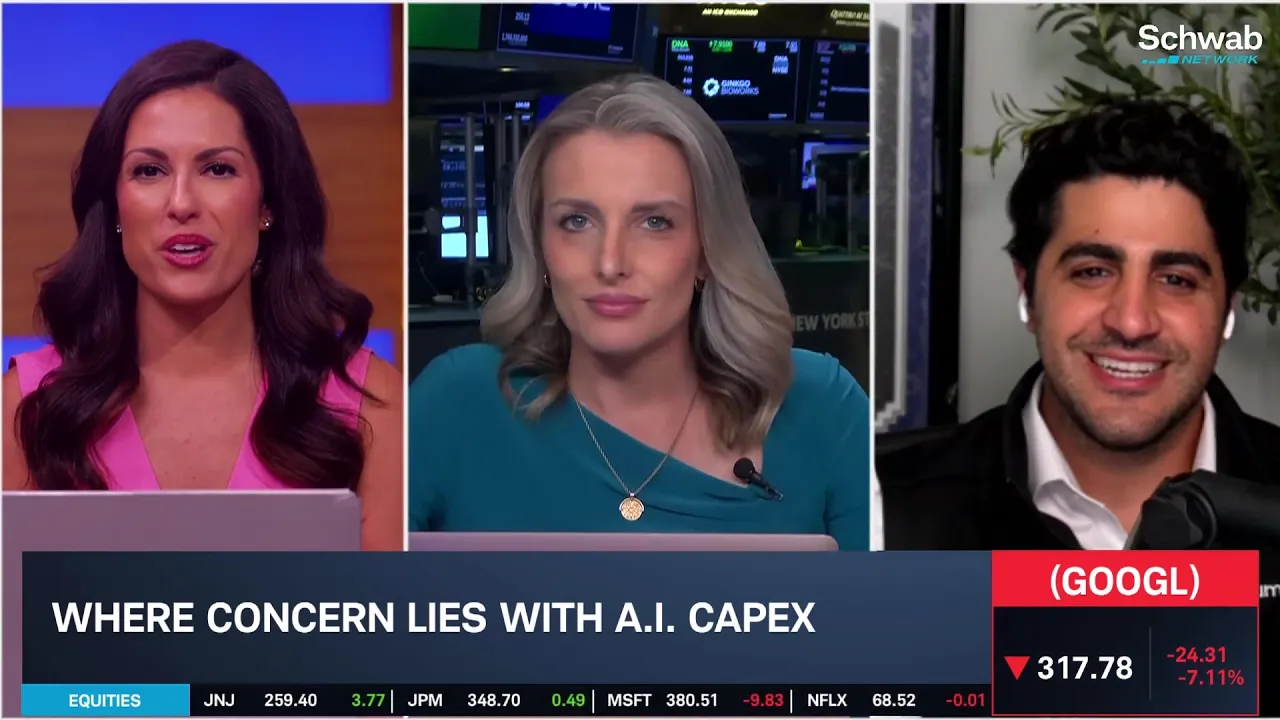
GOOGL Cash Flow Goes Negative: Shay Boloor Still Bullish on AI Standing

- Rendement de la vidéo
- +7,57%
- Appels
- 1
- Achat / Vente
- 1 0
- Publié
Recommandations
L'entrée est le cours de clôture de l'actif à la date de publication. Le cours actuel est la dernière clôture enregistrée.
-
Entrée $317,69 23 juil 2026Actuel $341,73 28 août 2026Résultat +$24,04
I do believe that the reaction is incredibly shortsighted because Google owns one of the most complete AI stacks in the market.
Transcription Complète
back into the conversation, though, and shift our attention over to alphabet earnings. Shai velour joining us, chief market strategist over at Futurum Equities. Shai great to have you here. I mean what a reaction to these numbers from alphabet. I mean they've been down pretty consistently through most of the day about 7%. I'm just looking they're still down a little bit over 7% right now. Is this a case of a great execution overshadowed by CapEx? Pretty much sum up what happened today in Google is Google is negative free cash flow. What it's because it's crazy perspective to have. It's totally different from what the old Google used to be. And I think that it's totally fine because Google produced one of the strongest operating cores we've seen this AI cycle. I mean, we had cloud revenue growing 82%, operating margins expanded 36%, but the market is just really hyper fixated on the cost of getting there. And you're seeing right now, Google's raising CapEx $15 billion every three months. They're now floating that they're going to expect another significant increase in 2027. There's going to temporarily rely on more expensive third party capacity, because there's so much demand that they can't keep up with it. That is all resulting in a negative quarterly free cash flow for the first time in over 20 years. So there was a couple shock factors during this print. But I do believe that the reaction is incredibly shortsighted because Google owns one of the most complete AI stacks in the market. You just saw it. What? Controlling your internal AI economics can result in with those cloud numbers in controls, custom chips, cloud infrastructure cybersecurity distribution, of course search. So I think that given time, it's looking a little hefty right now on their CapEx spend. But as time goes on, you're going to see cloud represent more and more of Google's total revenue because it's growing several times faster than search YouTube and the rest of Google services. Yeah. And some have been arguing today that the numbers that they reported perhaps justify the spending, but the markets seem to be having such a tough time with this today, Shai. And just to sort of emphasize the sell off we're seeing bespoke pointed out, you will not find a bigger one day drop in reaction to Q2 earnings for this name until you get back to July 2008, when it fell almost 10%. I mean, that's a long time ago. We're in a very different situation right now. Could there be a situation, do you suspect, where the market pushes back so much on all this CapEx that the hyperscalers are forced to tap the brakes? Unlikely. Just because we are in a prisoner's dilemma right now in this AI race, because whatever Google doesn't spend, meta will spend, Amazon will spend, Elon, SpaceX will spend. So I think these CEOs know that that whatever they want, whoever pumps the brakes first might be risking their long term competitive moat in the new AI economy that one of their competitors might be capitalizing on at the moment because of their ability to digest the market, being very upset with the initiatives that the companies are doing right now. But again, I think that this is going to be a prolonged digestion period for a lot of the max seven names, but the biggest winners, the center of gravity right now is going to continue being the semiconductor companies. You're seeing more evidence, again, that CapEx is not slowing down. It's going to continue to increase. And the companies with the deepest pockets are in this race that has no signs of slowing down. That will benefit the pricing power of a lot of these semiconductor chips. Where recently, due to Kimmy, the revelations that there was some fear of a deep sea 2.0 moment, that gave them a bit of a pullback, where I think that is the best opportunity right now in the market. And I want to follow up. I know we're focusing specifically on alphabet, but I have a broader question just based on what you just said there, do you think that we have a possibility of seeing a company just test out what happens if they just slow their spending a little? They don't raise the CapEx? Do you think we'll see that? I mean, perhaps even in this earnings period or next earnings period, just to see what happens, is one quarter really enough to dent the long term strategy? I know you said Meta and Amazon will step in and they'll spend in its place. But if we just test it out we've seen increased CapEx isn't yielding a good result. Do you expect to see someone try to take the alternative strategy and see what happens there? So I don't anticipate that. But if I want to play devil's advocate, I do think if there's one company among the Mac seven who might participate in that exercise, let's just say that it would be Microsoft. I don't think I think Amazon next week is going to report even higher CapEx numbers. Typically they report after Google reports their earnings. And it's always the delta is typically higher than what Google's CapEx increase is. So I anticipate Amazon will not be showing slowing down at all. But Microsoft is the first Mac seven name because their fiscal year ends in June to report the next 12 months of what their full year CapEx will be. So I think that's going to be the real whoa this cycle among the big tech companies of like what the visibility will be for the next 12 months on CapEx. And that could be the potential shock factor that we're talking about in this exercise. But I really don't think Amazon or Google will participate in that or meta, because they all have the luxury of having their own lane with a ton of cash flow, that they're building their own internal chips in, where Microsoft is playing catch up due to their overreliance on open AI initially, which they're getting better and better at. But yeah, I think Microsoft might be the one, but we'll see. Yeah. And maybe it wouldn't be such a bad thing for Microsoft, given some of the margin concerns and obviously the multiple compression that we've seen. I mean, some have said that the bar was so high for alphabet, but maybe not the others, because of course of those valuations, as we say. But it kind of reminds me of the conversation we had last time, Shai, because a lot of the financial commentators have been sort of coming out today as they woke up to that reaction saying, well, isn't alphabet? Damned if they do, damned if they don't, because last time you and I spoke, we kind of entertained the idea. If they don't, and you sort of thought that we could potentially see a rotation back into the hyperscalers. And I've asked a number of other people about this, and they all seem to sort of echo what you're saying, that it would come out of the check beneficiaries and back into the check takers if we did see a pullback in CapEx. So would it be such a bad thing? It really would. I think that we all know that the North star of this AI build out is going to be these hyperscalers. Like this is where the companies who own the ecosystem, own distribution, own the eyeballs are going to benefit the most on the application of AI, but nobody really knows when that is. They just know that's where the end game is going to be. But we're seeing more evidence that just every three months that it's the goalposts getting pushed out more and more. But Kimi was a revelation, like what they're able to do just with their small team. On what that means, on how the result of their ability to create these models at such a rapid pace. And it's also a lot more affordable if the more of those things happen in the near term, or even in the medium term, that's going to be the wow moment for these companies, because that's when they can really see the latest and greatest on AI and then benefit from that. Rather than spending this amount of CapEx, because right now they're at the mercy of these semiconductor components. And right now they just have to say yes, because they're in this race, right? That if they don't spend, someone else will. And I want to dive into the psychology of the concern around the spend is the concern, the actual spend itself and the number, or is it how long it might take to generate returns? I think it's both. I think if Google's numbers were incredible, let's just say that their video game like numbers, but they raised their CapEx $15 billion just in the past three months. That rate of change is exponential. And it didn't really produce confidence that they're going to be not negative free cash flow the following quarter. So I think that the push right now on CapEx spending is coming at a rapid pace. But again, like you're seeing their ability to show really insane internal fundamentals based on the spend that they're going to continue doing so. But nobody really knows the end in sight. Like until TSMC, TSMC is going to be the first one that really shows us that there's going to be a supply and demand balance. They've indicated recently that's going to happen in 2028, maybe, maybe 2029. So they're the real adults of this AI build out. And until TSMC tells me or everyone else that they see visibility of the supply and demand evening out, I just their CapEx is going to continue increasing and increasing until we get new evidence. All right. Well, Alphabet's still trading down a little bit more than 7% today following those numbers. So I really appreciate you breaking down the reaction that we
Commentaires 0
Connectez-vous pour rejoindre la discussion.
Se connecterAucun commentaire pour l'instant. Soyez le premier à partager votre avis !