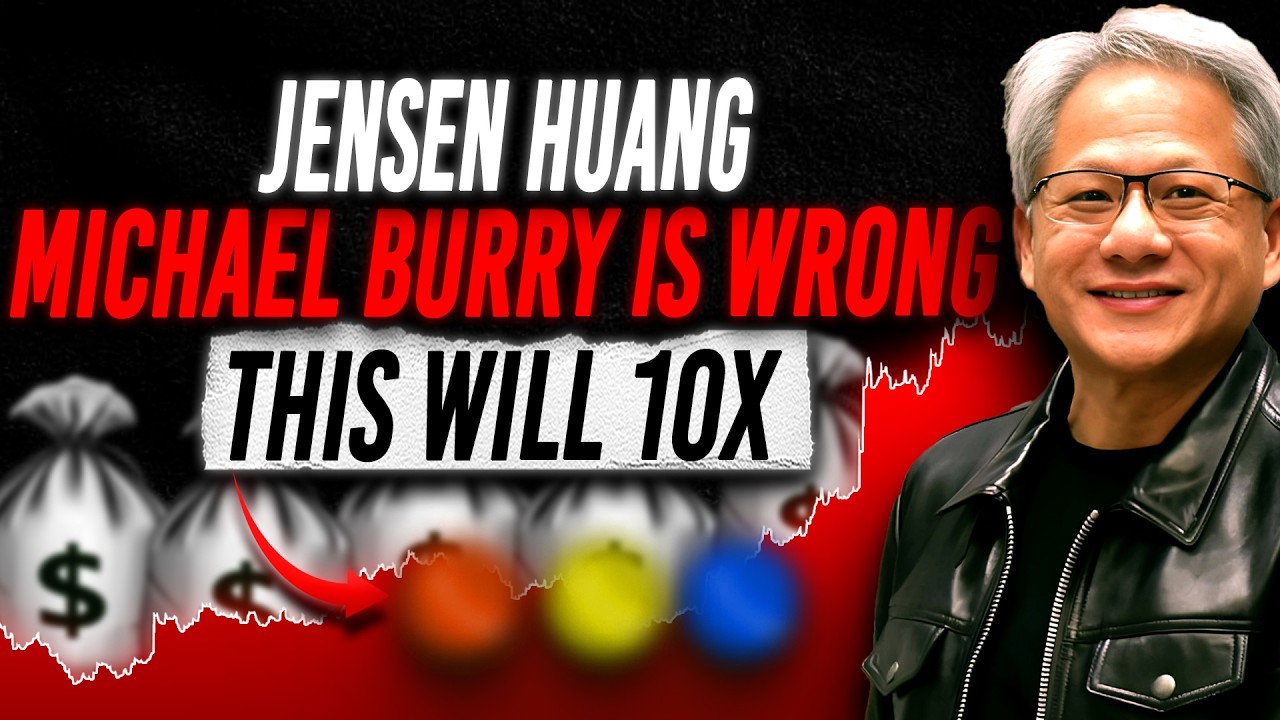
Jensen Huang Predicts 10x Growth In AI - Nvidia Is Quietly Buying Billions In These 3 Stocks -

- Rendement de la vidéo
- +11,26%
- Appels
- 3
- Achat / Vente
- 3 0
- Publié
Recommandations
L'entrée est le cours de clôture de l'actif à la date de publication. Le cours actuel est la dernière clôture enregistrée.
-
Entrée $91,67 27 juil 2026Actuel $100,51 07 août 2026Résultat +$8,84
Let's begin our stock breakdown with the original titan of silicon, Intel Corporation, INTC.
-
Entrée $70,79 27 juil 2026Actuel $88,89 07 août 2026Résultat +$18,10
Moving seamlessly to our second pick, let's turn our attention to the leading titan of the specialized AI cloud revolution, Coreweave Inc., ticker CRWV.
-
Entrée $388,99 27 juil 2026Actuel $414,03 07 août 2026Résultat +$25,04
Transitioning naturally to our third and final pick, we look at the hidden brain behind custom silicon, Synopsis, Inc., ticker SNPS.
Transcription Complète
My guess is that that uh the semiconductor industry is probably going to have to be 10 times larger than it is today over the next decade or so because we used to build computers for people to use and we're going to still continue to build incredible computers. These are now a processing AIS for uh humans to collaborate with. But in the future, we also have AI agents and robots and they're going to be using computers. So instead of just a billion people using computers, we're going to have a 100red billion agents and billions of robots all using computers. The computer industry, the chip and that's built on top of the chip industry surely is not big enough. And so this is one of the realizations of the semiconductor industry that now computers are built not just for people to use, but computers are being built for computers to use. While Wall Street bears scream that the $600 billion AI infrastructure spend is an unsustainable bubble about to burst, Nvidia CEO Jensen Hang isn't just ignoring the skeptics. He is radically redefining the entire scope of the market. While critics point to short-term ROI shortfalls, Hang projects that the global semiconductor industry, currently valued around $600 billion, will need to scale 10 times larger over the next decade. That represents an astonishing $6 trillion market expansion that most analysts are entirely failing to model. Why such a staggering leap? Because for the last 50 years, the chip industry built hardware for 8 billion humans. The next decade isn't about human users. It's about powering 100 billion autonomous AI agents and billions of physical robots, each consuming compute 24/7. To support this paradigm shift, massive bottlenecks in high bandwidth memory, silicon capacity, and energy infrastructure must be shattered. Nvidia isn't just selling GPUs. They are locking in raw capacity for the decade ahead with massive commitments, including a headline grabbing $500 billion plus agreement with SK Group and a direct $1 billion investment into cloud giants like Naver. Now, everyone knows Nvidia is the obvious winner in this race, but we aren't here to talk about buying Nvidia today. The real explosive alpha isn't in the chip designer itself. It's in the crucial ecosystem partners where Nvidia is actively pouring billions to secure its own future. Today, we are breaking down three high conviction semiconductor stocks backing Nvidia's supply chain. the exact company's position to capture the next wave of hyperrowth as Hang's 10 times thesis unfolds. Let's begin our stock breakdown with the original titan of silicon, Intel Corporation, INTC. While retail investors watched Nvidia dominate the early GPU training cycle, Jensen Huang recognized that the next frontier of AI compute required a massive structural partner, culminating in Nvidia acquiring $215 million shares worth $9.5 billion to back Intel's x86 integration and foundry architecture. As artificial intelligence transitions from raw model training to complex multi-step agentic workflows, the foundational architecture of the data center is shifting dramatically. Training massive AI models required sprawling clusters of GPUs with minimal reliance on server CPUs. But AI agents demand massive sequential logic, complex orchestration, and rapid inference, causing data center CPU to GPU deployment ratios to tighten rapidly from 1 to 8 up toward 1:1. This agentic inflection is sparking a massive renaissance in data center CPUs, expanding the addressable compute TAM toward $2 trillion by 2030. Intel, which still commands over 60% of the server CPU market, sits directly in the crosshairs of this demand spike. In its recent quarterly performance, total revenue surged over 25% with gross margins climbing to 41.8%. More strikingly, Intel's data center and AI division revenue exploded nearly 60%. Powered by massive demand for its flagship Xeon processors and higher blended selling prices. Beyond its core chip architecture, Intel possesses a massive catalyst. Its emerging Intel foundry business. With leading edge packaging and manufacturing capacity severely constrained worldwide, tech giants are urgently seeking domestic high volume alternatives. Intel's 18A process node is executing on schedule with advanced packaging deals already materializing and next generation 14A nodes approaching risk production. Following a recent 40% valuation pullback to 56 times forward earnings with key technical support firming up near the $90 level, long-term revenue targets project a path toward $82 billion with operating margins reaching 22.3% by 2028. Intel stands as a foundational anchor of Jensen Huang's decadel long semiconductor expansion. Moving seamlessly to our second pick, let's turn our attention to the leading titan of the specialized AI cloud revolution, Coreweave Inc., ticker CRWV. If you want to see where Nvidia is putting its money to guarantee the 10 times compute scaling Jensen Hang envisions, look no further than Coreeave, where Nvidia expanded its direct holding to 47.2 2 million shares valued at $3.7 billion, representing nearly 20% of NVIDIA's strategic portfolio. Coreweave operates as a dedicated Neocloud building and deploying high performance data center infrastructure purpose-built purely for massive GPU workloads rather than general legacy software. Unlike traditional hardware vendors whose revenues fluctuate wildly with one-off component sales, Cororeweave secures long-term multi-year rental contracts that lock in predictable, highly visible cash flows. This structural advantage is showcased by its landmark $21 billion taker agreement with Meta Platforms extending all the way out to 2032, securing average annual commitments of roughly $3.5 billion regardless of near-term market noise. Financially, Coreweave's operational velocity is scaling at a staggering pace. In its recent first quarter results, the company generated $3.0 0 billion in operating cash flow, delivered non-GAAP gross margins of 71.7% and adjusted EBITDA margins near 56%. Even more impressive is its total contracted backlog, which skyrocketed to an extraordinary $9.4 billion, providing roughly 8 years of revenue coverage relative to its current trajectory. Management has continuously raised its exit annual recurring revenue outlook, setting targets near $18.5 billion for the year and eyeing revenue scale past $30 billion by 2027. While bears point to Coree's heavy capital expenditure and $22.6 billion net debt profile, the reality under the hood is fundamentally different. Its debt structure operates much like project-based infrastructure financing, directly backed by multi-year enterprise contracts and high-value physical GPU clusters that received over $19 billion in institutional credit demand. Following a 50% market pullback from its peak, Coreweave's forward enterprise value to sales multiple sits at an attractive 6.5 times, a huge discount compared to lesser scaled peers despite boasting vastly superior contract visibility. Supported by Nvidia's backing and multi-gawatt buildout targets, Coreweave offers an incredible proxy for the next decade of AI growth. Transitioning naturally to our third and final pick, we look at the hidden brain behind custom silicon, Synopsis, Inc., ticker SNPS. While chipmakers capture public headlines, Synopsis controls the essential intellectual property and electronic design automation software sitting at the absolute root of the semiconductor innovation pipeline. Recognizing its indispensability, Nvidia holds over 4.8 8 million shares valued at $1.9 billion, representing over 10% of its strategic corporate portfolio. The fundamental thesis for Synopsis centers on a massive shift in chip architecture. As Aentic AI and physical robotics advance, tech giants are moving away from standardized off-the-shelf processors toward highly specialized custom applicationspecific integrated circuits. Designing these modern multid-di 3DIC chips is no longer just a digital software problem. It is a complex physical challenge involving intense power consumption, thermal management, and physical signal integrity. To dominate this space, Synopsis acquired ANIs and recently launched Multifysics Fusion, allowing engineers to simulate both silicon physics and system level dynamics simultaneously, delivering up to a 10 times speed improvement in design closure. Synopsis is also uniquely positioned to capitalize on the industry's structural pivot toward CPU forward server racks. As server architectures transition toward balanced 1:1 CPU toGPU ratios, Synopsis' high value PCI Express interconnect IP becomes the critical plumbing linking CPUs, GPUs, and high performance storage across next generation data centers. This design IP advantage directly complements Intel's expanding foundry ecosystem where custom processors co-developed for tech powerhouses depend heavily on Synopsis design architecture. Financially, Synopsis delivers extreme revenue visibility, high switching costs, and powerful pricing authority as chip designers simply cannot risk changing software tools when a single failed tape can cost hundreds of millions. Following its transformative expansion, fullear revenues are accelerating toward $9.7 billion with long-term forecasts targeting 20.92 in non-GAAP earnings per share and non-GAAP operating margins climbing into the mid40% range by 2028. Trading at a competitive forward EV to EBITDA multiple of under 20 times, Synopsis offers investors a high margin, sticky entry point into Jensen Hangs vision of a 10 times larger semiconductor universe. If you found value in this deep dive into Jensen Hang's 10 times semiconductor vision, make sure to hit that like button, subscribe to the channel, and turn on notifications. Drop a comment below letting us know which of these three stocks you're watching most closely. And we will see you in the next video.
Commentaires 0
Connectez-vous pour rejoindre la discussion.
Se connecterAucun commentaire pour l'instant. Soyez le premier à partager votre avis !