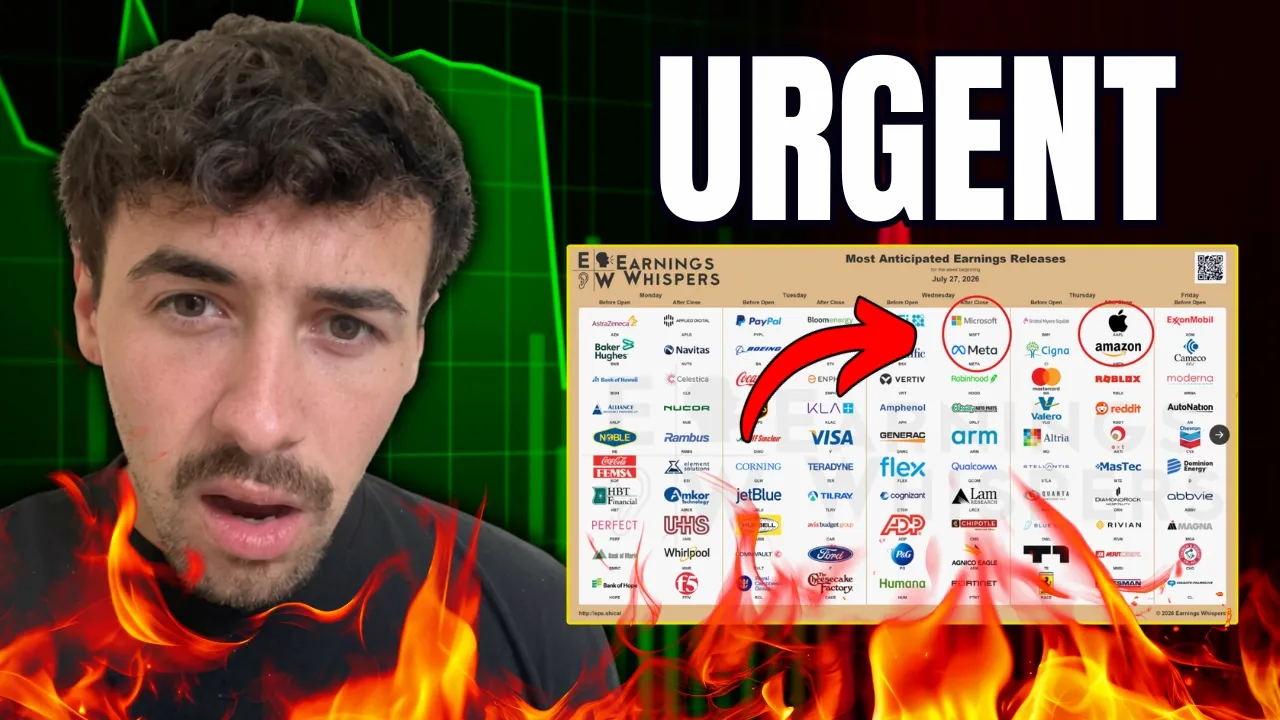
Tomorrow will be CRAZY in The Stock Market

- Rendement de la vidéo
- +27,08%
- Appels
- 1
- Achat / Vente
- 1 0
- Publié
Recommandations
L'entrée est le cours de clôture de l'actif à la date de publication. Le cours actuel est la dernière clôture enregistrée.
-
Entrée $393,35 28 juil 2026Actuel $502,97 07 août 2026Résultat +$109,62
I am more optimistic about Microsoft because they do have a free cash flow position that allows them to spend more without having to raise a bunch of debt, right? ... if I had to bet on one stock doing better than the other, I would bet on Microsoft doing better.
Contexte "I am more optimistic about Microsoft because they do have a free cash flow position that allows them to spend more without having to raise a bunch of debt, right? But, unfortunately, I think you're going to have a Google-like situation again..."
Transcription Complète
Holy smokes, we are going to have a crazy next 24 hours on our hands. Because tomorrow in after hours, you have earnings from Meta and Microsoft. Yeah, I'm going to share with you the expected EPS and the revenue and all of that. But what's really going to matter for these stocks is their CapEx guidance for this year and CapEx guidance for next year. That's also going to move the AI trade. I'm going to share with you what the expectations are around these numbers and what I think they're going to look like and ultimately what happens to the markets in different scenarios. But tomorrow we also have the Fed at 2:00 p.m. What is the Fed going to do? How could this move the markets? We'll we'll get into it in today's episode. So ladies and gentlemen, we have a banger for you today, one would say. The only thing that I ask you to do is hit that like button so you help push this video out to more people that need to hear it. And I will also say if you guys want to come trade and invest alongside of us in the Trading Community, you can see on screen we are up 37.5% year-to-date compared to the S&P's 8% year-to-date gain. We are almost 5x outperforming the S&P year-to-date and I think it's going to get even more dramatic into the end of this year. We could 10x outperform the S&P this year. And I think next year is going to be even crazier. So if you guys want to come join us, that link is down below. Not a recommendation, not a financial advisor, sharing thoughts, sharing opinions, sharing opportunities that Wall Street is overlooking. Okay, now that all of that fun stuff is out of the way, I do want to start this off with Meta and Microsoft earnings tomorrow because in all reality, like while people are going to have their own opinions on the Fed, it's pretty clear what they're going to do. Right? And we'll talk about that in just a moment and what impact that'll have on the markets. But first, I'm going to talk about Meta and Microsoft. So, I'm going to share with you the numbers, what analysts are projecting, but you have to understand at the end of the day, the only thing that matters is the capex trade. That's the only thing that matters for these stocks because look, you know, it's it's it's kind of like a small cap company, right? Like a maybe it's a MicroStrategy, where they're like and that's not a small company, but you get the idea. They're like, "Okay, look guys, we're going to dilute the out of you. We're going to raise a lot of debt, but we're going to buy this asset. We're going to invest that capital." Wall Street doesn't like to be diluted. Right? So, if Meta and Microsoft and just like Google last week, if they say, "Look, we're going to double down. We're going to continue to spend." Wall Street doesn't want to buy these stocks. Now, they are a very large weighting in the S&P and the Nasdaq, so it pulls the markets lower. Now, what's interesting though is over the last couple of months, AI stocks have rallied so hard that even though Google raised capex about $15 billion at the midpoint and reaffirmed that they're going to spend a lot next year, it's not impressive enough to drive a lot of buying in AI stocks, either. So, you have this weird situation where Wall Street is punishing the spenders and they're not rewarding the companies that are receiving the spending. So, you kind of have this this force that is really weighing on the Nasdaq right now. That is why the Nasdaq fell peak to trough 10% from its all-time high today. Now, you did bounce um around that 100-day moving average. You actually flushed below that. Buyers took over, bought it back up above the 100-day moving average. That's a good sign in the near term here. But look, it's really just going to matter what what the CapEx numbers look like from Meta and Microsoft tomorrow. Okay, so let's get into the breakdown here. First and foremost, you have Microsoft, which is down more than Meta. So, Microsoft from its all-time high, shout out the non-existent SaaS apocalypse fears, Microsoft is down almost 28% from highs. At one point, uh following last earnings, Microsoft had fallen almost 37%. Microsoft is up about 2 and 1/2% today. So, you've already seen quite a decline in Microsoft. Well, earnings per share are expected between $4.25 and or $4.24 to $4.25, up 15% year over year. Revenue consensus around 87.7 billion, that would be up 14.8% year over year. The Azure cloud segment, that's going to be the most important single metric. Um you're expecting anywhere between 39 to 40% growth here. It says any slowdown below 38% due to data center supply constraints will likely punish the stock. So, that's another part of it. If if cloud misses and spending goes up, yeah, you're going to have a big problem on your hands when it comes to Microsoft. But, it says here, the CapEx metric to watch. Wall Street is expecting full year or full calendar year 2026 CapEx to land near 190 billion. For the upcoming fiscal year 2027 guidance, guidance analysts want to see a disciplined CapEx growth target capped around 220 billion. If CFO Amy Hood guides for spending significantly higher than that, free cash flow panic will intensify. The the the funniest part about that, though, is Microsoft is really the only Mag 7 stock, or hyperscaler I should say, that actually will have positive free cash flow by the end of this year. They will all be negative. Amazon, Meta, Google, they will all be negative. Microsoft is the only one that's actually going to have positive free cash flow. Look, I have heard I have heard, you know, guidance numbers for Microsoft CapEx anywhere between 200 billion for next year and 200 60 billion for next year. You know, I think 220 billion would be a number that Wall Street would probably really like. Right? If we only go from 190, 190 billion, to 220, Wall Street would like that. Really anything below 240, 240 billion for next year, I think Microsoft gets rewarded for that to some extent. Now, that's still a lot of spending, but I think that's lower than most people would be expecting. Now, for Meta, okay, earnings per share expected between $7.13, $7.14, relatively flat compared to Q2 of last year. Um revenue consensus around 60.23 billion. That would be a 26.6% jump year-over-year. The CapEx metric to watch. Quarterly CapEx is expected to spike to a staggering 100% year-over-year to 33.15 billion for Q2 alone. So, they're spending more than 50% of the revenue they're bringing in on CapEx for Q2. Now, full-year guidance risk. It says here, Meta's current full-year 2026 CapEx guidance is pinned at 125 billion to 145 billion. Several prominent Wall Street analysts have warned that Mark Zuckerberg may raise the roof on that guidance tomorrow, potentially bumping it to 135 to 150 billion to fund their newly launched Muse Spark 1.1 LLM infrastructure. If that happens, Meta's going to fall, right? Um Meta's really not in a great position to be spending. They they only have free cash flow of like 60 billion. So, anything above 60 billion for CapEx is net dilution or debt issuance. So, again, it circles back to what I said previously, Microsoft and Meta and all the hyperscalers, they're spending so much money that they have to go into debt. They have to sell stock. You are the one that is funding that. And a lot of Wall Street doesn't want to be a part of it. At the same time, AI stocks have doubled or tripled in the past couple of months. You've already priced in a lot of good news and people have already overcrowded into AI stocks. So, the spenders are being punished and the recipients of the spending are not being rewarded, which is kind of not a great scenario. So, the markets are pricing in an 8 and 1/2% move for Meta tomorrow and about a 4 to 5% move for Microsoft. I will tell you, I am more optimistic about Microsoft because they do have a free cash flow position that allows them to spend more without having to raise a bunch of debt, right? But, unfortunately, I think you're going to have a Google-like situation again, where CapEx goes up a bit at the midpoint, not enough to say, "Yep, it's time to buy hyperscalers," but not enough to ignite AI stocks either. So, while I'm cautiously optimistic, if I had to bet on one stock doing better than the other, I would bet on Microsoft doing better. I, you know, I'm I'm not super optimistic that the spending's going to, you know, come in lower than expected. So, I do think this could be another drag on the markets coming tomorrow. Also, keep in mind, you are in your midterm seasonality moment. So, maybe the sentiment after the the midterms will change a little bit. Maybe people will say, "Okay, the CapEx isn't so bad. It's It's sustainable." I don't know, but right now, that's not the sentiment out there. And you are in the late July, August, you know, seasonal period where you do tend to get a correction before the midterms. What you really need to be focusing on right now are what areas of the markets are set to go up the most during the post-midterm rally. Because you do tend to have a correction before the midterms, but then you tend to bottom in October and go through like a 9-month rally. So, I think it's a lot less important about what's going to happen in the next week or two following, you know, the Fed or this earnings or that earnings. If you're really trying to think bigger picture here and make a lot of money, you want to be thinking about the areas that are going to benefit the most over the next 11 months during this post-midterms rat post-midterm rally. And I think that opportunity is firmly in software and small caps and cyclicals, the areas that Wall Street is kind of forgotten about at this point. You know, over the last couple of months, AI has been very popular. It's been a popular theme. So, people have kind of disregarded other areas of the markets. I think that's exactly where you want to be focusing and finding opportunities right now. Especially if hyperscalers do continue to spend and people aren't really going to be buying hyperscalers in that environment. If the spending is not super impressive, you know, super crazy, people aren't really going to be rushing out to buy AI stocks either. That could create an environment to really allow this rotation to continue to thrive. And again, that is kind of why the rotation trade did so well today. You know, healthcare, even consumer defensives, and cyclicals, and non-AI financials did really well. Non-AI industrials did quite well. Software did phenomenal today. Apple did well today. Now, beyond that, you are going to have the Fed meeting tomorrow. The markets are currently giving a 70% chance of a pause unless there is something dramatic that happens overnight, like a Fed official were to break the blackout period and then say, "Yep, we're going to raise rates tomorrow." You're not going to get a rate hike tomorrow. It would be unprecedented. The The Fed always does what the markets are pricing in ever since 1994. The market The Fed has never once went against the markets in the last 30-plus [snorts] years, 32 years. I don't think that's going to happen now. Right? Even though we have a new Fed chair and people are going to be nervous about that. What's more important is what happens at 2:30 when Kevin Warsh gets on the podium? What does he signal for the next Fed meeting? Because the markets are currently pricing in a 25.3% chance of a pause, a 55.6% chance of a rate hike, and a 19.1% chance of two rate hikes. So, following tomorrow's Fed meeting, assuming we don't get a rate hike, this probability of two rate hikes by next meeting's going to collapse because that would mean a a 50 basis point hike in September. So, those odds are going to fall. But, do we swing more towards expecting a pause or expecting a hike for September? And Kevin Warsh is going to potentially signal for us what to expect. I personally think the markets are being, again, overly hawkish on the Fed. I think I think the markets are just focusing too much on oil and short-term inflation pressures in which, if you actually look at some of the labor data that we've gotten recently, like the ADP employment change that came in today, was really bad, right? Look at this trend of ADP employment going from 40-ish thousand in March and really March through May, down to 15,000 today. You are consistently in a decline ever since May 2nd. I mean, you've been falling almost every month besides one. Besides or every week, besides the week of June 6th. You've been falling every month, every week, excuse me, pardon me, since May 2nd. This is a bigger story I don't think people are even thinking about right now. The last jobs report came in really bad. So, don't be surprised if Kevin Warsh says, "Look, I think the labor market's not as great as maybe we thought before." And at the end of the day, I don't think the Fed wants to make a dramatic decision like beginning a rate hiking cycle before the committees have a chance to even operate or commence. It would be like if you were hunting for deer or something and you got out in your hunting blind at 7:00 in the morning and started shooting trees, right? You're going to completely miss the mark. No deer is going to be in your line of sight all day. That would be like the Fed right now if they start raising rates in context to the, you know, committees that they're setting up. It makes no sense. And assuming I'm right, that would lead to again, likely this broadening to continue. So, bottom line, guys, we are in a period where you do tend to get a correction before the midterms and we've already gotten that in the Nasdaq here. Well, tomorrow I think we're going to hear from the hyperscalers that they're going to be spending more, maybe not as much as we thought, but likely not enough to like cause Meta or Microsoft to go back to new highs, right? Not enough to get some kind of crazy rally, but also not enough to ignite AI stocks, either. If AI stocks don't work, if hyperscalers don't work, if the Fed is less hawkish than we think, I think that's a really good setup for this broadening to continue. Now, I could be wrong. You know, maybe Microsoft comes out and they cut their CapEx guidance. Or maybe their earnings are so phenomenal that the markets buy the stock because of it. I think that's unlikely. If that was the case, I think Google would have went up, you know? What about Meta, you know? Is it possible? Of course. I just think it's a pretty low likelihood at this point. Now, yes, could they go earnings? They could. But how sustainable is it? Is it something you would want to go out and rush to buy? I don't think that's going to be the general consensus after hyperscaler earnings tomorrow. Now, Iran also said today they haven't sought US talks in the past 16 to 17 days. Apparently, Iran is in talks with Oman to come to an agreement to facilitate traffic in the Strait of Hormuz. Kind of noisy what we're hearing today, but the markets are generally taking it as a positive. I mean, oil is down 4% today. So, cutting through the cutting through the noise here, markets are taking it as a positive. And also, 10-year Treasury yields down about four basis points today. You're still kind of in the danger zone. You want to get below 4.5%. That's a pretty big psychological level. I think after the Fed tomorrow, that probably happens. And again, that's good for the rotation trade. So, I think we are in one of those weird scenarios where I'm not super optimistic about the Nasdaq or the S&P. Like, I don't think we're about to go through some kind of imminent huge rally, but I don't think we have to continue to die, either. Could the Nasdaq come down to its 200-day moving average? Of course. That would be downside of about 14% from peak to trough. You're already down, even after the bounce today, 9.7%. What's another, you know, couple percentage points? That could easily happen. But, I don't think we're going to fall 20, 30 plus percent. Again so it's kind of a strange environment because I'm actually quite bullish on the rotation trade, on other areas, right? The broadening trade to continue, but I'm not I'm not like super bullish on the indexes right now. I'm not super bearish on them, either. So, yeah, that's just my opinion. So, let me know your thoughts on this down below in the comment section. Hit the like button, as well as subscribe to the channel. If you guys want to come trade and invest alongside of us, that link is down below in the description of today's episode. Let me know your thoughts about Meta and Microsoft earnings. I know a lot of people are going to like to hear that, but we've been pretty accurate on this channel. So, hopefully, it's a little bit of a heads-up, or maybe some valuable perspective if you like perspective, hit that subscribe button, so you guys don't miss these videos. Have a great rest of your night. Signing off here, and I will see you in the next one.
Commentaires 0
Connectez-vous pour rejoindre la discussion.
Se connecterAucun commentaire pour l'instant. Soyez le premier à partager votre avis !