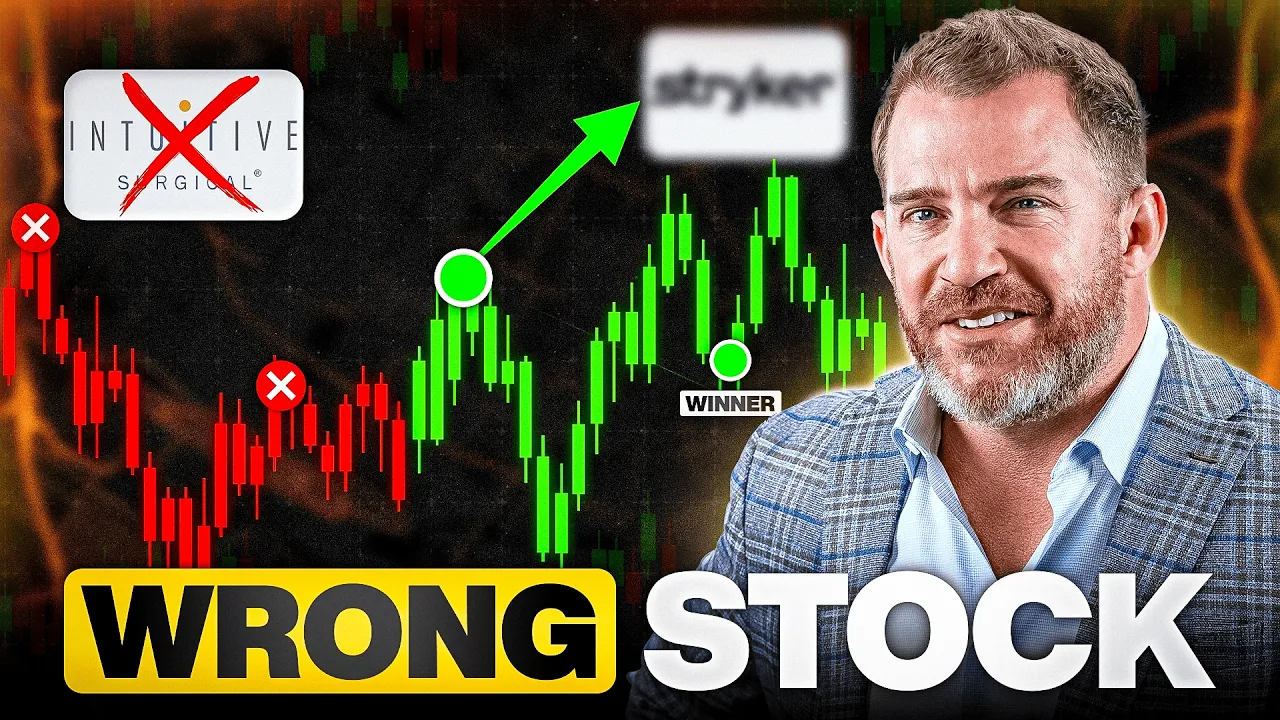
The FDA Just Changed Robotics Forever... Everyone Bought the Wrong Stock

- Rendement de la vidéo
- -5,02%
- Appels
- 2
- Achat / Vente
- 1 1
- Publié
Recommandations
L'entrée est le cours de clôture de l'actif à la date de publication. Le cours actuel est la dernière clôture enregistrée.
-
Entrée $353,10 29 juil 2026Actuel $378,66 07 août 2026Résultat −$25,56
When a category cracks open like that, the last thing I want to own is the company whose monopoly just got broken.
-
Entrée $352,25 29 juil 2026Actuel $337,43 06 août 2026Résultat −$14,82
what I'm seeing on this chart right now that is screaming buy.
Transcription Complète
Last week the FDA did something it almost never does. It didn't approve a product, it created an entire new category of product and one company stands to benefit in a big big way. Johnson & Johnson's Ottava surgical robot got what's called a DeNovo authorization. Now that's not a normal clearance. A DeNovo means the agency looked at the machine, decided nothing on the books was close enough to compare it to, and then wrote a brand new device classification to hold it in. They called it soft tissue robotics. And that class could not legally exist the day before. And every headline after this big news said the same thing. Here's Johnson & Johnson who can finally compete with Intuitive Surgical who for years has been the dominant player in this space. But what the FDA actually told us last Wednesday is that robotic surgery has stopped being one company's private monopoly and it has become a regulated category with room in it for other players. When a category cracks open like that, the last thing I want to own is the company whose monopoly just got broken. I want the one that already owns a completely different piece of this market and happens to be on sale for a reason that has nothing to do with any of it. It's roughly the same size as Intuitive but with more robots installed in this category than anybody on Earth. In fact, two of every three surgeries using this company's knee replacements are done by its own robot yet almost nobody outside the medical device world has ever heard of it. But the stock is currently 17% off its highs. Not because of competition or missed earnings, but because somebody hacked them. The company is Stryker, ticker SYK, and in the first quarter of this year a cyber attack shut down their global production for 3 weeks. Cost them roughly $375 million in missed revenue, but guess what? Management did not cut guidance. Not by a dollar. And they're reporting earnings tomorrow. Today I'm going to show you what this FDA decision is quietly good news for Stryker, why I think it will outperform Intuitive Surgical from here, the product cycle nobody is paying attention to, and what I'm seeing on this chart right now that is screaming buy. Make sure to subscribe to the channel because robotics is a huge investment theme right now and you don't want to miss it. So, let's talk about this company. Now, most people who have heard the name Stryker think about hospital beds and surgical tools. Folks, that is the old Stryker. The new Stryker owns a robot called Mako and Mako does orthopedic surgery, knees, hips, now shoulders. And here's the first thing to understand about last week's news. Stryker, first of all, is not in the soft tissue fight at all. You've got Ottawa, Da Vinci, Medtronic's Hugo. Those machines are all swinging at gallbladders and hernias. Stryker's in bone. So, while three of the biggest companies on Earth are fighting over abdominal surgeries, Stryker sits in its own category with almost no competition. And the FDA just spent a Wednesday afternoon reminding every investor on the planet that surgical robots is a real, approvable, and enormous market. Now, that news is bringing the crowd, but the crowd showed up looking at the wrong tickers. Here's the scale of this, okay? Stryker has more than 3,000 Mako systems installed worldwide. These machines have performed 2 and 1/2 million surgical procedures in 47 countries. And each machine, on top of selling for $1.2 million each, generates another quarter million dollars a year via service contract. Now, Stryker has for years manufactured prosthetic knees and hips, but now 2/3 of those knees and 1/3 of those hips are being surgically implanted using the company's own robot. And a lot of investors are getting this wrong. The robot is not the product. The robot is the thing that sells the product, okay? So, a hospital buys a Mako, and the surgeons train on it. Then every knee and hip and shoulder replacement that hospital implants comes from Stryker because the robot is built around Stryker's implants. So, the machine locks in the implant revenue for the next decade. It is the razor blade model, but for orthopedics. The implants are the recurring blade. Now, globally, they're only at about 50% utilization on knees, just 20% on hips, which means there's a lot of market share there still up for grabs. By the way, if you like content like this and you want the trades I'm making personally, you need to join my Black Ops trading service. It is five bucks. You get a whole year live 1-hour interactive group mentoring sessions with me every Monday for a whole year. Plus my weekly newsletter, a second session with my analyst uh indicators, bonus reports, a ton of stuff. It's the best $5 you'll spend this week. So, click the link in the description, scan that QR code, or just go to tradewithross.com to get signed up. Now, let me show you why the stock is on sale because the reason is a little silly. So, first quarter this year, as I said, somebody breached their systems. Stryker had to halt production for 3 weeks. 3 weeks of a $25 billion company not shipping. The damage, roughly 375 million in lost and deferred revenue. The stock fell from 380 in March to 280 in May. But, here's the crazy part. I mentioned this earlier, management did not touch guidance. They didn't revise down they expected their sales, their profits to be. They kept the full year at 8 to 9 and 1/2% organic growth. Roughly $15 in adjusted earnings with the recovery mostly coming in the back half of the year. So, the company is saying, "Look, we didn't lose the business. We lost 3 weeks of shipping, and we are going to catch up." Meaning, that dip in the stock price is a mispriced discount. And even with this three-week production outage, their Mako installations were a first-quarter record in the US and internationally during the shutdown. So, customers did not cancel their orders, they waited. And that, my friends, is a moat, and a strong one at that when you're talking about a million-dollar product. Now, Stryker is in the middle of the biggest product cycle in Mako's history, and it's happening right now while everybody's staring at Johnson & Johnson, whose robotics represent a fraction of their business. The new Mako 4 is the first major hardware refresh since Stryker bought the platform back in 2013, 13 years ago. Their CEO described the customer uptake as incredible, and it opens the door to applications the old system couldn't run. Mako shoulder launches on Mako 4 mid-year. That is an entirely new procedure category, new robots, new implants, new revenue. Then there's Mako RPS. It's a handheld robot. So, no big machine in the corner of the room, no CT scan required beforehand. It just went to full US commercial launch. And listen to what they're built for. Stryker's Mako general manager said they are specifically targeting surgeons who do manual procedures and don't use a robot at all today. And they're seeing heavy interest from ambulatory surgery centers. That is a completely new market. The big fixed robot costs a fortune, eats a whole operating room. An outpatient center was never going to buy one, but a handheld unit, one they can afford, that's how you get robotics into the surgery centers where more and more of the procedures are moving. Mako spine is still in development behind it. So, you've got four product launches stacking up in a business that already dominates this category, and investors are starting to wake up. So, let's take a look at Stryker here and you can see as I mentioned that news they were hacked back in March took a big beating on the stock and this thing is quickly playing catch up, but look back here, okay? And the stock was trending beautifully 2019, 20, 21, 2, 3, 4. It's been in a big holding pattern. Then you get the decline. If this trend were still intact, this thing be up in the high 400 if not 500 a share. But more important than that, look at the structural recovery we're seeing. This is exactly what I look for in a stock that's been declined. So, what I want to see is what we call a a a rounded bottom. This kind of shallowing consolidation where you've got the big sell-off, okay? There's your 30 plus percent decline. You then want to see the shallowing pullbacks. You want to see signs that buyers are coming in. Higher lows, higher highs, up against resistance here in this kind of 330, 340 area. So, very, very much a textbook turnaround. Currently breaking through. Uh I'm recording this, I guess it's going to be I recorded this yesterday before the market opened, but look at the the the move coming through here. So, really, really nice structural consolidation pushing out and look, if Thursday's print if tomorrow's earnings numbers shows that that deferred revenue came back, I would not be surprised to see this thing back above the $400 high by the end of the year. And there's also a bonus kicker for this one and that's the dividend. I know one knows exactly when a stock will move, but Stryker pays you to wait. Now, the yield is low, but the company has raised the dividend 16 years in a row and the payout ratio, which is what percentage of their profits they use for the dividend is only 40%. So, there is plenty of room to keep raising it. Plus, this company has a proven track record. Full year revenue of $25 billion for the first time. Four consecutive years of double-digit growth. Operating margins expanded for the second year in a row. All while absorbing $400 million in tariffs. Instrument sales grew 19% in the US last quarter. Endoscopy grew 11%. I mean, this is a company that just keeps compounding quarter after quarter after quarter, and nobody talks about it. Because Intuitive Surgical steals the headline. With a market cap of $129 billion, this is an institutional grade stock. And it is positioned to ride the momentum as robotics takes center stage for investors. The FDA story is evidence that this category is approvable. It kills the idea that one company owns surgical robots forever, and it puts a lot of new eyeballs on this sector. And Stryker is what those eyeballs will eventually find. A category leader, mid-product cycle, at a fair price, with maintained guidance, and a long track record of success. And for a long-term investment, that's about as close to a no-brainer as you're going to find. And right now, you can buy this thing at 2024 prices. Folks, don't forget to subscribe to the channel, and don't forget to join my Black Ops trading service. You will not believe how far you can come in a year. We're going to spend an hour together every Monday for a year, just five bucks. We'll look at your stocks, I'll show you what I'm buying, I'll show you where the leadership is, tips and tricks to identify good buy points, good sell points. You name it, nothing is off-limits, all for just $5. So, click the link in the description, scan that QR code over there in the corner. We're going to trade with ross.com to get signed up. Until then, I'll see you in the next video.
Commentaires 0
Connectez-vous pour rejoindre la discussion.
Se connecterAucun commentaire pour l'instant. Soyez le premier à partager votre avis !