CNBC Today On NVIDIA Stock, Micron Stock, SK Hynix Earnings, Big Tech Earnings - NVDA Update

- Rendement de la vidéo
- +14,36%
- Appels
- 3
- Achat / Vente
- 3 0
- Publié
Recommandations
L'entrée est le cours de clôture de l'actif à la date de publication. Le cours actuel est la dernière clôture enregistrée.
-
Entrée $585,61 29 juil 2026Actuel $592,90 07 août 2026Résultat +$7,29
has a buy rating on both stocks
Contexte Joining us now is Brent D. He is senior software analyst at Jeffre and has a buy rating on both stocks.
-
Entrée $390,54 29 juil 2026Actuel $502,97 07 août 2026Résultat +$112,43
has a buy rating on both stocks
Contexte Joining us now is Brent D. He is senior software analyst at Jeffre and has a buy rating on both stocks.
-
Entrée $390,54 29 juil 2026Actuel $502,97 07 août 2026Résultat +$112,43
I think this is actually becoming a buy right now.
Transcription Complète
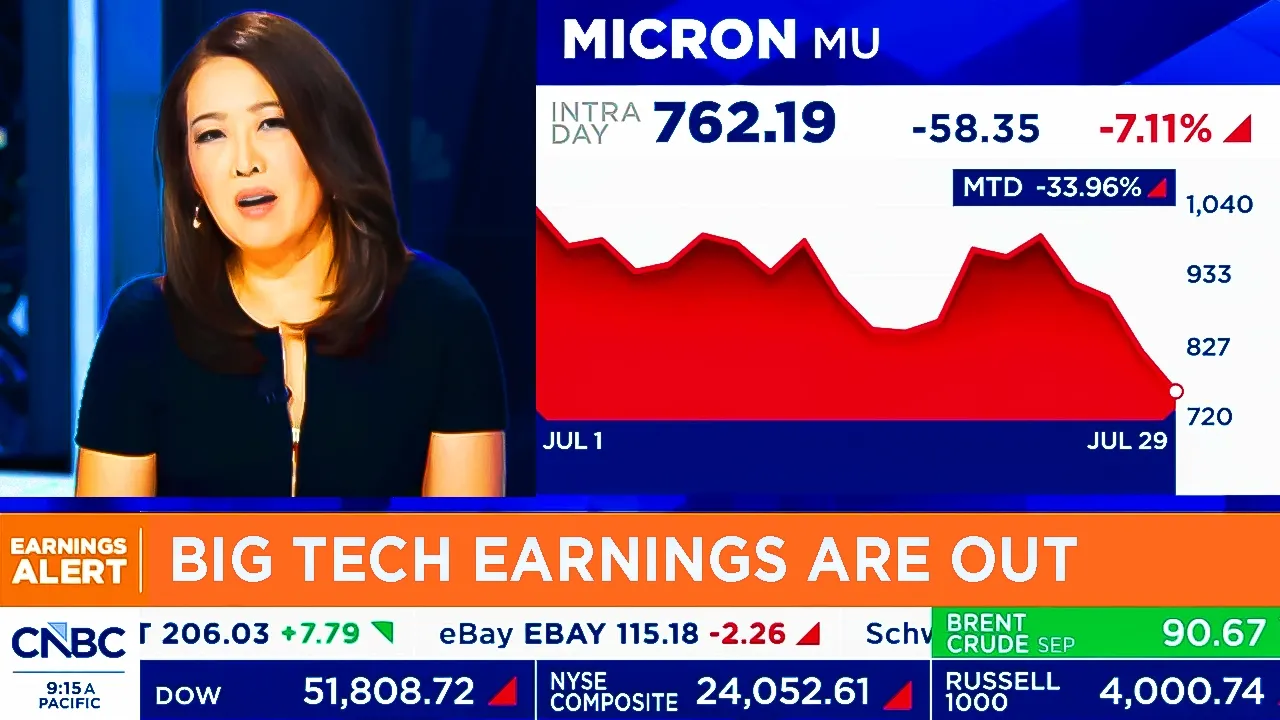
very lofty expectations uh because these were record profit numbers as you mentioned as well but there is a lot of nuance in the print. Uh one thing uh the market was concerned about really was the revenue miss that was driven actually by a miss in the average selling price growth rate of SKH Highix's products is a key metric that's been watched by the market. The lower average selling price or ASB was actually due to a higher proportion of high bandwidth memory compared to its competitors. Now you've got two types of memory, DRAM and nan. Both of the prices for this rocketed in the quarter, but that doesn't necessarily translate through to HBM prices right now because high bandwidth memory is actually negotiated on these longer term C contracts. So the prices you saw in the current quarter were actually negotiated prior to that and so they're playing catchup almost as well. SK Henich actually said that it concluded some of these long-term agreements with around 10 customers this year and that really explains the miss here for the numbers. The market thought higher DRAM and NAM prices now would immediately lead to higher revenue that they had forecast. But that's not really how HBM works given the dynamics of the memory markets changing so much. SKH said on the call that shipments of some of those higher value products will push to the second half of the year and as their next generation HBM ramps up and they said DRAM shipments rise in the second half of this year, this will have a positive impact broadly on the company's blended average selling price as well. So that should be positive. That's the bull case. The bare case of course is that memory is going through its classes its classic cycle. We've seen historically with more supply coming coming online for DRAM from China and from other players as well like Samsung and Micron. But the key here really over the longer term for SKH Highix is can it set strong pricing for high bandwidth memory to sustain its profitability and its margins which were over 83% in the quarter by the way over a longer time frame when supply eventually does catch up to demand Morgan. But what would you say based on this report that came out with their earnings and what we've seen happen not only to SKH Heinik's shares but shares of the entire semiconductor industry. >> Good morning. Uh so you know in general of course the the semi the socks doubled uh o over the last 3 months or so. So I I think a lot of what you're seeing here is you know we we we've had a big run. you know the socks has pulled back 25% from its high. Uh so you know it's a little bit of of of expectations after such a big run. You know what I could say for Esahin himself and and remember Micron reported about a month earlier that was probably the best report uh Micron's ever had uh you know given the strength of memory and such. But remember what's happened in memory is that the memory suppliers are severely supply constrained. can't produce more which is the very reason why we're bullish on memory uh because there's these physical constraints for for skinex himself what I can say is remember they don't unlike micron they don't provide formal forward guidance so there tends to be a lot more volatility in where street numbers go and so therefore you know it's it I' I'd consider this just a just a mismatch of expectations >> Chris I think the biggest issue for the entire industry though is this question about whether this boom and bust cycle is going to remain a boom cycle and and not hit the bust as we've seen happen in the past and and you're right there's far more demand than can be met at the moment. The question is if that demand is still around by the time they're able to ramp up and try and meet it. What do you think? Yeah, and and that's the right question and uh you know at least what you could say right now is because of the physical constraints in the industry I I I spoke about that with with memory but TSMC is facing the same thing right now. TSMC is is completely sold out and you just don't have the physical space to to make the semiconductors right now. So, it's really hard to see a situation right now where we're in over supply and typically, you know, the the the overshoot that happens in semis is you build too much capacity, you now have the capacity to ship stuff and the demand isn't there. And because the current upcycle requires the building of brand new buildings that take a long time to build, the even the potential of getting to that over supply situation is really, you know, 2028 at the very earliest. And as we speak to some of the equipment vendors, they even say, you know, it could push farther than that. >> Let's talk about Nvidia. Let's talk about Nvidia and what it's been doing to make sure that it is helping the AI cycle. You know, Jensen Wong will tell you that he's looking out there looking for the bottlenecks in growth for AI and trying to address all of those bottlenecks by using Nvidia's considerable heft and balance sheet um to make sure it props up some of those areas. That's why you've seen some of these financing deals that you know people have described as circular financing deals because Nvidia certainly benefits from the growth that it is helping maintain with some of these things. Nvidia shares um over five years up 905% but they have struggled a little bit lately even though they've had pretty incredible results and have been meeting demand and have an incredible balance sheet and there there are some thoughts that have been kind of put out there. Ben Emmens put out a note last night just talking about how the bond market is kind of coming calling at this point. Back in June, Nvidia issued seven tanches at a weighted average spread of treasuries of left less than half a percent. again because of inc Nvidia's incredible performance and their incredible balance sheet um they use those proceeds to take equity stakes and a lot of the hyperscalers and the data center builders and now we see credit default swaps rising on Nvidia shares which you would never anticipate from a company that's doing that well but it's because they have used so much of their currency to help some of these companies like an SKH or a HUD 8 and when that's their stocks have come under pressure that reflects back on Nvidia. Is that a fair reflection and should we read anything into this? What do you think about Nvidia itself? >> Yeah. So lot lot to unpack there but you know generally speaking I'm pretty comfortable with you know providing equity and such to shore up the supply chain because uh again the capital's required for your customers to to go and uh uh and expand capacity and you know an equity investment you know equity investments they made in open AI and such you know there's lots of folks in the public market that would have made that um where I'm a little less uh uh little less favorable is where you know some of the discussions about making you know backs stop backstopping some of the financing such that you know the the customers are going to the public markets and looking for financing and you by getting a backs stop and Broadcom did this is doing the same with a what they call an XPV for anthropic and open AI and that part of it is is less good because you know, there's some liability on there. And again, that liability is probably far in the future, but that part I'm I'm less comfortable with. >> Like the news about the 750 billion from backstopping for Nvidia that went 500 billion to skinex and 250 billion for Open AI. That's the type of stuff that makes you a little nervous. >> Yeah. And again, right now, you know, the benefit Nvidia has is they are generating just so much cash. they have such a strong balance sheet and and you know probably the healthiest balance sheet in the industry. So, you know, I think what Jensen's trying to do is figure that if if financing becomes a bottleneck, you know, that that constrains his business. So, let's try to remove that bottleneck. And again, Broadcom's doing the same. Uh but, uh, you know, ultimately, and listen, I think where the proof will be in the pudding that OpenAI and Anthropic, you know, they they they will go public uh in a fairly short order. They'll provide a lot more details around their business and and prove to investors that yes, there are returns here. there is a business model and you know one of the things we we spoke about with these companies is once those two uh big folks go public then they're going to be in much better position to go raise equity on their own and certainly they will raise equity through those public offerings and and so we get the question a lot is is what's going to calm people down what's going to what what is going to show that you know perhaps what's going on right now is reminiscent of deepseek a year ago which turned out to be a lot of nothing I I think the anthropic and open AI IPOs will go a long way to that because then we're going to get under the covers of the business model. We're going to see how they can finance and you're going to see how the equity markets react to that >> the news of the morning and that has to be what we've seen with SKH Highix. This is just the latest in the question surrounding AI and the buildout for that and what people think about semiconductors. Where are your thoughts around what's happening right now? Well, I I think there's uh several factors going into what is a a very thrashy morning for for SKHEX and a lot the chip. One uh we're seeing um a lot of uh confusion around what memory chips are uh in in in so far as AI compute uh is is concerned. So number one, SKH Highix has fundamentally very strong numbers as of the print uh late last night. Um they are seeing 80% gross margins on memory chips which is never before seen. Um they're having record-breaking quarters across the board. I think expectations were just very high. And number two I think DRAM is a very large uh market with very uh very different layers in it. SKH highex represents HBMs which is the highest bandwidth density um uh and um and quality as in so far as AI models and compute are concerned. And you know there's commodity DRAM by Samsung and Micron which is one step below that in tier. And so I think that uh their position SK Hunx's position in the AI compute market is very solid for the next two years and they're they're booked out with long-term contracts. So I think expectations were uh perhaps mismanaged was a little bit too high. Uh I think fundamentally uh this is uh going to be memory chips are out of the cyclical state that they were over the last 15 20 years and we're entering into a new state where it's sitting side by side with GPUs and logic processors. >> Steve a lot of the people I've talked to the industry say look when you have margins that are 80% or north of that you are incentivizing everybody else to come after your market. Um, you know, your margin is my opportunity has been that old saying that's been, I think, wrongfully attributed to Jeff Bezos because he told me he never said that. But when you have margins like that, the question becomes, how long can can that consist? And if you have huge demand right now that you can't meet, will that demand still be there by the time you can build out to it? What what do you say to those questions? >> No, it's a very good point. I mean, that's a that's a very apt phrase here. So let's talk about two things demand and supply. So on the demand side uh what we're seeing is u from models and training and inference across the board and the long context memory the the long context memory that is required for agents whether it's coding agents or deep research agents like perplexity uh you're going to need more and more HBMs and SKH is the 65% market share leader in HBMs. Now, let's talk uh about that long-term uh view. So, you look at autonomy, Neuro and Uber with a robo taxi fleet, Whimo, uh Tesla, FSD, they all need HBMs on board on the car. And so, what you're seeing is um in physical AI, robotics, humanoids, uh LLMs, and agents, you're going to see demand that is going to 10x from here just over the next 3 4 years. Uh that being said, on the supply side, let's talk about supply side. How can an a competitor enter the market and compete with SKH Highix or another HBM manufacturer? There was a CXMT IPO in China uh that was um wellreceived and lauded in Shanghai uh a couple days ago. Now, >> can they compete? Well, they make commodity DRAM. They are unable to make the uh stack to die uh structure and architecture of an HBM. And so uh in the Intels of the world, they are not uh they are not capable of creating HBMs at this quality level. So it'll be many years before there's a fab uh for uh memory chips that will be able to compete effectively in the market. And we're not talking about one or two years. We're talking about 3, four, 5 years uh to even be able to enter into the market. Uh the logic processors of Nvidia, Intel, and and AMD are very different all the way down to the fab and foundry level than they are from the DRAM side of it. So, >> so these are investments, right? >> Yeah. Uh I mean I I think look I think this is going to be a very challenging market to enter into. I think it's going to be a locked in market on memory. I think what you're seeing today is a lot of uh unknowns around uh whether or not uh after the 2 three years of of uh uh sales shortage or supply shortage if the these companies continue to maintain these profits. >> Yeah, let's get to meta earnings. They are out. Julia Borson's got those numbers. Julia Melissa, mixed results here. an EPS miss's earnings per share of $6.18 coming in well below expectations of $722 per share. Um you see shares are now down 7%. Now Meta revenues did beat estimates at 60.8 billion versus estimates of 60.17 billion. Now we are always focused on capex for Meta. Meta raising the bottom end of its capex range to for this year fiscal year capex between 130 and 145 billion. This is a slightly narrower range than what they had previously forecast to of 125 to 145 billion. So not moving the top end of that range, just bringing the bottom end of that range up higher. Um the company also guiding to third quarter revenues of 61 to 64 billion. Um the estimate is 63 63.15 billion. Um so we're going to continue to dig through these numbers. We see shares now down 8%, but I'm going to throw it back to you now, Mike. >> Julia, thank you. Uh yeah, now down 8 and a quarter% the the somewhat light revenue guide for the third quarter is a little bit of a trouble >> that and then when you when you raise the bottom end you're bringing up the midpoint basically of that capex spend and so you know in the context of what's happened today and what we're seeing with with bond yields there was concern already that meadow is pay had to pay much more in terms of interest expense in order to fund this AI buildout. Not only is are they going to be spending more potentially, but it's also going to be costing them a lot more if we are to believe that this move in in yields is a >> Yeah, that is a new wrinkle here. Tech is rate sensitive in a way directly in terms of outlay that it never was uh before. Microsoft earnings are out. Let's get to those. Kate Rooney has the numbers. >> Hey, Mike. So, it was a beat on revenue for Microsoft. We have 90.1 billion.01 billion I should say. Better than expected on the GAP EPS number. We're not going to compare this one. and it's $4.74 adjusted for the quarter on EPS. That does exclude an impact from OpenAI. There's also a $3.2 billion gain related to Anthropic. So, the EPS number a bit messier. We're not going to comp, but $4.74 there. Azure growth better than expected. That was 43% growth on Azure revenue, better than the 40% Street was expecting. Want to read you a quote from CT CEO Sati Nadell. says Azure revenue surpassed $100 billion for the first time. Also mentions Microsoft 365 copilot seats surpassing 30 million paid seats. That's a key number. He says it reflects some confidence in customers placing us to power their AI transformation and uh that is the latest guys. I will keep digging through this for some more details but it looks like shares more than 3% higher on this report. Back to you. All right, Kate, thanks. And that 30 million paid seat that compares to 20 million at the end of the last quarter. So there's pro progress growth year as well as uh quarter and quarter as well as year >> and better than expected growth in Azure. I mean it mimics what Google Cloud saw, but definitely probably also relief. The shares are exhaling. The month high is like 406 and it's above 404 here. >> Let's get back to Julia. She's got some more on meta. Julia. >> Yeah, just digging into the results here as we see the stock um dramatically lower after hours. Uh shares now down about 5%. Now the daily active people number coming in at 3.6 billion. This is slightly lower than the 3.61 billion that was anticipated but it was growth um up from 3.56 billion in the prior quarter. So we had seen a sequential decline from Q4 to Q1 in terms of the number of people using Meta's apps. They did see growth again. Free cash flow came in at 784 million. Analysts had been expecting free cash flow to actually turn negative. Um so this was better than expected. And I just want to flag one key note here. Um the company saying we continue to monitor active legal and regulatory matters that could significantly impact our business and financial results. Saying we continue to see scrutiny on youthreated issues in several markets and have a number of youth related trials scheduled for this year in the US which may ultimately result in a material loss. Certainly Melissa, this is something we've been reporting on very closely and could really have an impact on these results. Shares now down about 6%. Back over to you. Uh let's get back to uh Kate Rooney with a little more on Microsoft. Kate. >> Yeah, Mike. So digging through the numbers here, one interesting portion of this is capex for the quarter. They say it's $41 billion. Important thing is that this is aligned with guidance. So they are on track to hit that $190 billion guide for capex that they put out for the fiscal year. Microsoft is in its fiscal fourth quarter. So seems to be on track when we look at the capex number. We mentioned those co-pilot paid seats at 30 million. A little bit of context here. If you look back to Q2 in this fiscal year, it was 20 million. The quarter before that it was 15 million. So really strong growth. They say Net Seeds ads more than uh doubling quarter to quarter. And then M65 commercial cloud this is core part of the enterprise business. Revenue there grew 16%. Xbox that's been a struggling portion of the business. The gaming unit revenue there decreasing 10%. And then last thing guys a couple different segments. Productivity revenue, intelligent cloud revenue, and personal computing all slightly below expectations in a row here, but the overall numbers did beat especially revenue, but shares pairing those initial gains a little bit here, up more than 1%. Back to you, >> Kate. Thank you. Let's get more on the moves in Meta and Microsoft. Joining us now is Brent D. He is senior software analyst at Jeffre and has a buy rating on both stocks. Brent, um, for Meta, it got very tempting, I think, going into this report to kind of zag and say the pain's been absorbed. It's valuation's pretty depressed. Uh, what did they show? What did they need to show? What do you make of the market reaction? >> Yeah, I mean, the quarter itself was kind of blocked, right? Not a great revenue to beat. Margin below the street, 31 versus 33. Capex a little higher. you kind of had like the trifecta of things that could go wrong that aren't great for the stock, right? Not big upside, bigger expense, bigger capex. So, I think it just fuels this, hey, they've got to get ready for AI. Uh I think the overall ad market, which is driving the most bulk of their revenue, is still very healthy. It's just investors uh wanted more and this market, as you know, right now is just so fickle. >> Yeah, this was not this was not a good print. Yeah, hang on there. Uh, Julia Borson's got more uh from Meta. Julia, hey Melissa, with Meta Shares trading down about 5%, I want to flag two factors that were weighing on Meta's earnings per share in the quarter. The company announcing that it's $42 billion in costs and expenses, which was a 55% year-over-year increase, includes $2.4 4 billion of charges related to legal proceedings and 1.18 billion of severance expenses in connection to the May 2026 headcount reduction. So just flagging those two factors there. Um as we look ahead to the call which starts in about 10 minutes, we are expecting Mark Zuckerberg to share more on the enterprise business. He did say in the quote in the release here that AI is accelerating the core business, powering our next generation of products and opening the door to entirely new enterprise opportunities. So looking to hear more from that about him shortly. Back over to you Melissa. >> All right, Julia. Thanks Julia Borson. Still down 5%. Brent and just to sort of build off of what Julius I'm just wondering what what can the message be that Zuckerberg and company can give to the street? They're not going to we're not going to get obviously return on investment number, but what is sort of what are some of the things that they can say to sort of reframe their story and take control of the narrative? >> Yeah, I mean I think everyone wants clarity on what he's going to do in the compute business. um he's late, he should show up. There's still a lot of room, you know, are you going to cannonball into the enterprise pool? Are you going to do a wide compute buildout? So, everyone wants to hear ultimately what are they going to do on on this compute build? And I think that again, we don't have a lot of details. It's all been speculation, but makes a lot of sense. We know it's a big business for Amazon with AWS, with GCP, with Microsoft, with Azure. So, we'd like to hear more uh on that side. I think the other initiatives around glasses around some of the other AI initiatives you know when is that going to pay off how is it paying off on that side and then I think obviously the biggest driver of this company is just the health of all the advertisers and their spend and that looked good you know the revenue upside was okay wasn't amazing no one's doing back flips on that but just overall health and why are they guiding below the street uh for the next quarter is it just being conservative or is there something that they're seeing in an environment they that they don't like. Um, so again, I'd say the compute initiative is is probably the number one thing that everyone wants to hear. Uh, because how he does it is going to define how much money they have to spend. Are they going big into compute? Are they going to just sell chunks to large enterprises with a small team? Uh, this this is a big uh there's a lot of different ways they can they can go after this and we need to hear more uh on on his on his route to market. >> Yeah. Uh and just a word on on Microsoft, Bren, it looked like kind of a cleaner report on most fronts. The stock is adding to the the little bit of gains we've had this week. What's uh most important there? >> It was the biggest be in Azure and three quarters. That's the key headline. Their infrastructure business doing very well. Commercial uh cloud uh you know 14% growth. Uh capex was a little bit lighter. Uh was a good revenue beat and and really stable. So, I think this is kind of what Amy Hood has been instrumenting the CFO for years. It's just stability uh and and good good numbers. We're finally seeing the Azure reaceleration which is a signal that they're getting more capacity and AI online and uh they in our opinion with any LLM, any model you want to bring is a great place to come to them to run this as a safe uh safe harness if you will. So we we like the Microsoft story and we continue to to to be, you know, big believers in what they're doing. Uh right now it's just been a source of funds. Investors have just used Microsoft to uh source moving into SpaceX, moving into other names, energy, infrastructure, and so I I think again uh they deserve better. We think the fundamentals are really good there. And I think they're signaling that they don't have to go out and crank the capex uh to to drive these numbers. capex was actually a billion dollars lower than uh the street had had expected. So, you know, it's always been about a good balanced story. Unfortunately, investors are are not treating it that way. They're treating it as a source of funds to to fund uh other names in taxes. >> We do want to get to Meta Shares. They are at their after hour session lows right now, down by almost 10% after the company missed earnings expectations. The social media giant also delivering disappointing revenue guidance and narrowing its capex spend for the year by raising the bottom end of the range. The call is underway right now. Julia Borson's got those numbers. Julia? >> Yeah, a number of factors here, Melissa. As you mentioned, shares um trading lower on the company raising the lower end of its capex range for the year. Third quarter revenue guidance below expectations and an earnings miss. Now, on the earnings call just now, CEO Mark Zuckerberg saying that AI is improving the user experience and ad performance, saying it's also creating new potential revenue streams. Zuckerberg saying, quote, "We see a large enterprise opportunity to sell to businesses, including APIs, business agents, potentially selling compute directly in other services that we're building for large customers." He also said in response to a question just now, "We believe that there will continue to be a significantly higher margin on selling intelligence rather than selling compute directly. We think that there's a big opportunity obviously to sell compute as well." Zuckerberg going into some detail about how they're going to be offering several pricing options and tiers for their Meta 1 subscription offering, sharing some bullish commentary about the glasses as well. But the stock does not seem to like this call. Shares now trading down over 10%. Melissa, >> do we have an understanding yet, Julia, as to how Meta is viewing selling excess compute? Whether this is a sustainable business or if this is just sort of an opportunistic thing to do at this moment in time. Seems like it's way too early to to weigh in on that, Melissa. I mean, they haven't shared their plans around this at all. There's so many different ways they could do this. Zuckerberg saying they do believe they will use the majority of the capacity themselves, but that there is this opportunity for the excess capacity. So, he's teased ahead that they're going to be sharing more details, and I think that's when we'll get a sense of whether this could really be a long-term meaningful new revenue stream for the company. >> All right, Julia, continue to keep us posted, please. Julia Borston on Meta, those shares are down in excess of 10% right now. Uh Karen, what' you make of this quarter and the selloff? >> So, the quarter was fine, but that has nothing to do with this really. So, you know, in the business of what used to be their main business, right? So, and family family Daily Act is down a little bit, but you know, it was fine, but that's not the point. The point is the capex numbers disappointed. I guess it's better than had they raised them more as opposed to just being sort of in the range. Um, but just, you know, looking at what happened to the bond market early, everything just got more expensive, right? So if they they can either go to a more expensive debt market or they can go to a now very getting expensive not very but less favorable equity market for sure. So that sort of I don't know if that would should slow the wheels down >> maybe not just for meta more broadly as anybody to borrow right who has to borrow. So, um, if that ends up slowing, I actually think the best thing they could have reported is we're slowing things down materially. >> Yeah. >> For the stock right now, maybe they would say, "No, not for the longer longer business." I don't know how I mean, the street is really, you know, very disappointed. I don't know how much longer it can be sort of given a pass. This isn't even a pass. This is, I mean, down 10%. >> That's significant. >> It is very significant, particularly where it's come from before. I mean the t the timing of it in terms of the reports about um you know the most recent uh balance bond sale having to be priced you know above what it had priced the Hyperion deal and then you have this uptick in rates here I think >> and then you had Black Rockck doing most most of the debt. >> Yeah. Yes. So um yeah this is you know as a meta holder it's it's self-hinging in that it's less now but um this is now my fourth or fifth uh position where it used to be first it used to be a cash cow used to be great different story >> yield yield curve steeping not helping the hyperscaler spent um and and tightening the bottom end of the range but are they selling capacity or they selling over capacity I mean I just wonder you know when I hear that. Um I I I what's too bad is that we miss out on a 28% ad growth which makes them far and away the best uh and the fastest growing and uh their core business is kind of exciting right now. Um but I I do think it's a it's a something to be concerned. I also just think the regulatory issues were flagged as being something that had material uh chance to spike. I I know we never have we we typically have never worried about the regulatory framework for Google or for Meta, especially around the world when they're getting fined this and that, but some of these lawsuits in terms of the youth dynamic that that at least and they communicated them. I realize they have to get out there and talk about them. So, um I think there's there's a fair amount here. Note, by the way, trades right down to 520, which is that March 27 low. Um we'll see where we hold, but uh that's a key level. There's no diversifying away from their core business. They make 98% of their revenues from ads. So to diversify is is nothing. It's incremental. They're spending too much money. They have to have sort of a pseudo year of efficiency, but maybe a quarter of efficiency. >> How should we think about the impact of rising yields on the financing of these projects? >> I think it's a huge a huge factor. Um you know, listen, the the earlier uh debt offering we saw earlier this week was only 1.7 times over subscribed. That's like nothing in the bond world four or five times earlier in the year. Um, listen, higher yields affect the multiple affects debt sales. Um, you know, this I don't think this is a good environment for the hyperscalers at the moment. >> Yeah. >> Um, let's get to Microsoft here. The shares are higher by almost 2% after hours. The company's Azure cloud business grew revenue 43% year-on-year. The call kicks off in just about 5 minutes, 15 minutes time. Kate Rooney's got the report there. Kate, >> hey Melissa. So, Microsoft was helped by strong cloud growth in the quarter, a beat on the top line, at least when you look at total revenue that was up 18% from a year ago. EPS was a little bit messier. We're not going to compare that number. It did Notch a 3.2 billion gain from its stake in AI giant Anthropic. And it is also OpenAI's largest shareholder, 7 gain from its stake in that company. Azure revenue though that growth was better than expected. That was the key number to watch. 43% growth in the cloud business and it passed a hundred billion in revenue for the first time. Copilot also a bright spot paid seats there passed 30 million if you look back Q2 it was around 20 million Q3 rather fiscal year so that was 20 million meaningful jump there CT CEO Sachi Nadella said in the press release this reflects some confidence that customers are now placing in Microsoft to power their AI transformation the productivity and business segment too. So, think of Office, LinkedIn saw a 14% jump in revenue growth, also lower than expected cost for Microsoft thanks to its first ever voluntary retirement program. Xbox revenue did decline about 10%. We do expect to get a bit more clarity on this entire capex discussion on the call coming up soon, Mel. >> All right. Thank you, Kate. Kate Rooney. Um, and we have to keep in mind that we still we don't have any guidance from Microsoft. So, this happens every single quarter where the stock is moving in certain direction. conference call gets underway and it could be a completely different story you know in a half hour's time but still here we are capex looks at this point to be exactly what they said it was going to be no raise and for now that's good and Azure's better than expected so >> yeah I think this was even better than the whisper number on Azure which was kind of 41ish 40 to 41 so I I think it's important I think it's going to be important for them to show uh that the operating free cash flow um comes actually is free cash flow in other Was they coming in on the positive side? They were negative last quarter. Um I think people want to hear that co-pilot. I mean, you know, I don't know. Were they were they s sandbagging those earlier numbers? I mean, that's huge, huge growth in a short amount of time. And I I think let's just bring it back to the Apple story, which is it now Apple hasn't been spending like a drunken sailor that maybe Microsoft could be accused of, but you can make an argument that ultimately it's Microsoft's platform uh with enterprise and essentially in the retail community to to to own it and that and that co-pilot eventually will be something that has to be reckoned with. So um I think that kind of growth tells you that Microsoft because of who they are is still very well positioned. Yeah, quarteron quarter it's up 10 million more than 10 million pages% right and then from the previous it was 15 we were ridiculing Microsoft for 15 time here it's a >> but we still don't know what the seed economics are but it looks like that's a little bit of rear window eclipsed by both them outperforming on the seat growth and Azure growing above I think it was supposed to be estimates were 38% it was 43 43% growth technically it bounced where it should have five times maybe even six since 2023. I I think this is actually becoming a buy right now. >> What do you think? >> Uh I I think very good quarter for sure of all so far of all of them. We got some left to go. I think the best one. It's surprising to me actually it's not up more given the kind of day that we're having and the whole sort of rethinking about spend everywhere. This staying with capex as it is that's a win. Um given how you know it's had a pretty tough run. I think it actually should be up more, but worst half since 22 worst first half since 22. I mean, it's it's >> from Microsoft >> been awful. Yeah. >> Yeah. >> All right. I hope you're all doing well today and staying calm in this market. Today was a rough day throughout the market with multiple events unfolding at the same time. First, SKH Highix reported earnings overnight that fell short of lofty expectations even though revenue was up 257% year-over-year and operating profit was up 557% year-over-year. Then tensions escalated in the Middle East. Then we had FOMC in the afternoon. Also in an afternoon press conference, the president spoke about AI and indicated that the government is looking at possible controls. He also mentioned that it's important to not restrict AI too much given the competition with China. And all of this was happening as market participants nervously waited for earnings from Meta, Microsoft, and Samsung. The Cosby in South Korea also had another rough session overnight ahead of Wednesday's trading session in the US. So there were many events and stories all weighing on the market at the same time on Wednesday. I'm going to cover Meta in Microsoft earnings in a moment, but really quick, let me cover some important news stories. Jensen Hong was in Washington with the president on Wednesday. We don't know the details of what was discussed during Jensen's visit. This comes after Jensen met with lawmakers and the commerce secretary one day prior. Also, CNBC is reporting that OpenAI's CFO and board chair addressed employees in an internal meeting on Wednesday with CFO Sarah Frier saying that OpenAI's ARR in July exceeded the entire second quarter. That statement doesn't sound right, but CNBC did say they obtained a partial transcript of the meeting. So maybe that's what's causing the confusion. To me, it sounds like Frier likely meant that OpenAI added more net new ARR in July than what they added in all of Q2. That would make much more sense. Again, that's what it sounds like to me. And CNBC is reporting based on a partial transcript, so that could be incorrect. Hopefully, we will get clarification in the days ahead. Regardless, the main takeaway from the story is that OpenAI's revenue growth appears to be accelerating. OpenAI CFO and board chair are reported as having said that the momentum was driven by the release of GPT 5.6 six models chat GPT work and growing adoption of codecs. And now let's cover Meta and Microsoft earnings. I'll start with Meta. I'm just going to rapid fire important points from the earnings report and earnings call. Meta reported revenue slightly better than expectations, but reported a notable miss on EPS versus consensus. Meta reported capex of 31.08 billion for the quarter. Meta said they anticipate 2026 capex to be in the range of 130 to $145 billion, which is narrowed from the previously announced range of 125 to $145 billion. So, they raised the lower end of the range by $5 billion. On the earnings call, Zuckerberg said that a significant portion of Meta's compute will go toward Meta's own uses, but Meta also expects to grow a large business serving large customers as well. Meta's built their API, they're rolling out agents, and they're getting a lot of offers for compute at a significant premium over what Meta paid for it. So, it appears that Meta does not necessarily have excess compute, but they're preparing to sell compute capacity and other services to large customers given that they can charge a premium for that capacity due to the constraints throughout the industry. Later on in the call, Zuckerberg said that Meta has quite a number of offers at a meaningful premium over what they pay for the compute. That said, Zuckerberg also said that he thinks there will be significantly higher margin on selling intelligence rather than selling compute directly. But Meta thinks there's a big opportunity to sell compute as well. And now, let's cover some important points from Microsoft's earnings report and earnings call. I'm just going to rapid fire important points in no particular order. Azure and other cloud services revenue accelerated, increasing 43% year-over-year, and Microsoft's backlog grew 84% to $678 billion. All sequential commercial RPO growth was driven by customers outside of frontier model companies. NRPO increased 25% when excluding OpenAI RPO. Microsoft reported $41 billion in capex for the fiscal fourth quarter, which is in line with their capex guidance of over $40 billion for the quarter. Roughly twothirds of quarterly capex was spent on short-lived assets such as CPUs and GPUs. Microsoft reported total capex of $45.3 billion for fiscal 2026. On the earnings call, Microsoft CFO said, quote, "Customer demand continues to exceed available capacity." Microsoft CFO also said that additional new capacity for Azure was quickly monetized during the quarter. Microsoft 365 C-Pilot paid seats increased roughly 50% quarter-over-arter from over 20 million last quarter to over 30 million today. Microsoft CFO said that at the start of fiscal 2027, so at the start of the current quarter, Microsoft is extending the estimated useful life of their data centers and office buildings from 15 years to 25 years. That impact capex because more of Microsoft's future data center leases will shift from finance leases to operating leases as a result of this update. Finance leases are included in capex, but operating leases are not included in capex. Outside of this update, Microsoft calendar year 2026 capex investment expectations remain unchanged. However, the shift from finance to operating leases adjusts Microsoft's calendar 2026 capex expectation from approximately $190 billion to approximately $175 billion. This is because more future data center leases will now be classified as operating leases and excluded from capex. Therefore, reported capex will technically be lower. But Microsoft says its underlying infrastructure investment plans have not changed. And so Microsoft's expected capex for calendar 2026 is now technically $175 billion instead of the previously announced $190 billion even though Microsoft's underlying infrastructure investment plans have not changed. It's just that operating leases are not included in capex and so Microsoft had to remove that from the headline capex number. So the expected capex number technically changed from 190 to $175 billion. But the actual amount Microsoft expects to spend is essentially unchanged. They did not cut their underlying infrastructure investment plans. The lower reported capex number is the result of the lease classification change. Like I said ahead of earnings, there's a lot of nuance to Microsoft's AI strategy. Microsoft CFO said Microsoft expects fiscal 2027 capex will grow year-over-year given demand signals across their portfolio. Microsoft expects capex to be over $50 billion next quarter. Leadership also mentioned that their process of how quickly they can get capacity plugged in and operational was improved over the past 90 days. As a result, Microsoft was able to bring online more capacity during the quarter than what they originally expected. Microsoft monetized that additional capacity quickly. That bodess well for companies like Nvidia, Micron, SKH, and the rest of the AI hardware supply chain. As it relates to suppliers like Nvidia, Micron, and SKH, I would say that Meta and Microsoft's earnings and commentary were overall positive. Meta raised the lower end of their expected 2026 capex range and advertising revenue showed signs of strength up 27% year-over-year as Meta implements AI in their core advertising business. Microsoft's earnings report and commentary were even more positive in metas as it relates to companies like Nvidia, accelerating growth in Azure, higher next quarter capex, efficiency improvements that allowed Microsoft to bring more capacity online sooner than expected, and the fact that Microsoft quickly monetized that additional capacity during the quarter. All of that bodess well for companies like Nvidia, Micron, and so on. Really quick, while we're on the topic of Microsoft, they're now saying that they expect capex in calendar 2026 to be $175 billion. Microsoft reports on a fiscal year basis. So, if Microsoft spent $31.9 billion in fiscal Q3, then spent $41 billion in fiscal Q4 and they expect to spend $175 billion total in calendar 2026, then that means they expect Capex to average roughly $51 billion per quarter for the next two quarters. That is notably higher than previous quarters. We've now made it through three of the four major hypers scale companies earnings. All three either raised or maintained their capex guidance and provided positive commentary regarding capex and strong demand for compute. Now we have Amazon earnings on Thursday. I'm also expecting strong capex guidance and commentary from Amazon this earning season. Amazon CEO Andy Jasse spoke at length last earnings season about Amazon having very high confidence that they will monetize the capacity they're bringing online. As a reminder, AWS is monetizing new capacity as soon as it comes online. Last earning season, Jasse said, quote, "The faster AWS grows, the more short-term capex will spend." And then on July 1st, AWS raised GPU rental prices by 20%. And they made that decision based on supply and demand. In other words, demand is very strong and outpacing available supply. As Jasse said last earning season, the faster AWS grows, the more they will spend on capex. AWS is clearly growing, and so I expect strong capex guidance from Amazon. Overall, I'm expecting all four of the major hypers scale companies to report strong capex guidance and important commentary regarding AI monetization this earning season. I don't know what's going to happen in the short term, but from a long-term perspective, I am very confident that Nvidia will be worth much more in future years than it is today. When Jensen was on the Lex Freedman podcast not that long ago, he was very seriously raising the possibility of Nvidia becoming a $3 trillion revenue company in the near future. If that happens in the coming years, then it is very plausible that Nvidia could one day be worth tens of trillions of dollars in market cap. That might sound crazy, but that's what Jensen is implying when he raises the possibility of Nvidia becoming a $3 trillion revenue company. I guess the question at that point is what multiple the street will be willing to give Nvidia. I don't know the answer to that question, but I truly do think that Nvidia will be worth much more in future years than it is today based purely on the fundamental growth of the business. Based on everything I'm seeing, the world is still computed and I expect that to continue at least through the first half of calendar 2028. In a computed environment, developers will use whatever viable compute they can get their hands on. Today, there are no GPUs that are sitting dark due to a lack of demand. Like there was fiber sitting dark due to a lack of demand at the height of the dotcom bubble. Back then, companies were laying fiber in the hopes that use cases and demand would eventually show up. Today, we are seeing the complete opposite. As I've said many times, when market participants compare this AI revolution to the dotcom bubble, they ignore the fact that the internet is already here this time. This means that mass adoption of the technology and new use case development at scale are immediately possible. We don't have to wait years for it to show up. It's already here. The world is compute constrained which means there is not enough supply to satisfy demand. New capacity is utilized as soon as it comes online. The hyperscalers are monetizing capacity as soon as it comes online. Each of the hyperscalers spoke about being supply constrained on their most recent earnings calls. Additionally, many of the clouds are building out into contracted demand. They're not blindly building in the hopes that demand will eventually show up. No, they're building out because they have signed contracts and in some cases significant prepayments from their paying customers. This AI revolution is fundamentally different from the do-com bubble and 2026 will be a pivotal year for the AI industry thanks to the rapid adoption of Agentic AI and the proliferation of agentic systems in the world's leading enterprises. The leading AI labs revenues are surging right now. Agentic coding and the implementation of agentic systems in large enterprises are new use cases that are increasing inference demand significantly that subsequently is increasing compute demand. The rapid adoption of Agenic AI is why we're seeing an inflection in inference demand. It's why we're seeing the leading AI labs revenue surge. I wish both Anthropic and Open AI were public so the public could see the ramp in their revenues. Anthropic ARR has surpassed 47 billion, up from $9 billion just at the end of 2025. Open AAI is growing rapidly as well. I think the leading labs surging revenues may be the initial proof point that grabs market participants attention and causes them to realize that there will be a clear ROI on AI infrastructure. I think the leading labs surging revenues will also help assure investors of the longevity of Nvidia's growth since these labs revenues are directly tied to compute. If they had more compute, they would have greater revenues. It really is that simple. Demand is not the problem. The problem is a lack of supply to meet the demand. As I've said previously, I expect the world to be compute constrained at least through the first half of 2028, possibly longer. And so regardless of what happens in the short term, it's important for long-term investors to remain focused on the fundamentals, maintain a long-term perspective, and remember that we are only in the early stages of aic systems being adopted at scale. This will increase compute demand significantly. And after that, the next surge in compute demand will likely be fueled by physical AI. We're no longer talking about digital agents performing digital tasks. With physical AI, we're talking about physical AI agents performing physical tasks in the real world. NVIDIA CFO has called physical AI, quote, a multi-trillion dollar opportunity. and the next leg of growth for Nvidia. This industry will fundamentally transform society and Nvidia has positioned themselves to benefit massively. Nvidia sells the hardware for the data centers where the models are trained. They offer omniverse where the models are taught and tested. And Nvidia also sells the hardware that allows ondevice real-time inference through Nvidia AGX allowing robots to have intelligent interactions with the real world even when they are not connected to a data center. Notice that Nvidia is taking a holistic platform approach to physical AI and they're embedding themselves as the underlying foundation supporting all of it. Over 2 million developers are already building on the Nvidia robotic stack and this is not getting enough attention. As for production ramps, Blackwell Ultra has ramped quickly and remains in high demand. Reuben is on track to launch in 2026. Then we're expecting Nvidia Gro 3 LPX in the second half of 2026. Later on, we're expecting the launch of Reuben Ultra in 2027 and Fineman after that in 2028. We have a clear data center product roadmap stretching into 2028 and Jensen believes that AI infrastructure spinning will reach 3 to4 trillion annually by the end of the decade. That means Jensen is expecting growing AI demand and an expanding total addressable market underpinning all of this. I don't think we are anywhere near any type of bubble bursting type of event. With all of this in mind, I seriously think that Nvidia still has plenty of runway ahead of it. And I think this company will be worth substantially more in future years than it is today. At least that's my view of the situation. Quick note before I wrap up. All of the compilations on this channel are edited by Finn Vid with original structure and commentary. Occasionally the same edits appear elsewhere on YouTube. If you're looking for the original version, it's always here on this channel. Thanks for watching, Finnvid. I appreciate your support. Remember to stay calm in this market. Remember to maintain a long-term perspective and do not make any hasty or irrational decisions. With all of that being said, I hope you all have a great rest of the day. And I'm curious to hear your thoughts about Nvidia in the comments below. Please leave a like on this video so more people will see it. And while you're down there, please consider subscribing. It's free and you can always change your mind. Thanks for watching and hopefully I'll see you in the next
Commentaires 0
Connectez-vous pour rejoindre la discussion.
Se connecterAucun commentaire pour l'instant. Soyez le premier à partager votre avis !