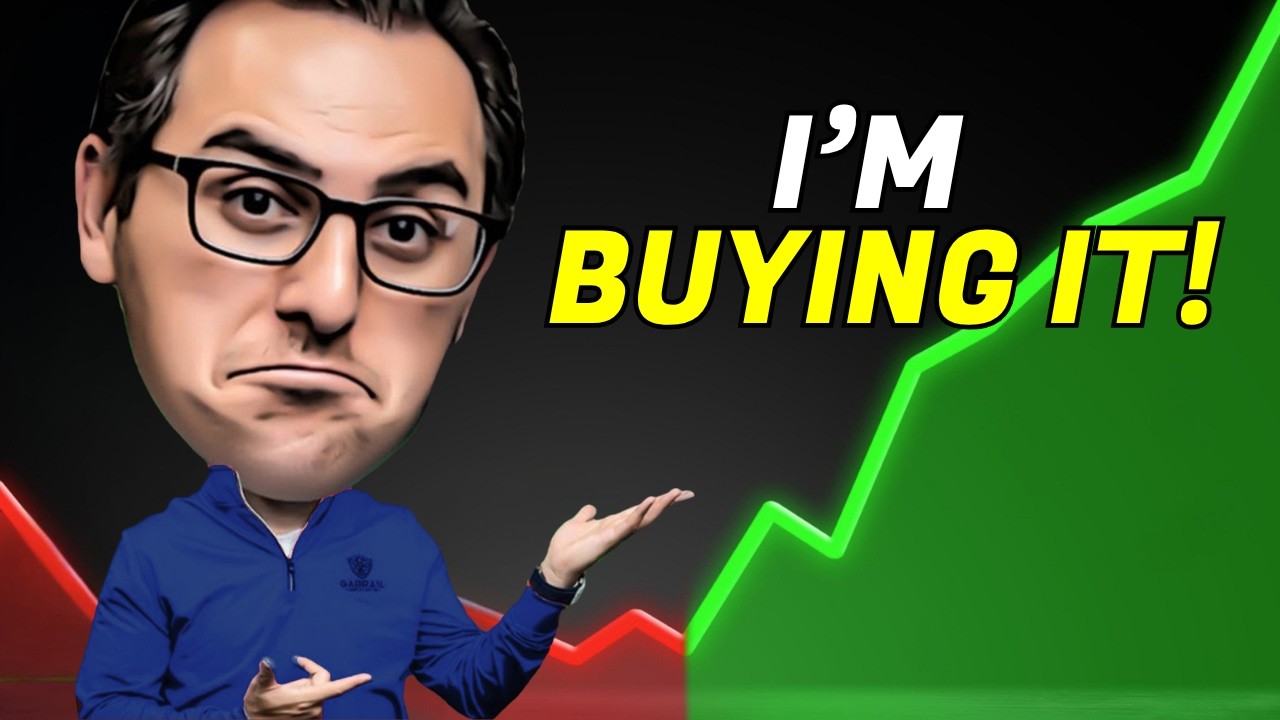
I'm Buying the Most Hated Stock in the Entire Market Right Now

- Rendement de la vidéo
- +4,98%
- Appels
- 3
- Achat / Vente
- 3 0
- Publié
Recommandations
L'entrée est le cours de clôture de l'actif à la date de publication. Le cours actuel est la dernière clôture enregistrée.
-
Entrée $247,90 30 juil 2026Actuel $267,10 07 août 2026Résultat +$19,20
guess what? I'm buying.
Contexte “The company is Adobe. Yes, the company behind Photoshop... and guess what? I’m buying.”
-
Entrée $247,90 30 juil 2026Actuel $267,10 07 août 2026Résultat +$19,20
I own Adobe.
-
Entrée $247,90 30 juil 2026Actuel $267,10 07 août 2026Résultat +$19,20
So, I'm happy to be the one being greedy.
Transcription Complète
There is one stock right now that Wall Street absolutely despises. Famous investors are publicly betting against it. Everyone is convinced that artificial intelligence is about to wipe it off the map. It might be the single most hated company in the entire market, and guess what? I'm buying. Is it possible that people are just dead wrong? Well, we're going to take a look at both sides from the bulls and the bears and find out who might be right. So, let's start with what happened because the fall has been absolutely brutal. The company is Adobe. Yes, the company behind Photoshop, Illustrator, Premiere, and Acrobat, the software that basically every designer, photographer, and video editor on Earth uses has been absolutely crushed, down huge from all-time highs. It's down about 66% where we stand right now versus all-time highs, but it got even worse recently, down almost 75%. So, why did fall? Two things stacked on top of each other. First, there was a massive sell-off in software stocks in general after a huge bull run. The whole group of subscription software companies, the ones called SaaS, which is software as a service, fell out of favor all at once. But, the second reason is what caused all that, and it's aimed straight at Adobe, artificial intelligence. Here's the fear in plain English. For decades, if you wanted to make a beautiful image or edit a video, you needed Adobe's powerful, complicated software, and you needed a real skill to use it. But now, new AI tools can spit out a finished image or video from a simple typed request in seconds for almost nothing. So, Wall Street looked at that and basically decided AI is going to make Adobe software absolutely useless. Who needs Photoshop when you can just ask a computer to make the picture for you? And when the market decides a company's future is in danger, it sells first and asks questions later. And that's exactly what happened to Adobe. But here's the wild part and I want you to sit with it. The business has continued to grow the entire time the stock was falling. The stock just recently dropped 33% year-to-date even as Adobe posted quarter after quarter of record sales and record profits. Stop and think about that. The price collapsed while the actual business got better. That's your very first clue that this is probably more of a fear story, not a broken business story. And fear stories are where patient investors can go shopping and make a killing. And guys, it's not just nervous traders. Some smart respected investors have lined up against Adobe. Let me give you one of the loudest voices. A famous investor named Terry Smith, who I respect immensely, runs one of the biggest funds in Europe. His concern is blunt. He basically said, "I can't see how they're going to make money from AI." His point is that Adobe doesn't own the powerful AI engines underneath it. So Adobe might end up paying other companies for the AI while its own customers just expect those AI features for free inside the subscription they already pay for. In other words, higher costs and no extra money coming in. Then after that, Terry expressed another concern. A while back, Adobe tried to buy a hot up-and-coming design company called Figma and offered a jaw-dropping $20 billion for it. Smith's take was that they'd be worried about what that reveals. Their point, if Adobe was willing to pay $20 billion to swallow a young competitor, then maybe Adobe itself is scared of these new modern tools. Maybe they see a threat coming that they can't simply build their way out of. Guys, a guy I respect very much named Gary, he talked to me and said, "Paul, it's very clear that Adobe's business is worse." I get why he's saying that, a slower growth rate. But for me, guys, this is something that we've seen countless times across a lot of industries. And don't get me wrong, I do think about the AI issue here. Is Adobe going to be able to adapt quickly? So, I want you to hear that I have other people in my ears telling me the same thing. So, let's be fair and lay out the full bear case, the three biggest reasons someone might think that Adobe is in real trouble. And I want you to take these seriously because they are not dumb or flippant. Bear case number one, AI could change what people even need. Think about how you use software today. The old way is you open Photoshop, you carefully edit this image. The new way with AI might be just make me five finished ad designs that match my brand. You see the difference? In the new world, you don't really care much about the tool anymore. You just want the finished end result. If that's how it goes, the value could slide away from Adobe's apps and toward whoever owns the AI brain doing the work. Adobe could add all of the AI features in the world and still lose simply because people need fewer of its programs, fewer seats, and fewer hours inside its software. Bear case number two, and this one might be the scariest. Adobe could lose the next generation. Right now, professionals are deeply locked in, but the real danger isn't today's pros. It's the teenagers, the small businesses, and the social media creators who are starting out right now on simple, cheap, easy phone apps, and who may never bother to learn Adobe at all. Adobe is surrounded by these newer rivals, web and mobile-first design apps, dead-simple content tools, brand new AI-first creativity apps, and slick presentation platforms. If an entire generation grows up creating without Adobe, then over time Adobe keeps its aging customers, but slowly loses future. It quietly becomes the software your parents used. It might even be featured on one of those progressive commercials about becoming an adult. Bear case number three. The AI math might not even add up. Adobe loves to brag that its new AI products already bringing in over $500 million a year. That sounds big until you realize it's less than 2% of Adobe's total recurring revenue. Meaning that building and running AI is wildly expensive. So, here's the nightmare scenario. Customers expect the AI features for in free inside and what they already pay for. Adobe's costs to run all that shoot up and the AI lets people get by with fewer subscriptions and the new AI money stays small. Put it all together and AI can actually squeeze Adobe's profits instead of growing them. Okay, that's the scary side and it is real. None of those statements I made right there do I even disagree with. Those are actual concerns. But, here's where it gets interesting because for every investor betting against Adobe, there's another sharp one quietly buying it. And this is where I think the market is missing some key points. Start with Michael Burry. Yes, the guy from The Big Short, the ultimate skeptic. He is actually long Adobe, means which means he's betting on it. And his argument is beautiful. Large language models, no matter how advanced they get, will never beat that creative instinct of a talented human being. In plain English, AI can crank out content all day, but it can't replace real human taste and creative judgment. And Adobe is the workshop where talented humans do exactly that work. Then you've got Oakmark, a legendary value fund which flatly calls Adobe's Creative Cloud the de facto standard for both professionals and students. Translation, it's the default. It's simply what everybody uses and what every student learns on. And maybe my favorite, Monish Pabrai, one of the sharpest value investors alive. He recently said that the established software companies, he He to names like Constellation Software and Adobe actually have a big head start and a real advantage in this whole AI shift and that they're far more likely to benefit from it than get killed by it. And he added, "The market is likely dead wrong about them. Let that sink in for a second." Now guys, those weren't even bull cases. Here are the three reasons that I think Adobe's going to be just fine and maybe a whole lot better than fine. Bull case number one, Adobe has a money machine that buys it time. Last quarter, Adobe pulled in about 6 and 1/2 billion dollars of revenue and the vast majority of that is steady, repeating subscription money that shows up like clockwork every single month. It turned that into over 2 billion dollars of profit and over 2 and 1/2 billion dollars in cash in one quarter. Guys, that's a financial fortress and here's why that matters. Adobe doesn't have to guess the AI future perfectly on day one. That river of cash lets it pour money into AI research by other companies, give away free apps to pull people in, and buy back its own stock all while easily surviving any mistakes along the way. In fact, it just used that cash to buy a company called Semrush to beef up its marketing tools. It keeps rolling out free and cheap apps like Express to hook the next generation and it is buying back its own shares hand over fist when they're cheap, which right now they're absolutely cheap in my opinion. Weak companies die during big changes. Rich ones adapt. Adobe is very, very rich. An example I'd give is, people don't know this, Blockbuster's obsolete, but Blockbuster was making major headway on their Netflix streaming version. They were killing it and then what happened? The financial crisis. Because they had a lot of debt, they were buried because of it. They were doing great on streaming. If it wasn't for the financial crisis, you might be watching Blockbuster instead of Netflix right now on your TV. But it was the financial crisis and a bad balance sheet that hurt them. Bull case number two. Adobe doesn't just sell tools. It owns the entire workflow. This is the big one that people miss. Photoshop, Illustrator, Premiere, Acrobat. They're not just separate little apps. They're one connected system that professionals and whole companies build their entire process around. Your files, your fonts, your brand assets, your team's approval steps. It all lies inside Adobe. It lives there. So, sure, some AI tool might do one simple thing that Photoshop does. But replacing your company's entire design, video, and document system? That's a nightmare almost nobody wants to go through. Adobe isn't just an app on your computer. It is the operating system for professional creative work. And don't forget, Acrobat and the PDF. The way the entire business world signs, shares, and manages documents runs through Adobe, too. That's a second giant moat that most people completely forget about. And bull case number three. AI might actually make Adobe stronger, not weaker. Adobe is stuffing its own AI called Firefly directly into inside all of its apps. Because here is the thing. A professional needs way more than one pretty AI image. They need layers. They need precise control, brand consistency, the right file formats, and everything that plug neatly into the rest of their work. Adobe does all of that and has a great weapon for big businesses. Adobe trained its AI on properly licensed material, so companies can use it without the fear of getting sued over who really owns the image. A large company will happily choose the safe, legal AI over a sketchy one every single time. And here's the early proof it's working. Adobe's AI products already crossed $500 million dollars year and more than tripled in just 12 months. If Adobe gets this right, AI isn't the thing that kills it. It's the next giant upgrade that makes customers use it more and pay even more. And guys, kind of a fourth bull case, people are worried about AI. Adobe for creativity, a new way to create with Adobe now in Claude. And guys, they do have open AI deals well with chat GPT. One time recently I was trying to make an image in Claude or chat GPT and it literally said to me, we recommend you go to Adobe for this because we're not the right place for it. And I was like, "Huh, that's interesting." Now guys, before we dive in, I want to remind you, never take our title or thumbnail literally. We're never here to give a stock tip. I own Adobe. Doesn't mean you should own it. We're here to teach a process that you can apply to your own stock picking and that might include Adobe. But we're here to teach that process so that one day you can apply it to your own investments and sleep better at night because you know how to value a stock, make good assumptions about its future, and understand the price you're paying relative to the value you're getting. So here is the entire fight boiled down in one sentence. Is AI a substitute for Adobe, something that replaces it, or is AI an enhancement, something that makes Adobe even better? The bears say substitute. I personally lean towards enhancement and I'm also leaning towards people are probably overreacting. And here's another key fact that both sides keep forgetting in all the shouting. While everyone argues about the future, Adobe's actual business is growing. Revenue is up 13% year over year last quarter. Its AI products, as we said, have more than tripled year over year. And its recurring revenue, which is a subscription money that essentially locked in for a year, now sits at over $27 billion with management still guiding for more growth. This is not a company falling apart. It's a company being priced like it is falling apart. And that gap right there is where opportunity could live. So feelings don't make you money. So, let's stop guessing, run Adobe through a process, and see is the juice worth the squeeze? Cuz remember, price difference change the entire investment thesis. So, guys, here's Adobe. It's down at 227 right now. Like I said you before, all-time high 700 bucks almost 5 years ago. So, high returns on capital, 36.7%. The reason I jumped to that already is this is the sign of a high-quality business in a moat. I usually start with the price of the company, which is $91 billion. Yes, the share price is just the market cap divided by the number of shares, but the next thing I do is I go to my enterprise value, 104 billion. That difference of 13 billion is essentially their debt. Guys, last year they made $10.3 billion in free cash flow. They made almost enough in 1 year to pay off all their debt. It is hard for companies that have very little debt relative their cash flow to go broke. All right, no dividend, which I love. Guys, it's selling for nine times free cash flow. Nine times. Another thing I love is their net income is less than their free cash flow. Everybody's going to focus on their net income, and even though it's still cheap, 12 times earnings, 8.9 times free cash flow is better, and that's the true lifeblood of the business. Consistent profit margins over the last 10 years. Guys, look at this. 90% gross margin. That means every extra subscription they sell, 90% of it is basically profit before overhead and taxes. So, they have pricing power in the sense that if they had to drop their price a little bit to gain back some business, they have the ability to do that. And guys, not much in acquisitions, but look at that revenue growth. 11% a year for the last 3 years. Guys, the AI boom started over 3 years ago, and they still grew 11% per year. Five 11.9% for the last 5 years, 17% for the last 10. Our community members have it as a buy rating. So, let's go to the eight pillars. It is an eight-pillar thriller. This does not mean buy it. But, it just tells you they're buying back shares, cash flow, net income, and revenue are up. It's selling for a low multiple, high returns on capital, low debt. What else do you want? To me, it's just about is this the right price or not? But, that takes making assumptions about the future. So, speaking of which, let's go look at the analyst estimates. Analysts have the profit going from $24 a share to 44 over the next 7 years. Guys, that's that's not a dying business right there. And revenue growth of 26 billion to 46 billion over the next 7 years, which is essentially high single-digit revenue growth every single year. Yes, it's not 13 or 14% and yes, does that mean the business is worse, the business is worse. But, has the price dropped enough to more than justify that? Now guys, I want to remind you, if this is overwhelming, you're not alone. The reason I created this channel was to simplify all this cuz investing, the hard part is the stomach, not the numbers. We're here to help you on both of them. In order to do that, the first thing I need us to do is be speaking the same language. So, going back to here, all these key metrics here, I have an absolutely free PDF that will send you all these key metrics, their definition, how they're calculated, why they're important, so you and I can speak the same language and you can become better at understanding companies. So, click the link in the description below or in our first pinned comment and download the PDF right now absolutely for free. And guys, now it's time to go see what is the company worth based on my assumptions. That's why I go to our stock analyzer tool. This is where I blend the story and the numbers together to make assumptions about the future and it'll then tell me this is the price you need to pay for those assumptions. So guys, first off, I did a 10-year analysis. Next, I'm going to observe the other than input here that the returns on capital are getting better. That's really good for a company that everybody thinks is dead. Next, what are my revenue growth assumptions? Guys, I went lower than analysts. I said 3, 6, and 9% revenue growth. Keep in mind, this is less than half what they did last year. Next, profit margin and free cash flow. Because free cash flow is the real lifeblood of the business, I'm going to focus on this one. I did 37, 40, and 43. Keep in mind, the last 10 years they did 39. So, I'm not being egregious by putting in 40 in the middle. Next one. What is the PE or price to free cash flow I would assign to this business 10 years from now? Well, it's a high-quality business as we see from returns on capital. It has a real good stronghold in the in the in the market. So, I look at this saying, "Once they get past this AI crap, they're going to deserve a premium." I put an 18, 21, and 24. And then finally, what's my desired return? Guys, as you can see here, I only put in 9%. That is not the return I want. That's purely my intrinsic value no margin of safety return. But you got to put a higher return than that cuz if not, just buy a low-cost ETF. For the But for the purpose of doing these videos, I do this now at 9%. Now, this is the part where I want you to really hear. Because what we just did with Adobe, stripping away a lot of the fear, looking at the real numbers, finding out what the business is actually worth, that is the entire game. That's how you stop guessing and start investing with confidence. But here's the thing. We do this every single week inside our community at everythingmoney.com. Not just Adobe. 4,000 stocks, 5,000 stocks a year. Earnings reports, news. Every time the market panics and everyone's running around screaming, we are in there together, running the numbers, finding out if it's real trouble or just noise. And I want to tell you a quick story because it matters. A while back, our own Dalton looked at Micron, a stock that nobody wanted to touch at the time. He ran it through the analyzer, liked what he saw around $90 per share. And he shared it with the community. People thought he was missing it since it wasn't Nvidia and Palantir. Fast forward, that stock has gone up 14X return for some people in our community. Now, I'm not telling you this to brag about Dalton or say he's giving a stock tip. He's not. But he showed his process. He showed the process that he does here at Everything Money like we all do. The same process you're watching right now. The same tool we use every single day inside the community. It's learning how to think for yourself so you stop making scared emotional decisions with your money. Now, I do need to be up front with you. We limit the number of spots in the community. We always have and we always will. We don't want it to become some massive water-down thing where nobody gets value. On top of that, I mean this, we have major changes coming that are going to make everything inside significantly better. So, if you've been sitting on the fence, this is the time. Lock in today's price. Lock in today's tools and benefits because once those changes roll out and the doors close, you're not going to be grandfathered in and the and today's opportunities will be gone. So, I ask you a question. What is that worth to you? What's it worth to you to be able to invest with clarity? To cheer on stocks falling? To be able to sit there and feel calm when everything feels irrational? If that's worth anything less than a dollar a day for you or multiple dollars a day, I don't know what to do for you. You're probably not going to do very well investing. But if you're willing to invest in yourself at a dollar per day, click the link below, try everything. The analyzer, the community, all of it. Because it clicks the way it clicked for thousands of other people in the community right now and you're going to wonder why you waited so long. All right. So, let's get to the results on Adobe right now. I hit the analyze button. The stock is a currently at 227. I have a low price based on free cash flow 400. High price of 890, middle price of 595, which means if my middle assumptions occur, I can expect a 23% return. Guys, my 3% growth rate I have a 17 and a half percent return. Is the juice worth the squeeze? Guys, I'm not telling you that I'm right on Adobe. What I'm saying is if I have 30 companies that are like this, then I'm going to do pretty well. Now, for me, I want a 15% return. Doesn't mean you should, but I've got a lot of real estate, a lot of businesses, so I don't need to I want to be very picky on the stocks I buy and don't need to jump on things just to make 12%. So, for me, my price is 15% and guys, my return is that, I'm already there. How incredible is that? That's why I'm interested in Adobe here. So, why am I buying one of the most hated stocks in the market? Because when I strip away the fear and look at the actual business, I don't see the company falling apart that everybody else sees. I see a wonderful company, huge profits, deep moat, a mountain of cash being sold at a scared down price because of something that might happen. The market is prob- pricing an apocalypse and guys, don't get me wrong, that could happen, but like I said, I'm looking at it going every single time I've seen that in history, it tends to not pan out that way. Could I be wrong? Absolutely, but I urge you to do the work yourself to see what could happen. The bears could turn out to be right and that's exactly why I demand a margin of safety and only buy at a price that protects me even if I misjudged it. But at today's price with a business that's strong, I think the crowd is making a mistake. Now, people would ask me, Paul, what would get you to change your mind on Adobe? If all of a sudden I see the business declining, not just decreasing growth. If the business is clearly and steadily declining in revenue and profit consistently over a while. That's what would get me go, "Okay, AI is much bigger than I expected." So, right now everyone is fearful about Adobe. So, I'm happy to be the one being greedy. That's the entire game. Buy wonderful businesses when they're hated and cheap, then be patient. That's how you win in this market. So, if you want to see how a beaten-down hated stock can quietly turn into one of the biggest winners of your entire life, I made a whole video on finding these exact kinds of opportunities. The stocks that can multiply your money 10 times over. It is the perfect next watch after this one. So, click it on your screen right now. Thank you for your time.
Commentaires 0
Connectez-vous pour rejoindre la discussion.
Se connecterAucun commentaire pour l'instant. Soyez le premier à partager votre avis !