
- Rendement de la vidéo
- -2,41%
- Appels
- 4
- Achat / Vente
- 4 0
- Publié
Recommandations
L'entrée est le cours de clôture de l'actif à la date de publication. Le cours actuel est la dernière clôture enregistrée.
-
Entrée $71,61 03 août 2026Actuel $70,47 06 août 2026Résultat −$1,14
We have Uber Technologies and Door Dash, my two most recent buys on my portfolio reporting this week.
-
Entrée $200,50 03 août 2026Actuel $209,16 06 août 2026Résultat +$8,66
We have Uber Technologies and Door Dash, my two most recent buys on my portfolio reporting this week.
-
Entrée $416,25 03 août 2026Actuel $408,17 07 août 2026Résultat −$8,08
We have S&P Global. I do own this company and I like the situation of S&P Global better.
-
Entrée $135,80 03 août 2026Actuel $123,01 07 août 2026Résultat −$12,79
what makes me confident enough to continue my investment in it
Contexte And what makes me confident enough to continue my investment in it is I do see the fundamentals improving.
Transcription Complète
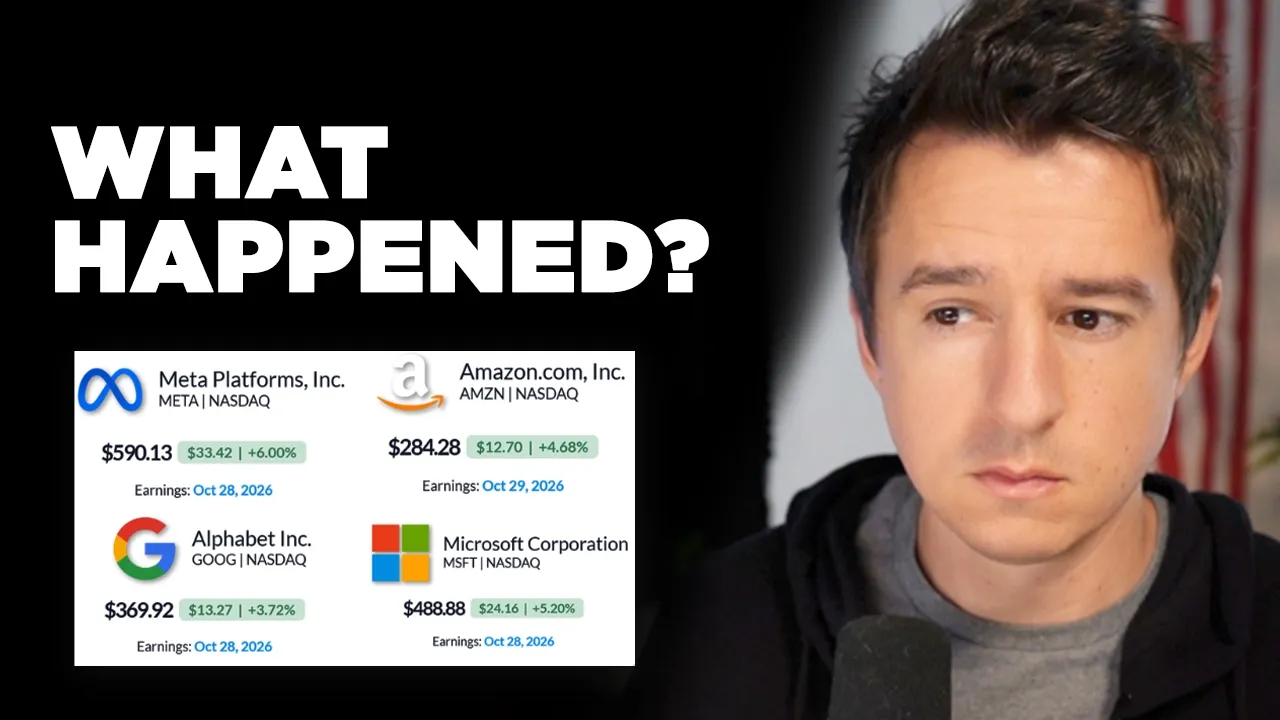
Welcome back everyone. Today on the Jel Carlson show, sentiment is changing rapidly for the big hyperscaler stocks. The ones that are spending on all the capex, the companies I've invested into, these ones are going up and they're going up quickly. They're being led by Amazon and Amazon is the primary driver here. Amazon has now reached $285 per share. It's up 5% on the day and Amazon is racing upwards. In fact, in just the past five business days, it's up 23%. That makes up for almost all of its gains this year. It's up 26% year-to date. Now you can see this massive spike. Microsoft also put up a great report. It was up 16% on the day. Now it's up an additional 5%. Completely erasing all losses for the entire year of 2026. So Microsoft was struggling. People are concerned about it. All of that's changed in the past one week. Then we also have Google, which investors surprisingly sold off after they released an incredible earnings report, but the stock is starting to get a lift again from Amazon's report. It's up 3% on the day. We also have Meta. Meta is another one that investors didn't like the report. They sold it off afterwards, but this one's getting a lift. It's up 5.5% on the day. And I believe a lot of this comes down to Amazon's report. Amazon is lifting up Meta. It's lifting up Google. It's making investors think twice about the whole AI capex spend. And this all actually makes sense because there were some parts of Amazon's earnings report that were so outlandishly good that the market is still trying to digest it. They're still trying to take in what really happened in Amazon's report. So, we're going to be taking a second look at it. What really happened to Amazon this last quarter? Why are investors now bidding up any stock that seems somewhat similar to Amazon? Now, of course, we have a lot of other stocks to talk about in this video. many that have recently reported earnings as well as ones that are going to report earnings this week. We have FICO that reported earnings and the stock continues to struggle. It's down near $1,000 per share. It could end up under it. I'll be going over what I think the big problem with FICO is. We have S&P Global that reported earnings. We have Palunteer. They're going to report today. We have Uber Technologies and Door Dash, my two most recent buys on my portfolio reporting this week. We have everyone's favorite, Dualingo. And we have Texas Roadhouse, which has been an unstoppable stock. And then finally, we have the biggest bull himself, Tom Lee, giving his explanation of why 2027 will be the best year in the stock market. So, there is a ton to get to in this episode. Let's go ahead and jump in. Now, before we get started into this, just a reminder that I created the website qual.com for investors like you, for people that follow this channel because it has everything that you need. It has stock analysis tools like the insights page. It gives you rundowns of companies. We have advanced chart builder so you can look at any metric that you want. We have earnings calendars and watch lists and portfolio trackers and so on. It also has Qualrum Studio which is like a Netflix that we built for investors with deep dives, ask me anything, exclusive content. I'll be releasing a huge portfolio update this week over an hourong video. And of course, you get access to the Discord community that has thousands of like-minded investors. And you get all of this for $10 per month. And you can try it out risk-free with a free trial at qualim.com. Now, like I've outlined, there's a vibe shift going on in the market. These companies that were talked about as though they're making some huge mistake by many market participants, which are the big capex spenders, are now seeing a resurgence. There is a chase to get back into these companies. People are tripping over themselves to buy shares today. Quite literally, they're they're jumping up hundreds of billions of dollars a day in market cap. Microsoft moved up 16% in a single day. This is a company over $3 trillion market cap. Amazon just recently surpassed $3 trillion today in market cap. It wasn't long ago that these companies were talked about by many people. Prominent bears, people like Michael Bur and many others went on making arguments against these big tech companies that their enormous spend into capex was weakening their economics, weakening their moat, making these companies less attractive, comparing them to the telecom companies of the past. But now we see this complete shift going on and everybody's changed their mind seemingly over just the past week. And I believe there's a couple different drivers behind this. Microsoft did great and I think that's certainly a part of it is how good Microsoft did. But I would say that the biggest driver behind this recent rally is Amazon. It wasn't after Microsoft reported that Google and Meta went up. It was after Amazon reported. Amazon did something in their earnings report that was spectacular. When we look at CNBC's reporting, they say that shares of Amazon hit an all-new high on Monday, putting its market cap over the three trillion threshold for the first time following a better thanex expected earnings report last week. Now, with CBC's reporting, it can give you the expectations that Amazon just beat their earnings estimates by a little bit and that's why the stock is up. But that's not really what's going on. The biggest thing that happened this last quarter is AWS. The growth rate of AWS has actually been incredible. It continues to accelerate. Now, this is something that I've talked about for a long period of time. In fact, if we go back 10 months, here's a video that I made. This is on September 5th, 2025. It's called Amazon's Growth is About to Explode. In this episode, I was doing my analysis on why I was so bullish on Amazon in 2026. And I want to highlight one part of that analysis. So, obviously, if this did happen, if Amazon did reacelerate AWS back up to 25% over the next three or four quarters, that'd be huge for the stock. we'd see the stock climb dramatically. It'd go up to 240, 250, 260. Amazon today would be dramatically undervalued if that happens. Now, of course, I love a good told you so where I was confident that AWS would accelerate growth and that would cause the stock to ultimately be undervalued at the time, and that appears to have happened, but I can't take full credit because the numbers that I say are in the range of accelerating up to 25% growth, and AWS has far surpassed those numbers. I underestimated it to a huge extent. The rate at which this behemoth is growing is actually incredible. If you take a minute to really look at the numbers here, this last quarter outlines a a story that's so convincingly good that even the biggest bears are having trouble here. AWS's revenue grew to 36.7% year-over-year to 42.2 billion. Its fifth straight quarter of accelerating growth and the fastest quarter growth in 18 quarters. AWS's annualized run rate has now reached $169 billion. Now, to get some comparables of how big this actually is, if we compare it to Netflix's revenue, for example, Netflix is at 48 billion. So AWS is over three times the size of Netflix in revenue and growing like three times as fast. And we can compare it to Tesla, for example. The whole company, we're just comparing AWS against all of Tesla. And it's over 70% bigger than Tesla. Tesla's generating hundred billion. AWS is at that 169 billion revenue run rate. So it's substantially larger than Tesla and Tesla is obviously not growing super fast. AWS is. So this one aspect of Amazon is three times the size of Netflix, nearly double the size of Tesla and it's growing much faster and it has higher margins. That's one aspect of it. When we even compare it to a company like Bergkshire Hathway. So we have Bergkshire Hathway here at $375 billion. That's still a ways off. So AWS is about half that size, but based on their growth, it won't be long until AWS is bigger than Bergkshire. It could actually get there quite quick. If it grows at its current growth rate, then it gets there at 2029. And in fact, AWS is actually going to accelerate growth next quarter. But I don't think even those assumptions are needed. Even if it grows at a rate of 25%, it'll get there in 2031. It's only a matter of time until AWS is bigger than Bergkshire Hathaway. This company, just this aspect of it, is a treasure. It's a treasure on planet Earth. There's not much like AWS. The scale and size and growth rate combined is one of a kind. And we have reason to believe that it will continue growing quickly at a very brisk pace for at least the next number of years. When we look at the backlog, it continues to go up faster than their actual revenue growth. Year-over-year, it's up 154%. Now, the backlog is $496 billion. And this is customer commitments going up while they're fulfilling on them as fast as they are. So the revenue growth is there. And Andy Jasse for the first time said that AWS is likely to become a trillion dollar revenue business. Now, of course, there's CEOs that throw out big promises and things that seem impractical, but in this case, I believe Andy Jasse, he has the numbers to back this up. It's real. The customer commitments, the growth rate, the secular trend that they're on, it's very practical. And while all of this is growing, we get to the best part here. It's growing profitably. AWS operating income was 16.6 billion with operating margins of around 39%. Margin expansion driven by efficiency gains, capacity optimization, and broader use of custom silicon and network gear. So, as they're growing this fast, margins are going up, operating margin is increasing. What an incredible combination. Amazon is giving you everything you could possibly hope for. The company's growing way faster than expected. The backlog's growing faster than expected and the profitability is higher than expected. The AI story is playing out. Management sees a strong linkage between AI and the core workloads. As AI grows, it drives higher demand for compute, storage, and databases. The backlog growth is already embedded in AWS capacity and capex planning, and it supports visibility into substantial demand through at least 2028. They believe that all the things that they're constructing that will come online throughout 2028 is already committed to. So even 2 years out, they have customer commitments for those things that will come online at that point in time. This is visibility and demand that investors could only dream of years ago, but they're getting it in this company today. Now with Amazon's breathtaking report in combination with Microsoft's, we have investors really reconsidering their thoughts on these companies and the future of them. Now, investors are racing to the entrance to get in on these stocks at higher and higher prices. This has caused my portfolio to race up near all-time highs. It's moved up quite a bit today. The passive income portfolio is at a million $30,000 with $374,000 in gains. Now, we have a lot of companies moving in the right direction. Mastercard has actually moved up big over just the past couple of months. Meta was down 30 plus,000. Now, it's down $24,000. It's moving up down 14%. And even Google, which has done great historically, but it went through a little bit of a glut, is now moving up as well. This one is now back to $70,000 of gains in this account. Microsoft back up to an $80,000 position in the passive income portfolio. $37,000 of gains here. When I look at the story fund, Amazon has now crossed the point of being a $200,000 position. It's $27,000 total with $82,000 in the green. So, Amazon's now a massive part of my portfolio, but it still lags behind Google. Google's still over Amazon at $223,000. Amazon again is at 207. So, right now, Google and Amazon in my portfolio are in a neck-and-neck race to see which company can be a bigger position. And I feel good about having both of these positions be heavily overweighted. Now, throughout last week and into this week, we also have some companies that reported earnings that haven't fared quite as well. For example, we have a company that so far I don't own and I've never owned, which is FICO. But FICO has been a company that's been circling around for a while. It's FICO has such a dominant market share in its respective credit business. And you'd think the stock would be doing well, but it's actually down 32% this year. In the past year, it's down 18%. FICO was running up big for a while. It got up to $2,300 per share, and now the stock has traded down. And with this last earnings report, it wasn't enough to change investors opinion on the direction of the stock. You can see it's down 7% today. Investors are still skeptical of it. There's a couple things driving FICO stock price down. One of them is simple valuation compression. The PE ratio on a trailing basis reached 100. A PE ratio of 100 is fine so long as investors are not fearful of anything in the future. But it becomes a problem to support these high PE ratios as soon as there's any amount of fear in the stock. And there has been a lot of fear introduced into the stock over the past year. The primary fear being that the regulatory moat has been eroded substantially over the past year. They no longer have the same regulatory protections that they once had as well as the new introduction of a competitive dynamic between them and their distributors. And then they started the butttheads. And now there is a full-on war that is hurting both of these companies. Both companies like Equifax and FICO have gone down substantially as they battle it out and become more competitive. And investors are not fully convinced that FICO deserves the premium that it once had. That FICO is as predictable as it once was. So they're now pricing it at a more skeptical valuation, one of a 22 Ford PE ratio. So fundamentally things are fine with the business. It still continues to grow profitably, but it is facing a new dynamic and investors are pricing in a new risk. looking at other options of I believe similar companies. We have S&P Global. I do own this company and I like the situation of S&P Global better. Now, S&P Global is not growing as fast as FICO, but it also doesn't have the same level of risk. It's not as concentrated of a company. It's not as reliant on one thing going well. And SMB Global is not growing super fast, but it actually is accelerating its growth. The revenue grew 11% year-over-year when you factor out the spin-offs. Though even without Mobility Global, their organic revenue growth is 11%. The ratings business is doing incredible along with Moody's. It's growing quickly. They own the S&P Dow Jones indices, which is an incredible business. Market intelligence, which is the part that investors are focused on the most, grew by 6%, subscription revenue increased by 6%, 9% growth in volume. So, they're actually growing in the amount of customers that are using the service and it continues onward. S&B Global has very efficient growth, super profitable. When their revenue grows by 11%, their earnings per share grow much faster. So, I'm still bullish on this one. I like the earnings report. Now, we also have today Palunteer reporting their earnings. I'm not going to have the data to be able to go over this one by the time they report, but I'll be looking forward to talking about this one more later this week. Now, we get into two companies that I do own that are reporting later this week. We have Uber and Door Dash. And I bought both of these companies about a month or so ago. And I bought them as a split buy, meaning I put an equal amount into each stock at the exact same time. I wanted to buy both of them as kind of a a paired buy. So we have the positions right here in the passive income portfolio. Uber's down just a hair. So it's down 2%. Door Dash is up 15%. So we're up at $3,000 on Door Dash, down $400 on Uber. Now I have an extensive deep dive into both of these companies in my exclusive video. So if you want to look at that, you can check it out. But overall, what I'm doing is I'm buying into these companies as a way of getting into this incredible network that they've created. For example, when we look at Door Dash, a lot of people don't realize how big Door Dash is in the United States. They have around 60% market share of food delivery within the US. That's big. That that's already a dominant mode. But not only that, they're expected for that market share to grow. They're expected to go from 60% to 70. So they've already cemented a lead and they're further cementing that lead in the future. That's going to create a dominant unbreakable moat of food delivery within the United States and that has to be a valuable business. This we're talking about getting food delivered in the US that has to have a lot of value long term. So I find Door Dash very intriguing. I believe it's a new thing that many investors consider a waste of money because it is expensive to have delivery. You can save money by picking it up. But I believe as people continue to gain wealth, GDP per capita goes up and food delivery costs go down that it will become more and more common. And I believe that a lot of people really value convenience over anything else. And Door Dash represents convenience. We look at Uber as well. Uber is a combination of both ride sharing and food delivery. They're competing on both fronts. Now, I don't think that Uber is going to win with Uber Eats within the United States. They'll be competitive. they'll be big. But I think that Door Dash has won food delivery in the US. But Uber is becoming highly competitive with food delivery outside of the US, especially in Europe. They have a good chance of dominating Europe. And I I really think that they they might pull far and away with the acquisitions that they're doing. Now, the ride sharing has more concerns about it. Many investors concerned about Whimo and all the other robo taxis. We have Zuks. We have Tesla in the game. We have all these companies saying that they're going to be doing ride sharing. But the market for ride sharing is incredibly huge. This is a massive market. The thing that I would compare it to is it's a bit like looking at Visa and saying that Visa is not going to be a successful company because there's Mastercard and because there's American Express and because there's PayPal and because there's a transfers and all different ways to move money and Venmo and uh the Cash App, right? There's lots of different ways to move money around, but Visa is still really big and makes a lot of money. Uber does not need to control 100% of the market to be a fantastic investment. It just needs to have a pretty dominant network and be really big, and I believe it will be. Also, in terms of the robo taxi scare, I believe that Uber can solve this problem by simply having them in-house. There is going to be suppliers that will supply robo taxis that work well. Uber will pay for them. and they'll buy them and license the technology and then they'll have them within their own fleet. So, I believe a lot of that will come down to Uber finally getting to that point, which I believe they will. But granted, both of these companies are on the side where they're higher risk. There is more downside with these companies. These are companies that are facing lots of hurdles, lots of regulatory burdens, lots of competition right now. So, as this plays out, I think we'll have a lot of hurdles along the way. But, I feel good about both of these companies going into this earnings. I'm looking to see big growth in the amount of deliveries for Door Dash, the amount of rides for Uber. Scaling is the name of the game. We're not looking so much at profits this quarter. We're looking at scaling. I expect to see Uber 1 members continue to grow. If they give an update, I think that's going to go up. I expect to see the Dash Pass continue to grow. Now, they don't report this every single quarter. They give landmark updates, but I think this is growing. Dash Pass is a great value for people that use Door Dash frequently. So, overall, I expect continued scaling by both of these companies. They're in growth mode. They need to continue their land grab. Now, moving on, we get to everyone's favorite stock, which is Dualingo. Duelingo is reporting earnings this week, and I still hold all of my shares of this company going into this week. In fact, if we look at my position here, we have Dualingo in the story fund is a $33,000 position $13,400 in the red. So, I'm down $13,000 on this stock. Now, just a note about this and what I think is actually great about this is the asymmetry of stocks. If you invest well, this is the type of thing that should happen. You should have situations where not every company is going to be a winner, but the winners make up for your losers. Peter Lynch, for example, only had around six out of 10 of his stocks actually go up. The other four went down. How did he get 30% returns over 13 years? Well, the ones that went up went up much more than the ones that went down went down. That's the asymmetry of stocks. many of his companies he made 10 times the return his initial investment on it which made up for other stocks going to near zero and we see that same type of situation with Duelingo. Many people talk about this like it's my worst investment ever. Okay, so let's just say Duelingo is the worst stock that I've invested in, you know, my biggest blunder, the worst case scenario. Duolingo is it that's the that's the bad decision Joseph made was investing in Dolingo. Well, I'm down $13,000 on it. My portfolio over its lifetime has generated over $500,000 in gains. So $500,000 in gains. And my biggest mistake is cost me $13,000. That's what's great about investing. That's the that's the situation that should happen. You should never build a portfolio that can collapse because of a single stock. So you can see that asymmetry playing out with companies like Google or Amazon. I'm making hundreds of thousands of dollars in gains. and my worst mistake, the the worst stock ever has cost me $13,000. Now, having said that, I also believe that eventually there is a solid chance that Duelingo actually becomes a profitable holding. There's no guarantee of it. There's actually a lot of risk attached to this company because it's a small market cap company, highly volatile with a lot of bearish takes and opinions on it. So, I'm not 100% confident of Dualingo. But what makes me confident enough to continue my investment in it is I do see the fundamentals improving. And I've also noticed something with this company. If you haven't used a Dualingo app in a long time, you probably have a outdated view on the app itself. Dualingo has been infusing their app with AI to make it far more advanced. For example, learning a language historically was a lot of filling in things like little sentences where you type in something or you fill something in. You weren't speaking a lot. Now with AI, you are constantly speaking and talking with the characters in Dualingo. They get you to talk and they talk back to you. They converse with you. It uses AI to accomplish that. And that's one of the biggest flaws of Duolingo historically that they've fixed that they're making the product far better. That will take time before it works its way into the metrics. The product improves and then the metrics will follow suit over time. So I see that aspect improving as well. Now, the risks of this company is that even though it's fallen down in stock price, it still trades at a healthy valuation, assuming a good amount of growth and operating leverage. So, there is still downside for Dolingo if the metrics continue to look bad and if they don't reinstill confidence into the investor base. Now, finally, we get to Texas Roadhouse reporting earnings this week, and this stock is on a roll. This stock cannot be stopped. It's now at $211. It's also a big dividend payer. It's at all-time highs, up 24% year-to date, not counting the dividends. We have Texas Roadhouse in the portfolio already. It's a massive winner. It's one of my best positions, one of the best investments that I've ever made. Currently, it's a $61,000 position, $53,000 in the green. And I'm still bullish on Texas Roadhouse. I still believe this company is worth owning because it is a compounding machine. It's one of the best restaurants in the world. I think it actually is the best operated one in the world. And there's still a continued long runway for growth. So heading into these earnings, I expect to see very strong earnings from this company. I think it's going to be good. The expectations are higher. The valuation has moved up, but I believe they're going to post strong results. Another thing I'll mention about Texas Roadhouse is they're putting up these numbers which are tremendous and they're growing fast in a time period where beef is incredibly expensive, where employees are incredibly expensive. You have employee inflation and beef inflation at the same time. When those factors improve for Texas Roadhouse, we have an incredible margin expansion story. So, I still believe that there's actually a lot of catalyst moving towards this stock, I expect it to go higher. Now, finally, we get to Tom Lee, who unsurprisingly has a bullish call on the market, believing it will go up potentially the most next year, that it could be one of the best years ever. Let's go out and listen to what he has to say. You know, I think August is a month to recover what how June and July have been sort of flat months, but earnings have >> earnings estimates have gone up a lot. So, the stock market's kind of a coiled spring and then we had a huge deleveraging as you're talking about because of the AI unwinding Korea's policy makers panicking. So, I I think the markets could actually rebound strongly this month. Like maybe we get to 7,800. this month, the 7,800. >> Yeah. For the S&P. >> So, he believes this month is going to be a good month, but the rest of the year after this month could be a little bit rocky. And then he explains why he believes 2027 is setting up for one of the best years ever. Because as we start to look at 2027, there's a lot of the clouds that are heading this year kind of lift. You know, the SpaceX unlock will be behind us and the market testing of the new Fed will be behind us. So, I I think and then of course there's already been a leverage unwind. So I think 2027 could be one of the best years for the stock market. >> So he mentions a couple factors here that SpaceX will continue to have that unlocked throughout the rest of the year. That'll put downward pressure on the stock market this year as SpaceX continues to sell off more and more shares. Uh but he's saying we'll get that behind us this year as well as we're going to get behind us the new Fed and the dynamic of that this year. So when we're heading into 2027, we have a lot of positive momentum with earnings growth. We have a couple bad factors already behind us by that point and it should set up really well for 2027. Now, I I hope so. I optimistically believe so, but I don't think this is the strongest case for an entire year rally. I think that this is more just looking at the bright side of it. The reason that I'm bullish going into 2027 is because the companies that I'm invested in are all structurally incredibly strong and they have continued demand going throughout 2027. These same numbers that you're seeing with all these hyperscalers, all the demand, all the monetization that they're having, we're just going to see more and more of that throughout next year. So, that's going to be it for this episode. Hope you enjoyed. See you in the next one.
Commentaires 0
Connectez-vous pour rejoindre la discussion.
Se connecterAucun commentaire pour l'instant. Soyez le premier à partager votre avis !