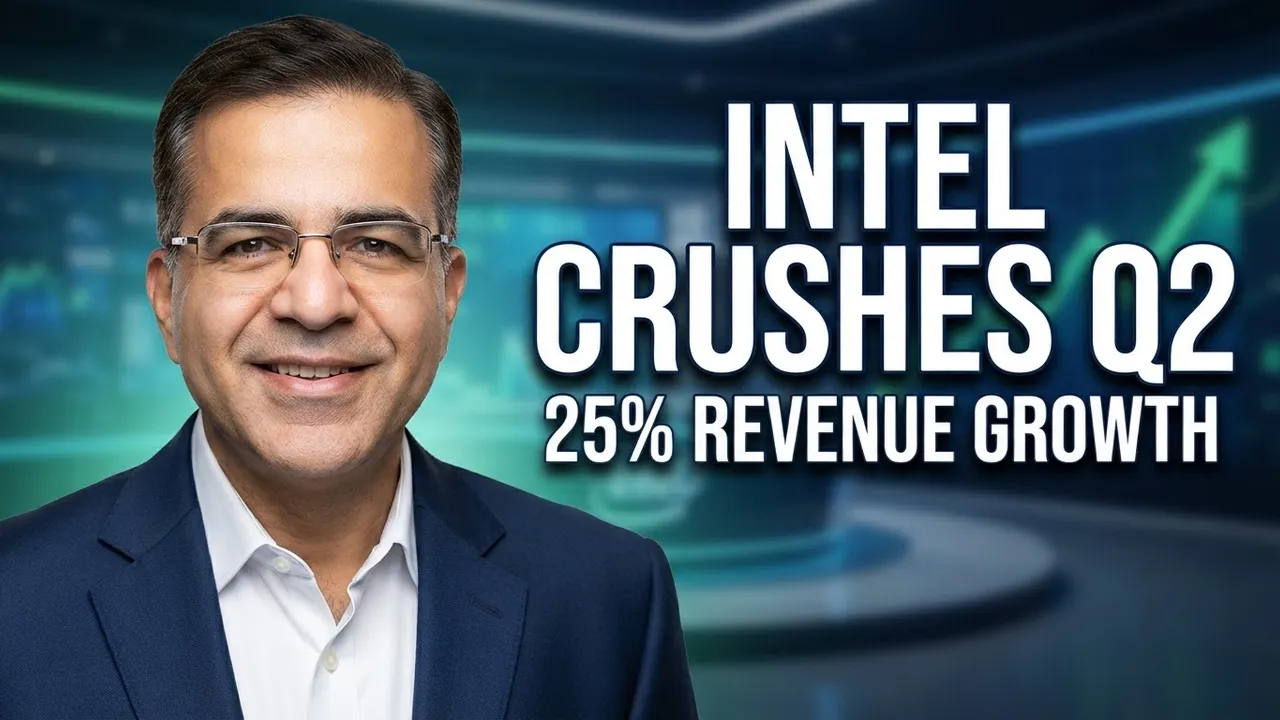
Intel Crushes Q2 | Here's What's Really Happening

- Rendement de la vidéo
- +9,68%
- Appels
- 1
- Achat / Vente
- 1 0
- Publié
Recommandations
L'entrée est le cours de clôture de l'actif à la date de publication. Le cours actuel est la dernière clôture enregistrée.
-
Entrée $91,00 03 août 2026Actuel $99,81 06 août 2026Résultat +$8,81
as we look at the potential for leverage and earnings growth, we think their earnings would probably quadruple over the next three to four years.
Contexte ...it is possible that Intel looks expensive, but as we look at the potential for leverage and earnings growth...
Transcription Complète
Plus the raised CapEx and how we can think about CapEx as CapEx being spent to meet demand that they are seeing right now. >> Yes, thanks Melissa. So I think what last night's earnings show is that Intel is not just standing on the sidelines. It's actually actively participating in this AI infrastructure buildout in two very important ways. The first way that you mentioned which is their strength in their core server CPU business almost 59% versus last year. You know, this is the fastest growth rate that they are seeing in the last 15 years. So very very notable and a big part of this growth rate is not just units. They are actually mixing up the quality of their products. So a lot of the strength that they are seeing is because of the better products that they are shipping. And of course because the CPU, right, their core product is finding a very strong place in this agentic AI deployment. So that's kind of the first box they checked. The second very important box they checked is dropping a lot more hints about the fact that they are getting closer to announcing more deals in their external foundry business. And you know, right now there is a shortage of everything in semiconductors, right? There's a shortage of wafers, there's a shortage of substrates, there's just a shortage of leading edge capacity and Intel is the only US-based player in the leading edge capacity. So the fact that they are able to improve the manufacturing yields right now of their 18A process and then in the future of the 14A process and signal, right, that they are going to raise CapEx. I think those are all very positive signs. >> There's a narrative going on this morning post earnings Vivek that they have short-term momentum to hand off to achieve the long-term growth. Does that merit a 100 forward PE on Intel when just and I know they're in different areas of the chip stack, but Nvidia is trading at a fifth of that. >> Sure. Now I think that that's a fair point. You know, Nvidia is definitely kind of you know, less expensive. It's a more compelling valuation, but I think Intel is a very different story in that there is long-term strategic value to Intel's US-based manufacturing assets. Right, there's only two or three companies on the planet that can make leading edge and right now we are extremely dependent on Taiwan Semiconductor. So, the fact that Intel is getting better and providing a domestic option for making these leading edge chips. I don't think that can be ignored. Now, it is going to take time to play out. It's not going to get ready overnight, but the fact that, you know, the Intel which is being led by the very prudent management team that they are willing to devote more capital resources, they are doing more strategic hires. They recently hired the ex-CEO of SK Hynix to really shore up their efforts in advanced packaging. I think those are all very good signs. So, I agree with you on a very near-term basis, it is possible that Intel looks expensive, but as we look at the potential for leverage and earnings growth, we think their earnings would probably quadruple over the next three to four years. >> Did you get much color on the the 10 long-term agreements that they were talking about on the call with customers and and how much of that is price locked and how much of that is volume locked and and if it's take or pay? >> Sure. I think Melissa in in semiconductors, you know, enforcing these agreements is is always a problematic. So, the core is that, you know, one needs to believe that the AI build-out is going to be very strong over the next few years. One has to believe that Intel will continue to make progress in their manufacturing. I think as long as they do those things, I think long-term agreements serve as some level of commitment, but I don't think there are perfect guarantees for anything in in in semiconductors. But, the fact of the matter is that everyone is short of supply. I mean, if we step aside and take a look at, you know, Google's recent earnings, I believe they were they used the word, you know constraints I think like eight or nine times on on the call. So that tells you that this build out is for real. This build out is happening across multiple customers, you know, the top five in the US along with neo clouds, along with sovereign, along with enterprise. So there is a very broad-based infrastructure build out and everyone wants to make sure that when they are spending these hundreds of billions of dollars of capex, there is actually reliable supply to back it up. So I think whether it's Intel, whether it's Micron, I think everyone in the supply chain is benefiting from this longer term agreement and alignment with their customers. >> And I know Vivek, this was a moment in time, but when Alphabet announced that it was raising its capex, the next day we did see some of those sort of the spend beneficiaries go higher, but not able to hold on to gains. Is there a concern that that the that these stocks will stop rising even on the back of increased capex? >> Yeah, I think it the scrutiny around return on investment is very natural. I think it is very justified. You know, at the same time we are also going through this summer period, you know, after a quarter where the semiconductor stocks went up over 80%. So I think some give back is natural. You know, of course we are seeing all the tensions in in the Middle East and what they are doing to interest rates and a lot more of this infrastructure is going to be funded by debt. So I we we understand a lot of those concerns, but I think it's important to realize that for the top hyperscalers investing is critical for their ability to grow. Without these investments, it'll be harder for them to grow and more importantly, they are going to be exposed to the disruption risk of somebody like an open AI and Tropic who are coming after a lot of those businesses along with a lot of the 60 other neo clouds who are coming after those businesses. So I think spending from the hyperscalers is both kind of offensive in nature, right? It's helping them grow faster, create new revenue. It's also
Commentaires 0
Connectez-vous pour rejoindre la discussion.
Se connecterAucun commentaire pour l'instant. Soyez le premier à partager votre avis !