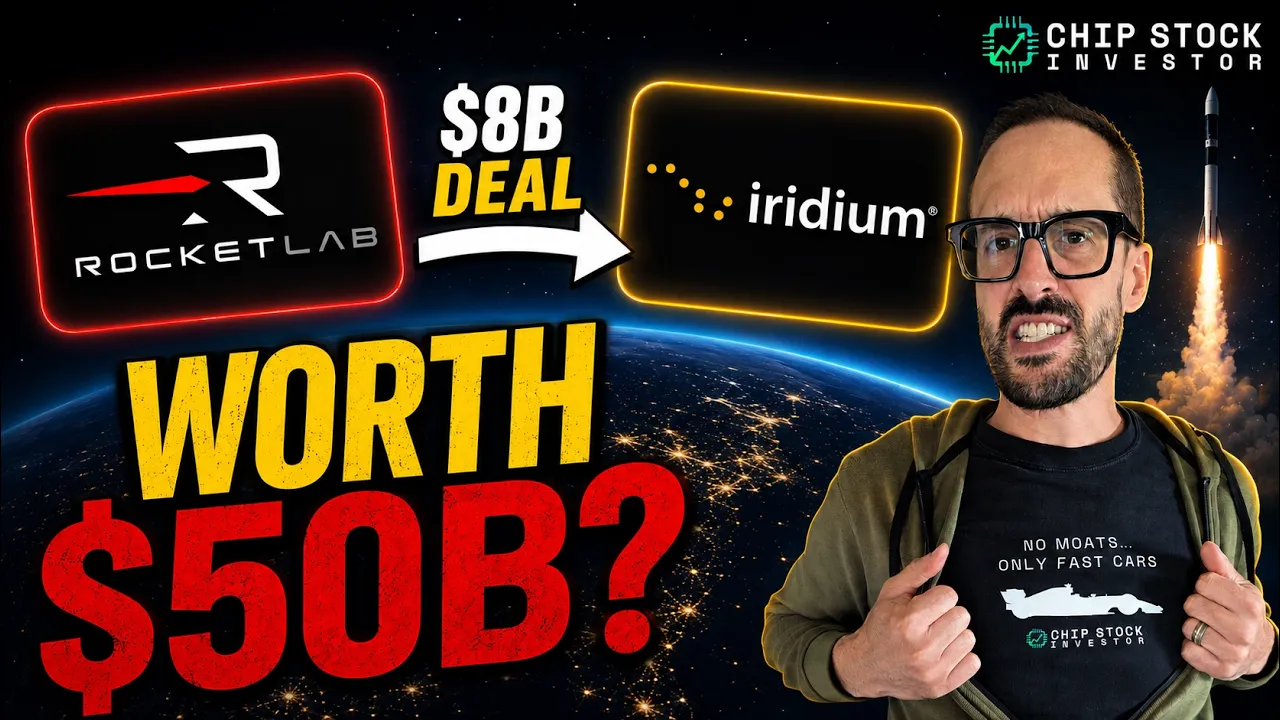
Rocket Lab Buying Iridium: Genius Move or Overpay?

- Rendement de la vidéo
- —
- Appels
- 2
- Achat / Vente
- 2 0
- Publié
Recommandations
L'entrée est le cours de clôture de l'actif à la date de publication. Le cours actuel est la dernière clôture enregistrée.
-
Entrée $82,83 07 août 2026Actuel $82,83 07 août 2026Résultat +$0,00
We're interested in maybe nibbling on this here within the next couple of months on Rocket Lab, just so we at the very least have a tracking position in the portfolio
Contexte “We're gonna remain patient here. We're interested in maybe nibbling on this here within the next couple of months on Rocket Lab, just so we at the very least have a tracking position in the portfolio...”
-
Entrée $34,59 07 août 2026Actuel $34,59 07 août 2026Résultat +$0,00
Same goes for MDA Space after their sell-off
Contexte “Same goes for MDA Space after their sell-off.”
Transcription Complète
It's been well over a year since we did
our Rocket Lab deep dive and a follow-up in the first half of 2025, and the pending
acquisition that Rocket Lab proposed to take over Iridium Communications
is, we think, a pretty big deal. It's noteworthy. Let's talk about that. Though we missed Rocket Lab during
the big sell-off, the tariff tantrum in March 2025, it's still on our
watchlist, so we're interested in seeing where this goes, interested
in the space stock sell-off overall. MDA Space, one that we did a
review on last month, catch that. That's also on our watchlist too. Let's take a look at this. Just by way of brief review,
Rocket Lab is building itself into a vertically integrated hardware
and software/services business. They make various components
for space vehicles. They offer the manufacture of
space vehicles and satellites specifically for their customers. They also have that infrastructure there
in the middle with launch services. The Electron rocket is their workhorse. It's a small rocket. It can handle small payloads. And the Neutron, they're
still working on that. They're being cautious in getting that
ready for perhaps by the end of 2026. But we like that they're
being cautious about that. That is a mid-range rocket that can
handle much bigger payloads, and will put them in more direct competition with
SpaceX and its mid-sized launch services. SpaceX's Falcon 9 rocket specifically. So that's just a brief overview here
of the space economy supply chain. We like these types of companies that can
vertically integrate from everything from data and components at the bottom, at
the base of the economic hierarchy, all the way up to end products and services. And Rocket Lab has obviously said for a
while now, it eventually wants to have its own satellite constellation, providing
space-based services and communications and data services to customers. So acquiring Iridium Communications,
which has been around for a long time now, makes a lot of sense. It's similar to what Amazon is doing
with the acquisition of Globalstar. Now we have alluded to this in recent
weeks, that Rocket Lab acquiring Iridium would essentially help
it catch up to SpaceX's Starlink. But let's get a little more nuanced
in that because, what Iridium offers is not actually the same
thing as what SpaceX Starlink does. Starlink especially targeting individual
users, households, small businesses, users that need high bandwidth internet wherever
they may travel, wherever they may go. Iridium, when it launched its next
gen services in the mid to late 2010s, that's when we owned Iridium through
the early 2020s during the launch of that using SpaceX, and then the
initial commercialization of that. Iridium marketed itself as the highest
performance text, voice, and data services that could span the entire globe. And obviously that would appeal to
the maritime industry, aviation, and they have been successful in
launching a number of deals with that, including a sub-segment that offers air
traffic control services to airports. They have a subsidiary called
Aireon, that handles that. And the biggest customers that would
be interested in Iridium satellites are various government entities as well. So they provide all sorts of things, IoT,
services, asset tracking, basic data. We'll get into why that
is here momentarily. But before we do, we just wanted
to go through our investment thesis checklist on the research dashboard. If you haven't used this
yet, we hope you'll try it. We have a really big update
coming out around September 1st. So if you're already a
Semi Insider, take a look. We welcome your feedback. If you're not part of Semi Insider
yet, definitely check that out. You can get access to that
over at chipstockinvestor.com. But we wanted to revamp our
investment thesis checklist on Rocket Lab combining it with Iridium
Communications, the Iridium business. Some of these have already
been enforced for Rocket Lab. It's why it's been on our watch list. Industry secular growth trend, check. Absolutely. Sales cycle length seems to be
quite long or countercyclical. A lot of Rocket Lab's deals are
with government agencies, and those deals tend to perform quite well,
equate to revenue regardless of the overall strength of the market. But this last one in our qualitative
analysis metric hierarchy, niche advantage or breadth and depth company. When you pair Iridium services at the
top of the economic hierarchy with everything Rocket Lab does already, the
ability to build satellites and systems for its customers as well as launch them
into space with its infrastructure, now we have a company that is maybe less
niche advantage within the space economy and more a company that has actual
great breadth and depth in what they can offer to their potential customers. So that gets a check for us as well. Moving to the quantitative metrics, this
is where there are a lot of questions that will come up for Rocket Lab, a
standalone business, or if you want to consider Rocket Lab plus Iridium
on a pro forma basis, either way. So revenue, industry average or better? Yes. Rocket Lab growing at a very nice pace. That is one of the reasons
why the stock has done so well in the last year and a half. Revenue has been increasing
and accelerating. In Q1 2026, revenue was
up 63% year over year. That compares to the mostly
mid 30% range that the company reported for most of 2025. So that first box is a pretty easy green
check for us, but we have questions about the scalability of the operating margin. Is it growing? Yes, they have been making some progress
towards breakeven, but we need to revamp that and incorporate iridium into the mix. Free cash flow, you know, the company is
focused on growth right now, so obviously it's free cash flow negative, but can
they get to that sustainable breakeven point and eventually start scaling
to 20% free cash flow profit margin? Per share profit, of
course, that's also out. The company's not reporting
profit in absolute terms. On a per share basis, it's
also not going to be scaling. And then the balance sheet, this
one's also pretty clear-cut. This used to get a green check. They used to have net cash. After they finish the iridium deal,
they are going to flip to net debt. They're going to be purchasing Iridium for
$8 billion in a combination of new stock issuance and a cash component as well. So they're going to have to take
out additional debt to do that, and part of that they're also going
to pay for with cash on balance. So for the immediate future after
the Iridium tie-up, Rocket Lab will no longer have net cash on balance. That could be okay if the
company continues to scale up its profit margins over time. So Iridium, a satellite constellation
that is now approaching a decade old. Rocket Lab has hinted that it is
going to be involved in designing and deploying the new next generation
Iridium satellite constellation. The existing low Earth orbit
constellation of about 66 satellites will probably continue to operate
and provide some fantastic returns for Rocket Lab after they finish
the acquisition, including this. A lot of investors have been super
interested in this direct device communications functionality being
talked about quite a lot from companies like AST SpaceMobile. Pretty much everybody in this business
wants to be able to offer this, and there's a lot of technology advancements
happening to make this possible. But Iridium, just using some
software-based updates to its existing constellation, is going to be able
to offer this this year from their existing low Earth orbit, LEO, L-band
spectrum satellite constellation. We'll talk about what L-band
here is in just a second. So offering this later this year and
continuously improving this capability is another big reason why Rocket
Lab is probably interested in the Iridium satellite constellation and
the technical team that has been able to pull this off with some satellites
that are, not the newest, not the most cutting-edge hardware in orbit. But let's break this down. What exactly is up there in
orbit around the Earth? Well, Iridium has LEO, low
Earth orbit, constellation of 66 satellites plus a handful of spares. This is different from a
geostationary orbit constellation, that stays fixed in orbit above
the Earth a much further distance. And paired with L-band frequencies,
L-band spectrum that Iridium has, they're able to offer this highly reliable,
always-on service for text, voice, and some data no matter where the user may be. So if they're part of the maritime
industry on a ship in the middle of the ocean, if it's some exploration
mission in the South Pole in Antarctica. Or some government agency that's tracking
personnel or assets in the middle of nowhere, in the middle of a desert,
this is where Iridium really does well. Now let's talk about that L-band spectrum. This is a slide that we made last
year when we were talking about NVIDIA's investment in Nokia,
talking about 6G development and what it offers over and above 5G. But we can actually reuse this and
talk about these different bands of spectrum for the satellite industry. When we're talking about these different
bands, primarily we're discussing gigahertz mostly on the lower end of
this spectrum, radio spectrum, where the wavelengths are fairly long. Some of these frequencies are inching
their way towards microwave wavelengths. But what is it exactly? L-band, which is what Iridium's
constellation primarily uses when communicating with its users at
sea or on land, this is in the one to two gigahertz spectrum. So this is not the most advanced stuff. This low frequency is not able to
handle some of the high bandwidth applications that let's say Starlink
is able to offer, which primarily operates in the K band spectrum. Some newer next gen services are also
applying for V band all the way there at the bottom left of this chart. As is the case with all
things engineering, there is a typical trade-off here. The lower frequencies like the L band
that Iridium primarily operates in because those wavelengths are so long,
it does a really great job of cutting through atmospheric interference. It can penetrate buildings. The trade-off is lower bandwidth. So satellite-to-satellite
communications on Iridium also operates in the K band spectrum. But when communicating with users on
Earth, L-band is fantastic at best because their network is designed for reliability. A lot of the innovation happening
though is in that K-band spectrum with higher frequencies offering
higher bandwidth and higher real-world actual throughput of data. So that's where all this talk comes in
of being able to offer true broadband internet direct to devices, or in some
cases just an outright replacement for traditional terrestrial-based internet. That's what Rocket Lab gets in Iridium
Communications, and no doubt they are probably going to be developing
and eventually launching some higher performance satellites to build out a
higher performance constellation, more data services, not just the highly
reliable voice and text and basic data services that Iridium currently offers. So we like this move. It builds Rocket Lab into a true
vertically integrated business with a lot of future options and the ability
to launch those new services into orbit at an increasingly lower cost as
they work on their rocket technology. But let's talk about some of
the financials of this deal. This is where we get a little bit
more nervous, even after the big Rocket Lab sell-off, and think, there
could be some more downside perhaps. Either way, if this is a bottom
for Rocket Lab, we're willing to be patient and just wait for that
really great entry point that we'd like to get in a position like this. So back to the research dashboard. Interesting chart. Iridium actually by revenue, the bigger
company, although Rocket Lab is the high growth company, and if these companies
were to remain independent of each other on a standalone basis, Rocket Lab
within a couple of years is probably the bigger business than Iridium is. Iridium, it's been around for
decades, used to be part of Motorola, during the dot-com years,
went bankrupt, has reemerged. Revenue growth is not what's
going on here at Iridium. Pretty stable business with some mature
relationships with its government and with its government entity and other customers. But on a pro forma basis, if you combined
both companies through Q1 2026 on a trailing 12-month basis, they together
generated about $1.6 billion in sales with over half of that, 884 million of
it coming from Iridium Communications. But on a profitability basis,
things get more interesting. Again, Iridium, the mature company, they
are free cash flow positive, two hundred and eighty-eight million generated in
the trailing 12 months leading up through Q1 2026 versus negative three hundred
and sixteen million for Rocket Lab. They've had some elevated
expenses in recent quarters. Not a surprise. They're doing a lot of developments,
integrating other acquisitions. But Iridium essentially buys them some
free cash flow, and once the merger is complete, on a pro forma basis, this
company is very close to breakeven. Negative twenty-eight million
in the last trailing 12 months if you combine the two together. Now, one more look at this tool. I changed the option to
EBITDA, not adjusted EBITDA, just EBITDA on a GAAP basis. The reason why I did this, these are
very capital-intensive businesses. Even today, still in 2026, costs a
lot of money to develop, manufacture, and then launch satellites into orbit. And that says nothing about
operating them on an ongoing basis. So EBITDA helps factor for actual
operating income when you strip out expenses like depreciation. Depreciation being money that was
already spent on the manufacture and launch of the satellite network, but
nevertheless still gets incorporated into the income statement when
calculating GAAP net profit or loss. So on an EBITDA basis, Rocket Lab
negative $173 million over the last trailing 12 months through Q1 2026. Positive $423 million for Iridium. Again, we're closer to 10 years since
they completed the launch of their Iridium NEXT constellation, so they
are in cash flow generation mode. And so Rocket Lab gets that positive
EBITDA once this is complete, and they flip to EBITDA negative to
EBITDA positive on a pro forma basis, $250 million if you combine
these two companies through Q1 2026. Not bad. Obviously not wildly profitable,
but for a company that is very much focused on scaling up its ecosystem,
its vertically integrated business, there's something to be said for that. So whether you want to look at it
on a free cash flow basis or on a GAAP basis, acquiring Iridium
helps Rocket Lab quite a bit. If you're just looking at it
from a profitability and a sustainability standpoint. They get much more financially efficient
and closer to self-sustaining without needing to rely on lots of outside
financing from debt or issuance of new stock into the market to raise cash. Couple of valuation notes. As of this recording, after market
close on Monday, July 27th, if we were to combine these two companies
today, market cap is about 45 billion. We can also look at this on an enterprise
value basis, which also includes Iridium Communications net debt. They had about 1.8 billion in debt
on their balance sheet, as well as the debt Rocket Lab will need
to take out to get this deal done. The enterprise value is
closer to 50 billion. So let's keep that in mind. Trailing 12-month price
to sales ratio, under 30X. Obviously, it's a very high multiple
even after a sizable sell-off. The market expecting this
business will grow at a very fast rate for many years to come. There's that trailing 12-month
EBITDA of $250 million, which means there's a trailing 12-month
EV to EBITDA of about 200X. This is not a value stock. This is very much a high growth stock. This is not a very meaningful
multiple on a trailing basis. This assumes the company overall
continues to grow at a very fast pace and gradually over time, the EBITDA
margins get to a more healthy number. But we do have trailing 12-month
pro forma EBITDA of 250 million, which means we can actually run a
reverse DCF, discounted cash flow. And I've alluded to this in the past, but
you can do more than just solve for stock price with this tool on our dashboard. So I've clicked on the use custom weight
override, loaded up Rocket Lab and just used the custom weight override
and plugged in 250 for 250 million. And what I was trying to solve for in
this scenario was the enterprise value of currently around 50 billion if you combine
Rocket Lab and Iridium together today. What's a scenario that
makes that a fair value? Since this is a somewhat countercyclical,
defensive market, given all the government contracts, I decided to use a 10-year
initial high growth period and then a terminal rate thereafter of 5%. That's probably still a little bit
on the high side, but nevertheless, I think Rocket Lab is one of those
companies that could remain in high growth mode for many years to come. And so then after inputting that, what's
solved for the initial 10 years of growth? What's the average CAGR, compound
annual growth rate, needed to get it to fair value of 50
billion enterprise value today? I got 35% average EBITDA growth
rate for the next 10 years. What that means is if that were to happen,
EBITDA would grow from 250 million to around 5 billion in year 2035, 2036. For reference, SpaceX 2025
EBITDA was just over $4 billion. No matter how you slice it,
Rocket Lab trades for a premium. Getting Iridium into the mix and
creating that services layer in the economic hierarchy really opens up
the revenue possibilities for them and also opens up higher profit
revenue for Rocket Lab as well. So we like the deal, but I'm
not thinking this is exactly a cheap stock after the sell-off. We're gonna remain patient here. We're interested in maybe nibbling on
this here within the next couple of months on Rocket Lab, just so we at the
very least have a tracking position in the portfolio, incentivizes us to maybe
keep tabs on this a bit more closely. Same goes for MDA Space
after their sell-off. We also own that small position in 5N
Plus that we took earlier this year, and that also affords some access to the
space industry, as well as semiconductor stocks in general are just profitable
suppliers to the space economy. No matter what happens with the
development of next-gen rockets, next-gen satellites and satellite constellations,
key semiconductor suppliers will win.
Commentaires 0
Connectez-vous pour rejoindre la discussion.
Se connecterAucun commentaire pour l'instant. Soyez le premier à partager votre avis !