
- Rendement de la vidéo
- —
- Appels
- 1
- Achat / Vente
- 1 0
- Publié
Recommandations
L'entrée est le cours de clôture de l'actif à la date de publication. Le cours actuel est la dernière clôture enregistrée.
-
Entrée $1 212,21 07 août 2026Actuel $1 212,21 07 août 2026Résultat +$0,00
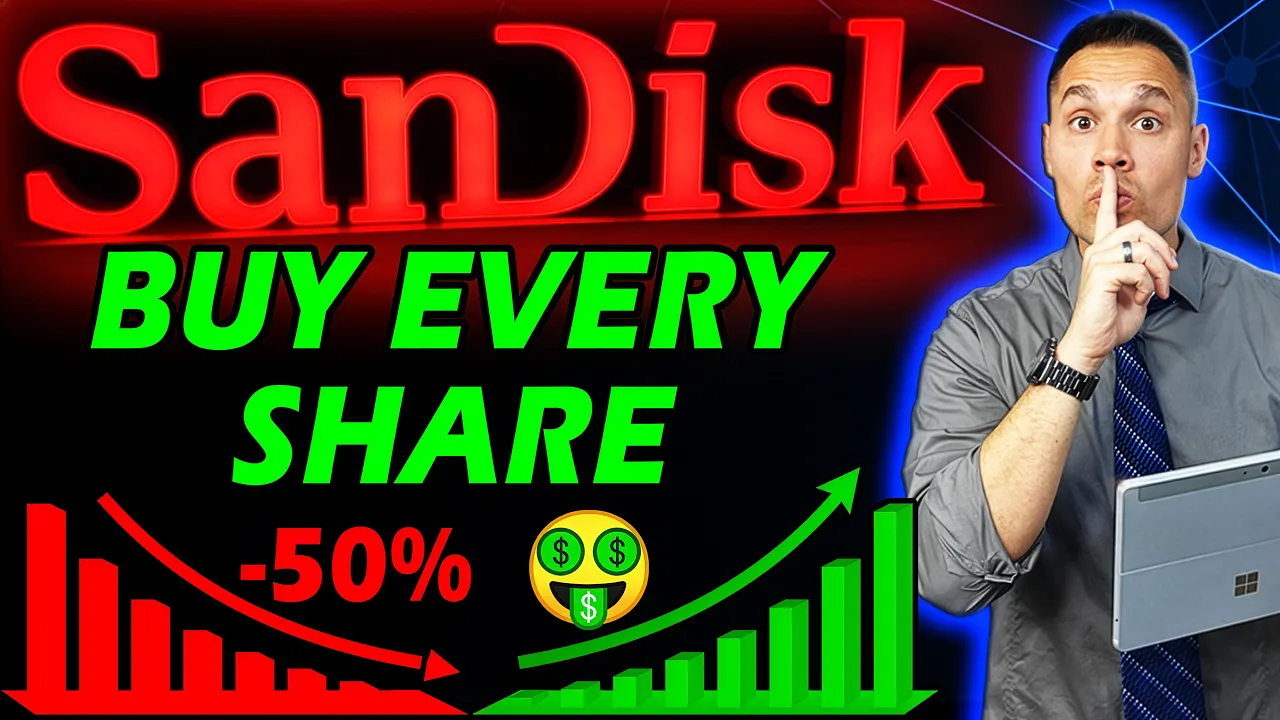
if you ask me to give this an official rating, I would actually rate this a buy
Contexte “if you ask me to give this an official rating, I would actually rate this a buy.”
Transcription Complète
Hey, welcome back subscribers. Uh we've got a quick update for you today about SanDisk stock, one of the hottest stocks in the market this past year. Oh, because they just reported earnings and the stock actually sunk by double digits uh despite posting some pretty incredible numbers that beat Wall Street estimates across the board. And so I've been getting a lot of comments and messages asking me to share my thoughts and if I'm considering buying the dip here too since altogether it's actually lost like over half its entire value really from the highs uh during this giant sell-off that's been going uh been going on. So uh let's pull up the stock chart here. We'll take a look at those earnings. We'll talk a little bit about the business, the crazy cheap valuation. You guys might not believe some of the valuation metrics on this stock right here. It's kind of got a lot of people arguing over it because it is based on gigantic growth that you know some people feel um might not last once supply catches up to demand. But we'll talk a little bit about that too in this video and I'll share my thoughts on all of this. So um hit that like button, make sure you subscribe. Let's go ahead and jump into it. All right. Now, um, as you guys know, this is a stock here that had previously skyrocketed by thousands of percents, um, as one of the single biggest winners of really the entire like AI boom. And that happened since um, being spun out from Western Digital back in February of last year. But more recently, that momentum has completely reversed uh, with the stock having now crashed by around 50% from the very top. And that's a crash really that uh continued here on earnings um despite some blowout numbers with sales easily beating estimates on a mind-blowing 372% growth year-over-year reaching nearly 9 billion. and their profits were just as impressive, if not more so, uh, with net income per share climbing from only 29 the same quarter a year ago, to 23.41 the previous quarter and now 3925, $39.25 per share of net income here um, this quarter. And that also crushed estimates, too, by the way. But it's really crazy to to see that that much growth. And um thanks to all of this new AI demand, well, their margins have, you know, as you expect, now soared through the roof uh with a record high of 85% in adjusted gross margins. Again, now this was driven primarily by all of that surging demand that just left SanDisk with, I would say, like, you know, a ton of pricing power like re, you know, because of the lack of market supply out there that just really allowed them to raise prices as much as they um you know, really wanted to. and it just kind of dramatically improved their margins. And we're just seeing so many chip companies now being able to do that. Just raise prices, improve margins. And so, um, you can see just where all of this growth is, uh, coming from if you break down their segments too here. So, just digging a little bit deeper into the earnings report. So, data center revenue, for example, it's surged by triple digits, uh, just from the prior quarter alone. And um that's really because you know hyperscalers just continue to load up on all of um SanDisk like high bandwidth storage solutions. Meanwhile, their edge segment um which includes storage for automotive, industrial and the internet of things jumped close to 400% year-over-year. Uh proving that you know AI adoption is really broadening far beyond just the cloud. SanDisk is finding you know plenty of customers out there. they are in no short of of customers or and even kind of individual markets to be selling their products to. There's just demand everywhere for them. Now, of course, the only weak spot, as you would expect, is going to be in their consumer um segment, which like you know, it's almost gotten to the point of like who even cares about that anymore? SanDisk is probably sitting there, the management team, the board. They're probably just sitting there thinking like who cares about the consumer? We're just selling to all these companies and we're raking in insane profits. But yeah, the consumer segment now is really it's become just kind of tiny compared to the other two. And it even shrunk further this this quarter. Uh declining by 5%. By the way, I'm not saying that I'm in support of any of that. I'm just saying that that's kind of that's like the reality of this whole AI boom is that uh consumers are just kind of getting left behind. You look at game console prices, you look at computer prices, RAM prices, like consumers are just getting priced out because all of these companies are coming in and saying, "Hey, we'll take everything. we want you to build our specific chips, the things that we need for our um data center for our AI compute and you know the consumer be screwed, right? So that's unfortunately that's like the reality of the situation but um yeah so that's what happened with consumer actually decline focus is of course shifting over now to AI and enterprise data center markets. Now to summarize this uh these earnings were again just absolutely phenomenal and in any other sane type of like market conditions a stock like this should have really like soared on these results and especially at the valuation that it's at because um when you look at how much incredible growth analysts are projecting in the coming years uh their forward P ratio shrinks all the way down to just six and that is like an unbelievably low valuation. In fact, their PEG ratio, okay, that now that's based on like the next 5 years of projected um earnings growth, but it is currently sitting now at less than 0.1. I mean, I don't even know what to make of that. It's 97% lower than the sector median. I mean, that's something that you just never come across. And especially when the company is performing like this incredibly well, right? This is normally, okay, we'll come back to this, but normally this is this is something that when you see a company performing like this, you would expect a very rich valuation. That is not the case of of what we're actually seeing at this moment. Now, again, we'll come back to this here in just a second because there are some reasons or or kind of excuses for for why this is the case. We'll touch on this, but first um let's just talk about, you know, why did the stock even fall on such strong um earnings results? Well, it basically comes down to two main factors here. So future guidance and the more broader kind of excuse is of cyclical fear for again a stock that had already risen by thousands of percent since being spun out. Now on the outlook side of things, SanDisk issued revenue guidance for their next quarter to be between 10.3 and 10.8 billion. But while that would still be a very large uh still be very large growth for the quarter, the midpoint of it would still be about 5% short of the 11.1 billion that Wall Street analysts were expecting. So just shy of what analysts were expecting. And because of that, you know, crazy rally in the stock earlier on, I just think the market was perhaps being a little over greedy here, expecting like absolute perfection in their results, in their guidance, wanting to see everything just phenomenal um without really considering how good everything's actually going and what the underlying valuation really is. Uh I mean the company even announced um a giant $14 billion stock buyback authorization and even that wasn't enough to you know distract the market from the softer guidance. Uh but secondly and and this is the the much bigger reason that also ties to the low PE metrics that we're seeing now um is that the memory chip industry is of course notoriously cyclical historically a very cyclical business and I just think investors are kind of stuck with that same mentality for right or wrong. Okay, I'll let you guys be the judge of that. I'm not like I'm not knocking them for this. I'm just telling you like that this is the case here. This is what investors are kind of thinking that, you know, they're they're basically worried about another downturn to come because they've seen it before, right? When they've seen the cyclicality, they've seen the market rise and they've seen it fall. And so they're kind of waiting for that fall. And they're thinking that, you know, once supply catches up with demand, things are going to change. Now, right now, supply has been so tight that these chip companies have been able to raise prices and just print money like crazy. But eventually those extraordinarily high margins um you know they what they do is they encourage competitors to build new factories and just start flooding the market with alternatives and that does eventually send supply soaring and that causes prices to crash back down kind of like a commodity. Um and that also so the prices come crashing down and and that comes along with the giant um profits that they've been raking in. All of that stuff starts to crash and that's why you have the cheap valuation right now because the market isn't convinced that um this this is going to be different that this that it's not going to happen again. They think it will happen again. In fact, those fears were amplified recently too when a Chinese memory um chip company called CXMT, they went public with a half a trillion dollar valuation. And that's signaling that, you know, even some well-funded foreign competitors could eventually step in too and drive down global memory prices. Now, that's not to say that Sandis doesn't SanDisk doesn't hold a huge, you know, competitive edge regardless. that should help insulate themselves from at least some of this as a leading producer of nan flash memory and highcapacity solid state drives which are excuse me which are great for um AI compute and see AI data centers they have to consume and store uh basically like oceans of data and that's including text image video and they do all of this in order to um of course learn and perform tasks and they want to be able to do it faster faster and cheaper and better. So, it's always you're always trying to upgrade, you're always trying to perform better, you're always trying to raise efficiency, raise performance. And um historically, you know, they would just use traditional hard drives, which are a lot slower but also cheaper. Well, because there's such a big shortage of enterprisegrade hard drives right now on the market because of this AI boom, well, SanDisk drives are now helping meet a lot of that demand. And again, even if there wasn't a shortage, those traditional hard drives would still be, you know, way too slow to keep up with the newest AI workloads that want to keep getting stronger and faster. And the other differentiator for SanDisk is also in how the AI market is shifting into like a new phase as well. See, the early days of AI were all about training these AI models, but now the industry is focusing more heavily on inference, which is when the AI tries to quickly process your prompts to give you an answer in real time. Well, SanDisk's NAND memory chips are some of the best for these specific tasks. In fact, they just announced a major collaboration with the Korean memory um specialist SK Highix uh to help develop industry standards for a brand new technology called high bandwidth flash or HBF. And already we're seeing tech leaders like Google jump on board because these hyperscalers are desperately trying to find cheaper, more accessible alternatives to traditional high bandwidth memory or HBM which currently remains extremely expensive and in short supply across the market. But by establishing high bandwidth flash as an industry standard, well, data center costs can be lowered and the roll out of AI applications, new ones um can be accelerated. As you can see though, it's a little complicated when trying to gauge all of these different market dynamics. But, you know, if it makes any SanDisk investors out there feel better, well, you should know that market research is projecting that uh the AI powered storage market will grow by 24% per year, up from 36 billion last year, all the way up to 255 billion by the year 2034. Furthermore, AI servers are expected to account for 51% of all nan flash demand globally by 2027. And because it typically takes anywhere from 18 to 24 months to actually build and ramp up um all of those new um nan flash manufacturing facilities, well the overall supply of these memory chips is not likely to catch up so quickly to all the surging demand. So this leaves us with the ultimate question. Is the recent crash a warning sign to stay away or is it a devalue buying opportunity? I personally think that it's closer to the latter myself after this sell-off. I am uh still just kind of shocked by the incredibly low valuation metrics. Normally a PE of around six in the tech sector would mean that the market expects this company's earnings to completely collapse in the near future. But SanDisk has actually been taking several steps to protect themselves from that exact scenario, primarily through what they call new business models or NBMs, where instead of just selling their memory chips on the open cyclical market at whatever the current daily price happens to be. Well, SanDisk has actually been locking in their enterprise customers into longerterm contracts that can last up to 5 years in duration. Just this past quarter alone, they already signed three new customers to those agreements, and they expanded their deals with two existing ones, too. As a result, SanDisk now has a minimum of about $94 billion in total expected revenue strictly locked in from these new NBM contracts. And again, that's assuming like the absolute floor in pricing. In other words, unless the AI bubble completely bursts and the market begins to collapse on itself, I just don't see how SanDisk's business could crater by so much to the point where this valuation today would finally start to, you know, make any sense. Right now though, it just simply doesn't. And I think that's pretty objectively true. Now, it's not a stock that I own myself yet, but that's only because I already own so many AI tech stocks that I'm having a hard time even just kind of keeping track of all of them. things are developing all the time and I've got so many of them and they're so volatile that it's been a headache to own so many. But to be completely honest with you, if you ask me to give this an official rating, I would actually rate this a buy. That's just my opinion. I could of course be wrong about this and you should always do your own research and make your own decisions, but that's really what my gut tells me. And look, I wouldn't be surprised at all if I wake up one of these mornings soon and just grab some shares on impulse to dip my toes in because again, when I look at everything objectively, I just don't understand why investors have turned so sour, so bearish on Sandis. Something just doesn't really add up to me. But um now, what do you guys think? Are you buying the dip or do you generally stay away from the cyclical memory chips market at all costs, even if the valuation is so incredibly low? I tend to kind of stay away from it myself, but I am uh I am very very tempted to buy some SanDisk stock. And again, um don't be surprised if the next time we talk about it, I just let you guys know that I did open up a position cuz I I'm definitely thinking about it. Um yeah, let me know down in the comments though how you feel either way. I hope you enjoyed this update. Um and uh we can chat about it down there in the comments. But hope you're all doing well and I will catch you guys in the next video. All right, take care my friends. Bye-bye. >> [music] [music]
Commentaires 0
Connectez-vous pour rejoindre la discussion.
Se connecterAucun commentaire pour l'instant. Soyez le premier à partager votre avis !