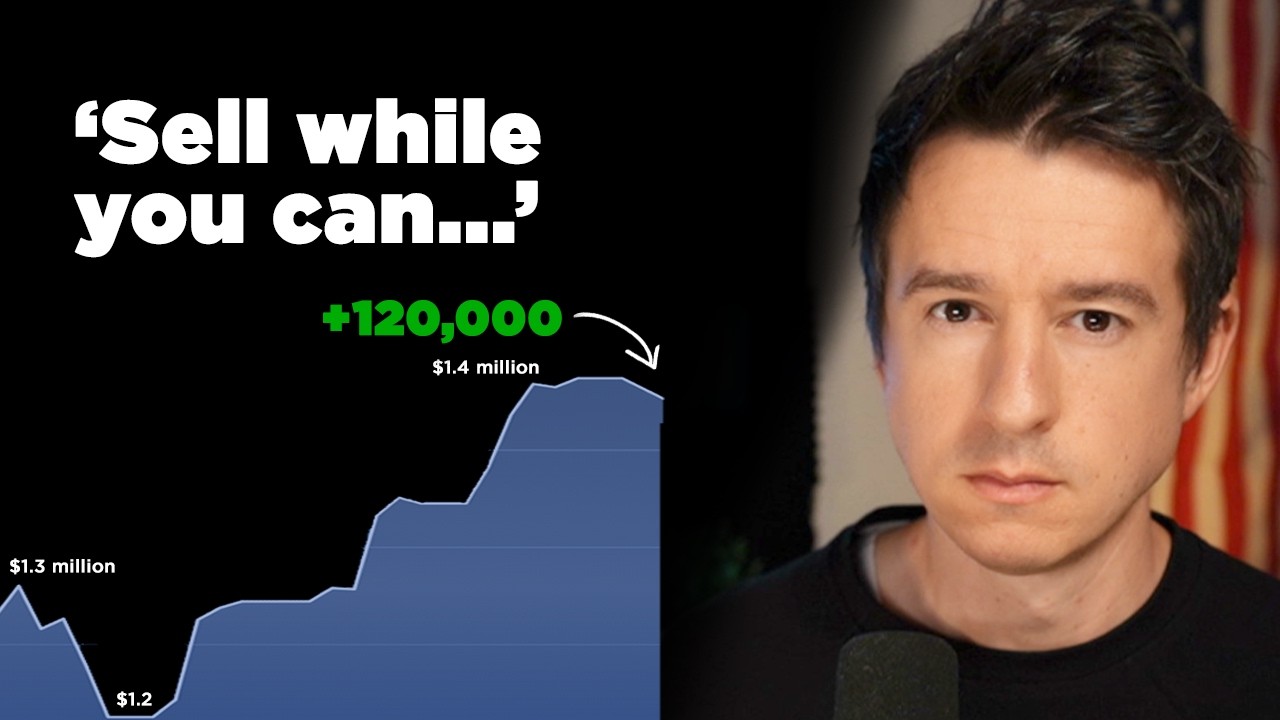
Analyst Warns Things Could Get Much Worse

- Rendement de la vidéo
- -2,78%
- Appels
- 2
- Achat / Vente
- 1 1
- Publié
Recommandations
L'entrée est le cours de clôture de l'actif à la date de publication. Le cours actuel est la dernière clôture enregistrée.
-
Entrée $248,28 20 avr 2026Actuel $262,07 24 août 2026Résultat +$13,79
I've recently highlighted both of these as my top picks for 2026. These are great companies to invest in…
Contexte “Now, as we look at the stocks that I've highlighted recently, two that I've talked about the most this year is likely Meta and Amazon. And I've recently highlighted both of these as my top picks for 2026. These are great companies to invest in based on a lot of their fundamentals, their catalyst, their valuation, their optionality and so on.”
-
Entrée $248,63 20 avr 2026Actuel $276,27 24 août 2026Résultat −$27,64
So, for now, despite the cheap valuations, it's a stock that I continue to stay away from.
Transcription Complète
Today on the Joseph Carlson Show, my portfolio is up $108,000 in the past 30 days. That's right, we've had a massive jump. We'll be going over what's changed, what's really happened, which stocks are moving the most, and we also have some big news. For example, with this massive recovery over just the past couple of weeks, not every investor is buying it. This analyst in particular went on to TV and explained that this is not an easily reversible situation, that things could get much worse. But is he right to be so cautious? We'll be going over the situation and how reversible it really is. Now, we've also been discussing Meta. This is one of my biggest picks for 2026. I bought into a very large position in Meta. It's a top three position in my portfolio, and I've shared bullish news on Meta over and over again throughout this year, making my case for the stock. But like good investors, I like to look at contrary views. I like to look at the bare cases for the companies that I'm invested in. and I found a good one. We're going to be looking at this article. This is by an analyst from Bloomberg. And he systematically details a bearish thesis on Meta that I've never heard before. And no, this is not just that Meta spending a lot on capex. Like everybody else has pointed out. This is an entirely new bare thesis. We're also going to be taking a little walk in the land of software. Software companies like Salesforce and Adobe have been going through an immense amount of pain, but they're starting to fight back. First of all, we have Mark Banoff saying that software bears are all wrong. Every one of them are wrong about Salesforce and Salesforce is making some aggressive moves to address the software concerns. We also have an article here highlighting that the creative software industry has declared open war on Adobe. Salesforce and Adobe are two stocks that are trying to fight back, but can they do it? We also have Netflix that reported their earnings and they dropped 10% the day after earnings. They're down another 2.2% 2% on the day, which brings them down to $95 per share. As a Netflix shareholder, I'll be giving my take on whether or not you should be concerned about this recent earnings report. And then finally, we have a continuation of the fail of the week. Last week, it was that the company Allirds, this overpriced shoe company, decided to turn into an AI company. They announced that they were buying Nvidia chips, that they're becoming an AI company, and the stock went up 500 to 700%. But they started a trend. Now there is MYM. This is a company I've never heard of before, but my copied allirds. The next day they decided to change their name to Mym AI and decided to turn into an AI company. And guess what? The stock went up a lot. We'll be looking at this overall trend of companies rebranding into different companies to boost their stock and the typical outcomes these have in the fail of the week. So, we have a ton to get to in this episode. Plus, if you haven't tried it out right now, I think it's time to give Qualum a try. You've probably heard about it before, but we've had some big updates. You've seen Qualum before. You can research any stock and at a glance, you can see the fundamentals of a company. But now, we've added on something entirely new, which is Qualram Studio. If you click on the studio link, suddenly Qualum transports you into a Netflix-like library. You have an entire organized and structured streaming service dedicated to financial content. And this is all exclusive Qualrum Originals. These are all things that you're never going to find on the public YouTube channel. We have long- form, hour-long earnings reactions to companies like Netflix. This is just a recent one. We have in-depth portfolio updates to go over each position. We have episodes like this one on Brookfield Corporation, which are hour-long deep dives into these companies where I examine them in a way that I can't on YouTube. And guess what? If you join Qualram, you get all of this included at no additional price. It's all in the same membership with no price increases, no bait and switch, no funny business. All of it is included and you can try it out now risk-f free with a 7-day free trial at qualum.com. Now, to start things off, we get into this massive recovery that's happened over the past couple of weeks. We know that this market got started off a little bit shaky, but it has recovered and we can see that in my portfolio. This is the combined net value of both the passive income portfolio and the story fund. So those two portfolios combined is about $1.42 million. And you can see that this is over the past one month, which is the past 30 days. It started off at around 1,315,000. We dipped all the way down with the sell-off to 1,262,000. So it went down like 50 $50,000 and then it just had a massive recovery from 1.26 back to 1.32 all the way up to 1.37. Now we're at 1.42, which overall the change from here to here is about a 9% increase. So this is how quickly things can change. One moment you can be down like 50 $60,000. Another moment you can be back back up a net gain of 100,000. This portfolio has whipsawed between going down 5 to 6% to now up a couple percentage points. The difference is like a 9% increase in a couple weeks, which is very volatile. But this is the volatility you have to get used to investing in this market. During this time period, over the past one month, I've only bought one company, just one trade in the entire portfolio, and it was Meta. I bought $4,000 of it at $536 per share. Currently, Meta sits at 673, which is about a 25% increase. So, this one buy was great. I wish I bought more. I wish I bought 8,000 or 10,000, but I didn't have as much cash sitting on hand at the time. The passive income portfolio is now at a value of $976,000. $332,000 of that is gains. So, it's coming back a little bit, but I want to continue this. I want to get this to 400,000 and $500,000 worth of gains. I want to get this portfolio to over a million worth of value. When I switch over to the smaller of the two portfolios, the Story Fund, this one has also had an incredible recovery over that same time period. It's now up to $419,000 with $147,000 in gains. And this one likewise has been whipsawing back and forth. But overall, you can see that this one is moving in a really good direction. Now, as we're celebrating this massive market recovery, not everyone is so excited. There's still analysts saying, "Hey, hold your horses. Things aren't quite as good as they look." And they're giving a warning that investors are being misled. Investors just aren't smart enough to realize what's going on. Complacent investors risk getting wrong-footed as they continue to misread developments in the Iran war. Growing investor optimism over the end to hostilities in the Gulf have helped propel stocks higher since the two-week ceasefire was agreed between the US and Iran on April 7th. So, we've had this big recovery in both indices over this supposed ceasefire. And we have analysts saying that this is not the case. This should not be happening. That investors are being misled. This one in particular points out how these issues being caused today are not easily reversible. Markets are wrong on both counts. one, President Trump's pain point is actually quite a bit lower. You can have a full-fledged correction again in equities before he has to completely capitulate to this this Iranian assertion of influence in Hormuz. Uh but then beyond that for the longer term issues, Iran has a much deeper pain point than the market is really thinking about as well. And so what we see is that the market is believing this is like liberation day. President Trump can raise the temperature, but then he can lower the temperature at the perfect timing. and he's sort of the maestro. But we could be in a different situation now and that's because Iran has been attacked and they have a higher pain threshold and they're not really integrated in global markets. Investors in this case may actually be very efficient pricing in that this war is likely not to have a long-term impact on their holdings. And in fact, one of the warnings given here is on a 12-month time horizon. Quote, "Over the 12-month time horizon, investors should be treating this seriously. On a 12-month time horizon, you shouldn't be in stocks at all. Not even a little bit. Stocks are always risky on a 12-month time horizon. If you have a long-term viewpoint, which is well over one year, at a minimum, it should be 5 years plus that you're investing your money, your odds of making money go up significantly. In fact, it is almost a perfect linear scale that the longer you invest in equities, the higher probability you have of having a positive return. It goes from a coin flip to pretty good odds, beating out Vegas. And then it goes to really good odds where you're you're very unlikely to lose money. And then over a 10-year time period, you're almost 95% plus likely to make money investing in stocks. When you get to a 20-year time period within the S&P 500, there's never been a recorded history of 20 years where you've lost money on stocks. In every 20-year rolling period, you've always made money. And of course, that's even noting if you tried to time the worst time to buy ever, the very peak of the dot bubble, you still made money over a 20-year time period. So, while there's analysts that will harp on how bad things look for the next couple of months, just keep that in mind. The longer you hold these companies, the more likely you are to make money. Now, as we look at the stocks that I've highlighted recently, two that I've talked about the most this year is likely Meta and Amazon. And I've recently highlighted both of these as my top picks for 2026. These are great companies to invest in based on a lot of their fundamentals, their catalyst, their valuation, their optionality and so on. Met is the newest large position to my portfolio and I've talked glowingly about this company for some time. But I also think it's good to look at differing views and this is certainly a strong bare thesis on meta. So Mark Zuckerberg has spent a fortune developing Muse Spark, their latest AI model which they they released in the app store. It's been in the top 10 of the app store since release. And although it's not as good as Gemini or Chat GBT's flagship models, it's pretty good and it's really fast. It's super low latency, so you get quick response times. The overall quality of the responses, I think, are are relatively good. And it's aimed at being a personal assistant. It doesn't have any functionality for businessto business applications. Met is going for the consumer. They're not going for businesses. In this push to monetize Instagram, then compete with Tik Tok and YouTube, Zuckerberg all but abandoned his app's utility as products that consumers use to manage or celebrate their lives. People no longer use Facebook to organize their parties, nor post pictures of the morning after. They don't use it to find new friends and post on their wall. Gen Z doesn't hang out in Facebook groups for their favorite interests. Nobody even cares about the relationship status field anymore. Everything that made Meta's products truly personal has long left the building. Instead, they become content portals, the digital equivalent of trashy daytime TV, a time suck, many people are starting to turn their backs on, recognizing that it's brain rot. While regulators and courtrooms worldwide are starting to move decisively on limiting addictiveness and access for young people, that's pretty harsh. Meta is no longer a place where people are social anymore on Facebook. You're not getting the family updates. You're not posting pictures for grandma and grandpa to see. It's now just this trashy brain rot feed of garbage that people are consuming because they're addicted and it's like a sugar rush and regulators are cracking down on it because now there's lawsuits and lots of people complaining and one of the most popular pastimes in America is complaining about social media. So the problem he's highlighting is Meta's apps have become impersonal and Mark Zuckerberg is trying to become a personal assistant in people's daily lives. And he contrasts this with Google. Google has the most popular email service which is Gmail. It has the best maps app and all the vital information about the real world captured within it. It has calendar where lives are truly organized. It has a shopping and travel platform. And of course, it has Google search, the gateway to the rest of the online world. That's what I call a kit of parts for the personal super intelligence. If you're not using Google for these things, you're likely using Apple. Its AI has been slow out of the gate, but its device footprint is insurmountable for a decade or more. So, sure, Meta is poised to overtake Google and digital ads, but that should be seen as the last hurrah for the web 2.0 era, that Meta dominated rather than a signal that the company is strongly placed for what's to come next. Okay, so there we have the argument that Google's way better position than Meta. Now, I'm going to have to take the other side of this. I do disagree with the author here. I don't believe that Meta surpassing Google and ad revenue is signs of the last hurrah of a dying company. I don't believe that at all. Uh when we look at Meta, this shows that this company is more ruthlessly efficient in figuring out user behavior than any company on planet Earth. It knows what you want out of life. It knows what type of content you like watching, what type of content prevents you from watching something. It knows what type of people you surround yourself with. It knows where you live. It knows everything about you. And no, it doesn't have to listen to your conversations to accomplish that. It doesn't have to have the mic on in the background or any type of conspiracy theory. What Meta does instead is have such an advanced understanding with AI of your user behavior. All the nuances, all the things that you click on, the seconds you spend watching something, all the the interest that you have with selling things on the marketplace, chatting people in different social circles, all of that is placed in the meta's intelligence to form a profile where they understand every single person on earth. Now, every company does this to some degree. They try to understand their customers to better serve them and create products and market to them as well. But nobody does this better than Meta. No other company has this much data on this many users. And while Meta lacks the Gmail and they lack YouTube and all these different properties, Meta does have a lot of things to become a personal assistant. Aside from what the author says, there are still people posting on Facebook. First of all, like people still use Facebook. Um there's a lot of communities on Meta, a lot of social circles on it. Uh there's a lot of people chatting to and from each other, not just watching content creators, but even the comment section are elaborate on Meta. The size of their social network is still immense. And I think that that's a little bit understated here in this. Another thing that the author forgot to mention is that Meta is coming out with their own hardware. Now, Apple has always had the advantage in hardware because of their ecosystem, but Mark Zuckerberg has been trying to break that ecosystem for a long period of time. They've been trying to do this with the new wave of hardware and he's positioned Meta to have that new wave of hardware which is glasses. Having Meta glasses is a new type of hardware that is broadly appealing. Now Apple will make glasses as well. There's no doubt about it. Apple's actively developing glasses and they will make it part of their ecosystem with the iPhone. But what Apple lacks is a good AI model. Meta has that. They have Muse Spark, which is low latency, which will be highly optimized for their own hardware. So, there's also other applications for this capex spend that I think will be beneficial to Meta's future. Meta has a long runway of revenue growth, a long runway of monetization. And although there is there is things to complain about, it's not a perfect company. I've heard the problems with Meta, I still believe that the riskreward is highly skewed for this company. Now, next we get to other companies that are having real troubles. These are the software companies Salesforce and Adobe. Both of these companies are in the gutter. They're down 25% or so this year. They're down even more if you zoom out further. When we look at Salesforce, Mark Benoff, the leader of this company, doesn't believe there's a problem. At least publicly, he's stating so. Mark Benoff has also announced the release of a brand new product. By the end of this year, it plans to unveil a new AI platform that automatically studies its users and takes actions on their behalf. Cenamed Agent Albert. Now the early version of this was agent force which has been slow to gain traction. The only thing that it could really do is within the Salesforce ecosystem. So it couldn't jump from different ecosystem to ecosystem. And that's what they're hoping to solve with this next iteration. So Mark Beni off is saying we have a a new thing coming out. It's going to be awesome. We're going to release it this year and it will boost Salesforce's numbers, the adoption, the word of mouth, and the growth. Another company that's in the gutter today, which is Adobe. This is one that a lot of investors have jumped into. It seems like a highquality company that is at a low valuation, but Adobe is facing an influx of competitors. Pricing in particular has given competitors an opening to attack. Some of the best alternatives aren't just undercutting Adobe's price. They're available for free. People love free. One example was announced this week as Autograph, a motion design software akin to Adobe's After Effects. Autograph was acquired by Cinema 4D maker Maxon last year and has now been relaunched with free access for individual users. It initially cost $1,800 for a permanent license or $59 per month for subscription, which was a hard sell compared to the $35 a month standalone After Effects subscription that Adobe demanded and continues to charge today. And while Autograph isn't directly comparable, it provides a similar suite of animation and VFX tools and doesn't charge a dime. So some of these companies like like this one uh Autograph sees blood in the water. They know Adobe's stock price is way down. They know Adobe can't lower pricing for its products otherwise its revenue will go completely flat. So Adobe can't lower prices. Adobe has to continue raising prices to make up for volume gain deficiencies. And now these other companies are saying, "Let's let's lower our prices to zero. Let's just give away our product and let's try to take down Adobe." It is a coordinated effort to try to kill this leader. Canva also dropped its own bomb on Adobe's After Effects this week. Canva has made the full version of Calvary available for free instead of locking the motion graphics software behind its own user subscriptions. after the design platform acquired it back in February. If that sounds familiar, it's because Canva did the similar thing with Affinity, a trio of apps it acquired that provide similar features to Adobe's Illustrator, Photoshop, and Inesign software. While Affinity Designer 2, Affinity Photo 2, and Affinity Publisher, uh, they were all $70 payments or $160 for all three. They've since been combined into a single entity entirely for free. So, what we're seeing is is these competitors to Adobe that were once charging thousands of dollars for a permanent license or $70 a month, $60 a month. This one, $70 a month, they're all free now. The biggest one in the room is Adobe. And they know that Adobee's expensive. And now they're starting to buy every single competitor, lower the prices as much as possible. Likely what they'll do is if they gain market share from Adobe, their prices are going to go up. But in the meantime, they can offer their products for free to try to bring down Adobe. Other Adobe apps also took a hit this week thanks to the latest Da Vinci Resolve 21 update. The free multi-purpose post-prouction software, which is already considered a rival to Premiere Pro. It now includes photo editing features like color correction, masking tools, and important support from Apple Photos and Lightroom. So, all of this is going on. All of them are lowering their prices. They're making their products, which are free and different products work better with each other. Again, it seems like a concerted effort to bring down Adobe, and it looks like Apple's actually getting in on the game. Even when Adobe alternatives aren't free, they're becoming more attractively priced. Apple launched its Creator Studio suite in January, which includes access to a whole host of editing apps, including Final Cut Pro, Logic Pro, Pixelmator Pro, Motion, Compressor, and MainStage. This is all for $13 per month. So, Apple's making their whole suite of tools as well. They're making it 13 bucks a month instead of Adobe's $70 per month. The big takeaway here is that Adobe once was facing some competition, but not to the extent they are today. Any investor in Adobe must realize that the competitive intensity to this company is raising substantially. It's raising by the week. Every week there's bigger competitors. They're more robust. Their product suite is improving dramatically and their prices are much better than Adobe's. And although Adobe has held this advantage for a long period of time, it is raising real questions in investors minds of whether or not they'll hold it in the future. Freedom from Adobe's app ecosystem is actually starting to look plausible. And making that freedom increasingly free is the icing on the cake. Adobe is a very cheap stock by the number. But what keeps me from going into either of these companies is how quickly the dynamic is changing. How quickly competitors are improving. It's a dynamic of fundamental questioning. It's not just that the companies are cheap or that the cash flows are good today, but looking out 5 to 10 years, where is Adobe going to be? Since I can't answer that question, I frankly just don't know. It's a game that I don't want to play. So, for now, despite the cheap valuations, it's a stock that I continue to stay away from. Now, moving on, we get to Netflix, which posted their earnings, and the stock dropped 10% after hours, and it's continued to drop today. So, what gives? What was so wrong with Netflix earnings report? Well, let's go ahead and just take a look first of all at the stock. One thing I'll mention is that even after this big drop, Netflix is up five five and a half% this year. That's not exactly a catastrophe. If you invested in Netflix this year, the odds are that you're in the green, especially if you invested during the dip when they were buying Warner Brothers Discovery, but Netflix is actually in a much better position today than they were earlier this year, despite what you may have felt with the drop in the stock. Let's go ahead and just take a look at some of the things that we learned. First of all, Netflix actually maintained their 2026 guidance. So, you may have heard that their guidance was soft or weak or what have you. Uh, their guidance was fine. They literally maintained it. So, it's the same guidance that they've always had. Revenue growth of 12 to 14% and operating margins of 31.5%. That means that revenue is growing 12 to 14% with operating margins moving upwards. Those are both good. advertising business is expected to roughly double to about three billion in 2026. Netflix is now becoming a meaningful advertising business. A meaningful amount of their profits, their revenue is now from ads. Netflix still has a massive total addressable market which is estimated to be 800 million. This is not counting Russia and China. Outside of that, there's 800 million households Netflix can grow into. And that number of households also is growing. So they're they're just growing their total addressable market as they continue to add on more subscribers. We also have Netflix doing what I believe is the most important thing here, which is shifting from a company that offers purely TV and movies to an overall entertainment digital ecosystem. They're strengthening their core film and series slate, originals and license, but they're also expanding into podcasts, regional live sports, games, leveraging technology across delivery, discovery, and production. improving monetization via pricing plan, design, distribution partners, and ads. Netflix is growing their digital entertainment empire in the best way possible. They're avoiding all the bad segments of TV, basically cable, linear television. They're not doing any of that, but they're moving into podcasts, live sporting events. They're moving into shorts on their app, which is spliced up content that you can kind of go through and you can discover content that way. And they're investing aggressively in all of this. One of the things that investors were a little bit disappointed by this report is that Netflix just got handed $2.8 billion thanks to David Ellison and Paramount. So they got this big influx of cash, but instead of just doing buybacks, Netflix said that we're going to raise our content budget. So instead of returning that money back to the investors, increasing their per share growth and per share free cash flow growth, they said that they're going to spend more money on content for their consumers. And while that's a disappointment in the short term, every investor wants buybacks to go through the roof, in the long term of the company, creating a broader set of content is a good thing. Netflix will gain more subscribers. They'll lengthen the distance between them and the next biggest company. They'll make it harder for others to compete. They're now going to be spending $20 billion worth of content. Netflix has a proprietary way of measuring highquality engagement, and they said that that metric has reached an all-time high in Q1. Some investors are upset that that metric is opaque. It's not something that we can look at in a objective way, but Netflix does have metrics for analyzing consumer behavior and they're saying that that's going in a positive direction. We also know that retention has remained better this year than last year. So, people that are signing up for Netflix are keeping their membership even longer now than they did before. We don't have a rise in churn or people canceling their memberships. We also have what I think is one of the most positive aspects of Netflix in terms of an investment profile. And that is a company that can consistently raise prices without causing damage to the brand, without causing regulatory problems, without causing any type of long-term issues. They do these small incremental price increases. And because Netflix offers so much value, they're investing so much in content, consumers continue to pay. And the amount of consumers that cancel remains relatively consistent. So overall, when I look at this report, ad revenue is doubling, Netflix subscribers are going up, margins are increasing, they're spending more on content, they're developing different pieces of content in different categories. This is a company that's growing globally, that has a massive mode. It's very difficult to compete with Netflix. Netflix is a true attention aggregator. It is a staple of a subscription service. It offers way too much high-quality entertainment for people to go without for long. Now, finally, in this week's fail of the week, we have the continuation of the Allirds AI. If you missed the most recent episode, a company named Allirds, which created shoes that were dramatically overpriced, had an overpriced stock. Now, Allird's stock went down after a lot of hype faded that it went down a lot. It went down like 90% until it was literally just dollars. And a lot of investors were bearish on the stock. A lot of investors were shorting the company. It had a short interest of like 17%. A lot of people betting against it. And Alberts decided to make a crucial pivot. They sold their brand equity and their name for tens of millions of dollars. and they decided to pivot to AI, calling themselves New Bird AI, where they would take advantage of the frenzy for AI compute by buying Nvidia chips and offering those services. Now, this caused a lot of big headlines. The headlines caused a lot of short sellers to close on their positions, and you had the stock go up about 500 plus% in a single day. The investors on this company just 5x their their price with a simple press release, one that they knew would generate headlines. Now, anytime there's a frenzy to get into some type of trend, which in this day and age is building out AI infrastructure, that is the trend of the day, there's going to be copycats, and now we see them coming left and right. A day later, we have the company MYM. My said that it's now operating under a new name, MYM AI, as it moves to integrate privacy focused AI into its secure messaging on social media platforms. So basically this company which is a messaging platform for social media they basically just said that they're going to tack on aai to the end of their name. So instead of my now my AAI and what do you think happened when they added on that little AAI to the end of their name? Well of course the stock went up like crazy when benchmarked against each other. You can see that my here in green popped like 300%. Then you have allirds that popped the 700%. Both of these stocks rocketed right after a simple rebranding right after a name change. Just adding onai made the company worth well over double. This is of course a red flag. Anybody can see this. When it's a one-off thing, I I think it's all right. But when we're seeing a trend of companies that can simply double, they can just double the valuation of their entire enterprise or more by adding on. Aai, it's reminiscent of the early.com bubble. Remember when companies they so needed to be a dot company that they were just naming themselves.com companies even though they didn't sell anything online even though they had really no web presence and even just renaming themselves that caused those companies to get crazy valuations. That of course is looked back on as hysteria as investors just investing in anything because it has the name. Now we're seeing the same thing happen with all birds or newbird AI and with my changing its name with aai at the end. In both cases, we're seeing this.com bubble-l like behavior. And we've seen recent events like this happen where a simple name swap has caused stocks to jump multiples of their valuation. For example, more recently, this is back in 2017, so not quite back all the way to the dot bubble, but this was when blockchain was taking off. Remember that all that mattered was blockchain. Uh, everybody was just talking about how they're a blockchain company. It it seems like that was a long time ago, but that was that was back just a couple years ago. Everybody wanted to be blockchain. This $24 million ICT company says that it's pivoting to the blockchain and its stock jumped 200%. So just under a decade ago, we had companies trying to take advantage of the same type of frenzy into blockchain by changing their company by pivoting it from an IC tea company to a blockchain one. The New York beverage maker, Long Island Iced Tea, says it's changing its name to Long Blockchain Corp. as it shifts its focus to investing in the technology behind Bitcoin. Now, that was back in 2017, but what if we fast forward a couple years and just take a look at what happened with that company? Here's one of the more recent updates. This is in 2021. We have the SEC charging individuals with insider trading. Eric Watson, an undisclosed control person of the long blockchain company, who helped drive the business change within the company and signed a confidentiality agreement not to disclose the company's business plans, tipped his friends and broker, and then this guy Barrett Lindsay in turn allegedly passed the material non-public information on to his friend. With hours of receiving this confidential information, they acquired 35,000 shares of the stock. According to the complaint, the company's stock price skyrocketed and press release was issued, spiking more than 380% intraday. Within 2 hours of the announcement, they sold their shares for over $160,000 in elicit profits. Now, the SEC charged him with that and they were both found to be impermanent injunction, which they don't technically say that they did anything wrong, but they did agree to pay back $325,000 from one of them, $75,000 from the other, and they're both impermanent injunction. So, it's a way of saying we didn't do anything wrong, but here's all the money that that we took. That's back. Now, both of these individuals have a history of doing this type of thing before. They've been found to be part of criminal conspiracy and committing securities fraud. But here they are again. It's the usual suspects. And I believe that we're going to see more of this type of thing. More people changing their name to AI, more people trying to take advantage of sharp stock bumps. We'll see it happen and it should be investigated in every single case. This is one of the cases where I do pat the SEC on the back. They should look at this type of behavior because in a lot of cases, it's straight up market manipulation. And in the other cases, it's simply following a fad and signs of a bubble. In every case, it is the fail of the week. That's all for this episode.
Commentaires 0
Connectez-vous pour rejoindre la discussion.
Se connecterAucun commentaire pour l'instant. Soyez le premier à partager votre avis !