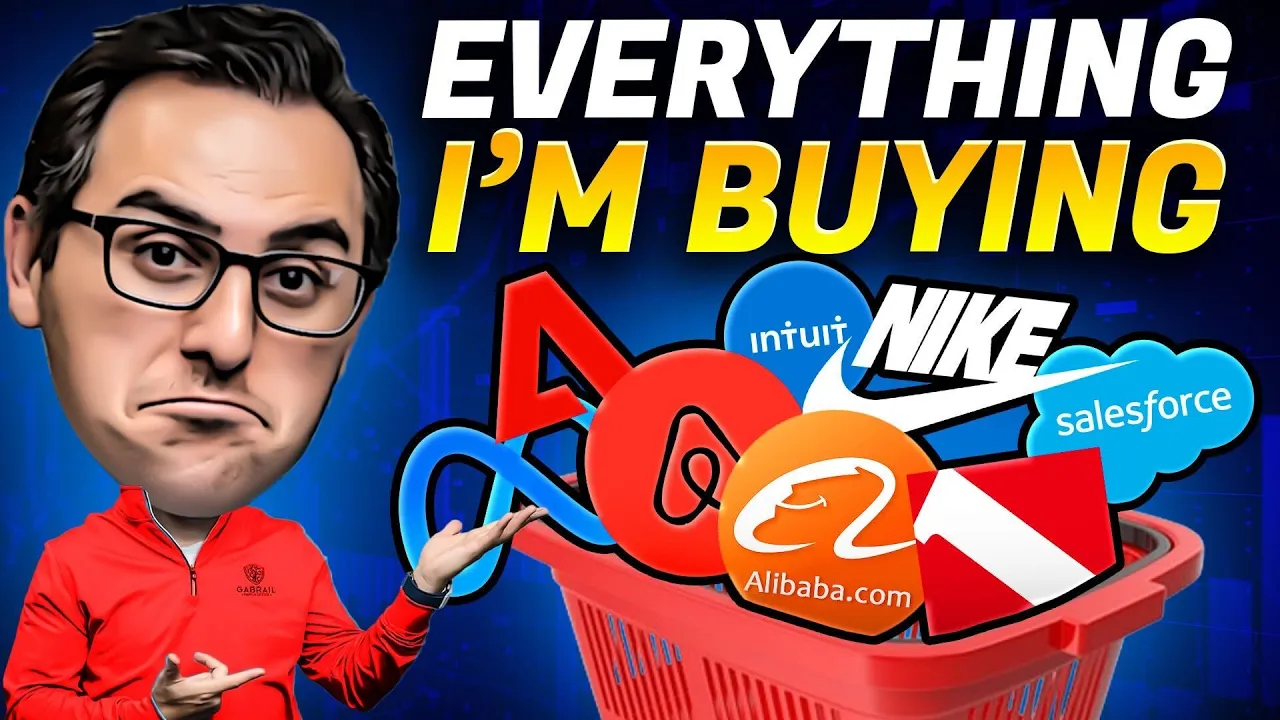
Now, the other 11 moves, these are all cash secured puts. And here's the list. Airbnb Adobe Alibaba Salesforce into it, Southwest Airlines, Meta, Nike, Paycom, Sprouts, Farmers Market, and Uber.
Contexte
The narrator lists the cash-secured put targets and later gives strike prices.
A few of them, like Alibaba and Sprouts Farmers Market, I actually owned before and then lost them when they got called away through covered calls. So, I'm working my way back into them.
Contexte
He explicitly says he is working his way back into Sprouts Farmers Market via this strategy.
Transcription Complète
Guys, I am making 12 moves in my portfolio right now and not one of them is a sell. Every single one is a plan to own more shares. Now, here's why that matters. The Buffett indicator and the Schiller PE ratio have both been blasting and saying that this market is over 100% overvalued. For a long time, I still find opportunities even this overpriced market. I'm going to show you every move that I'm making right now and I'm going to break it down so simply that even if you've never bought a stock in your life, you're gonna walk away knowing what I'm doing and why. So, I'm going to show you all 12 moves. Then, I want you to stick around for the analysis and the lesson because that's really where this gets good. So, the first move, I outright bought shares of Builder First Source, straight up purchased it. And on top of that, I'm also running puts on it. And we will get into what that means in just a second. Now, the other 11 moves, these are all cash secured puts. And here's the list. Airbnb Adobe Alibaba Salesforce into it, Southwest Airlines, Meta, Nike, Paycom, Sprouts, Farmers Market, and Uber. Now, I know some of you may be looking at the list and thinking, "What is a cash secured put? How does that even work?" Stick with me. I'm going to break it down, what I did, and how my strategy works. But here's what I want you to understand right now. These are real moves that I'm making in my real portfolio and I'm finding value in a market that by every measure I trust has been massively overpriced for quite some time. The whole point of this video is to share the lesson on how to find value. You can still find opportunity. You just have to know where to look and how to position yourself to take advantage of that. And right now I have got strike prices set on all 11 of these stocks that I mentioned. Some of them are really close to where the stocks are trading. others a little bit further away. But what this means is there's a real chance that I'm going to own all of them come sometime in May. And I'm going to share every single strike price with you so you can see exactly what I'm doing and why. This is what investing in an overvalued market actually looks like when you stop waiting for perfect conditions and start finding the pockets of value that are still out there. Now, keep in mind, I want you to know, not one thing makes me believe that if the market has a very bad bare market that all these stocks wouldn't fall further. They will fall further. And I'm okay with them continue to fall because if I really believe in what I'm buying, then I should want lower prices to build that position. And a quick reminder, please don't copy my moves. My moves are made based on my situation. I have no idea what yours is. What I do want you to copy and emulate is the process. Learn how to look at a stock the right way. Learn how to decide if the price makes sense for what you're getting. Is the price below the value? That's what changes your financial future, not following someone else's buy. Now, before I show you guys all the strike prices, I want to do a quick analysis on one of the stocks on this list because this is an important thing to identify. This is why we're here and why I teach on YouTube to help you understand value and find it. Right now, Salesforce is down over 20% in the last 3 months. My strike price on these puts is about $18 away from where it's trading right now. So, this one's quite close. That's not a long that's not a lot of drop to happen, especially with the volatility over the last three months. Now, Salesforce, if you don't know what they do, they are the company when it comes to helping businesses manage their sales teams and their leads. This is why their ticker symbol is CRM. Think of it like the central nervous system for a company's entire sales operation. So, why is it down? Well, there's a narrative going around right now, and you're going to hear the same narrative on a handful of the stocks that I'm looking at. The narrative is AI is going to make software businesses like Salesforce obsolete. that companies won't need these tools anymore because AI is just going to do it all. And guys, AI is absolutely changing the landscape. That is real. I was just upstairs minutes ago where my sales manager came in and showed me a sales management tool about training people on phone calls. He said to me, Paul, act like you're the salesperson here. And I went through a whole it was incredible. Now, does sal was it through Salesforce? No. But that doesn't mean that Salesforce can't make that acquisition or do something along those lines. But what I'm seeing on some of these companies is actually what I believe to be an overreaction. The market is pricing in a worst case scenario and the numbers I believe tell a different story as of right now. And that's exactly what I want to show you because this is a skill that you can learn. Now, when sentiment gets really negative on a stock, how do you know if it's the fear that's justified or the market's just going too far? There are several ways. And by the way, you could just be missing it. But what I do is I look at the numbers. I look at numbers about when they're saying these changes happen. And I believe the numbers will tell me a little bit more than what people's reactions are. And don't forget also guys, people tend to overreact on the upside and downside. So let me show you now. The first stock is CRM. Salesforce. Guys, these are the guys who own Slack. This has been a major company that has done very well. But the one interesting thing is people think AI is going to destroy this company. Guys, my entire thesis on a lot of AI things is AI will change the way in which we live the world, which we live in the world, the way we operate business. But I don't think there's going to be many companies, especially large ones, that are completely wiped out by AI. I think a company like CRM, will be enhanced by AI. Guys, here are the things I love about CRM. The first thing is look at this free cash flow. Free cash flow is cash from operations minus all the big capital expenditures they make investing into their company. Usually free cash flow in most companies is the same as net income or lower. Guys, free cash flow last year was 14.4 billion. Net income was 7.4 billion. The last 5-year average was 9.6 billion. The 5-year net income number was 3.9. Everyone else in this world is going to focus on this. You're going to focus on free cash flow. That is the lifeblood of the business. This company is selling for less than 12 times last year's free cash flow. It is selling for less than 18 times the 5-year average free cash flow. Now, does this mean that this company is going to make me tons of money? No. But what it does mean is if I think this company is going to be around for a very long time and they're going to have more revenue and profit, this might be the opportunity I need to go pick up shares of a very good company at a much lower price. Guys, they pay a dividend. It only eats up 1.6 billion and the return on capital is lower than I'd like, but it is getting better. The 5-year return on capital is 4%, the one year is 7%. But this happens very regularly when companies are spending a lot of money on growth. Their returns on capital can be lower. Now, couple of other things I love. 78% gross margin. That means every extra dollar they bring in, 78 cents of it goes to the bottom line before overhead and taxes. That's an incredible, incredible number. And the other thing I love is look at their profit margin. 10-year profit margin 10 and a half% 5year 11.3 1 year 18. It's getting better. And we will get to this on the stock analyzer. Their free cash flow 25% over the last 10 years, 27 and a half over the last five, and 35% in the last one year. Getting better. Now, our community members have an average rating of a buy here with intrinsic value of 292. And the stock is currently around 180 with an all-time high of 369 back in December of 24. It's half of its all-time high. Basically, that's incredible. Okay, let's look at the eight pillars. So, remember we talked about the difference between the PE ratio and the price to free cash flow. Look at how different these things are. One is an X, one's a check. I'm not even worried about that. This one does bother me a little bit. Hopefully, it gets better and there are ways in which it gets better. They're buying back shares. Their cash flow is up. Their net income ups. The revenue is up. And guys, very low debt levels. Look at this. They can pay off, remember, their free cash flow is up a lot in the last five years. And based on their fiveyear free cash flow, they can pay off all their debt in 1.7 years. Based on fiveyear average numbers, their last year was way higher. So, it's probably less than one year of the of their of their um free cash flow they can pay off their debt. Now let's see what analysts have to say about this guys. They have almost a doubling of earnings per share from 11.88 to 2149 in the next five years. 17% 11 12 13 1.5 18 14 and 6% growth on earnings per share and revenue. Have you seen a cuter line in the world than this? 9% 11% 9% 9% 9% 9 and a half%. 50% growth over 50% growth in revenue over the next five years. Again, analysts aren't going to be right in all these things. I don't necessarily trust them all the time, but at the end of the day, I'm looking at going, "What are we seeing?" Especially with a stock down so much, analysts would usually be the first ones to be like, "Oh, we missed it on this one. This is a terrible company. Let's move on." So, we have some of the story. We have some of the numbers. So, we go to stock analyzer. Let's pull up the last time I did CRM in our stock analyzer tool. Now, I'm going to change I'll explain this shortly, but here's what we have. Like I said, returns on capital are getting better. Revenue growth, I did five, 7 and a half, and 10%. Now, profit margin, I did 12, 16, and 20, but remember, free cash flow is the most important. So, 25, 30, and 35%. Now, what PE, what price to free cash flow would I put at the end of 10 years, at the end of my analysis? Well, guys, I always tell people, you start at 15 or 16, which is about the market average. You go higher for good companies, lower for bad companies. Now, I consider CRM a decent company, pretty good company. They really Salesforce.com is the the is the pillar for CRM. They have Slack, which everyone uses for intercomp conversations about different things. So, I'm going to go higher on this one, but the returns on capital are lower, but getting better. I put 15, 17, and 19 before. I'm actually going to change that. Here's what I'm going to do. I'm actually going to go 14, 18, and 22 because I do think that we could wake up, 10 years from now, and this is a much higher return on capital business and much more ingrained in the world. So, it deserves a premium. And then finally, my no margin of safety, only 9% intrinsic value return. This is what the company is worth. If you saw before, I had 15% in there. For me personally, I want a 15% return. But guys, that is really high. The reason my returns are 15% is I own and operate a thousand apartments. I have many businesses and only 30% of my net worth can be invested in c in stocks at any given time. So, I'm going to be very picky. a dollar cost average and a lowcost ETFs and when I buy a stock I want to buy it when it's a screaming deal. So for me 15%'s the number. I don't recommend that for everybody but doesn't mean it shouldn't be yours. It's all about your personal belief of what you want to get. So I hit the analyze button. The stock's currently at 180. I have a low price of 190 based on cash flow. High price of 520. Middle price of 319. This is why I'm interested in this company guys. So, let me show you guys my actual 15%. If I put my personal 15% return in here, look at this. I have a low price of 130, high price of 330, middle price of 208. If my middle assumptions occur and I focus on my discounted cash flow, my return is 17.2%. And guys, all of these returns down here include the dividend. All right, guys. So, let me um let me tell you the strike prices here. Let me walk you through the list. Airbnb $110. Alibaba $110, Builder First Source 65, Salesforce 160, Intuitit 310, Southwest 30, Meta485, Nike 40, Paycom 100, Sprouts Farmers Market 70, and Uber at $60. Now, with Adobe, I am being very aggressive with my puts on that one. Now, guys, when I wrote Adobe at 215, it was a lot lower and now it's skyrocketed. Same with Meta. So, this is what's fun about the cash secured puts. if they skyrocket, if the stock skyrockets in price, I just got myself free premium. Now, here's the thing about this list. Some of these stocks I already own. A few of them, like Alibaba and Sprouts Farmers Market, I actually owned before and then lost them when they got called away through covered calls. So, I'm working my way back into them. And this strategy is how I do it. I get to generate income while I wait. And the stock hits my price, I'm buying it at a level that I'm already happy with. That's the beauty of all of this for me. I'm not chasing. I'm not panic buying. I'm setting my price. I'm getting paid to wait for that price to hit. And if a stock comes to me, great. And if it doesn't, I still made a very good return on the cash that's sitting in my account. So, I'm going to show you exactly how this works. And we're going to do it with a full analysis. So, let's look at Uber. So, Uber's down about 15% in the last 6 months. And when you look at what this company's actually been doing, that drop starts to look like an overreaction in my opinion. Now, here's what's real. Uber is massively profitable now. They've grown their free cash flow consistently over the last several years. The business is working. So why is the stock down? Same story we talked about with Salesforce. We believe it's the narrative. The market's scared. Scared about autonomous vehicles. Scared about Whimo eating their lunch. Scared about Tesla potentially rolling out their own autonomous fleet and cutting Uber out of the picture entirely. And guys, those are real things worth watching. I'm not going to sit here and tell you competition doesn't matter. It absolutely does. And their competition are two very large companies with deep pockets. But here's what the market might be missing. Uber isn't sitting still. They just announced a commitment of over 10 billion toward autonomous vehicles. They are planning to deploy robo taxis in at least 28 cities by 2828. They're not fighting autonomous vehicles. They're joining them. They're positioning themselves to be the platform that runs on top of whatever fleet is out there, whether it's their own cars or somebody else's. So, the narrative is that autonomous vehicles are killing Uber. My goal, my hope is that Uber figures out how to own the autonomous vehicle wave instead of getting wiped out by it. The numbers back up a healthy business. The fear is real, but I think it's gone too far. Now, this is kind of a side thing. When I hear people say, "But Paul, it they're going against Google." Yeah, you're right. But Google, does anybody remember what the Google um social media company was? Social network was >> for the record, I just asked the two guys here and we couldn't remember the name. It's not to say that they're going to fail at this one. They're Whimo's awesome. I've been Whimos. I really enjoy them. But the point is, just because a company's big doesn't mean they always dominate. Uber is the verb. Uber was the first one to market and people have an affinity towards that. So, let me show you the numbers real quick and then I'll show you my put strategy with Uber. All right, guys. So, Uber's $160 billion company. Returns on capital getting a lot better. It went from negative over the last 5 years to 8%. You've got major cash flow, 9.8 billion. So, the the difference in debt they can easily manage. Our community members have an average rating of a buy on here with a 118 intrinsic value. We got the eight pillars here. A lot of X's. The only checks here, cash flow growth, net income growth, revenue growth. Shares are up a little bit, but hopefully with the extra cash flow, it'll pay that down. Another thing, the the debt here is based on the 5year average free cash flow of 3.9 billion. Last year, they did 9.76. So, if they just stay at this 9.76 and grow five or 10% a year from there, this number falls to two immediately. The price of free cash flow, same thing. in the price to earnings. Their earnings and free cash flow is up so much. So, I'm looking at this going, "It doesn't bother me so much." So, you might be wondering, "Well, Paul, you're doing puts, but you're also analyzing." Guys, this is what I consider the biggest mistake that people do when selling cash secured puts. I only write cash secured puts on stocks I want at the price I want. In my head, what I think to myself is, if that stock was at this strike price today, would I buy it? If the answer is yes, then I've got to just focus on that. That's all I worry about. What people end up doing is the stock falls further. They get the shares like, damn, I really wanted a lower price. You can't think that way. That's a very important part here. Okay, so let's go to analyst estimates. Analysts see 350 per share growing to 620 in the next four years. And then revenue growing from 60 billion up to $90 billion, a 50% increase in the next four years. But again, they could be wrong. So, let's go to our stock analyzer tool, pull up Uber, and again, I have my 15% return in here. So, I'm going to change that to my 9% intrinsic value return. Now, revenue, I have 6, 9, and 14%. Profit margin and free cash flow, I did 18, 22, and 26. The reason being is they recently hit that 18/19 mark, but their ability to grow will hopefully help their profit margin, so I put a little bit more in there. Now, what PE did I put for the future? 1822 and 26. Why? Because returns on capital are getting better. And guys, it's still you don't say take let's let's lift there. We say let's Uber there. Let's Uber there. We don't say let's Whimo there. Some people might in the cities that have it, but right now the verb is Uber. And I think that's worth a lot right there. Not in the sense of that they're going to be around forever. That means that the case cuz look at um Tupperware. You know what I mean? they're pretty much gone and it's like everybody calls their plastic cartridges or whatever it is Tupperware. So guys, you can see I've made some pretty reasonable assumptions in my opinion on Uber and this is something that you guys can easily learn to do with the stock analyzer tool to save you countless hours. And here's why you need that. What you just watched me do took about 3 minutes and it told me more about Uber than most people will ever know before they buy it. Most investors would have just looked at the price, maybe read a headline or two, and made a decision based on that and saying, "Hey, I love Uber. I'm going to buy it." That's how you buy a stock, and then that's how you feel sick to your stomach when it drops because you never really knew what it was worth in the first place. The stock analyzer tool and our software changes all of that. You put in smart assumptions about a company's cash flow, about its growth, exactly what you just watched me do right here, and it shows you the price where you actually get the return that you are looking for. It's not a guess on that. It's a number that means something. Pair that with the eight pillars and you've just you're not just getting a price, you're getting a full picture of whether the business is even worth owning for you at all. People who use this stop making the emotional decisions. They stop buying on hype and they're and hoping for the best. They know and understand what they own. They know what they paid and they know why. That's what it feels like to sleep well at night when everybody else is panicking as stocks fall. No matter what the market is doing, you're going to understand why you're buying what you're buying. And on top of that, if the stock falls further, you're not going to panic as much as everybody else. And here's the thing, you just saw how simple this is. If I can do it live right here in a few minutes, you can, too. You don't need a finance degree. You don't need a PhD. You don't need to be a math person. You just need the right tools. So, here's what I want you to do right now. I want you to start a 7-day trial for just seven bucks. Click the link. Click the link below in the description or in our first pinned comment and get full access today. Run Uber or any of these companies through it yourself. Run whatever stock you've been thinking about buying. See what the numbers actually tell you before you spend a single dollar on it. So, here's what my results look like on Uber. I hit the analyze button and the stock's at 77. Guys, look at this. I have a low price of 95, high price of 334, a middle price of about 170. This shows me a range of outcomes of 12 to 30% with my middle at 20%. Now guys, I repeat this all the time. I don't know if I'm going to be right on any individual company, but if I buy 30 or 40 companies that make sense to me that are large companies that have staying power, I'm probably going to do okay if I'm able to get my 15% return. That's what's key here. Let me show you what kind of income I can make while waiting for Uber to hit the price I want it to hit. Now, here's how a cash secured put works in plain English. When I sell a put on a stock, I'm basically saying I want to buy the stock, but I wanted to buy it at a lower price than where it's at right now. So, I pick the price that I'm happy buying it at. That is called the strike price. I pick it at a future date. That's called the expiration date. And while I wait to see if it gets there on that date, the market pays me money just for making the commitment of I will buy it on this date at this price. I'm being paid to wait. So, I'm either going to buy a great stock at a price I love, which is lower than today, or I'm going to pocket that money and move on. Either way, I win. So, for example, Uber's currently at $77. I want to buy it at $60. Now, you might sit there and say, "Well, Paul, it's currently at 77. Your numbers look like 20%." I got that, but I want to be a little greedy. I want to make some cash in my money. So instead of sitting there and just waiting for the stock to hit 60, I can sell somebody the right to force me to buy the stock at 60 bucks. So what does that happen? Well, it happens when the stock falls below 60. But remember guys, if I pay 77 for it today and it falls to 60, I just lost $17. What I do here is somebody pays me to wait for it to fall at 60 and then I pay 60 bucks for it. I'm getting it for $17 cheaper. 20% cheaper and I'm getting paid for that. So, you might be wondering, well, Paul, how much are you getting paid? That $60 strike price is the price I'm happy buying it at. So, I pick a date in the future. Right now, I have it from May 15th and I have a $60 strike price, guys. If you look right now, my $60 put, I'm being paid 23 cents if I were to do it right now, which is a 4.9% annualized return. What that means if I did that month after month after month and never got the shares, my cash would generate 4.9%. You're probably like, "Paul, that sucks. I get like 3.75." You're right. But I didn't sell it for 23 cents. I did this a few weeks ago when the price I got was 84 cents. My return was well over 15% return. That is what's big key here. Why? So why did the price fall so much? Because Uber's stock price went up. The higher it goes, the further away from 60 it gets, the less likely it is to hit 60, therefore the less premium paid. Now, I threw a lot at you and I get it. It feels overwhelming, but the basic idea I want you to remember is I am buying a stock I want at a lower price and being paid for that. My cash in my account makes 3.5 3.6%. But if I'm able to do this on companies I love at 12 to 15% cash returns, I will do it over and over again. I'll make one to 1.25% per month on my cash waiting to buy companies I want. Now, if the stock falls below 60, I've got to pay 60 for it no matter what. I still keep my 85 cents, but I've got to pay $60 for it. So, what's the risk here? The risk here is a stock falls to 50 bucks and I'm paying 60 bucks for a $50 stock. But to me, that's not the risk because if if Uber was at 60 bucks today, I'm buying it no matter what. So, I'm going to lose $10 either way. At least now I got 85 cents for that to happen. That's the big key. Now guys, if that was either very exciting for you or confusing but sounded interesting, just do me a favor. We have a link below, also in our description or our first pinned comment. Download our options PDF. It's absolutely free. It'll explain this whole cash secured put and on top of that also our covered call strategy. This is a way in which I generate income every single month on my cash as well as on my portfolio of stocks. It's something that I wish I'd learned 25 years ago on how to do and I just learned it in the last six years. So guys, go ahead and download that right now. And on top of that, if you're looking for potential value in this market right now, I put together a video on three stocks that look like if execution goes well, might bring multibagger returns down the road. I ran them through our process and they just look really interesting right now. So click the video on your screen and go watch it right now. Thank you for your time.

Commentaires 0
Connectez-vous pour rejoindre la discussion.
Se connecterAucun commentaire pour l'instant. Soyez le premier à partager votre avis !