
- Rendement de la vidéo
- +2,26%
- Appels
- 2
- Achat / Vente
- 1 1
- Publié
Recommandations
L'entrée est le cours de clôture de l'actif à la date de publication. Le cours actuel est la dernière clôture enregistrée.
-
Entrée $489,28 06 août 2026Actuel $483,36 07 août 2026Résultat +$5,92
My verdict would be to avoid chasing the decline.
Contexte AMD ... My verdict would be to avoid chasing the decline. I become more interested around $400 and materially more interested below $350.
-
Entrée $335,67 06 août 2026Actuel $346,80 07 août 2026Résultat +$11,13
Apploving is the only stock out of the five here that I consider beginning to buy immediately.
Contexte ... Apploving is the only stock out of the five here that I consider beginning to buy immediately. But I still use tranches because a near 20% pre-market decline can remain very volatile after the opening bell.
Transcription Complète
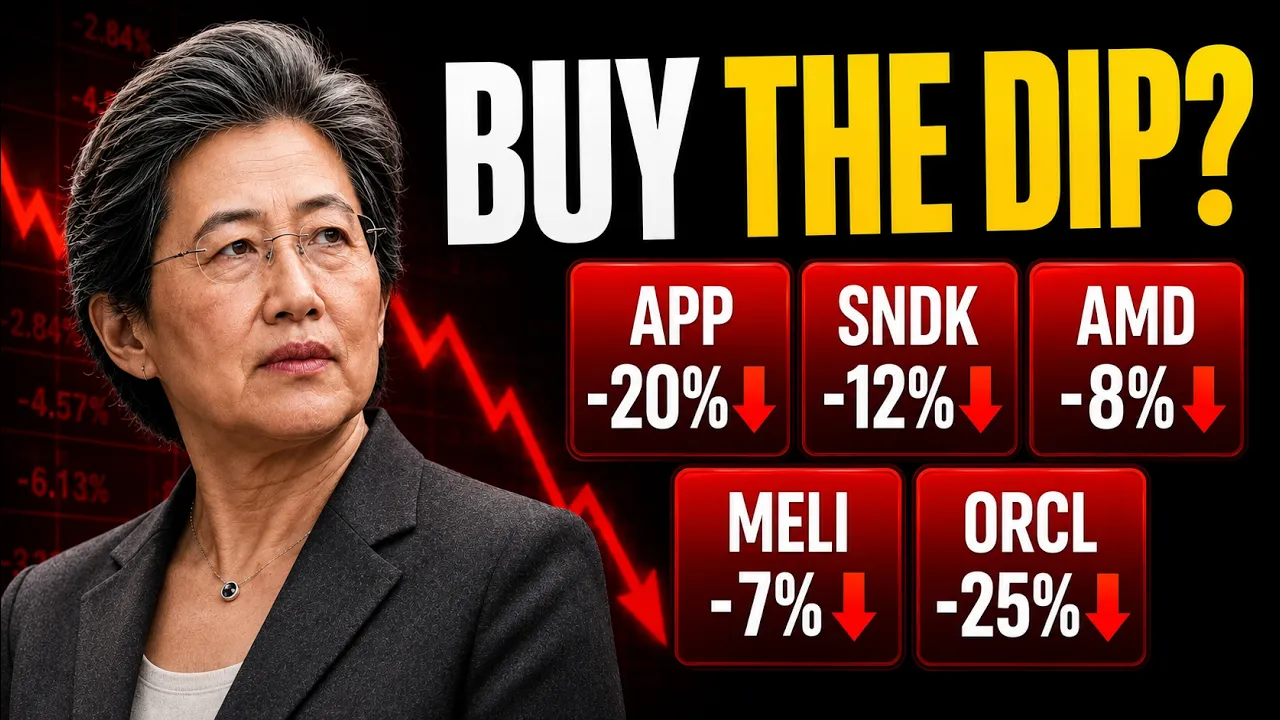
The US stock market has just reached another all-time high. But beneath that record, five major growth stocks have been hammered and some of the earnings reactions, well, they barely make sense. We've got one company here which in fact grew revenue by 53%, missed expectations by less than 1%. And we can see in the pre-market, well, it's lost around 1/5th of its total market cap. We've got another that beat earnings expectations by 14%, beat revenue by 7% and still fell double digits as we can see down around 10% in the pre-market. This is already after dropping around 5 1.5% yesterday. And then we've got AMD which grew its revenue by 50% more than doubled its data center business and suffered its biggest post earnings reset in months down just over 7% yesterday. also looks to be down in the pre-market. And then we move on to Mercardo Libé, which also grew revenue by 50%, but investors looked beyond that growth and found the sharp deterioration in profitability. That's down only around 3% in the pre-market, but it's also negative year to date. And then finally, we've got Oracle. That's down more than 25% this year as the cost of funding it is enormous AI ambitions, well, they start to alarm the credit market. In fact, zooming out to the last 12 months, this one's down 44%. And this is ultimately happening while the wider market remains strong. Small caps are up more than 22% this year, beating both the S&P 500 and the Magnificent 7. And then when we look at over the last 12 months, well, value stocks have also returned 34%, more than twice the return delivered by growth. Meanwhile, we can see the four largest AI spenders. They've almost doubled their quarterly capital expenditure. Demand is extraordinary. But the amount of money needed to satisfy that demand, well, that's also extraordinary, too. And we can see even just looking at the last 30 days, this is not a market that stopped rising. It's a market that's become far more selective about what kind of growth is prepared to reward. But before looking at the individual stocks, let's listen to the strongest argument from the president Goldman Sachs for why this bull market could still have much further to run. >> I would say the most important factor right now is earnings earnings growth. You know, earnings growth continues to be really strong. Uh we're going to have the second quarter was the seventh consecutive quarter in the S&P of double digit earnings growth. So we've had very consistent and significant earnings growth which is propelling markets. ultimately the most important fundamental driver and I would say recently it's broadening >> and that broadening is visible in the performance of value financials and smaller businesses. The market's not rising purely because investors are chasing the same seven companies but ultimately strong earnings they do not automatically make every stock attractive and Jamie Diamond he believes broad market valuations still leave very little room for error. You recently told our our former colleague Wilfrid Frost in a podcast that you wouldn't be a buyer of treasuries. You wouldn't be a buyer of equities at these levels. Why is that? >> Well, treasuries I just said I I already embedded in the marketplace. There are people's assumptions about inflation. My my guess is that there's a higher odds for that than the other ones. Equities I should have said it that way. There are always equities you can buy, but asset prices are high. So stock prices, however you measure them, you know, in the top five or 10 percent of all-time measurement, but at any point in time, a stock could be a good buy. And that's true globally. So, you know, you look around the world, no, you should shouldn't speak generically about stock prices. >> And that distinction is the point of today's video. These five stocks have all fallen, but the reasons are completely different. One may have become genuinely attractive. Some are only fairly valued and at least one could be a classic falling knife disguised behind a very low earnings multiple. And the first one that we can discuss today is Mardo Libé. It shares well they're down around 3% this morning. But this was not remotely a weak revenue report. As we said earlier, down 5% year to date over the last 12 months. This one's actually down around 20%, losing 1/5if of their market cap. Over the last 5 years, they've barely turned green. And as of today, it's trading around the mid to low end of the 52- week range with a near four and a half strong buy rating from Wall Street. Seeing Alpha also give it a respectable buy. And we can see from their earnings revenue, well, it beat expectations by around 4% and reached 10.2 billion. Earnings, well, that narrowly beat expectations, too. Yet EPS that still declined by around 11% year-over-year. Now, the operating figures were enormous. to GMV gross merchandise volume reached 21.9 billion. Items sold increased 45% and total payment volume rose 56% to 101 billion. And also when we take a look at their credit portfolio, well that expanded by 75% year-over-year to 16.4 billion. That's exciting growth, but the pace of lending introduces risks that do not exist in a traditional marketplace business. And commerce revenue, we can see that was up 50%. Fintech revenue that rose 49% and Marcado Pago well that generated around 2.1 billion while Merardo Credto 2.3 billion. And you'll notice that quarterly revenues increased from less than 1 billion in 2019 to now for the first time sitting more than 10 billion. The company's long-term growth record, well, it remains exceptional. In fact, if we look at just the last few years, they've managed to compound their revenue at a rate of 53% yearonear. And you can see here that the growth is also becoming deeper. Assets managed per fintech user increased from $82 in early 2023 to $264. While the average buyer purchased 8.9 items, and unique commerce buyers grew 26%, fintech users increased 30%. But most importantly, customers using both commerce and fintech grew 37%, making them Micardo's Libre's fastest growing user group. But you could argue one of the reasons why the stock fell were their operating margin declined from 12.2% to now sitting at 6.7 while net margin fell from 7.7% to only 4.6. But bear in mind, this is while they're increasing their revenue at such a rapid rate on a continual basis. You can also see that their sales and marketing well that reached 1.1 billion product development 700 million and provisions for doubtful credit that reached around 1.3 billion. Now the credit card portfolio is particularly important. Its interest margin after losses moved from 0 to -2.5% even as the company aggressively expanded lending. And it is worth pointing out that Marcado Libé deserves a premium to most retailers. But even after the decline that we've seen even over the last year, will it trade around 47 times forward gap earnings and more than 24 times when we take a look here at forward ebit. Now consensus they essentially expect P to fall from around 50 times this year to 33 based on 27 numbers 23 and a half on 28 down to 16 on 2029. And Wall Street well they're expecting around 15% upside over the next year. Not dramatic. The average price target sits just above $2,200. But again, the range here fairly wide, $1,750 on the bottom end, 2,800 on the top end. Right now, share price isn't actually too dissimilar from the low end here. Now, my central DCF, it assumes free cash flow grows by around 20% annually and produces a price of $1,791 per share. The low case here 15% 1,229 more optimistic 2564 and you can see the current price well it therefore sits almost directly on top of my central valuation and reverse DCF always important to justify today's price while Mardo Libre needs to compound free cash flow at around 20% for many years yes that is possible but it's definitely not a low expectation and as you can see using that middle rate there is no margin of safety For investors today, it looks to be trading at a fairly small but nonetheless 3% premium. So, my verdict is that Marcado Libé remains one of Latin America's finest businesses, but around $1,850. I personally see it fair value rather than a major margin of safety. When looking at the company right now, I'd probably hold it. I become more interested below $1,700. But this 3% fall alone isn't enough for me to aggressively buy the dip. Now, before we continue, just to let you know that I release my latest weekly article. I drop one every single week covering severely undervalued stocks as well as what's gone in the market over the last few days. So, you can click on the pin comment below, sign up, and read these straight away. Now, the next stock we look at is AMD Advanced Micro Devices, where the shares fell around 7% yesterday despite reporting one of the strongest revenue quarters in the company's history. Bear in mind though, it is still up tripledigit year to date. Also trading towards the upper end of the 52- week range. All-time highs sit around $585 where we get a very rare strong buy 4.98 out of five for quant and a strong buy rating from Wall Street. Seek Alpha will give it a hold. Now revenue we can see beat expectations and grew 50% year-over-year. Adjusted EPS that reached 166 beating consensus by around 3%. And data center revenue reached 6.7 billion increased 107%. Client revenue well that rose 23% embedded revenue rose 19%. However, we can see here gaming although very small in relation to the other streams that declined around 31%. And in 5 years quarterly data center revenues expanded from around 600 million to almost 6.7 billion. data center. Well, that in fact now generates close to 60% of AMD's revenue and carries a segment operating margin of 31%. The most important question is whether this acceleration can continue. Lisa Sue believes the number Wall Street is modeling for 2027, well, it may still be far too low. Well, Jim, you know, actually what I would say is we are in an extraordinary time for AI compute right now. You know, we just updated our overall market numbers. you know, we see the market for overall uh computing and adaptive high performance and adaptive computing going up to over $2 trillion um as we go through 2030. And with all of that information, we wanted to reframe where our business is. And the fact is um our data center business is accelerating. We're extremely excited about our uh foundational model um large strategic partners like OpenAI and Meta and we just added Anthropic uh to the mix there. And this is a case where, you know, we do see our data center business growing well over 100% as we go into 2027. And and those are just very large numbers when you think about, you know, the base that we're on top of. >> That is an extraordinary bullish statement. Mandrin is not seeing AI demand moderate. It expects data center growth to remain above 100% into 2027, but AMD's opportunity must be viewed beside Nvidia. AMD generated 11.5 billion this quarter, while Nvidia's quarterly revenue base is many times larger. Now, in terms of Wall Street, their average price for AMD sits just above $600. That's around 26% upside. But what's fascinating here is that some bullish analysts actually see it more than double that price at $1,250. Lower end here sitting below $400. And AMD's expected growth remains exceptional. Forward revenue, well that's sitting at the 50% region. EBIT dollar growth sitting at 78% with EBIT growth sitting at 69. Adjusted EPS that's above 60%. But the problem with AMD is the starting price. AMD trades in fact at almost 70 times forward non-GAAP earnings and around 62 times forward EBIT DAR. Now the multiple does fall to around 31 based on 2027 numbers and 22 based on 2028 but only because as we can see here earnings are expected to more than double next year. Now my central model here assumes AMD based on an expectations generates 10 billion of free cash flow in 2026 followed by around 20% annual growth. It produces a value of around $392 at 15% growth while it falls to $33 and at 25 rises to $55. Even the optimistic scenario here offers only modest upside from the current price where the reverse DCF well that suggests AMD needs to compound free cash flow at almost 24% for a decade simply to justify today's price at around $475. Now using that middle rate, we can see there's no margin of safety. in fact looks to be trading at around a 21% premium. Now AMD overall it may deliver this growth at 24% maybe even 25 or in fact higher but investors today are already paying for an extraordinary outcome leaving very little protection if deployment timing margins or competition disappoints. My verdict would be to avoid chasing the decline. I become more interested around $400 and materially more interested below $350. And this is where the analysis becomes even more interesting because this next company fell far harder despite missing revenue expectations by less than one percentage point. And as always, if the breakdowns are useful, smash that like button. But stay with me because Apploving may be the only one of these five I'd actually consider to begin buying today. Now, we can see as we mentioned earlier, this one is down nearly 20% after reporting their earnings, extending a year-to- date decline that was already at 38% before this latest drop. It will now open at a new 52- week low, where prior, in fact, to their earnings report, this one had a strong buy rating from Wall Street, a fairly respectable one, two from Seek Alpha. And the apparent disaster was a revenue miss of less than 1%. EPS still beat by 1 cent. Revenue grew 53% and EPS increased 57% year-over-year. Revenue in fact reached 1.9 billion. Net income from continuing operations. Well, that increased to 1.267 billion producing a net margin of 66%. That's in fact 64% growth year-over-year. Adjusted EBID. Well, that increase 58% to 1.6 6 billion while the margin remained at an almost unbelievable 84% and free cash flow that reached 863 million for the quarter. The company in fact they also as we can see here they repurchased 551 million of shares reducing the total share count to 335 and also worth pointing out for the third quarter management expects revenue of around 2 to 2.1 billion and adjusted EBIT Dar 1.7 to 1.74 at that midpoint that still implies revenue growth close to 47% and EBITD growth close to 50%. Yes, growth is moderating, but it certainly has not disappeared. Now, management admitted the results fell short of its own standard, but it attributed the shortfall mainly to timing around improvements to their advertising model. Now, to be fair, this was the first revenue miss after a sequence of strong beats. The question is whether it represents one poorly timed quarter or the beginning of a more durable slowdown. Wall Street, however, prior to the drop that we saw today, they estimated around 54% upside, average price target $645, range somewhere between $400 to $900. And the current forecast remain powerful. Forward revenue growth above 31%. EIT dollar growth near to 49% and long-term EPS sitting around 37%. And at the previous closing price while apploving traded around 25 times Ford earnings and around 21 times forward Ebit and around the $350 pre-market price, the unchanged consent estimate would place Apploving near 22 times this year earnings and around 16 to 17 times 2027. And you can see my DCF producer central value of $55 using 5.8 8 billion of starting free cash flow per analyst expectations and 10% annual growth. Even the low end at 5% produces $369. The 15% upper end 689 creating, as we can see, a lot of substantial theoretical upside, we're talking pretty much a double 101%. But ultimately, you could argue the free cash flow assumption is aggressive. They generated around 2.15 billion during the first half. So reaching just below 6 billion, it does require a very strong second half, but that is what analysts are forecasting today. So using that middle rate, we do get a margin of safety, quite a large one at 32%. I therefore wouldn't say this is severely undervalued with complete confidence. A more cautious valuation range you could argue is sitting somewhere around $450. But even where it does sit today, the market is no longer demanding endless 50% growth. This is the first decline where the risk and reward are beginning to look attractive. And my verdict would be buying tanches not because the bottom is guaranteed to be in, but because a near 20% decline appears excessive relative to a sub 1% miss and continued growth near 50%. Now the fourth stock we look at is Sandix. That one was down 5.4% during yesterday's session. It's down more than 10% in the pre-market despite one of the biggest earnings beats of the quarter. Now, obviously definitely have to highlight this one year to date has done incredibly well, up 469%. Over the last month, though, this one's lost one quarter of their total market cap, trading around the midpoint of the 52- week range. Crazy to think this one was trading at $40 within the 52- week range. Quant though, give it the strongest rating, $4.99, strong buy. Wall Street very respectable buy. We can see a Seek Alpha, they've gone for a hold. Now adjusted EPS that beat expectations by 14% revenue beat by 7% and increased 51% sequentially to almost 9 billion. And we can see here that gap net income reached 6.9 billion while non-GAAP net income increased 68% sequentially to more than 6.1 billion. And the next quarter outlook that's not weak either. Management expects revenue between 10.3 to 10.8 billion while adjusted EPS sitting somewhere between $44 and $46. Data center revenue reached almost three billion and more than doubled sequentially. Edge revenue increased 48% while consumer revenue declined by 32. Non-GAAP gross margin though that reached an extraordinary 85% compared with only 26% one year earlier. The expansion explains the explosion in earnings. But something important to note here is that the latest acceleration is not purely driven by volume. Sandis said only approximately one-third of sequential growth came from selling more units. In fact, they say that approximately twothirds of the latest revenue increase came from higher pricing. That is fantastic while price are rising but dangerous if the memory cycle turns. Data center demand is also unquestionably real. Revenue in that segment increase from only 18 million in 2023 to almost 3 billion today. And Sandex is also trying to reduce traditional memory cyclicality through long-term custom agreements with minimum pricing and committed volumes. These agreements represent 94 billion of minimum contracted revenue, 60 billion of remaining obligations and 16 1.5 billion of financial guarantees. Approximately half of fiscal 27's production and 2/3 of fiscal 28 production are already committed with an average agreement duration above 4 years. reportedly free cash flow. Well, that reached just over 7 billion, but around 2 billion came from customer prepayments and deposits under those new agreements. So, after removing that benefit, adjusted free cash flow was still an exceptional 5 billion. But the distinction matters when building a long-term valuation. We can see Wall Street, they see this at over $2,200 in the next 12 months, 63% potential upside, sums it as high as $3,169. And at a first glance when you look at Sandis you could say it looks absurdly cheap. It trades in fact at just over six times forward earnings and approximately five times forward EBIT DAR. But the multiple does rise from around five times on 2028 numbers to 11 times on 2029 and 2021 based on 2030 because analysts as we can clearly see here they are fully expecting those earnings to collapse. Consensus are modeling 56% earnings decline in 29 followed by another 45% decline in 2030 is why the stock looks so cheap today. And you can see my display low growth ECF produces around $1,453 per share above the current pre-market price although volatile sitting around $1,200. Bear in mind this valuation starts with around 9.3 billion of free cash flow that was for their full year. And we have used an 8% discount rate to an extremely cyclical semiconductor company. Normalizing cash flow and using a higher required return could pull fair value much closer to or even below the current share price. But using that lower rate, we do get a 17% margin of safety. My overall verdict here would be actually to wait. Yes, the results were phenomenal, but this may be peak profitability. A low PE is never automatically a bargain, especially when the earnings denominator could collapse. And the final stock we have here is Oracle. It appears cheaper than most AI businesses and its growth is accelerating, but it carries the most serious financial risk of the five. And as we said, it's down 26% year to date. Over the last year, down 44% and in the pre-market sitting around $140, is also down around 3%. Now, Oracle does trade very close to its 52- week low where we do get a near strong buy rating from Wall Street, but with a very weak buy from Seek Alpha. And in their most recent earnings, while quarterly revenue reached 19.2 billion, increased 21% year-over-year, cloud revenue, while that grew 47% while Oracle's cloud infrastructure was up 93% with remaining performance obligations reaching an extraordinary 638 billion, increasing 363% year-over-year. The demand Oracle has contracted is therefore not theoretical. Where operating profit reach 6.1 billion, net profit 4.3 on an income statement basis, Oracle appears extremely profitable and their annual revenues increase from 39 billion in 2020 to more than 67 billion and forecast suggested it could approach 90 billion next year. Revenue growth is also expected to accelerate from around 17% to more than 32% as Oracle begins recognizing its enormous AI backlog with their operating profit. That's also forecast to increase from around 21 billion to almost 68 billion by 2029. And consensus expects forward revenue growth above 31% EBIT DAR above 35% and long-term EPS sitting around the 28% region. But bear in mind, accounting profit is not cash flow. Oracle's free cash flow has moved from around positive 12 billion to negative 25 billion. And ultimately the reason here is infrastructure. Oracle's trying to build enough data center capacity to satisfy contracts that are arriving faster than it can currently fund them internally. And we can see here that credit markets are treating Oracle very differently from Microsoft, Amazon, Alphabet, Meta, and Nvidia. Its 5-year default protection cost has risen above 200 basis points. and Oracle's credit default swap has even exceeded the level reached around the layman brothers collapse. That's a dramatic signal, but to be fair, it does require important context. It doesn't mean Oracle's about to default. CDS prices reflect liquidity recovery assumptions and demand for protection, but lenders are clearly demanding substantially more compensation. This is precisely the type of hidden financial leverage that Jamie Diamond believes can make an otherwise healthy market more vulnerable to abrupt disruption. Not I think that market handles that very well. But when I talk about leverage, margin debt is the highest it's ever been. There's a lot of margin debt you don't see cuz it's not called margin debt. It's called other things. So it's that kind of leverage, some hidden, some public. We we see a lot of it and it's high. You know, it's not I'm not going to say it's systemic high. is going to cause a disaster, but it's high. >> For Oracle specifically, the concern is simple. Can the contracted AI revenue begin generating cash before the infrastructure commitments place even more pressure on the balance sheet? The thing to note is though, unlike AMD, Oracle does not look expensive on earnings. It trades around 18 times forward earnings below its 5-year 20 and its dividend yield is also close to its historical norm. But P multiple does not capture the enormous cash consumed by infrastructure investment. And if we were to look at the blue tunnel from simply safe dividends which highlights the intrinsic fair value price is hitting just below the bottom end which could in fact be argued as a potential undervaluation signal. Look at the last 5 years 10 years. This one has spent many many periods trading in a severely undervalued level. And if you go back and look at the episodes that we covered on stocks that should be considered for selling, Oracle during this period came up massively where it was trading a ridiculous valuation. Now just because it looks better in terms of value doesn't again automatically make it a buy. And Wall Street with one of the largest upside we've seen today 72% from their predictions. Their average price target $248. The range going from 110 to 400 on the upper end. Now my central valuation here gives a value of around $160 compared with a share price close to $140 but bear in mind the free cash flow was around -24 billion in 2026 and then we've used assumptions based on analyst we can see in fact negative for 2728 16 billion in 2029 31 billion 2030 and that is when the growth rate applied continues also again factor in we've used an 8% discount rate despite elevated credit risk and includes more than 167 billion of debt against around 32 billion of cash. So upside is real, but only if Oracle successfully converts backlog into cash before the cost of funding that backlog overwhelms the economics. You can see a 13% margin of safety. For me, it's a spective watch, not a core buy. Around $120, the risk becomes more attractive. At $140, I need greater evidence that free cash flow is turning. So, those five stocks were all hammered, but treating every decline as the same opportunity would be a major mistake. In terms of ranking, at number five, I've had SanDisk. The earnings beat was spectacular, but pricing drove most of the growth, and Consensus expects profits to collapse after 2028. At number four, AMD. It may be the strongest business in the list, but around $475, too much future growth is already embedded in the price. At number three, I'd have Oracle. It may be undervalued if its enormous backlog converts successfully, but the cash flow and financing risk prevents me from calling it a straightforward buy. At number two, Micardo Libé. I prefer the underlying business to Oracle and SanDisk, but the current price sits close to my central estimate of fair value. At number one, I've have Apploving. The company miss revenue by less than 1%, continues growing near 50%, produces enormous margins, and now trades at a far more reasonable valuation. And apploving is the only stock out of the five here that I consider beginning to buy immediately. But I still use tranches because a near 20% pre-market decline can remain very volatile after the opening bell. So when looking at those fives, it leaves me with one buy, two stocks worth watching closely, and one exceptional business at the wrong price and one apparent bargain where the current profits may be close to peak levels. The broader lesson is the markets not abandon growth. It's simply become much less tolerant of weak margins, expensive valuations, and uncertain cash conversion. That shift helps explain why value and smaller companies have led while many of the markets former growth favorites have struggled. Let me know in the comments which of these five you'd buy, which one you believe is the most dangerous falling knife. And as always, don't forget to sign up to the free weekly newsletter. More importantly, have a great day. I'll see you all on the next one.
Commentaires 0
Connectez-vous pour rejoindre la discussion.
Se connecterAucun commentaire pour l'instant. Soyez le premier à partager votre avis !