Nokia's $2.8B AI Order Surge: Why Wall Street Target Is Moving To $18.50

- Rendement de la vidéo
- —
- Appels
- 2
- Achat / Vente
- 2 0
- Publié
Recommandations
L'entrée est le cours de clôture de l'actif à la date de publication. Le cours actuel est la dernière clôture enregistrée.
-
Entrée $10,58 13 août 2026Actuel $10,58 13 août 2026Résultat +$0,00
Bank of America raised its price target on Nokia to $18.50, maintaining a buy rating and pointing directly to the structural order surge.
-
Entrée $10,58 13 août 2026Actuel $10,58 13 août 2026Résultat +$0,00
At the same time, SEB equities upgraded the stock to buy with a€ 12 target, citing accelerating cloud demand.
Transcription Complète
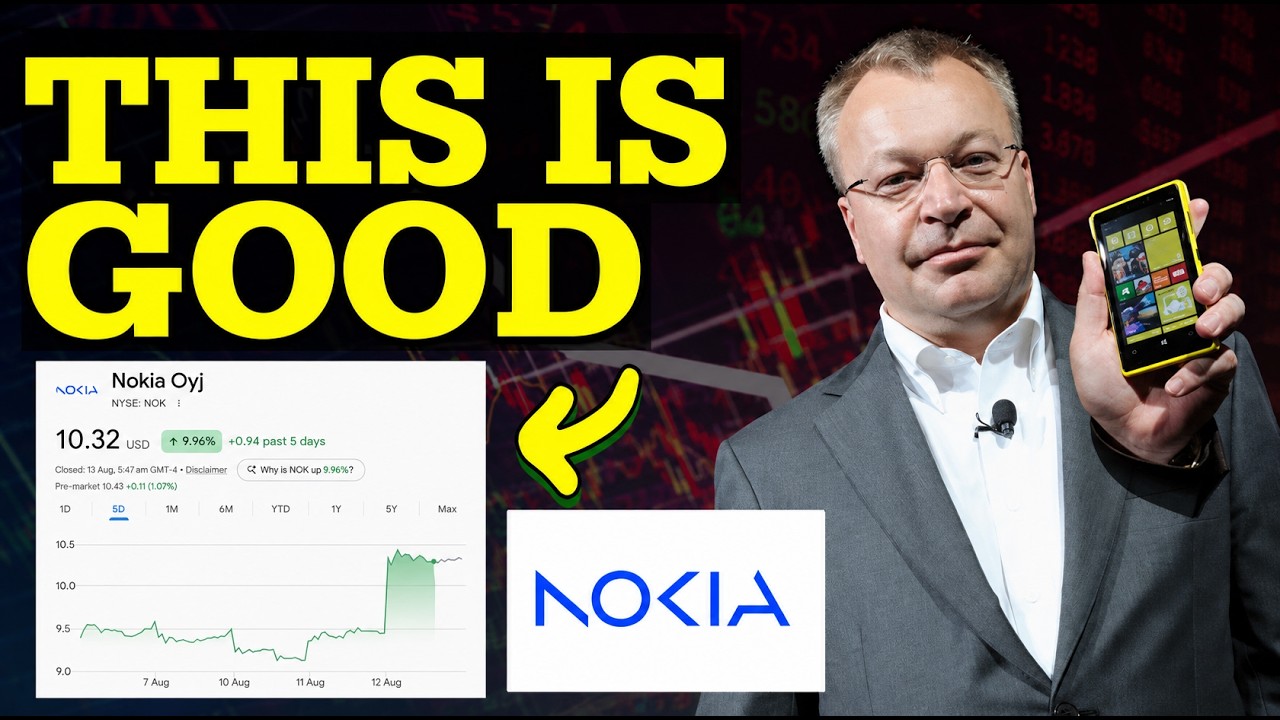
Good day to you everyone. Welcome back to the channel. Today we will talk about Nokia and its recent massive stock surge following an upbeat optical networking outlook. Nokia shares recently surged 9.2% in a single trading session, adding approximately €4.4 billion in market capitalization. This impressive rally pushed the stock above $10 per share as Wall Street re-evaluates Nokia from a legacy telecom equipment vendor into a critical artificial intelligence infrastructure play. Retail traders and institutional investors alike are eyeing a return toward $15 spurred by multiple operational catalysts across high-speed optical networking and data center connectivity. The immediate trigger behind this massive move is Nokia's latest disclosure regarding its AI and cloud order pipeline. The company reported that total order intake connected to its AI and cloud segment reached 2.8 billion. Even more striking, management revealed that these AI related orders are now running at 6.3 times the segment's quarterly revenue. That indicates an extraordinary volume of backlog accumulating in its optical and data center interconnect divisions. Furthermore, major Wall Street institutions have responded aggressively to these developments. Bank of America raised its price target on Nokia to $18.50, maintaining a buy rating and pointing directly to the structural order surge. At the same time, SEB equities upgraded the stock to buy with a€ 12 target, citing accelerating cloud demand. Meanwhile, reported regulatory moves by the United States Federal Communications Commission to restrict new Chinese optical transceivers are creating a regulatory tailwind, encouraging global cloud providers to pivot toward non-Chinese suppliers like Nokia. Hey everyone, quick pause before we dive deeper into the financial figures. If you have not realized yet, this presenter on screen is a digital clone of me. I create these videos to share datadriven perspectives and clear economic analysis on major stocks. So, if you enjoy this content, consider giving the channel a follow to help share these insights with more people. Now looking closely at Nokia's topline performance, the second quarter results proved that this order momentum is already showing up on the income statement. Net sales rose 8% year-over-year to 4.82 billion, beating consensus analyst expectations. The standout performer within Nokia was the network infrastructure division, which expanded by 12% overall. Within that division, optical networks revenue jumped 19% while IP networks grew 15% year-over-year. The company's focused effort to diversify away from traditional wireless carrier spending into high growth hyperscaler demand is bearing fruit. Revenue, specifically from AI and cloud customers, more than doubled, soaring 103% year-over-year and now representing nearly 10% of total company revenue. This growth reflects the critical role that optical transport plays in modern artificial intelligence workloads. A major strategic driver behind this revenue expansion is Nokia's acquisition of Infinera, which was completed in early 2025 for $2.3 billion. By integrating infin Nokia expanded its scale in optical networking, particularly across North American webscale customers and hypers scale data center operators. Management confirmed that the merger is on track to deliver €200 million in annual operating profit synergies by 2027 while expanding optical networking revenues significantly. To understand whether Nokia's rally is sustainable, we must look at the broader macro trends across the optical communications industry. The surge in generative artificial intelligence and large language models is fundamentally altering network architecture. Training and inferencing massive AI models require moving vast amounts of data not just within a single data center rack, but across geographically distributed server clusters and regions. Industry peers across the optical spectrum are reporting similar exponential demand patterns. Sienna Corporation recently reported 40% year-over-year revenue growth in its fiscal second quarter, accompanied by a record $7.7 billion order backlog. Sienna's management highlighted that hyperscala capital expenditures are expected to approach $1 trillion in total capex with an increasingly larger share directed specifically toward optical network infrastructure. Sienna's chief executive officer projected that the addressable optical market will double to $50 billion by 2029. Similarly, component manufacturers such as Lumenum, Coherent, and Marll technology have posted strong financial beats driven by optical transceivers and high-speed pluggables. Industry data indicates that data center decision makers expect interconnect bandwidth requirements to increase by more than six times over the next 5 years. Furthermore, over 40% of new data center facilities being constructed today are explicitly designed for artificial intelligence workloads. These industry-wide data points confirm that the demand surge is not a one quarter fluke or vendor specific event. Hyperscalers including Microsoft, Alphabet, Amazon and Meta are encountering physical space and power constraints at individual data center facilities. Consequently, they are adopting scale across network architectures, connecting multiple data centers with high-capacity 800 GB and optical links to operate as single unified AI supercomputers. While revenue growth is accelerating, evaluating profitability and cash generation is essential for long-term investors. Nokia's comparable second quarter operating profit rose substantially with comparable earnings per share climbing to€ 7 cents from 4 cents in the prior year period. Management also nudged its fullear profit outlook higher, demonstrating confidence in its operational execution. However, the margin profile reveals ongoing structural dynamics that warrant careful monitoring. Nokia's comparable operating margin currently sits around 6.2%. While this represents a solid recovery from prior quarters, it remains below the peak levels of nearly 11% seen during earlier network upgrade cycles. Margin expansion is being tempered by rising component costs, particularly memory chip shortages that management expects to persist through 2027. To protect gross margins against these inflationary supply chain pressures, Nokia is securing long-term component supply agreements, modifying hardware designs, and passing cost increases directly onto enterprise customers. Additionally, the high margin patent licensing division, Nokia Technologies, continues to provide a dependable cash buffer, generating stable recurring revenue with minimal variable expenditure. From an operating cash flow perspective, Nokia maintained a solid cash position of 5.46 billion euros in cash and short-term investments against long-term debt of €3.1 billion. This net cash position provides financial flexibility to fund strategic research and development, expand manufacturing capacity for optical systems, and execute ongoing share buybacks aimed at offsetting equity issuance from past acquisitions. Turning to valuation metrics, Nokia stock is undergoing a fundamental rerating by the market. Historically, Nokia traded as a low multiple legacy telecommunications equipment maker burdened by slow growth in carrier capital expenditures. With the expansion of its AI optical business, investors are comparing its valuation against higher multiple networking peers. Nokia currently trades at a forward price to earnings ratio of approximately 23.7 based on consensus estimates for the upcoming 12 months. On a price to operating cash flow basis, the stock trades at around 14 times trailing cash generation. Compared to purely hardware focused legacy vendors, these multiples reflect the growth premium attached to its AI and cloud order pipeline. By comparison, direct optical rival Sienna trades at a elevated forward earnings multiple following its recent price rally, while broader networking hardware peers like Cisco trade closer to 15 times forward earnings. If Nokia successfully converts its€ 2.8 8 billion euro AI order pipeline into higher margin recurring revenue. Forward operating cash flow multiples could compress naturally, making the stock appear attractively valued relative to its long-term growth rate. In summary, Nokia's 9.2% price surge reflects a meaningful strategic pivot from traditional telecom hardware toward high-capacity optical infrastructure for artificial intelligence. With€2.8 8 billion in AI orders, an expanding market share via the Infinera acquisition, and strong industry-wide tailwinds, Nokia possesses clear operational catalysts. However, investors should remain attentive to supply chain constraints, potential memory cost pressures, and the ongoing weakness in legacy mobile network spending. As always, this analysis represents my personal perspective based on publicly available data, and you should always conduct your own thorough research before making any financial decisions. Thank you for watching, and I look forward to hearing your thoughts on Nokia in the comments below.
Commentaires 0
Connectez-vous pour rejoindre la discussion.
Se connecterAucun commentaire pour l'instant. Soyez le premier à partager votre avis !