One through eight are Palantir, CrowdStrike, Palo Alto, Snowflake, Cloudflare, etcetera. There's a reason that these businesses trade so well, and it's because revenue compounds with usage.
One through eight are Palantir, CrowdStrike, Palo Alto, Snowflake, Cloudflare, etcetera. There's a reason that these businesses trade so well, and it's because revenue compounds with usage.
One through eight are Palantir, CrowdStrike, Palo Alto, Snowflake, Cloudflare, etcetera. There's a reason that these businesses trade so well, and it's because revenue compounds with usage.
One through eight are Palantir, CrowdStrike, Palo Alto, Snowflake, Cloudflare, etcetera. There's a reason that these businesses trade so well, and it's because revenue compounds with usage.
One through eight are Palantir, CrowdStrike, Palo Alto, Snowflake, Cloudflare, etcetera. There's a reason that these businesses trade so well, and it's because revenue compounds with usage.
Transcription Complète
I wanna start with general question about buying
and building organically. You know, at all layers of the five layer cake stack, all of
that's happening at once. Some people are building. Some people are are out in the market.
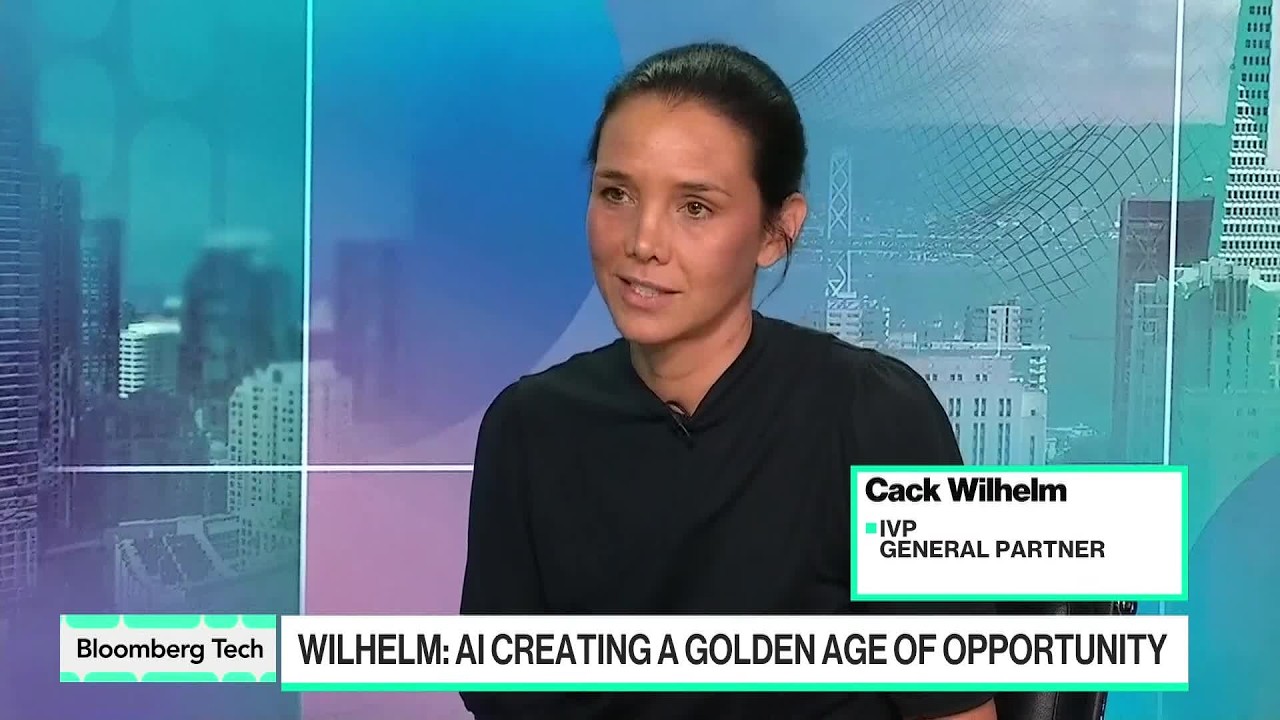
What is it that you see most in your in your portfolio? Yeah. Good question. So we're a venture capitalist.
Right? We're trying to invest in all these companies. We're you know, some of them we're
gonna sell to bigger companies, but the ones that we love are the ones that go
all the way. Right? The ones that go series b to S and P as we
like to say at IBP. So we're investing in the likes of Series b to S and P? Series b to S and P. That's the that's the internal mantra. I mean, we joke. Yeah. Sorry. I didn't mean to interrupt you. I
just like that. No. Yeah. So we're investing in the likes
of the Databricks and Decartes, you know, hopefully, those ten years ago versus today. But, yeah,
I mean, I think it's no surprise that NVIDIA's acquiring something like excuse me. I said
NVIDIA. Meant Anthropic. Anthropic in acquiring Descartes because what you have in Descartes is you have,
I mean, it's a world model, but I think that the reason that they're acquiring Descartes
is because of this inference optimization. Yes. And that is, like, one of these layers
of the stack that's becoming a super hot commodity. Software to make the chips run better in
simple terms. You're you're you're an infrastructure investor. Your background is in software infra. Where do
you focus right now? What what is your sort of area of expertise in the lane
that you're most focused on? Yeah. So very much software infrastructure and cyber
security. Different reasons for the two. You know, I learned this less lesson very viscerally as
a kid. Like, my first job out of college was working at Oracle selling databases. And
in a single day, I was a sales rep. I visited Chevron, Intuit, and Marmot, like
the tech clothing brand. And I was astounded at the the ray like, sort of the
breadth of of industries, but then the breadth of use cases too. And that was the
moment that it was like, you know what? These infrastructure companies have vast markets and TAMs.
And if you build something hard that no one else wants to build, I mean, these
can be long term compounding businesses. What are some of the the sort of,
I don't know. You you I I guess you'd say you don't have a favorite child,
but in the portfolio, like, which companies, yeah, are your favorites right now that you see
having the most potential? Okay. Well, let's tie this to public markets.
And if you look at the top 10 trading names, you have to get all the
way to number eight or nine before you get to a, like, sort of a conventional
software SaaS company. Right? And one through eight are Palantir, CrowdStrike, Palo Alto, Snowflake, Cloudflare, etcetera.
There's a reason that these businesses trade so well, and it's because revenue compounds with usage.
Right? And, like, implicit in that is it is uncorresponding to seats. I've totally forgot the
question you have. Question is which which are your favorite Oh, so my fave my my favorites are
the ones that do that. You know? So my favorites are Clickhouse. My favorites are Perplexity,
a usage compounding business. My favorites are Cribble, LangChain, Base 10. All of these are technical
founders building technical products selling into a technical audience. And once you have them, the net
dollar retention or, like, the the accumulating usage from those accounts is well over a 100,
a 150 Really interested in Perplexity. You know, we've they
seem to offer a much broader range of things now Absolutely. Than their origin. One way
that you could explain to us is when when you make the the sponsorship or pitch
to the rest of the partners and why Perplexity, What is the future that you'd outlined
to to the team? Why you'd back them? Perplexity was easy. It was two things. So
September 2023, it's about 2,000,000 in ARR as compared to the whatever Arvin has said publicly,
500,000,000. This is so this is three years ago. It came down two things. Number one,
the CEO. I mean, Arvin is in a class of his own, a technical wizard, extremely
ambitious. And number two, it was as simple as they ship product quickly. Yes. Right? And that is a compounding advantage in
this environment. So I think the mistake with Perplexity is thinking of it only as an
answer engine just as the mistake with thinking about Anthropic as just a model company. That
short changes both of those companies dramatically. Right? Perplexity was the first to be an answer
engine. It was also the first to launch a browser, Comet. It was the first to
launch deep research. It was the first to lurch launch a computer agent with computer. And
so that is a usage compounding story. Right? Because you put all those things together and
as revenue scales with usage. We could sort of stop for for any
period of time and say, there's a lot happening in AI. Are we in an AI
bubble, etcetera, etcetera? I I would ask you, what is the trend within AI that you
have identified? What do you think is happening within all of the companies that you're backing
that that is less talked about at the moment? That they have insatiable interest in demand. But that's not changed. Right? Demand is still
running far ahead of the industry's ability to supply. Right. Exactly. I think someone said this morning
that they could sell their whole 02/2027 book today if, you know, given the chance. Now
you wouldn't wanna do that. But I I think that the thing that people are missing
is we can sign simultaneously be in a golden age of technology, which I think unequivocally
I mean, I'm a, like, diehard optimist, but I think unequivocally we are. And we could
have a capital markets adjustment. I won't say correction because that's probably a technical term. But
that wouldn't negate the fact that the it wouldn't say that the trend is fake. It
would just say that we have, like, a timing mismatch. And we probably have timing mismatches
all the time. I I just think we're in the I mean, mean, there are gonna
be different phases of this sort of AI proliferation, and we're still in sort of the
individual productivity phase. So if you're a corporate CEO, you might be underwhelmed. Right? Because you're
like, where is it showing up in the numbers? But if you look back, I mean,
think of I think it was 1987, the, MIT Nobel economist, Richard Solo. He said he
said the, the computer age is showing up everywhere except in the productivity stats. Yes. But that was in 1987. Right? And, like,
look today. I mean, he's also famous for the for the solo paradox, which which said,
like, which is really obvious today, but that general purpose technology will show up in long
term growth numbers, which, like, unequivocally it has. And so I think right right now, we're
probably in this, like, expectation mismatch where you have where you have it showing up in
productivity, but it's a little bit more individual. And we needed to flow through to workflows
and then to just, like, absolutely transforming companies. I'd love to end the conversation by learning
a little bit about IVP. You know, what the what the partnership's guiding principles are, what
you're trying to do differently. Yeah. I mean, honestly, the thing we're trying
to do differently is that we have done the same thing for forty six years. And now it's gonna change. If we can invest in
10 companies of consequence a year that have the potential to be generational companies, only 10.
Right? We don't want decision fatigue. We invest in 10 companies a year. That you know,
that's our mission. Is it harder to resist the urge to
to invest? Absolutely. But venture is a picking business. Yes. Venture is not a index coverage business. And
hence, we stick to our we do one thing, one thing well, and that's invest in
10 companies a year. It's okay based on reporting. Therefore, if some
funds have 50% write down, you just say 50% of these didn't work out. I'm asking
for an insight to the reality of how that works at the end. Oh, yeah. I mean, the in venture, you
have to adjust quickly that you can't flog yourself for the losers because the losers are
in service of the winners. Right? Across my portfolio, probably one or two companies will make
up the the vast, nugget of returns versus the long tail. I guess my question was that's still true
in the AI age. Oh, that is that is more true today
than it was yesterday, and it's five times more true than it was five years ago.
Yeah. Yeah. I mean, look at this morning. Right? Lovable raising at 13,000,000,000 and, Cognition raising
at 40,000,000,000. I mean, I think there are these just, like, crowned winners, and those are
gonna be the ones that return all the the returns in venture capital. And I think what you said earlier
is look at the the companies that can ship product. Cack Wilhelm, my VP. It's been
great to have you here.

Commentaires 0
Connectez-vous pour rejoindre la discussion.
Se connecterAucun commentaire pour l'instant. Soyez le premier à partager votre avis !