Google Stock Is Going Down Again: How Nvidia $500B Deal Threatens Its Moat (But Buffett Still Buy)

- Rendement de la vidéo
- —
- Appels
- 1
- Achat / Vente
- 1 0
- Publié
Recommandations
L'entrée est le cours de clôture de l'actif à la date de publication. Le cours actuel est la dernière clôture enregistrée.
-
Entrée $345,90 14 août 2026Actuel $345,90 14 août 2026Résultat +$0,00
I calculate the intrinsic value based on long-term normalized cash flows to be well above current trading levels.
Contexte "I calculate the intrinsic value based on long-term normalized cash flows to be well above current trading levels. So, this valuation disconnect remains one of the most interesting setups in mega-cap technology."
Transcription Complète
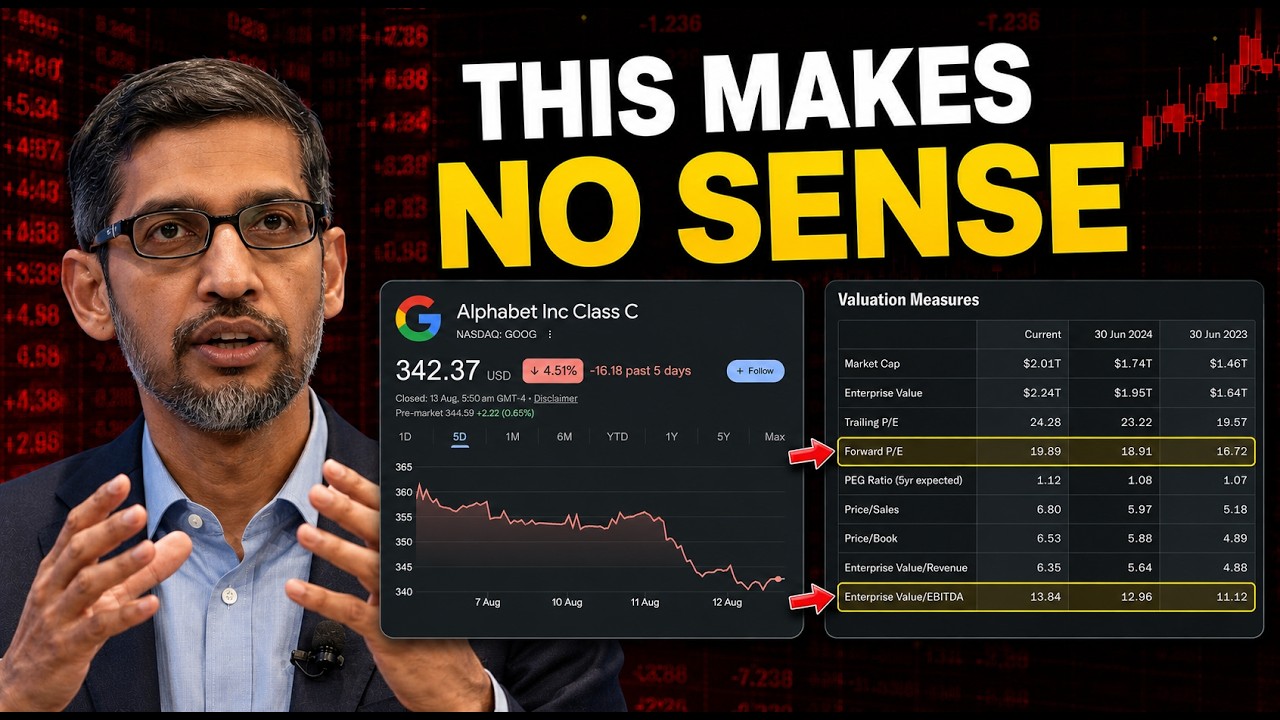
Good day to you everyone. Welcome back to the channel. Today we will talk about Alphabet stock trading down again after a brief rally following Microsoft earnings. Shares of Google parent company Alphabet are currently trading around $342 per share, representing a forward price-to-earnings ratio of just 17. This valuation level stands out as exceptionally low for a mega-cap technology leader with market dominance across multiple sectors. Many investors are struggling to understand why the market is selling off Alphabet despite its strong positions in global tech. Alphabet remains the undisputed leader in internet search, holding over 85% of global search market share. It is a premier powerhouse in artificial intelligence with its native Gemini architecture. It operates Google Cloud with massive enterprise momentum, and it maintains a key strategic investment in Anthropic, which is reportedly preparing for its highly anticipated initial public offering. Yet, despite these structural advantages, serious downside risks have emerged that are causing institutional investors to reevaluate the stock. >> [music] >> To analyze what is driving the recent pressure on Alphabet stock, we must examine the fundamental revenue figures and operating metrics from the second quarter of 2026. Alphabet delivered historic top-line results, posting total quarterly revenue of nearly $120 billion. This This represents an impressive year-over-year growth rate of 24%, proving that demand for Alphabet's digital ecosystem remains robust. The highlight of the earnings report was Google Cloud, which accelerated to $20 billion in quarterly revenue. On an annualized basis, Google Cloud is now operating at an 80 billion dollar run rate growing at an extraordinary 82% year-over-year. The enterprise demand for Gemini artificial intelligence models has pushed Google Cloud's backlog to a record 460 billion dollars with nearly 90% of Fortune 100 companies actively building on Alphabet's AI stack. However, the financial metrics reveal a sharp divergence between top-line expansion and free cash flow generation. Alphabet's capital expenditures soared to nearly 45 billion dollars in a single quarter bringing total 2026 capital expenditure projections to approximately 175 billion dollars. This massive investment in data centers, custom silicon, and gigawatt scale power infrastructure caused operating cash flow margins to compress. Free cash flow margin dropped from 21% in prior periods down to just 9%. While revenue beats expectations, the market is pricing in the reality of a massive capital spending cycle that absorbs cash flow in the near term. Hey everyone, quick pause here. If you haven't realized, the person speaking to you right now is my digital clone. I created this system to share data-driven perspectives and economic analysis on major stocks. So, if you're enjoying these breakdown videos, please consider giving the channel a follow as it really helps spread these insights to more people. Now, turning back to the macro industry context, global advertising expenditure continues to expand at roughly 12% annually. Digital search remains the most lucrative advertising surface on the internet generating reliable cash flow for market leaders. However, the artificial intelligence landscape is shifting from pure software margin expansion into a capital-intensive infrastructure war. Major technology firms are fighting to secure advanced semiconductors, power generation capacity, and specialized data center facilities. In previous years, technology companies scaled software products with near zero marginal cost. Today, scaling frontier AI models requires billions of dollars in upfront capital outlays for hardware compute. Microsoft, Amazon, Meta, and Alphabet are all pouring record amounts of capital into data center build-outs. The key challenge for Alphabet is that investors are measuring every dollar of capital expenditure against immediate cash flow returns. While advertising revenues support this massive investment, the market remains hyper-focused on whether hardware expenditure will translate into durable long-term operating margins. The most critical downside factor currently pressuring Alphabet stock involves Nvidia's recent $500 billion financing deal with Wall Street institutions. Nvidia partnered with major asset managers, including Apollo, BlackRock, Blackstone, Brookfield, Goldman Sachs, and KKR to establish dedicated AI compute financing platforms. Under this framework, institutional capital is mobilized to finance data centers, GPU clusters, and power facilities with Nvidia backstopping up to 25% of the residual value of its chips. This financial structure turns graphics processing units into a financeable, cash-flowing asset class, similar to real estate or energy infrastructure. This development poses a direct competitive threat to Google's proprietary custom chip strategy. For over a decade, Google developed its Tensor Processing Units, known as TPUs, to establish a cost advantage over rivals relying entirely on Nvidia GPUs. By training and running Gemini on internal TPUs, Google avoided paying Nvidia's lucrative hardware margins and offered lower cloud compute pricing to external clients like Anthropic. However, Nvidia's $500 billion financing vehicle democratizes access to massive GPU clusters for rival cloud platforms and AI developers. When institutional capital easily finances Nvidia hardware, the cost premium and competitive exclusivity of Google's custom TPUs are significantly diluted. Competitors can now scale AI factories without needing massive cash reserves on their balance sheets, eroding one of Google's primary hardware The second major downside concern stems from Google's recent Pixel 11 phone launch and the dynamics surrounding its consumer hardware distribution. Google officially unveiled the Pixel 11 lineup, introducing price hikes of roughly $100 across all models. The standard Pixel 11 now starts at $899 with the Pro and Fold models reaching upwards of 1,100 to 1,900 dollars. Google executives attributed these price increases to surging memory chip costs and the hardware demands of running native Gemini AI features directly on device. However, these price hikes reveal a fundamental flaw in how Google executes its hardware strategy. Google does not sell smartphones primarily to generate hardware manufacturing profits. The core objective of the Pixel phone line is to secure a direct distribution mode. By placing native Google hardware into consumers' hands, Google guarantees that its search engine remains the unchallengeable default, embeds Gemini as the primary native voice assistant, and collects high-value user data without paying tens of billions of dollars in default placement fees to Apple or third-party manufacturers. When Google raises prices on price-sensitive consumers, phone sales volume suffers. If consumers reject higher-priced Pixel hardware, Google fails to expand its direct user base. The phone itself is merely the delivery mechanism for Google's software moat, and pushing price hikes onto consumers directly undermines the adoption required to maintain that moat. Despite these downside prices, prominent super investors see massive upside value in Alphabet stock. Berkshire Hathaway, initiated under Warren Buffett and expanded under Greg Abel, has built a position in Alphabet valued at over $24 billion, making it Berkshire's fifth-largest equity holding. Super investors are drawn to Alphabet because its search revenue acts as an economic toll bridge on global commerce. Operating margins in search and YouTube remain exceptionally high, delivering resilient cash flows that cushion capital expenditure demands. Furthermore, Google Cloud's acceleration to an $80 billion run rate demonstrates that enterprise AI monetization is occurring in real time. Google's equity stake in Anthropic provides additional upside value as Anthropic prepares for its public market listing. Alphabet's balance sheet holds over $200 billion dollars cash and liquid assets, providing unparalleled financial flexibility. Trading at 17 times forward earnings, Alphabet is priced at a historically cheap valuation relative to its 27 times average PE ratio, presenting significant long-term margin of safety. Evaluating Alphabet at $342 per share requires weighing near-term infrastructure headwinds against long-term cash generation power. While Nvidia's $500 financing deal pressures custom silicon advantages and pixel price hikes slow hardware distribution, Alphabet's core cash flows, cloud acceleration, and 17 times forward PE multiple offer compelling fundamental support. I calculate the intrinsic value based on long-term normalized cash flows to be well above current trading levels. So, this valuation disconnect remains one of the most interesting setups in mega-cap technology. Thank you for joining today's breakdown, and I am eager to read your thoughts on Google stock in the comments section below.
Commentaires 0
Connectez-vous pour rejoindre la discussion.
Se connecterAucun commentaire pour l'instant. Soyez le premier à partager votre avis !