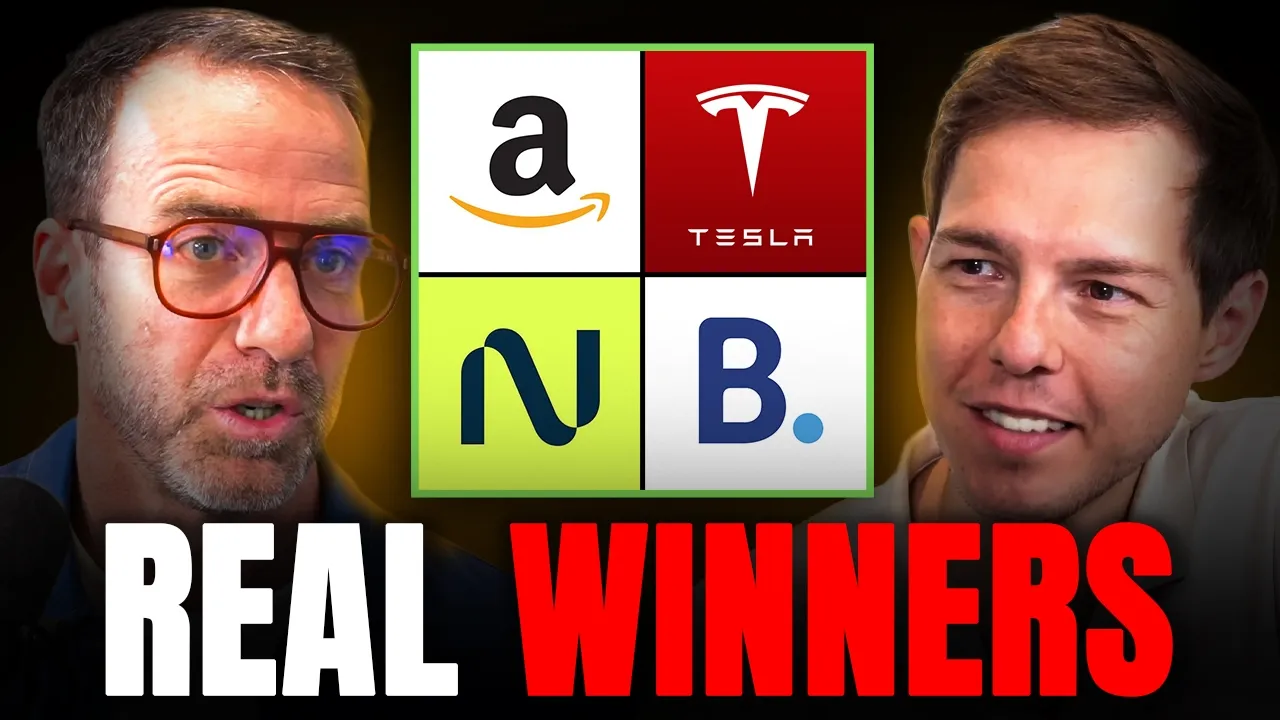
That's why I'm so hyped on Amazon, because Amazon is a company that spent 25 years building a global logistics network, distribution around the world, invested tens and tens of billions of dollars doing that, right? ... So, if I'm an investor right now, and I'm thinking the next 5 years, the next 8 years, who are going to be the big winners that no one's talking about today cuz maybe they're boring companies, I'm going to look at companies that have massive distribution moats
Contexte
“That's why I'm so hyped on Amazon, because Amazon is a company that spent 25 years building a global logistics network... So, if I'm an investor right now, and I'm thinking the next 5 years, the next 8 years... I'm going to look at companies that have massive distribution moats...”
Transcription Complète
You could perfect the methodology. It's all about information dissemination. You invest when you know something that other people haven't seen and you exit the investment when the rest of the world sees what you saw, right? Like all the people that made all their money on Tesla back in the day, they simply got in a Tesla and drove one. They're like, "This is a game-changing moment for the world." And they invested in Tesla. And then some number of years later, when the rest of the world was hyped on Tesla, they decided, "Well, I made all this money. Everyone kind of knows what I know now, so I'm going to sell, right?" It doesn't have to be an all or none decision. Like I always say, if you are unsure about something, buy half, sell half. Like that's the other rule that I live by. It's such a dumb rule, by the way. It's like it's such a dumb rule. It's like every time someone is confused, they call me. They're like, "Dude, I don't know, man. I'm I'm just like I'm at odds." Should I exit? I was like, "Dude, if you're at odds, just sell half of whatever you're planning on selling. And if it goes your way, be so happy that you pulled the trigger to sell half. If it doesn't go your way, be so happy that you didn't sell at all. You know what I'm saying? Like that that that dude, it's psychology. This this psychology part of investing is so important and you have control over it. Dude, I've been doing that forever. If works. It actually works. Glass half full, right? Like it's the greatest thing in the world. You don't have to overthink investing. You don't have to nail every trade. Just like live your life. When you see something that's popping that you connect the dots to a company that's going to benefit from it, if if you're the whole world's not already talking about it, you probably have some edge there. >> So after this last big win then, are you still invested aggressively in Nebius, Bloom, and Amazon? >> Y- mainly Bloom and Amazon, yes. Uh I think the the big picture here is that everyone has the wrong framing for this AI supercycle. People are trying to frame the size of this AI sector by how much money it could potentially make companies or save companies. I think history will reveal that we will only know the value of AI once we understand what can be built once compute becomes fully abundant, okay? So, what I mean by that is our minds can't actually even assess the value of the AI sector today because until compute becomes truly abundant we won't know what we can do with it as a civilization. Um think about movies that rewrite themselves in real time based on your emotions, personalized movies, okay? Think about video games that have no scripted content because they're being generated in real time. Think about having 24/7 scientific discoveries made with tens of millions of agents that are operating on the equivalent of trillions of dollars of compute today, right? Uh we're extending life. Uh I think what we'll ultimately find out is that AI will be looked at in the future as something that looks much less like software and much more like the you know, electricity basically, like the founding of electricity. So, if you think about that, when we discovered electricity were we able to capably understand what the world would do with that? Just just think about that. When we discovered electricity, were we able to comprehend how that would change the world and what economies would be grown from that and industries and sectors? Absolutely not. So, it's insane that we think we could actually frame the size of the AI world based on the world today. We just don't have enough compute and enough capacity to even assess what we want to do with it yet. Do like like so we need to get out of the current frame and understand that there's a different framework that we're not ready for that will emerge over the next 10 to 15 years. And that's how I think about it. So, if you think about it like that, whoever those leaders are and they'll they could change over time, I need to be heavily invested in that. I just I have to be. >> So, I saw this tweet that says, "Here's how you retire in 5 years. Right now, the biggest play is AI infrastructure. Then from 2028 to 2030, it's the AI power grids. And then from 2030 onwards, it's physical AI and robotics." What are your thoughts on that? >> That could be true, but I have a bit of a different non-competitive thesis on what I'm focused on. Obviously, in the last show we talked a lot about the AI efficiency wave and how the next big leg up in technology would be any company that's going to benefit from AI, right? Save money from AI, generate more revenue from AI because you essentially now can grow you can grow as a company without having to spend infinitely to grow, right? If if intelligence is free. I think the biggest opportunity going forward when it comes to monetizing AI are those companies that have distribution. So, I just got you guys a coffee, an iced coffee. >> Mhm. >> Got you guys an iced coffee. >> Yes. >> Well, when you guys were setting up. >> that. >> And so, when I when I went in my car, I spilled one from those cups, right? Why can we not make better coffee cups, right? And I was thinking, infinite intelligence and AI is going to enable us to make way better plastic coffee cups that are way cheaper. I don't even know what that means right now, but it will. And you could say that for essentially every single product in the world. We're going to figure out how to make better products way cheaper because having access to infinite intelligence is going to teach us how to do that. So, who's going to benefit from that? Is it going to be a startup that develops the next best plastic coffee cup when we have infinite ubiquitous intelligence? Or would be the company that already has massive distribution in coffee cups if every company's going to have access to that intelligence at the same time? >> I just want to say, I have no idea why they've not put gimbals in cars for cups. Cuz that you have you could have a coffee filled all the way to the brim and you make a turn and it just turns >> they do. I've seen it. I've seen >> I have never seen that. I I think in a Ferrari or a sports car or a Porsche, a little like just something >> Okay, but do you not remember the infomercial cup from like 12 years ago that it would it had that counter balancing in the cup itself? That was essentially what you're talking about. >> In the Why don't they put that in cars? >> But they because no one even buys the cup anymore. I don't know, you might be overthinking it. Even though it makes sense, people don't care. >> I've spilled so much coffee cuz I fill it up to the top and I just take a turn too much and the thing just spills over. >> But listen, think about what I just said. >> Yes. >> It's not going to be a new company. It's going to be because once intelligence becomes fully democratized and free, >> [sighs and gasps] >> you don't have any inherent advantage by coming up with something better. The company that has the distribution already is the company that's going to get that advantage because everyone will have access to the best coffee cup design simultaneously. So, the company that already has the distribution of the coffee cups and has the manufacturing facility, and has the logistics, and has the deployment of billions of coffee cups, is going to get to make coffee cups cheaper and better, but mainly cheaper, right? Um and that company is going to become more profitable. And you could repeat that story for almost every single company in the world that has massive distribution and moats in their industry sector that do not rely on intelligence. That's why I'm so hyped on Amazon, because Amazon is a company that spent 25 years building a global logistics network, distribution around the world, invested tens and tens of billions of dollars doing that, right? But you just need to look at companies that can operate more efficiently once intelligence becomes infinite. And it's all about distribution. Those that have distribution will win. So, if I'm an investor right now, and I'm thinking the next 5 years, the next 8 years, who are going to be the big winners that no one's talking about today cuz maybe they're boring companies, I'm going to look at companies that have massive distribution moats, because once the intelligence wave hits, they are going to win in so many ways, every way, right? They'll be making their products cheaper. In fact, I just saw I just read an earnings report earlier today on a trade I got lucky on. It was booking.com. >> Yes. >> And I was scanning the earnings report, and I noticed something in there. And it is that the cost of their customer service at booking.com was meaningfully coming down due to the AI tools that they've been developing and instituting across the organization. Which we hadn't seen that yet, guys. Like we had not seen that hit regular end climate. is what I was talking about, right? The AI efficiency wave. This is just one little piece of information. If we start to see that wording starting to come out more and more in earnings reports, we're lowering our costs to this AI to watch out. Dude, you are going to see AI blow up unlike we've ever seen it before cuz that is the last leg that everyone's waiting for. Everyone that is anti-AI in terms of not believing in its value keeps raising the bar and raising the bar. At first it was like, "Hey, the hyperscalers are not seeing any returns on their investments." Okay, well, they're seeing the returns, but they're only seeing returns because all these companies are spending so much money on compute with them and they're not seeing any returns on their investment. And so eventually it's all going to unwind. As soon as we start to see all the world's companies saying, "Nope, we're operating at higher efficiency. We are now growing at and we're able to make this step growing because we can grow more efficiently. Like we would have to spend this much money to enter this space, but now we're doing it for 10 cents on the dollar. And so we're taking that initiative and now we're generating more revenue, more profits." As soon as those reports start hitting the street, that is going to lead to I think the biggest mega cycle that we've ever seen in AI yet because it's not about 20 companies, guys. It's about every theoretically every company in the S&P. Right? For the most Not all of them. Yeah, like whichever ones So, last time we talked about companies that would benefit from efficiencies and that still exist and also from from from revenue expansion due to being able to operate and grow more efficiently. So, now a use case that didn't make sense for them before now makes sense because the costs are lower so they can chase that use case. This time we're talking about the companies that benefit most are the ones that have moats in distribution. So, that's where I'm looking the next year. I'm trying to decipher who has the biggest distribution moats because intelligence is going to bring costs down massively. >> What do you think about the SpaceX IPO? Because that's now down, I believe, over 40% from its peak. At what price do you buy SpaceX? Now, really quick, every business is asking themselves the same question. How do we make AI work for us? The possibilities are limitless, but guessing is too risky and sitting on the sidelines is not an option because one thing is certain, if you're not doing it, your competitors are already making their move. And that's where our sponsor NetSuite by Oracle comes in. It's the number one AI cloud ERP trusted by over 43,000 businesses to manage everything from financials and inventory to commerce, HR, and CRM all in one unified system. When all of your data's in one place, your AI becomes a lot smarter. It doesn't just guess, it knows. NetSuite intelligently automates routine tasks, delivers real-time insights, and helps you make fast, confident decisions that actually help drive growth. And it's not just an add-on, it's AI that's literally built right into the system that runs your business, helping you cut costs, improve accuracy, and stay ahead of the competition. Whether your company is making millions or even hundreds of millions, NetSuite gives you visibility and control to keep moving forward. Honestly, if I were building a business of this size, NetSuite's the only company that I have 100% confidence in. So, if your revenues are at least in the seven figures, get our completely free business guide demystifying AI at netsuite.com/clips. Again, the guide is free for you at netsuite.com/clips. netsuite.com/clips with the link down below in the description. What do you think about the SpaceX IPO? Because that's now down, I believe, over 40% from its peak. At what price do you buy SpaceX? >> If If you look at everything I said about SpaceX, you can tell I was trying to like be really careful with my words because so many retail investors were so hyped on SpaceX. I wanted to kind of warn them, but like I didn't want to like >> [sighs] >> I didn't want to be the guy to like poop on the party, right? And and SpaceX did so well when it IPO'd. I was really happy for all these people that made money, but the truth is, as I said before, anyone with any amount of money, institutions or high net worth, has been pitched SpaceX 100 times in the 12 to 18 months before that IPO. So, anyone with real money had the ability to invest in SpaceX at hundreds of billions of dollars. And virtually nothing has changed between them then and now. So, I think it's insane seeing SpaceX at a trillion and a half. If If you love it at a trillion and a half and you have money to invest, you should have been investing aggressively at 3, 4, 500 billion. So, like I just don't know I don't understand. It makes zero >> say that about Tesla? Because a lot of people said the same thing about Tesla that oh, it's overvalued, it's this and that, but it still somehow managed to do well. >> No. No, the numbers are totally different. I just risk reward on large numbers here. I mean, the numbers aren't there. The numbers are only there for SpaceX under like theoreticals that are years out, which is why I said, you know, if you want to invest in SpaceX and the story continues to get better and better, it's possible with a blue sky company like that that people will continue to value it for what it they might build 10 years from now. And if you want to be part of that game, then go ahead and be part of it. It's not something I'm interested for me, that's a highly speculative game based on something that might or might never materialize. When I look at SpaceX's actual business, I love it and that's why I invested in it at $30 billion. Okay, I loved what they were doing with satellites and I was like the satellite business is going to be worth more than $30 billion. I see it at $1.6 trillion today even after the move down. You said it was like $1.6 trillion. Is that right? >> $1.6 today after being down 40%. >> I I'm like whatever people are seeing in SpaceX is something more than I'm able to see. So I only invest in companies when I see something that others don't. It's the opposite with SpaceX. With SpaceX others see something in SpaceX that I don't which is totally fine. It's just not right for me. Um so there's no world in which SpaceX becomes an investment in my portfolio and unless something radically changes. Radically. >> even if it does follow your thesis which is they have distribution and they have a moat. Would you agree with that? >> They have distribution. They have a moat. Absolutely. >> The only difference is that there's no practical use case for exactly that. Like that is assuming that we can't come up with an alternative solution that you know outside of space or like on earth that can do what SpaceX is trying to do with AI. Is that like the main >> People are valuing SpaceX based on the best of all best case scenarios. Right? That That's what I'm saying. >> So it's just >> Yeah I don't Yeah I just don't It's not even a math problem. It's just like the people that are invested in SpaceX are invested in it because they believe in these pie in the sky goals which is awesome. I hope they hit them. I just like I not only I don't believe in them. All right? I haven't seen proof that I think we're highly likely to hit that. And even if we were it wouldn't matter to me cuz it's already being valued assuming that that happens. Right? So I'm going to invest in something where I see something big that is likely to happen where the rest of the world doesn't see it. And I have conviction it will happen. So it's the polar opposite of how I invest.

Commentaires 0
Connectez-vous pour rejoindre la discussion.
Se connecterAucun commentaire pour l'instant. Soyez le premier à partager votre avis !