Coke, McDonald's Caterpillar Johnson Johnson, Taiwan Semi, etc.
Contexte
"25% in high quality stocks, 25% in property and casualty, 25% in gold and bitcoin and 25% in cash. So... Coke, McDonald's Caterpillar Johnson Johnson, Taiwan Semi, etc."
Coke, McDonald's Caterpillar Johnson Johnson, Taiwan Semi, etc.
Contexte
"25% in high quality stocks, 25% in property and casualty, 25% in gold and bitcoin and 25% in cash. So... Coke, McDonald's Caterpillar Johnson Johnson, Taiwan Semi, etc."
Coke, McDonald's Caterpillar Johnson Johnson, Taiwan Semi, etc.
Contexte
"25% in high quality stocks, 25% in property and casualty, 25% in gold and bitcoin and 25% in cash. So... Coke, McDonald's Caterpillar Johnson Johnson, Taiwan Semi, etc."
Coke, McDonald's Caterpillar Johnson Johnson, Taiwan Semi, etc.
Contexte
"25% in high quality stocks, 25% in property and casualty, 25% in gold and bitcoin and 25% in cash. So... Coke, McDonald's Caterpillar Johnson Johnson, Taiwan Semi, etc."
My favorite investment right now has to be um gold streaming companies. Uh there's a new one that just uh went public this year called Versame. It's a fantastic business, it's going to be out home run for investment for investors
Royal Gold, uh, Franco Nevada, uh, these these firms take US dollars and they buy gold mines with them
Contexte
"but also the the the oldest and best are still great. Royal Gold, uh, Franco Nevada, uh, these these firms take US dollars and they buy gold mines with them"
Royal Gold, uh, Franco Nevada, uh, these these firms take US dollars and they buy gold mines with them
Contexte
"but also the the the oldest and best are still great. Royal Gold, uh, Franco Nevada, uh, these these firms take US dollars and they buy gold mines with them"
Transcription Complète
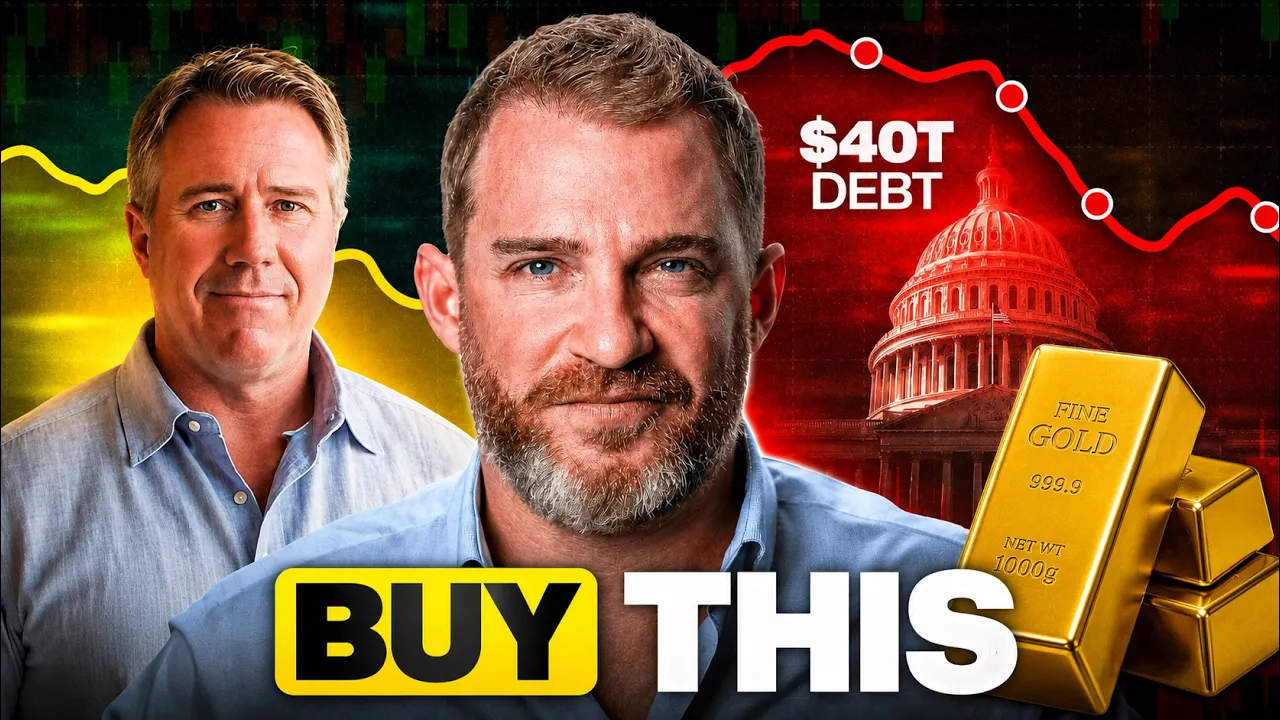
Porter Stansberry is one of the most polarizing figures in the investing world. He is rich, he speaks his mind, and he pulls no punches. But he's also wellspoken, an [music] extremely talented writer, and has a better understanding of the debt markets than anyone I've ever met. His new book is titled 2029, the end of America. Porter believes the United States Treasury will be insolvent inside of 3 years, which sounds crazy, but his arguments are convincing. I just finished reading the book and I've asked him to come on this channel to discuss it because I want all of you to hear both what he is predicting [music] and what you can do to protect yourself financially. Now, he has promised to lay out his portfolio which was designed specifically for this very event. Ladies and gentlemen, Border Stanberry Porter, welcome. Thanks for coming on. >> Man, I'm really I'm really glad to be here and uh it's very fascinating that we have some similar uh background. I I didn't realize until we spoke that you uh you worked many moons ago at the Oxford Club. >> I want to ask you about financial stuff directly. That's mainly my topic is investments and stock trading. Uh you've been in this business for 20 years, 30 years uh plus. You put a date at 2029 uh on this book and I know it's an estimate, right? No one can target to the exact but essentially some level of financial collapse. What what is it? Do you mind laying out your case for kind of what you're seeing, how you think things are going to play out over the next call it five years or so? >> Yeah, I not at all. I think when I used to talk about these ideas, people would look at me like I had four eyeballs, you know, but now when I talk about these ideas, everyone's like, "Yeah, obviously." But now the problem is they're like, "Well, it's so obvious that it's not it can't be a crisis because everyone knows it's happening." So, it's just interesting because it used to be people would say, "Oh, that could never happen." Now they say, "Oh yeah obviously." >> Yeah. And by the way, guys, what he's referring to, Porter published uh something called, was it 2012? It was called, was it called The End of America? >> Right. So I wrote I wrote a documentary um 15 years ago called The End of America. And what I wrote about was the fact that the government was using the printing press to bail out the global banking system from the global financial crisis. I said that that was going to have all kinds of repercussions on our society. Namely, that when you debotch the currency, you were going to send a whole bunch of people in the middle class into the lower class and they weren't going to understand how it happened and it was going to completely destabilize our country politically because all of a sudden these people were going to be impoverished and they wouldn't understand why. And I said what you would see is big decline in labor force participation rate. I said you'd see a huge increase in gambling, a huge increase in prostitution, a huge increase in drug addiction and alcoholism, and a huge increase of of what I call crimes of desperation. And if you look what's happened to our society, those things have all happened. And all I also said, you'd see a huge rise in political violence. And this was before uh Occupy Wall Street, before Black Lives Matter, before the government tried to, you know, trap us all in our homes for for the flu. So, you know, there's no question that our society has changed dramatically in the last 15 years. And I believe it's because so many people's wages and savings have been destroyed through this this policy that they, you know, they they they call quantitative easing. But what it really, of course, is is a huge expansion of the money supply, far in excess of savings or gains to productivity. the result of which has been the doubling of grocery prices, the you know the tripling of health care prices. When I used to talk about this 15 years ago, people would look at me like I was crazy and they'd say, "Oh, that could never happen in our country." Now, everybody goes, "Well, of course, obviously." So, what's the problem? And the problem is that most of the transfer payments that the government has to make are specifically legislatively automatically linked to inflation. So the the social security payments, Medicare payments, uh veterans administration benefits, th all those transfer payments are now growing twice as fast as GDP and they are not financable. So, it's not just that the government debt is growing faster than GDP. It's that the benefits are expanding at the same pace as inflation and the government has to print in order to pay its bills. We cannot run a 5 to 7% of GDP fiscal deficit when we are $40 trillion in debt when we have full employment. >> There is there is no way. That's such a good point because we know how much they printed following CO. We can argue whether whether over whether that was >> the right thing to do or not, but we're we're hearing huge GDP growth. Everything's great and and we're still we still can't make ends meet. >> No, I'm saying what does this look like in a bad time? >> They don't talk anything about it, but so far this year, they've printed roughly a hundred billion dollar, right? That's just that's just taxes that they didn't pass through legislation and they're stealing from us. Um, so you know that these are very real problems and what I what I point out is that the ability to finance our existing debts is going to reach a a plateau. It's going to reach a limit at around 2029. And that is exactly the same time, by the way, that all the trust funds that have been funding the the operating deficits in Social Security and Medicare are going to begin to run dry. Now if you look at the government's estimates they say between 2032 and 2034 but those estimates don't don't you know account for an an a higher than expected rate of inflation which we are having and they also don't account for any kind of recession or bare market. So in other words if everything goes perfectly social security is going to run out of money by 2032. And what I'm saying is by 2029, the fact that it is going to run out of money will become such a near-term problem that it will affect the current year's budget. And so 2029 will be the year we have this reckoning. And there are no good solutions. If we try to print our way out, all we do is cause those transfer benefits to skyrocket because they're all linked to inflation. A and the other thing that people don't want to talk about is no matter how you structure tax payments, America has never been able to get more than about 20% of GDP in tax revenue. Didn't matter. Even when the tax rates were 90%. Why? Well, because when tax rates are 90%, people like me and you just stop working. >> Quit working. Yeah. >> Yeah. So, you know, you you can't So, so in other words, what I'm saying is that our government by 2029 will have to default. there will be absolutely no choice and it's what that default will look like which is really the entire point of book that I wrote and if you look to history if you look to examples like Philip the fair which I think is just a fantastic story >> really cool >> um governments that go bankrupt always do the same things they always always always find a way to steal assets from their creditors and the the American government's biggest creditor are the people that it owes benefits to in social security and Medicare the that that who's really is holding the bag here. Sure, foreign central banks own $7 trillion worth of treasuries, but the the vast majority of what we owe we owe to the to the beneficiaries of Social Security and Medicare who have paid into those systems for their entire lives. So just imagine the political havoc when they go, "Oops, sorry, there's no money here." Well, this is an argument I hear a lot and and people get heated understandably so, especially boomers and retirees going, "It's not an entitlement. I paid that money. It's mine." And that's true. But, you know, even a generation ago, there was what was it? Five worker five workers per retiree receiving benefits. Today, it's like 2.6 or 2.7. It's a small fraction. So, prices are are are up. They're trying to to suck money out of half as many people to provide these benefits for others who they already spent it. Is that is that too simplified of a of a take on that? >> Is even simpler. Uh the the FICA taxes, the payroll taxes that you pay that that are that go directly to the Social Security Administration's trusts. Um those funds are nothing but a tax. There is no account. The money goes directly into the general fund. it is spent in the same calendar year that is produced. Um the the whole accounting charade of the Social Security Administration's trust funds is just that it's an accounting charade. The government gets the money. It writes an IOU to Social Security. It says here's your Treasury bond. Good luck collecting and they go spend the money. And this has all been adjudicated by the Supreme Court. You do not have any legal right whatsoever to the taxes you've paid to to FICA to the federal government. Zero. So you can say all you want that it's a that it's a that it's an account. The government actually sends you like little documents over the years that tells you how much you've got in the in the system. >> Yeah. >> All those are all lies. >> Yeah. >> So um if people don't know that that's a shock, but it's it's it's it's you can look up the the Supreme Court case. The the the name of the case escaped me at the moment. It's in the book. It'll come back to me in a second. Yeah. All it is is a tax and the taxes are not nearly high enough to pay uh for the benefits that have been promised and the money is going to run out somewhere between 2030 and 2034. It is not possible. It is not possible for two people for two working people to support two retirees. It's not possible. >> Can't be done. >> How do you recommend preparing for this? you lay out uh I thought very well a a basically four bucket portfolio in this book um for people worrying about this and retirees that you know have a an IRA or whatever put away what survives this what thrives in this and what do you absolutely avoid in terms of investments >> yeah well that's the real question we you and I are not in charge of the government's uh fiscal or monetary policy we you know we can tell everyone that they're They're doing things that are going to lead to a very very significant fiscal and monetary crisis in a very short amount of time. But the question is not, you know, okay, it's it's what do I do to protect myself and my family? And the the number one thing that you that I think that you really really need to figure out how to do is how to get a hold of real assets that are productive. So I I outline a way of investing in timber in this book and you know it's a way that will protect you and your family from inflation and it'll protect you whether the stock market goes up or down and it can lead to a lot of income for you as well. That's one of the things that has historically performed very best during periods of uncertainty, especially during periods of inflation. The other thing I did was I went and I looked at what are all which companies were able to continue paying their dividends throughout the great depression. And you know if you if you are invested in common stocks that are when I say this people again look at me like I have four eyes. I'm not saying to go buy an index fund. I'm not saying that stocks as a whole are going to do very well if inflation goes to 10 or 12% or if the Treasury defaults. I mean, I don't expect that at all. >> Be a rough day on Wall Street. >> Yeah, very rough day on Wall Street. What I'm saying is that would I rather have $100 in the bank or $100 worth of Coca-Cola stock in that on that day? Assuming, by the way, the stock market doesn't even open. And my answer is, I would rather have $100 worth of Coca-Cola stock. Why? Well, because when I hold a dollar, all I'm holding is a receipt from a bankrupt treasury. I I'm I own nothing. And if you want to know what that's like, go talk to anyone who's lived in Argentina for the past 30 years. You know, when I was in Argentina during one of their crisises and the 2003 time frame, their dollar had gone from one to one to one to four and their entire middle class was wiped out. My tour guide for that trip was a full-fledged medical doctor who didn't have a job because nobody could afford to pay for doctors anymore. So he was actually become a tour guide whereas you know he used to be a medical director. That's what happens to societies when their currencies go to zero. Now we thought when Argentina was was was 4 to1 that it was dirt cheap. I mean I remember looking at $10 million apartments in Buenos areas that were selling for $500,000 but only if you had hard currency. Nobody wanted pesos. And that was when it was 4 to1. Okay. Well, it at at the at the most recent peak it was 300 to one. So, wherever the currency is, it can always go lower. Okay? And what happens to something like a Coca-Cola is what they'll do is they'll increase their prices because they've got to pay their suppliers. So, the the price of Coke will keep going up in terms of the the worthless currency and that so will the value of their dividends. So if you look at any any place that's survived a hyperinflation, one of the things that does the best is very highquality businesses. That's not to say every stock. It's to say very high quality businesses. So I would say Coca-Cola, I'd say Philip Morris, I'd say Hershey, I'd say things like um uh beer companies. those things are going to do okay no matter what happens to the currency because those are things that everyday people are going to want to have every day that anyone can afford. And so that's a that's a very good way of protecting your assets. So timber very high quality businesses and of course the most obvious choice are are gold and bitcoin. And in the scenario that I think we're going to see, I would I expect the price of gold to go above $10,000 an ounce, maybe above $20,000 an ounce. And so I've always advocated, and this has been true of me, as you know, since 2005. I've always advocated holding at least 10% of your portfolio in gold. Um, and I think up to 25% makes sense for most people. >> 25% gold. Okay. So you're 25% gold, 25% what you call lendy stock, but basically these ones that have and the the argument being listen if they existed for the last h 100red years the odds are very good they're going to be around in 30 or 40 more and yeah you you Coke, McDonald's Caterpillar Johnson Johnson, Taiwan Semi, etc. Um so basically kind of like four buckets of one into stocks uh these companies a quarter into gold gold like gold royalty streams and Bitcoin. Um, I've kind of been iffy on Bitcoin. Not because I don't agree with the the concept of it, but it scares the hell out of me to think all my life savings can be on a flash drive that falls down a gutter and it's gone forever. U, but you think it survives and does well as digital gold. >> Yeah, I do. Money is evolves because of human choices. And in many ways, Bitcoin is a better form of money than gold. And it is no surprise that more and more people are choosing it as a reserve asset. As far as using it, I would personally never try to put my Bitcoin on a zip drive or do anything like that. I use the ETFs that are available. I go, you know, maybe I'm naive, but I actually trust, you know, a trillion dollar bank to know what it's doing and and to be able to uh manage the the technical process better than I can. >> Yes. So, I I think I think you're going to see more and more and more people continue to adopt Bitcoin because it is actually a better form of money and money is something that evolves through human choice. >> Do you think I mean right now we have I think for the first time ever a pro- crypto president and whether that's because his son started crypto companies I don't know. Um but he wasn't this pro crypto at his first term. you know, the the next person who comes in if they were very anti- Bitcoin. I mean, in my if you look back through history, not a lot of governments have allowed someone to compete with their control over the national currency. And I've always looked at Bitcoin is yeah, they're letting it go now because nobody actually buys anything with it, right? As you said, it's a better store or it's a very good store of value. People are holding as an investment. But if you know, you and I were transacting bids, if I was paying my my my lawn guy in Bitcoin, I'm pretty sure the government would come around pretty quickly if they realized you and I were, you know, paying for goods and services and avoiding taxes. >> I I disagree with you about all that. Um, >> do you really? >> Oh, yeah. Very strongly. Uh, reserve assets are never used in transactions. Gold was never used as a daily currency. Uh, that's not the point of money. That that's what currency is for. It's not what money is for. Money is for settling debts and money is for holding value over over decades. That's the point of money. And obviously you to do that you want to you want to have something that is safe over periods of time that doesn't expand its supply in a way that you can't understand and that is easy to transact in and bulk. And in that regards, Bitcoin is is somewhat better than gold. It's also much easier to hide. Much easier. >> So you don't you don't think it'll ever be used as like a day-to-day currency. You just think it'd be served like as gold of it. No. Just like, by the way, again, >> which gold isn't either. Yeah. >> Never. And and and by the way, people forget this. The government outlawed gold in the United States for 42 years from 1933 to 1975. >> Outlawed gold. You weren't allowed to have gold as Americans. Yeah. >> Did that did that lead to people abandoning gold as a as a market currency? No. Not at least. >> Okay. So, that makes a lot more sense. >> They can outlaw Bitcoin if they want and then I'll have to move my Bitcoin to Switzerland or do something else with it. But it won't it will not stop the growth of Bitcoin adoption because because Bitcoin is simply a better form of money and the market goes to where that is being created and where that is respected and and where that can be used lawfully. So it would be a terrible mistake for our country to outlaw Bitcoin. I'm not saying we won't do it. We make terrible mistakes all the time. >> Uh but it won't it will not stop Bitcoin's value from from um from increasing. >> Okay. And then I well I'll let them read the book for the other but you you have another bucket of stocks in this book which I thought was really cool that the PNC lines kind of an interesting angle there which is essentially the the formula that Warren Buffett used for 70 years which is insurance companies take in premiums they invest a float they know what they're doing and they they make a little bit of profit and they get money to invest for free for a year right and show compound >> and I think I think the most important thing there is to realize that truly that the bond market and when I mean when I say bond bonds. What I'm talking about is fixed income securities that are more than about 5 years in duration. Those are no longer investable. You you cannot have what's called duration risk in your portfolio. You cannot if you buy a 10-year bond or or a 15-year bond, you're going to lose between 50 and 75% of your wealth. You is no longer an investable asset. Cannot do that anymore. And if you look at the bond market since the end of COVID, those bonds have lost about 60% of their value. They will continue to lose that much every five or seven years because the government is going to continue to print money to pay those those debts. And insurance companies are a replacement for that. It's it's a way of you you want to have used to have fixed income in your portfolio because they were they were less volatile. And they are less volatile. The problem is they're only less volatile because they're going down in a tight channel. It's not the kind of low volatility you want, >> right? They're just steadily declining. >> And so, and so I I would replace if you if you had a 60/40 portfolio, 60% in equities, 40% in fixed income, I would replace the fixed income portion with property and casualty insurance equity. And you do that because what what are what's a property and casualty insurance company? Well, the balance sheet is just a whole bunch of fixed income. But unlike a a a bond, the the insurance company has the ability to manage duration risk. They can hedge the duration risk. They can buy shorter term fixed income. And best of all, they have this underwriting unit on top of it that's getting these premiums and investing the float. And they can make a little bit money on underwriting so that the the combined return on equity for them, if they're doing a good job, is between 15 and 20%. And that's enough to protect you from inflation while still being mainly at fixed income investments. >> Other than like you said really great century old companies, quality stocks, uh the PNC insurance carriers, gold, gold stream, Bitcoin, etc. Um cash. Do you hold should people be holding cash? I'm just trying to help people who are viewing that that they scared of this go how to wipe because scaring people doesn't help them, right? showing them how to protect h how to to protect themselves does. So cash position. >> Yeah. So um I actually um just coincidentally I've been writing about these ideas. This this idea of of a permanent portfolio approach where every year you rebalance you have 25% in high quality stocks, 25% in property and casualty, 25% in gold and bitcoin and 25% in cash. And the reason why you use the cash is so that when you rebalance, you have fresh powder to reallocate and to buy things at a lower price. So let's say there, let's say the treasury does default in 2029 and let's say stock prices go down 50% that year. Well, that'll be I'm not saying it's good news, but I'm saying you'll be able to survive it because you've got 20 25% in cash and now you can reallocate that cash into into high quality stocks at a much lower price. you'll get dividend income and over time you're going to be you're going to be absolutely just fine. You'll be able to manage that kind of a a reduction in equity price because meanwhile the property and casualty stocks will have gone up because they're safe. The gold will have gone way up because it's not it's not denominated and it because it's not a um it's not a government form of money. It's a private form of money. And so your overall returns will be good. And I learned this approach from my mentor Harry Brown. And I actually have an ETF now that does all this for you if you want to make it really simple. It's called Porter and Companies Permanent Portfolio. And the symbol is PCP. And if you if you want after the show, I'll send you a comparison that shows how our you know I call this a very safe investing fund. how this works compared to other risk parity approaches, other permanent portfolio approaches that are out there. But for folks who want a very safe way to invest that is really created specifically because of the risk to the bond market and to the risk to the dollar. This is a really simple way of doing it. You can also of course do it yourself. There's there's nothing that we're doing in an ETF that you can't do yourself easily. So, four buckets, 25% in each cash. Like you said, if if things crash, great. Buy stuff in the cheap. If a fluke thing happens and gold falls to 3,000 an ounce, maybe you put some more money toward gold, toward precious metals. Um, pretty simple. I got one last question for you, and that is this for people watching. If you had to identify your best opportunity, investment opportunity, and the one thing you wouldn't touch with your enemy's money, what your your favorite and least favorite right now, what would it be? >> Uh my favorite investment right now has to be um gold streaming companies. Uh there's a new one that just uh went public this year called Versame. It's a fantastic business. It's going to be out home run for investment for investors, but also the the the oldest and best are still great. Royal Gold, uh, Franco Nevada, uh, these these firms take US dollars and they buy gold mines with them that have 20 and 30 year productive lives. And they don't have to run the mines. They don't have to be responsible for fixing the mines. All they do is get paid a percentage of the mines's output in gold. So this is a this is a a financial structure that is highly levered to the increasing price of gold and the decreasing value of the dollar. It's the perfect vehicle for investors today. And then what I would not touch is I would not touch long duration fixed income. Anything that's over five years in duration, I would not own. >> Well, Porter, I appreciate your time. It's wonderful talking to you. Uh for anyone watching this, if you haven't, I encourage you to read this. I thought it was very good. you you're a a true words smmith. As I said before, you've got a way of putting things in uh terms people can understand and and and laying it out and and and comparing it against historical uh uh precedent. And uh I think it's the wakeup call a lot of people need to watch. But thank you for coming on and uh if they want to learn more about your or join your email list, how do they do that? >> Oh, it's uh pretty simple. Just go to uh portersjournal.com and uh you can sign up for my free daily and learn more about what I do. Perfect. Thanks Porter.

Commentaires 0
Connectez-vous pour rejoindre la discussion.
Se connecterAucun commentaire pour l'instant. Soyez le premier à partager votre avis !