Contexte
“Meta is my number one stock pick… The reason that I have Meta as a number one stock pick is because I have a sense for when sentiment is incredibly low on a company, when the stock price is depressed and the fundamentals are good.”
My third top pick for the remainder of 2026 is S&P Global
Contexte
“My third top pick for the remainder of 2026 is S&P Global.”
Transcription Complète
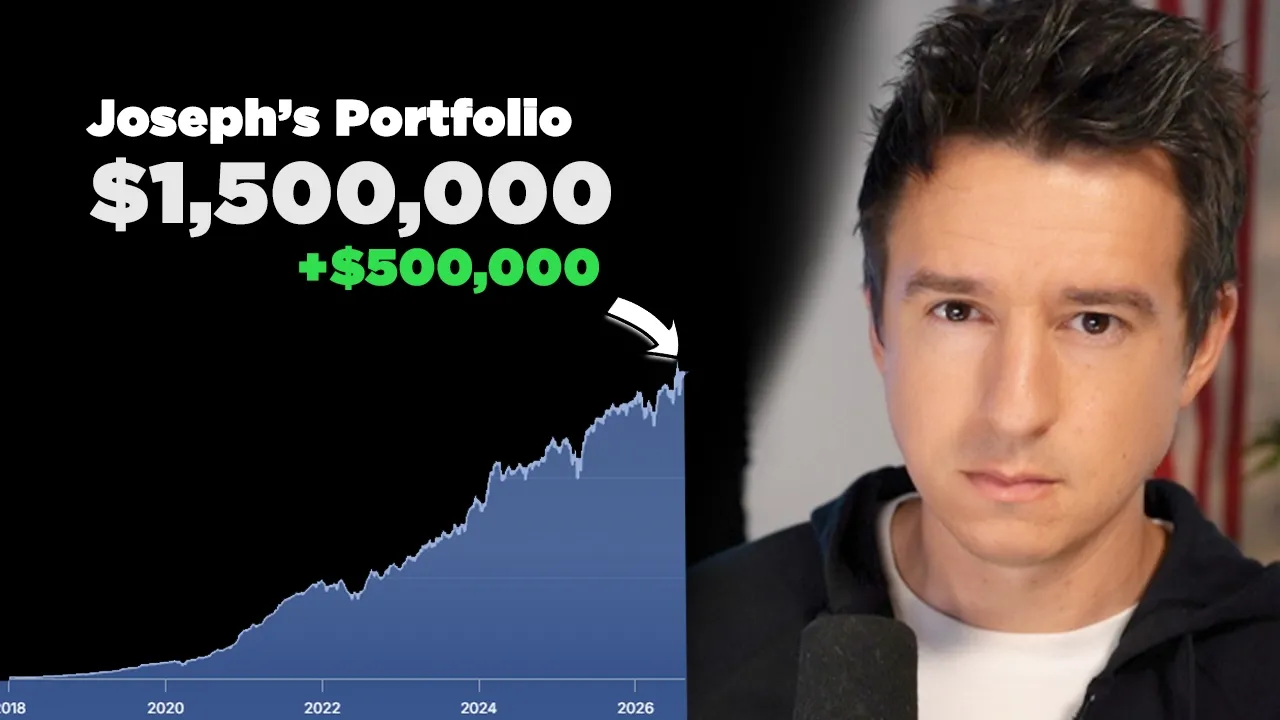
Welcome everyone. Today on the Joseph Carlson show, I have a portfolio of around $1.47 million. And of that, over $500,000 of it are gains. Now, how did this happen? How did I get to this point where we have over half a million dollars in gains? Well, I plan on sharing the story, going over the biggest things to growing a portfolio, what I believe are the best lessons in doing so, and how you can get yourself in a future where you also have a million-doll portfolio. So, we'll be going over all of that in today's episode. Plus, we're going to be looking at three companies that are my top picks for the remainder of 2026. At the beginning of the year, it was Amazon and Meta, and I'll be updating that. We're making an adjustment. Now, we have three top picks. We also had news that Dualingo had a little whoopsies. They showed their August DAU projections. So, I'll be going over that. And then, finally, in the fail of the week, we have a video here of Amazon delivering a package straight into someone's backyard pool. I'll be reacting to this entire video later. And then finally, I have another announcement to add. We had another member join the Carlson family in just the past day. So, we now have four kids. And I'll be sharing just a couple of thoughts on raising children in today's crazy world. Now, let's go ahead and get started. Now, we start things off by looking at how I got to the point of getting $500,000 plus in gains on a $1.4 million portfolio. We're going to be going over the whole story of how this happened and my advice for anybody that's building their portfolio today. So, we have a lot to go over, but I first want to just back up and give you an idea of the story of how this all started. Back in 2019, I started a YouTube channel. The premise of the YouTube channel was very simple. It was the idea that I would show you what I'm doing with my finances, with my investments, and I wouldn't tell you what to do with yours. That is the exact opposite of most of financial media. Most of financial media tells you and pitches you on what to do with your finances while not showing you what they're doing with theirs. And I wanted just the opposite. I wanted to be transparent. I wanted to be very forthcoming with everything that I'm buying, everything that I'm selling and my thoughts and logic behind my decisions so that viewers could analyze them and either agree or disagree with my thoughts and they could also see my actions of what I'm buying and what I'm selling very transparently. So, that was the premise of the channel. I started off in early 2019. I uploaded a video that showed my concentrated portfolio with many OG companies of stocks that I was very excited about. Now, I didn't start investing when I started YouTube. I started investing a couple years beforehand. About 2016, I really started a portfolio. So, I've been buying these companies and doing research and analysis on stocks for years prior to ever starting YouTube. I loved it. I love researching companies. I love breaking them down and doing analysis. I am obsessed with it. So, YouTube was no act. I wasn't putting on some different persona when I started YouTube. All YouTube was was a window into what I'm already doing. And that's how the show began. I started tracking my portfolio, tracking my trades, showing everything and the reasons that I think certain companies will evolve in certain ways. At the beginning, I focused heavily on Apple. Back in 2019, I made a strong case in many videos about how Apple's transforming from a hardware seller to a software seller. And that transition happened. Apple did really well and more and more people started viewing the channel. I I started getting more and more followers and it grew rapidly over just the the first year. We gained 100,000 subscribers. Uh and the main channel has now reached over half a million subscribers. The after hours channel, which you're watching today, is a little bit of a different format, but it's the same stuff. And this one's now at a quarter million subscribers as well and continues to grow. So that's basically been the heart of my channel, showing my journey of building investments, my thoughts and analysis over time. And with that, I've had some market commentary and news commentary as well. But I've continued to show my portfolio every single week for now over 6 years. Not a week has gone by without me displaying my portfolio and the gains or losses or the progress or the declines in it. I've done that up until now for many years and I plan to in the future. I'm going to be showing you how I grow this portfolio from 1.4 million or 1 1.5 up to 5 million by having attractive returns with different companies by having compounding all of these hundreds of thousands of dollars in gains. This is what is growing this portfolio primarily. It's not primarily deposits at this point. But as my portfolio is well on its way, it's snowballing. It's compounding. I think it's important to just do a refresher of how you start out and how you get to the point where you have this type of compounding. There's a couple different options to go. One of them that I think is worth mentioning is ETFs. If you want a simple way to grow wealth, start buying ETFs. And I specifically like growth ETFs. I think they're the best. If I was to never have a portfolio like this, if I was to never do individual investing, my next thing that I'd be buying is SPY or SCHG. These are great large cap growth ETFs that you'll have very good performance and you've had very good performance over long periods of time. So there's ways to do this without ever even even bringing in individual stocks. If that's not your thing and you don't like analysis, you don't like looking at individual stocks, there's ways to do it without doing that. But I love analysis. I love investing in individual stocks. And I think that most investors, even if you have a big ETF holding, you can also have some individual stocks because it gets you really in the mindset of a business owner. It gets you thinking about which companies will really do well over the next 10 years and you have huge opportunities to outperform. In any case, you can have an all ETF portfolio or you can have an all individual stock portfolio or you can do a hybrid approach, which I think is the best for most people. And when you're looking at building your portfolio, there's a few things that really help out, especially early on. First of all, at the very early stages, the most important thing is simply budgeting and depositing money on a frequent basis. You have to get that down. Continually deposit money as much as you can. Make budgeting a priority. Try to get raises at your job, which you can put the additional cash flow into your portfolio. Exercise that mental muscle of constantly building your portfolio. Now, as it gets past the point of $100,000 and then $200,000, it becomes increasingly important to have attractive gains. You can no longer just rely on deposits. Once you get to the point where you have millions of dollars in a portfolio, deposits aren't going to lift it. Like, I I I can throw $20,000 in this and it moves up $20,000. That's just not enough. In a single day, this portfolio will trade around $30,000. So it becomes far more important to have attractive gains the bigger and bigger your portfolio is. But at the early stages, get deposits down, get that ball rolling. Once you get a little bit of the ball rolling, you get the portfolio bigger, that's where I think you get into a different category. And this is where having an edge matters. The reason that I've been able to make attractive returns on the huge majority of companies that I invest in is specifically because I work in areas that I have an edge. meaning I have an advantage over the average investor. With Google, I have an advantage over the average investor. The same thing with Mastercard, the same thing with Amazon, the same thing I believe with Meta. That's not proven here, but I think it will be proven over time. And with ASML, with Netflix, with Microsoft, with Costco, with Texas Roadhouse, and so on. Now, you may say, Joseph, these are very big, publicly known companies where everybody has the same information. So, how do you have an edge over everyone else? And while it's true I have the same information, generally speaking, as anyone else, the edge does not come from just being presented the same information. The edge comes from behavior and judgment. Two investors can look at the same information and one that's emotional and doesn't have good judgment can interpret it in a much worse way than someone that is unemotional, disciplined, and has good investing analysis and judgment. That is where the edge comes in. So people that say you can't possibly have an edge in Google because everybody knows everything about Google, that's not accurate. My edge in Google is my behavior, analysis, and judgment and interpretation of the data. And this is where we get into something that I wrote a couple years ago. I want to go over this. This is what is my edge? I wrote this in August of 2023, but it has really good lessons which I believe are still applicable today. My primary focus when I'm doing analysis on any company is assessing the long-term durable competitive advantages of the business. A business needs to have this before even considering the growth rates. Growth rates don't matter if the company can't maintain any type of advantage. Otherwise, you have a company that's doing well for only a short period of time. Does the business have high barriers to entry? Does it have the majority market share? Is its products and brand name deeply entrenched? Does it sit on top of the food chain? How difficult would it be for someone else to take market share? Does the business require a lot of PhDs with high R&D budgets to grow? Does this business grow only by acquisitions? Does the business have a lot of leverage? Will this business survive a bad recession? These are the type of questions you ask when you're looking at durability. Low-risk businesses are ones that have dominant market positions, high barriers to entry, deeply entrenched brand names and distribution, cashrich balance sheets, organic revenue growth through volume pricing, and no reliance on high risk R&D. So basically, I'm looking for companies that are incredibly strong, ones that have good solid reason to continue being stronger in the future. A lot of these are well- capitalized large companies. So there's a a basket of companies that are very strong and they get economically more powerful through their huge network effects. The other thing is simply having a concentrated portfolio does allow you a higher chance of outperforming. Now concentration doesn't mean every risk factor has to be concentrated. So, I'm not buying 8 to 15 banks that all have the same exact risk factors. I'm not buying 8 to 15 streaming services or 8 to 15 restaurants. I'm buying companies in all different categories. So, even though my portfolio is concentrated, it has all different risk factors. So, when you look at my companies, you'll notice this. They're very they're very diversified in their risk factors. We have Google and Meta, which are in advertising, but they're actually different parts of advertising. We have Mastercard, payment processing. We have S&P Global and Moody's which are in credit rating. We have ASML which is in lithography and semi-production. We have Netflix, a streaming service. We have uh corporate software company. We have Costco, a restaurant. We have a consumer learning app. And then we have Door Dash and Uber, which is mobility and delivery. Uh a diversified network of these. There are some similar risk factors, but overall this is a very diversified portfolio if you look at risk factors alone. It's concentrated though in the number of holdings which allows it to outperform. The other thing that I point out is simply holding periods. Holding a company for a long period of time is difficult because there's so many opportunities to scare you out of every company. My average holding period is is typically over five years. So even though there's a list of companies that I've sold, I've sold uh Salesforce and into it and Equifax. That's three companies that I've sold. While there's companies that I've held for five plus, six plus years easily. Ones like Texas Roadhouse and Costco, uh, Microsoft, Google, all of these have been multi- multi-year holdings, and that's where I really get the most gains. So, even though I don't follow this perfectly, there's going to be time periods where I sell holdings earlier than I wish I'd have to, overall, my goal is to have these companies that compound, and they do so for long periods of time, and I want to have low turnover. that lowers my tax burden. It leads to better results. And my analysis, for the most part, is aimed at having very long-term positions. If you remain patient, unemotional, and disciplined, you'll have much better results. I try to be patient, unemotional, and disciplined in my approach in investing. Hopefully, you see that through my content, but that's the goal. This means I don't get excited when my stocks go up. I don't become sad when stocks go down. I don't become complacent or arrogant when my portfolio is doing well. Now, does that mean that you can ever be happy when your portfolio is doing well? No, that's not what I'm talking about. So, I'll smile. I'll I'll be happy. I'll uh celebrate if my portfolio is having a great month. But that does not mean that I all of a sudden think that every stock is great, that I become super complacent and that I become arrogant and believe I can do no wrong with my picks. And to the contrary, you'll notice that when stocks go down, when there's tariff wars, when there's an Iran conflict, when there's COVID, I've always been on the side of being far less reactive. I don't come out with videos saying you should panic and sell everything. I didn't do that during CO. I held every single position. I continued to buy in dramatically during the dip. I did it with the tariff pressure when everybody was scared about that. Uh the same thing with the Iran conflicts and oil prices. and I'll do it again in the next one because remaining unemotional, remaining disciplined typically leads to much better results and it has throughout my investing history. A lot of these stocks and the way that they've performed as a result of being able to buy them during those time periods of peak panic. So that's a a thing to exercise as an investor. You can have an edge in your behavior. Just don't follow the crowd and become so gloomy when everyone else is gloomy. And you'll see me do that on this channel. When there's the next panic and everybody's concerned, you'll see me coming out with videos trying to be a little bit more level-headed. Speculation is when you invest in something and you have really no clue how it's going to turn out. You might have a couple thoughts on it, but it's not predictable. The whole situation isn't predictable. The more short-term you move, the more speculative your behavior will come. When you're focused primarily on just short-term catalysts, upgrades, and downgrades, and leverage tools to trade stocks, that in a lot of cases is glorified gambling. Most investors use these tactics, and they have subpar returns. If you are speculating, you should be doing so with a very small portion of your portfolio. You'll have superior long-term success by looking at situations that have very predictable outcomes. Now, there is no guarantees. So, I invest in more than one company, but I do so with the thought that each company has a 90% plus chance of being a successful investment. When you do that with a basket of 14 companies, all of them having a 90% chance of success, you have an overall very attractive return. So, those are some real things that you can do in your investing, whether or not you're investing in ETFs or individual companies or a mix, that will help out your returns. Getting better control over your behavior, decision-making, and analysis will ultimately lead to a much better outcome. Now, in terms of my show going forward and what I plan on doing to try to improve transparency and to show you the journey along the way, I also have made a couple small changes. One of them is that when I'm showing my portfolio, usually you'll see this screen. This is the M1 Finance uh brokerage, and I really like it. I'm still using it. Nothing's really changing here. But I show you this screen. I show you the gains of this portfolio, and this is the passive income portfolio. But to show this, I think it's it's a little bit hard to see. I have to zoom way in. I have to scroll down these companies and the biggest problem with showing this view is I have to combine it with another portfolio that I have. That was the passive income portfolio. And then I have another portfolio called the story fund. The story fund is smaller. It's only $450,000, $150,000 in gains, but I have a list of companies here. Some of them are different and some of them are the same. Now, I've talked with M1 Finance about combining these two portfolios to have one unified view. and we looked at the technicalities and it's really far more difficult than it looks. If we combined them, I'd lose a tremendous amount of historical data including a lot of gains, a lot of realized gains, dividends paid, all that type of stuff would be really messy combining these two portfolios. So rather than do that, I decided to keep them separate. So all the data still exists, it's all calculated correctly. And then I simply made a Chrome extension, a Chrome extension that combines it all together visually. This is that Chrome extension. So, it's actually in the M1 Finance dashboard. It looks at both portfolios and visually combines them together into a single portfolio. And that's what you see here. This is the total combined portfolio. So, when you look at this, this is my exact overall portfolio that's mathematically perfect. And all the data comes exactly from the brokerage. In fact, you'll see as I'm looking at this that some of these numbers will just be updating. That's because it's literally plugged in to the exact numbers that the brokerage is providing. But this gives you an easier way to see my overall portfolio, all my positions in order from biggest to smallest, as well as my gains or losses on each position, the total size, and the waiting of each position. So hopefully this makes it easier to follow week by week and video by video what I'm doing. Another thing I added was the ability to track the gain or loss since the last video. So for example, we have a video today. I can go baseline and set a baseline. And now this will track exactly what happens to my portfolio since August 20th. You can see it just went up $73 in just the past couple seconds. And you it'll trade around. It will go into the red. It will go into the green. But this will save the baseline. And then the next time we do an update and I show you my portfolio, I can show you since the last episode how much it's gone up or down. The goal here is to increase continuity. So you can actually see the progress in dollar amount every single video as we go along this journey. So, you're going to see the continuity. You're going to see the growth of the portfolio. You'll see every single trade that I do, the changes that I make, my analysis on these stocks as well. And if you want to make sure to follow this journey of me growing this from 1.5 million up to 5 million, just make sure you subscribe to the channel. I'll show the whole thing here as transparent as possible. Now, regarding how I plan on growing this, a lot of my strategy relies on buying incredibly good companies. I call them very highquality compounding machines and buying them specifically when opportunity presents when other investors are concerned about them with concerns that I believe are misunderstood or just invalid. One of the examples of this was buying the Google dip during the Chat GPT scare. Google was at an incredibly attractive valuation just a couple years ago because people were concerned about Chrome being sold off and Chat GPT eating away at their market share. The data proved that that wasn't happening and the stock was at a discount and that's when I piled in a lot of money. That's why I have a very attractive return in a short amount of time. And this is a strategy that I like to repeat. Now, my top two picks entering into 2026 was Amazon and Meta. Those are the two. And I'm removing Amazon from a top pick in 2026. The reason why is because when I look at Amazon today, it's already been successful. It's in the green by 16% this year. it's outperformed the market. So, I'm no longer calling Amazon a top pick because it's already done so well. It's already been a successful holding and I believe that there's other ones that will do well the remainder of this year. The other top pick was Meta and I still have Meta as a top pick in 2026, but this one has not gone my way. I am down a staggering 37 almost $38,000 in Meta and I've only owned the stock in 2026. So, this has been a terrible holding, a terrible position, a a total devastating loss, right? I don't think so. It hasn't gone my way so far. It's definitely detracted from my returns this year, but I don't view this as a big problem because the problem comes in when there's fundamental deterioration with the company and I don't see that with Meta. Let's go ahead and take a look at why Meta stock is down so much. This is from Fortune. They say Meta faces a $1.4 4 trillion market threat that could mean turning in the keys and walking away. Meta is facing a $1.4 trillion lawsuit. Here's the type of videos being blasted out to the public. This is what a lot of investors are seeing on CNBC or Fox News. Let's go ahead and just play a clip of this. >> That could set a precedent for thousands of other cases like it. A group of states is suing the company for $1.4 trillion. Those plaintiffs claim it designed its >> they have like a 100 foot wide TV and on the TV it literally says $1.4 trillion. Meta on trial. This is what's going on. It's it's it's the worst situation. Meta would have to pay $1.4 trillion. That's more than the market cap of the company. And this is the type of thing people are seeing. Now, what do you think happens to investor sentiment when this type of thing is being blasted across the television to millions of people? Obviously, people are going to be concerned about this stock. This is as bad as it gets. They're comparing Meta to big tobacco, to cigarettes. Cigarettes directly cause lung cancer and hearing loss. And they're comparing Meta to cigarettes. Meta is being sued primarily for making their services too addictive. And what the prosecutors site primarily for saying that Meta had made the service too addictive is infinite scroll, where you go to the bottom of a page and it just continues to load indefinitely forever. Now, infinite scroll is not something that Meta invented. It existed years prior to Meta. It was widely used online. Meta just implemented it as a standard in their app like everyone else. Every app in the world does infinite scroll. Almost every website does it as well. This is a widely used common feature throughout all of society before Meta even really existed and Facebook caught market share. The other feature that's most widely cited for being intentionally destructive and addictive is autoplaying videos, which is the same way that cable television and over-the-air TV has functioned for literally 50 years. You turn on a television, it continues playing until you turn it off. Autoplay is not some devious invention by Meta either. Now, Meta is also being accused of concealing how bad their product was for people. The prosecutors are arguing that Meta did an internal study, an internal experiment where they found that people that quit Meta, especially teenagers, had better emotional outcomes and less anxiety. That was one experiment that they found. Meta said that they didn't have evidence that using Facebook caused emotional anxiety. And prosecutors point to that one study to say yes, they did. They had that experiment. This study was not some long-term peer-reviewed study. Meta also has a number of studies showing that their product makes people happier. Many of them self-report that they have better social experiences, better social circles, that they enjoy their time using Meta products. They found a number of these studies saying uh people like it more. And the prosecutors, of course, never mentioned those studies. They only mentioned the one that made them look bad. So, a lot of people looking at the news are seeing a very cherrypicked view without Meta there to defend themselves in all these cases. But Meta does have a good defense. The features that they implemented are widely implemented across different companies. The things are being accused of concealing are not conclusive evidence of anything. And even the studies that they cite where they had good outcomes for people, they also don't believe are conclusive evidence as well. They're just anecdotal studies that they run all the time. So I believe when you look at the case of Meta, it's actually much stronger than what a lot of people think. Meta has very valid defenses for a lot of things that they're arguing and you'll see that in court. Nobody wants to mention it and I'm the big bad guy for mentioning a big company's defense, but they do have a very solid defense. The reason that I have Meta as a number one stock pick is because I have a sense for when sentiment is incredibly low on a company, when the stock price is depressed and the fundamentals are good. In Meta, all of these things arrive. And if the outcome is anywhere better than investors are pricing in or expecting, then this stock will do well. Now, my second top pick for 2026 is Uber. This has moved firmly into my second place pick, and I want to go over a couple reasons why. First is simple valuation. Uber trades at a 24 PE, 17 times PE of 2027's earnings, and it trades at a 6.3% free cash flow yield, 5% after you factor in stockbased comp. And there is some insurance float that factors in as well, but it's still at a very high healthy free cash flow yield. And while it's at that nice healthy yield, Uber is also growing very quick. Look at these fundamentals. Everything is up and to the right. The gross bookings, the Uber one members, which is becoming an increasingly important membership for the company. You have the free cash flows, huge amounts of cash flows every single quarter now. And there's a lot of exciting things happening for this company. The biggest risk to it and the reason that sentiment is low is because of Whimo and other AVs that pose a threat to Uber's core business. I believe the threat is overstated. I think that will be proven over time. And Uber continues to grow in very interesting ways. For example, Uber just did a video showing the new partnership with Zipline, which is drone delivery. >> More people are using it. All of e-commerce is kind of moving there. We think that 10 to 15 minute delivery time. >> Uber's planning on getting to the point where they're doing a million drone deliveries per day. So, they have big ambitions with drone delivery. And this is another expansion of this business. Uber is a company that has a very strong bare case, but the network is massive. The team on it is very forward-looking. They're moving fast to consolidate and aggregate all the demand that comes along with ride sharing. And there's also big updates on Uber with AVs. They continue to implement them in their fleet. And I believe lots of AV partners will aggregate in Uber's network. So I've moved Uber as my second top pick for 2026. Now I have Uber towards the bottom of the portfolio. It was a split buy between Uber and Door Dash. Door Dash has raced up 28% since buying it. So I'm not putting that as a top pick. It's it's already gone up quite a bit. We have Uber now working its way into the green. I bought this one on a good dip, but I do have it as a $25,000 position, and my trading on this will be pretty simple. My third top pick for the remainder of 2026 is S&P Global. This is also one in the portfolio. I have it right here. It's position number five currently, $126,000 invested, and it's only up $18,500. So, we're in the green by 20% give or take. But, this has not been some incredible performer. I don't believe the S&P Global is getting the credit it deserves. When I look at this company, first of all, again, the valuation of it is very undemanding. We're looking at a company here trading at a 22 Ford PE ratio. That's a low historically for S&P Global and a 4 and a.5% free cash flow yield for a company that is incredibly efficient. They have almost no stock-based compensation, no capital expenditures, there's not much marketing expense. Overall, this is a very efficient company at an attractive valuation. Investors are concerned about the market intelligence business. We look at market intelligence. It's this big revenue line here, but it continues to grow in the mid single digits, five, six% year-over-year. It's not a super fast growing portion of the business, but it's also not the most important portion. The ratings is the most important portion, and that's growing quickly at 14%. This is also what makes up the highest margins, the biggest operating profits of the business. The market intelligence is just not as important. It's a nice add-on, but investors are putting too much weight into that revenue stream. The ratings business will continue to do exceptionally well, and I believe this stock will make a full recovery this year. So, in my portfolio, I've been building those three positions. I've been buying Uber. I've been buying Meta. I've been buying S&P Global. These are companies that I think are fantastic. And when they eventually recover, which I expect they will, it'll bump up the total gain of this portfolio much higher. Now, moving on, we get to some news. The first story is that Dualingo apparently made an oopsies. They showed their August DAU growth, which is their daily active user growth year-over-year, and they accidentally revealed this number during some type of presentation. So, basically, in situations like this where Dualingo accidentally shows investor related insider information like their growth or a KPI growth, especially as one as important as DAU growth, what they need to do is make sure it's not just one party that knows it. They need to make sure everyone knows it. So once they accidentally showed this to this small group of investors, they made sure immediately to tell everyone else because if you only have one group of investors knowing this information, of course, it's a bit like insider trading. So they don't want to have that happen. They are forced legally to disclose it to the entire world. Now, Duelingo disclosed the number, but they also did so with a lot of caveats and a lot of disclaimers. They say that it is unvalidated. It is preliminary internal data showing investors the indicated and estimated DAU growth of 27%. Similar estimated growth rates were displayed for prior days in August. But these figures have not completed review or validation. The company cautioned that this should not be indicative of their Q3 results. So they're saying don't believe that this is going to be like the growth rate for next quarter. That's not what this is saying. Now this did cause the stock to jump a little bit. Duelingo was up 5% on the day. So it's now up to $146 per share. When I look at my position in Dolingo, it's now a $35,000 position with 11,500 in the red. So, it's working its way back. Overall, it's it's moving more close to the green, but this is still one of the big losers in the portfolio. Now, moving on, we get to today's fail of the week. In this case, it is Amazon drone delivery. We have a video here. Now, this is a video taken by a lady in Texas that was excited to have Amazon drone delivery, but she became disappointed in where Amazon chose to drop off the product. >> Okay, it dropped it right in her hot tub. the hot tub portion of her pool there. So, her backyard's like, it looks like it's 90% uh pool and hot tub. It's just 90% water. There's some cement around the area, but this drone comes in, which is actually a big drone. These things are cool. Like, this is a real drone dropping off a product there, and it drops it right off in the middle of the hot tub. Now, a couple thoughts about this. First of all, this is like the most first world problem in the world. Yeah, this drone that that delivered a package to me, which is is like the future, right? We're living in the future. It delivered a package. It accidentally dropped it off in my hot tub because I have a massive hot tub and pool. My life is so difficult. I'm going to complain about this. There's some people, it doesn't matter how good their life is. They're always going to find reasons to complain. Another thing, as many people here pointed out, Amazon literally has an app that gives you the precise location that you can select of where the drone will drop it off. So, this lady selected her hot tub or her patio to have it dropped off and then was upset that the drone went and dropped it off there. So, this is also likely self-inflicted. I personally can't wait until we get the option of drone delivery. Now, finally, I wanted to mention one other thing. We had a big change in the Carlson household. We welcomed the fourth member, new family member, which was born in just the past day. So, he's still very new. It's his first day here. Now, the reason that I posted about this, I actually shared one photo, which I don't share a lot of photos of my family, my wife, or my kids for obvious reasons, but I wanted to share one uh this one I I thought was a good one to share because because I think there's some important things going on. One of them is that there's a big urge, it seems like, in society to pressure people into not having kids, making it feel unattainable, unreachable, like you need to be perfectly financially stable and have everything perfect before you can even think about having a kid. So, I'm not going to lecture anyone on what to do with your family. You all get to decide. But I think it's important to share a different perspective than the one that's shared online continually by the news. Um, first of all, having kids is awesome. It is the coolest thing I think you can do on planet Earth. They are the funnest things, the best things. Uh, it brings out the best in people. If you have children, you'll have a love for them. If you're a normal parent, you will feel a love so immense that it is completely unmatched. I believe it's the most pure love that you can feel as a human. I would argue even more than your love for your spouse because your love for your spouse could be pretty big. That could be very big. But even so, when you love your spouse, you're also expecting things in return, right? You're both in a relationship. You're both working hard. You have a reasonable expectation that your spouse is going to work hard and that you're going to get kind of this symbiotic relationship. With a kid, it's different. With a child, it's completely different. You feel an immense love for them unconditionally with no expectation of getting anything back in the relationship. None. I love my children more than anything and I don't expect them to do anything to ever pay me back ever. I would love them and serve them for the rest of their lives. And that is different than I believe anything else. The second thing that I'll mention is kids are actually really fun. They're actually awesome. More people should talk positively about them. My boy now is 11 years old and I watch movies with him. I go out to the movies frequently with him. We play Xbox together. We stay up late at night watching YouTube videos of scor scary scary stories and horror stories, right? He he loves that stuff. We play soccer together. We go camping together. Uh we go fishing together. Uh we do a lot together. It's fun. I look forward to spending time with him. And that perspective isn't shared. A lot of times they're they're looked at like a nuisance, which is not true. Unless you're a deeply selfish person. Kids are actually a lot of fun. if you can put down the phone and spending time with them, they're fun. Um, and so that's another thing that I think is is lost with a lot of the the conversations I see online. And then finally, one last thing, a lot of people look at this and they'll go, "Joseph, of course, it's easy to have kids when you have millions of dollars and you're a YouTuber and you make a lot of money." That is true. I'm in a very strong and fortunate position financially today. And that does alleviate some of the burdens of having kids, but it doesn't alleviate the most important ones. And it's really not as important, I believe, as people make it out to be. I did not have hardly any money when we had our first kid. When we had my first kid, I was 25 years old. I was making $40,000 a year, I believe, right around there. 35 $40,000 per year. We had like no money and it worked out anyways. You make it work. We made homemade meals. We we still traveled. We still did things. We just didn't have a lot of discretionary money to spend. And that's fine because a lot of entertainment can be had for very cheap. Uh, and this is something that also gets missed. You only have a short window to really build a family and have kids, but you have your entire life to make money. There's always more time and to work and to to get job increases and pay and to build things that make money. But having children is a bit more limited. Having money is great. Making more money relieves a level of stress, for sure. But I think there's way too much emphasis on being super financially stable before ever thinking about having a kid. That's not the journey I took. It's not the one that I think is best. And uh from my perspective, having a full family full of kids and experiences and life and development is way better than having a bunch of money. So that's my thoughts overall. That's going to be it for this episode. Hope you enjoyed. See you in the next one.

Commentaires 0
Connectez-vous pour rejoindre la discussion.
Se connecterAucun commentaire pour l'instant. Soyez le premier à partager votre avis !