
- Rendement de la vidéo
- —
- Appels
- 1
- Achat / Vente
- 1 0
- Publié
Recommandations
L'entrée est le cours de clôture de l'actif à la date de publication. Le cours actuel est la dernière clôture enregistrée.
-
Entrée $545,83 20 août 2026Actuel $545,83 20 août 2026Résultat +$0,00
at around $546, my decision is a buy, but specifically a gradual buy, not all in purchase
Transcription Complète
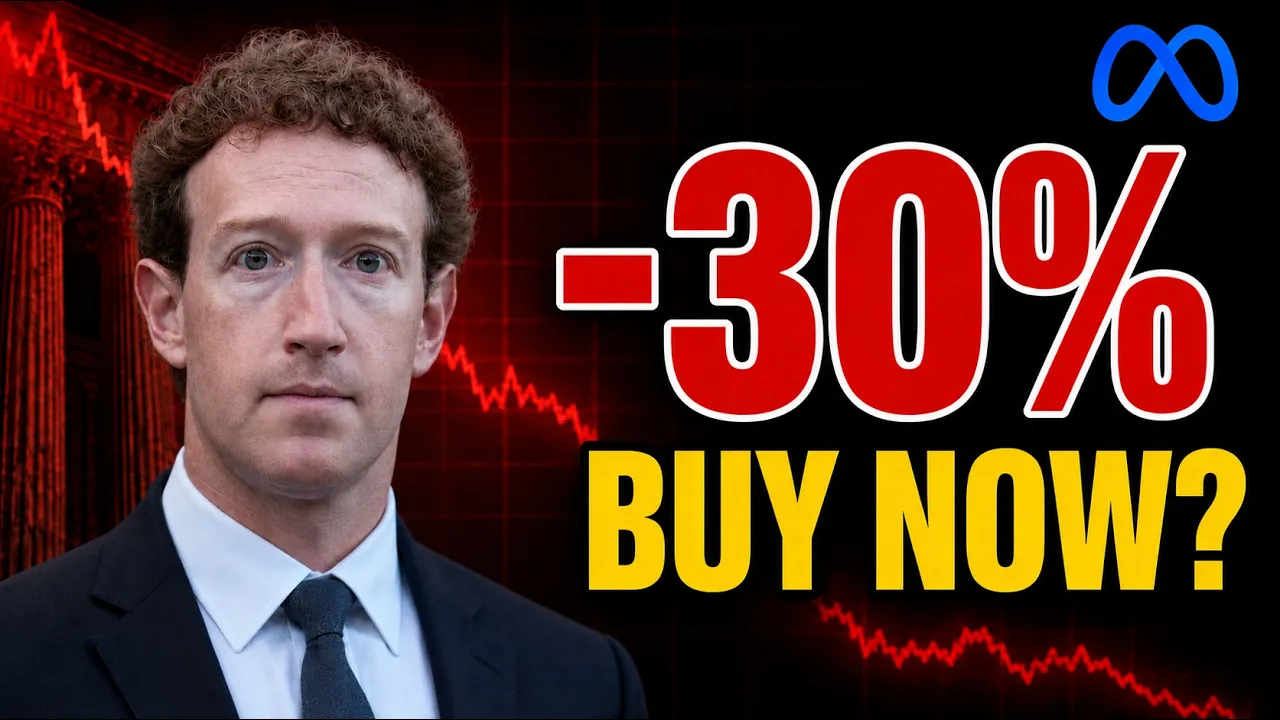
Meta is facing a potential $1.4 trillion legal threat, but that number's not the reason I believe this could become the most important MetaTrial investors have ever seen. We have in fact 29 states which are challenging how Facebook and Instagram were designed and the theoretical damages being discussed while they're close to the entire value of the company. But if investors only concentrate on that terrifying number, well, they may completely misunderstand both the downside and the opportunity because the most damaging outcome may not be a financial payment at all. The headline risk, well, it's an enormous fine. The business risk, though, that is far more serious. A judge could force Meta to change the machinery that keeps people scrolling as well as keeping advertisers paying. And just in the most recent quarter, will Meta produce almost $32 billion of operating cash flow, but only $784 million of free cash flow? Let's take a listen to why this trial could reshape far more than just one quarter for Meta. >> It's being called the largest consumer protection lawsuit in American history, bigger than cases brought against big tobacco more than two decades ago. [music] >> It's going to be massive if indeed this goes through. uh and it's going to have a huge impact on the company. >> The clear distinction here with this lawsuit and with the other lawsuits, thousands of them in fact, that are being brought in the US at the moment, >> [music] >> um that Meta and other tech companies knowingly profited from harm. >> That's the crucial frame, not merely an enormous lawsuit, but an allegation that Meta knowingly profited from harm. and my bare base and bull valuations today. Therefore, test both financial penalties and permanent product damage. We're going to have one scenario here that produces almost no upside. Another which produces more than 50% and the difference is what happens to Meta's cash generation machine after the spending cycle. And by the end, I'm going to show you what the current price already assumes, what a $200 billion penalty does to the valuation, and exactly what I would personally do with Meta Stock today. Now, the stock itself is trading $546, and it's also not too far above 52-E lows at 520. So, to decide whether that is an opportunity or a warning, we're gonna have to begin in the courtroom. Bear in mind, Med is a company that's down 17% year to date. And over the last year, well, it's down 27% even stretching to the last five years, not the best return, around 54%. Now, the simplest version here is that a bipartisan group of 29 states accuses MEA of harming young users, mishandling children's data, and misleading the public. Meta, they strongly deny these allegations. And there is an important distinction here. California, Colorado, Kentucky, and New Jersey. They lead the state specific consumer protection claims while the federal children's data claims they involve the wider coalition of 29 states. And also something interesting to note here, the jury is advisory. Its conclusion can guide the case, but the judge Rogers ultimately decides liability and if Meda loses exactly what penalties and what remedies should be imposed. And the trial is expected to last around five to six weeks. Mark Zuckerberg and the Instagram chief are expected to testify alongside current and former employees and experts in both technology and psychology. And the states, well, they allege Med features to encourage compulsive use. Meta says the claims are unsubstantiated, but investors should focus on what the states want changed, not just what they want paid. We've talked about some of the damages that are being sought, but it sounds like you think some of the remedies being sought are also pretty uh significant. >> Yeah. Well, listen, the the monetary damages can be large. Tens of million billions, if not hundreds of millions of dollars. But where this gets really interesting are the other remedies. The state attorneys general bringing this case are asking for product changes, but they're also requesting that Meta delete the data that it acquired from children unlawfully as it alleges and then also eliminate the models that it trained using that data. >> That is the first point investors could not miss. A one-time financial penalty damages the balance sheet once. forced deletion of data or train systems could damage assets that Met has spent years building. And the states they're also seeking tighter restrictions for younger users, as well as the removal of features that they describe as addictive that includes infinite scroll and parts of content recommendation systems. And infinite scroll sounds like a design choice. Economically though, it is in fact inventory. More time in the application creates more opportunities to show content, more advertising impressions, and more information about what users respond to. And we can see just from their latest quarter, well, worldwide ads increase 14%. That's why an order affecting the feed is not merely cosmetic, it could strike directly at one of Meta's two fundamental revenue drivers. And Meta's other revenue driver is price. That was up 12% worldwide yearonear. Again, this is from their latest quarter. And this brief clip explains why losing this case could change the company even if Meta can financially survive the ultimate fine. It's a it's a product safety issue if you like, but the stakes are so much higher. I mean, Meta is trying to claim that uh you know, the potential costs, the potential fines could run uh to $1.4 trillion. the attorney generals, the states uh put that a much lower figure, 200 billion. But either way, the changes to the platform and the potential fines mean that uh you know, even if it's not an existential issue, it's likely to change the company and if it lo if it loses. So, separate the figures immediately. 1.4 trillion, that's Meta's theoretical maximum calculation. Roughly 200 billion, that's the coalition's more realistic demand. Neither should automatically become our expected outcome. And experts quoted around the case consider the 1.4 trillion figure extraordinarily unlikely. Obviously, it's useful for a headline a bit of clickbait. But treating as the base case, that would be analysis by shock value. And the figure becomes enormous. Essentially, because state penalties can be calculated per violation and multiplied across millions of users, it produces theoretical exposure very different from the amount eventually upheld, appealed, or in fact potentially settled. And the New Mexico offers a real president. Meta was ordered to pay roughly $942 million across civil penalties and remediation while also making platform changes. Now, also worth highlighting, Meta is appealing that decision. And if we just consider this fine in terms of Meta's current share count, the New Mexico amount that was around 37 cents per share. This $200 billion by contrast, that's roughly $79 per Meta share. And the $79 calculation will become important later on because it produces a surprising result when applied to the base valuation. And it helps explain why Wall Street's average target sits near the $754 mark. And we also have the big tobacco comparison. It's emotionally powerful, but we should use it very carefully. The similarity is the allegation that companies knew about harms while continuing to market a product. Not that the eventual economics must be exactly identical. And this proceeding, while it also matters because early cases can establish the framework for thousands of related claims, a result against medic could increase pressure from a broader settlement. A defense victory, well, that could weaken the leverage. And reputational damage, that's harder to quantify. It can influence regulators, advertisers, parents, and future juries. But investors should resist turning an unquantifiable risk into an unlimited number. That's why we need scenarios. So my legal conclusion is therefore simple. The maximum fine is not my base case. The material risk is that remedies reduce engagement, impressions, and data advantages for years rather than just costing Meta money once. And now comes the part that determines whether those risks are survivable. Meta's on a spective application waiting for revenue. It operates one of the largest and most profitable advertising systems ever created and the latest operating data is considerably stronger than the stock price chart suggests. So before accepting the legal bare case, let us examine the cash engine that would have to absorb it. And we can see that Med's family of applications now serves around 3.6 billion daily active people. Growth obviously it's slower than it once was, but the audience is still expanding from an extraordinary base. And I'd probably say more importantly, family average revenue per person reached $16.86. That's up when we take a look from $13.65 65 one year earlier. Meta's monetizing each user more effectively and compared with other listed social platforms. The monetization gap is enormous. Reddit, Snap, and Pinterest, yet they're improving. But none of them approaches Meta's average revenue per person at a comparable global scale. And you can see Med's trailing advertising revenues around $223 billion within sight of Google search and many times larger than YouTube, Amazon advertising or even LinkedIn. And the revenue is not growing through one lever alone. Worldwide impressions increased 14% including healthy growth across North America, Europe, Asia Pacific, and the rest of the world. While at the same time, average price per ad increased 12% worldwide and 20% in the US and Canada. Volume and price moving together. That's an exceptionally powerful combination. And revenue growth is around 28% year-over-year, while forward revenues estimated to be around 23%. These rates are significantly higher than the sector median. Profitability, well, that remains elite. Gross margin sits above 80%. EBIT margin sits at 38%, EBIT DAR margin 48% and net income margin that's close to 30. Wings operating margin that sits at 38%. Free cash flow margin however that's fallen to 18% because capital expenditure for Meta is just consuming so much cash yet when we turn to return on equity that's sitting at 30% very impressive return on invested capital 18% return on capital's declined from recent peaks again infrastructure investment just continues to surge and I'd also say that conventional balance sheet leverage is not the immediate problem net debt to EBIT does around 0.16 expect to come down to.14 net debt net capital that's very low. Both of these are comfortably below the danger levels. And one thing we don't discuss a lot is Meta in terms of generating more revenue. They're doing it with fewer employees than at the 2022 peak. Headcount remains roughly 14% lower even after selective hirings returned. It ultimately supports the underlining margin story where we can see that over the longer term diluted earnings per share and net income they've increased dramatically while the diluted share counts declined. So buybacks have amplified growth per remaining share. Now, we can highlight that the latest quarter it did miss the consensus earnings estimate and near-term year-over-year EPS, well, the comparisons are pretty soft, but analysts currently expect growth to reacelerate meaningfully into 2027 from $31. And we can see here 2027 just shy of 35. And Bill Aman, Persing Square, well, they have an investment meta. They described just a few days ago that Meta is one of the clearest AI beneficiaries. better recommendations, increase engagement, improving targeting raises ad monetization, and new consumer and business agents. Well, they may create additional products. And its key claim is that these benefits are already visible in Meta's fastest quarterly advertising growth since 2021. That is strong evidence than promising a completely new AI business years from now. And we can see that Meta's AI standalone applications grown rapidly, more than 400% in this data set. But it does remain much smaller than the Jack GBT Gemini. So distribution is an advantage. Independent product leadership that's just not yet proven. And I'll say Meta, they have recently introduced a dividend yield is modestly above its short history. But this is not primarily a dividend thesis. Cash generation and capital allocation that will determine the return. And if we look at the blue tunnel from Simply Safe Dividends, which points out the fair price intrinsic value, well, we can see that it sits below the bottom end. This is an undervaluation potential signal. Although we would say we like to continually point this out that Meda company for many years has traded severely undervalued. It's also one that when we look at over the last 5 years, it delivered a positive total return but has underperformed both the S&P 500 and the NASDAQ 100. So investors have already paid a price for repeated spending cycles and strategic uncertainty. Now with Meta History Matters, it traded near eight times forward earnings during the 2022 crisis. Today it trades closer to 17 times. So the stock is discounted, but this is not a repeat of the absolute 22 valuation. And when we do look at the valuation rating, yes, it does get an F, but that's because the communication services contains much cheaper and in fact much much weaker businesses against their own history. However, almost every major multiple as we can see here on the percentage difference to their 5year average well is around 15 to 24% lower and the forward price to earnings ratio sitting at 17 times. That's much lower than their 5year average of 22. So historical discount is real but it only becomes attractive if the future earnings are not purchased with permanently excessive capital expenditure. Now when we look at the valuation method here, forward price to operating cash flow that's fallen below 10. It looks extremely inexpensive until we remember operating cash flow is not free cash flow when data centers consumes tens of billions every single quarter. I mean operating cash flow itself is approaching $130 billion on a trailing basis. The valuation is compressed even as the figure rises. But the entire debate is what proportion ultimately belongs to the shareholders because ultimately capital expenditures not just merely risen is exploded. So this is where an excellent operating business becomes a difficult investment decision. Meta is spending at historic levels. So listen to the sharpest version of the argument that shareholders still cannot see the return. I think it all exists to distract from the fact that Meta will not disclose its AI revenues or show any kind of return on investment for its AI. Mark Zuckerberg wants us to talk about Meta in terms of super intelligence so that we don't think about the fact that he's making boring also rand large language models that do basically the same things as everyone else. That is the sharpest bare argument. The return remains unproven. While quarterly capital expenditures reached $30 billion, roughly five times the level from only 3 years earlier, operating cash flow still covered that investment, but only just after equipment purchase and financial lease principal payments, free cash flow. It fell from more than 12 billion in the previous quarter to $784 million. And this is not a normal fluctuation. Meta's quarterly free cash flow collapsed from 13.2 billion in March to in fact less than 2 billion in June. And that's why the free cash flow margin has fallen from the low to mid30s to 18% over the trading period despite an operating margin that remains close to 40%. Now bear in mind Meta also substantial commitments beyond conventional debt around $347 billion of leases not yet started and $349 billion of purchase commitments as we can see. And these commitments are not ordinary debt due tomorrow but they lock MA into a multi-year infrastructure build. We have Muhammad Elarin who captures the exact race shareholders are now underwriting. So look fundamentally we have a race going on between the promise and the earnings that comes with AI and the cost of funding all all that that's a waste going on and that waste is going to determine many many things and many is running that race at extraordinary scale estimated compute capacity rises from roughly 2 1/2 gaw in 2025 to more than 14 gawatt by 2030 and a meaningful portion is assigned to add inference small business language model inference and training. But the largest future segment in this estimate is excess capacity that could potentially support an AI cloud business. And the uncertainty is visible in 2028 capital expenditure estimates. Meta's range runs from roughly $115 billion well to almost 300 billion. That's not a forecast. It's evidence that visibility is extremely low. And Persing Square argues unused compute could be sold into a constrained market. But Meta's control structure changes the risk because Zuckerberg has already told investors which mistake he fears more. >> Well, Mark Zuckerberg would probably disagree. He actually I was in the room when he he had a sit down interview with our very own Emily Chang a few summers ago and he actually said, you know, I would much rather overspend and and be wrong betting on this than uh wake up in a few years and realize we underinvested. and so he's willing to lose a little money uh to make sure they're in position. >> That philosophy explains both the opportunity and the discount. Zuckerberg controls the company if he believes under investment is the greater risk. Shareholders cannot force a rapid retreat simply because free cash flow looks uncomfortable and the first potential return is a direct AI product. Meta AI is growing rapidly, but the standalone user base remains small relative to chat GBT and Gemini and direct revenue disclosure that remains limited. And we've got a clip from Dan Iver. This was from a few weeks ago. Now, better ranking targeting can already improve advertising, but investors still want a new revenue engine. Listen to why even modest adoption of Meta's proposed subscription could really matter. >> You got 900 outperform. You mentioned investors want to see it. Do users want to see it? Are they going to be willing to pay it? We're only talking about what seems to be, according to some of the reporting here, $3 to $4 a month for a sub for Insta, Facebook, and WhatsApp. >> Yeah, you start to get any sort of adoption, you you start to now look at revenues that could be up 2, three, 4%. And then so on as the adoption curve increases. >> That is the attraction. Subscriptions do not need to replace advertising. Even a few percentage points of incremental revenue matters enormously on a platform that's already generating more than $200 billion. But remember that capacity does not become valuable merely because it exists. It must produce higher advertising cash flow, sell external services at attractive returns or create products users will pay for. Otherwise, depreciation follows the spending. And we've got some external estimates where they project only 11 billion of metas-free cash flow in 2027. Well below Microsoft, Google and Amazon and below even the $17 billion in my best scenario. And the discrepancy is important. My three paths are informed by analyst estimates but deliberately separated to test different recoveries. Their scenarios, not claims that anyone can predict annual cash flow to the nearest billion. And across the hyperscalers, free cash flows become volatile as infrastructure spending accelerates. Meta's longerterm growth has been strong, but the latest data shows why backward-looking cash flow can overstate current earnings power. Conversely, using only today's depressed free cash flow that may understate normalized earnings power if the capital cycle eventually moderates. The tension is precisely why the valuation range is unusually wide. And Persing expects earning growth above 20% over the next few years and considers 18 times Ford earnings highly discounted. It's a credible bull case, but it depends on advertising growth surviving the legal and spending risk. And remember, Meta has already shown it can restore efficiency through headcount discipline. The unanswered question is whether physical infrastructure can be moderated as quickly. Employees can be reduced. Long-term leases and purchase commitments, they cannot simply disappear. For now, the strongest proof of return is not a chatbot is the double-digit increase in advertisement pricing while impressions also grow. If those trends persist, AI is already paying through the core business. The strongest proof though against the thesis is equally clear. Almost all quarterly operating cash was consumed by equipment and lease payments. Shelders are being asked to trust that the conversion will arrive later. So, the AI question is not simply whether Meta wins or loses. is whether the eventual cash return exceeds the cost of building more than 14 gawatt of capacity and accepting years of depressed free cash flow. My answer today is cautiously positive because the advertising engines accelerating but the margin of safety must compensate us for capital intensity, legal remedies and unusually poor forecasting visibility. And that brings us to the market price. The next question is not whether Meta is cheaper than last year. is whether 17 times forward earnings is cheap enough for the growth, the spending, and the risk that we've just examined. We can see that consensus places Meta at roughly 17 1.5 times 2026 earnings, 15.7 based on 2027, 13 based on 2028, and 11.6 on 2029. And we have the forward PG. It's around 0.84, which looks inexpensive relative to the sector and meta's history. But the PG ratio ignores the cash absorbed by capital expenditure and it can't resolve the legal risk. And the current forward multiple while it's still below many historical periods but far above the crisis trough. I call the valuation discounted but not severely distressed. And we've also got the market paying a lower multiple despite substantial earnings growth and a shrinking share count. It tells us investors doubt either the durability of earnings, the cash conversion or just both. Now on 2027 estimates, Meta combines a lower price to earnings ratio than Microsoft and Amazon with stronger projected revenue growth. Only Nvidia offers a more aggressive growth to valuation relationship in this comparison. And Meta also has a lower proportion of value assigned to future growth opportunities than several mega cap peers. In plain English, investors are paying less for unproven future projects than they are elsewhere. And we even have institutional filings. They show meta among the most frequently purchased or added names in this data set is essentially the latest quarter of super investors. We did a deep dive not too long ago where we can see around 14 track buys and Wall Street's average target implies nearly 38% upside. But before accepting it, listen carefully to the earnings of multiple logic that analysts use to justify much higher prices. >> Yeah, I mean remember this this company's going to do 30 plus dollars of earnings power. So you don't have to put a big multiple on the stock to get a higher price target, right? If you you just put a 20 multiple on it, you're over $600. You know, we think it could sustain a higher multiple and it could actually do more than 30. It can be $35 of earnings power. So you can get to, you know, $8 $900 pretty quick on on a pretty reasonable multiple. The arithmetic is reasonable, but price targets can hide assumptions. $35 of earnings multiplied by 20 produces $700, not $900. Unless either earnings or the multiple moves higher. Likewise, a low price to operating cash flow multiple does not guarantee a bargain while capital expenditure remains elevated. We need a model that explicitly subtracts the investment required to run and expand the business. And just before we get into that, I want to let you know I released one weekly article covering severely undervalued stocks as well as what's gone in the market in the last few days. You can click below, sign up, read all of these straight away. Now ultimately that is why my decision on meta rests on free cash flow rather than earnings multiple. But because nobody can forecast this investment cycle precisely one valuation it's not enough. I'm going to begin with a bare case that still assumes some recovery then a base case built around a stronger normalization. Finally a bull case in which Meta's enormous investment produces exceptional cash returns and the targets are very different. More importantly the required return changes every answer. So here's the full valuation and then I'm going to impose the legal stress test before giving you my final decision. Now all three models are obviously going to begin with the free cash flow for 2025 which came in around 44 billion and then deliberately a depressed $2 billion in 2026. Now the 2 billion is not a normalized earnings estimate. It reflects what an extraordinary investment year can do when $30 billion of quarterly capital expenditure almost eliminates as we saw the free cash flow produced. Now on the bare case, we're going to see it recover to 17 billion in 27, 35 in 28, 15 29, 65 in 2030, and then we're going to apply a 12% growth rate through 2035. And using an 8% discount rate and 3% perpetual growth, it produces an intrinsic value of $568, which only sits around 4% above the current price today. Now if we raise the required return let's say to 9% in fact well the value falls to $456 and this implies around $31% downside. So the bare case is not a free option and then if we change this to 10% required return the value falls to $377. Now if we go back to the original 8% the one thing to point out here is the reverse DCF is saying here that the explicit bare path would still require around 11% growth after the forecast period to justify today's market price at an 8% discount rate. If we then move to the base case where it seems free cash flow recovers to 20 billion 27 50 and 28 75 and 29 95 billion in 2030 where we use the same 12% growth the 8% discount rate and 3% perpetual growth while the base case comes to $832 which as we can note here implies around 52% upside from today's price. Then if we do like we did with the bare case and increase the discount rate to 9% while the price falls to $668 leaving around 22% upside the investment still attractive but no longer obviously mispriced. If we go one step further let's say here now to 10% the value falls to $553 which as we can see not too dissimilar from today's price. The market therefore prices something close to my base cash flow path at a 10% required return. And if we go back to the 8%, we can see the reverse DCF, it only requires around 1.3% growth beyond the explicit base forecast at an 8% discount rate. So once Meta reaches 95 billion of cash flow, very little heroic terminal growth is needed. Now the bull case it assumes 23 billion 27 62 and 28 100 billion 29 135 billion by 2030 and at 8% again the exact same numbers we get a value of 1,179 that is genuine bullcase territory not my central target where we're talking in fact upside of 116% and then if we change the discount rate here we can see 9% the bcase value falls to $947 still offering more than 70% upside from today and then going to 10%. Well, even at this rate, the bull case, as we can see, still offers upside $782, which equates to 43% upside, exceptional cash generation. It can absorb a demanding required return. And returning back to the 8%, well, the negative 7.4% reverse DCF figure, it means this explicit bull path could tolerate declining cash flow after 2035 and still justify today's price. It doesn't mean I expect negative growth. Remember the external 11 billion 2027 estimate. My bare case begins at 17 billion. If that more pessimistic estimate proves right and recovery remains delayed, even the bare valuation may be too generous. So now we can apply the legal stress test. A $200 billion charge spread across the current share count is around $78.65 per share. Now if we go to the base case firstly we can see here it gives us a 34% margin of safety and if we just subtract this amount mechanically what we can do here just a very simple minus $79 round it up that comes to $753 that's pretty much identical to what we see from Wall Street where the margin of safety comes to 28% and from an upside perspective it's still sitting roughly around 38 doesn't mean the fine is harmless it means a strong cash flow recovery can absorb even an exceptionally large one-time payment. And then if we change the discount rate in combination, in fact, with that fine at 9%, the intrinsic price comes to $668 minus the fine, it comes to $589, only around 8% above today's price. Still margin of safety sitting at 7%. And then if we continue and stress test this at 10% in fact, it's sitting not too dissimilar, but remember, we haven't taken the fine off. Once we do that, we get $474 implying 13% downside a 15% premium. So required return matters as much as the legal headline. Now the subtraction is intentionally simplistic. A financial payment can be modeled once forced product changes must be modeled through lower future impressions, margins, and cash flow, and it could therefore be more damaging. Now, if a remedy permanently reduces impressions, the correct response is not subtracting $79. It's moving from the base cash flow path towards the bare path perhaps while also demanding a higher discount rate. And the combination is where the downside becomes substantial weaker cash recovery and a 9 or 10% required return. Investors who only show the 8% bull case, they're ignoring the most important variable. So my central view remains between those extremes. I don't expect a $1.4 trillion payment and I do expect Meta's cash flow to recover. This is going to be the base case. As we said, the 12% growth rate, the 8% discount rate, but also in fact including that $79 payment still giving investors a margin of safety around 28%. So, in essence, I refuse to treat this $832 as a guaranteed destination. And at around $546, my decision is a buy, but specifically a gradual buy, not all in purchase, made as though the next 6 weeks can't create a ton of volatility. The current valuation also gives us strong revenue growth. elite margins and a dominant advertising franchise from multiple well below Meta's historical average and below several slower growing mega cap peers. But at the same time, the price is discounted for legitimate reasons. Free cash flows collapse under enormous capital spending. Future commitments are substantial. AI revenue remains poorly disclosed and the legal remedies could affect the core product. But what's making me willing to buy is that the business is not weakening underneath the risks. daily users, revenue per person, impressions, ad pricing, revenue, and operating cash flow. They're all moving higher. And Meta doesn't require a perfect chatbot or a trillion dollar cloud business to justify the current price. It needs AI to strengthen advertising and capital expenditure eventually to normalize enough for cash conversion to recover. The single development most likely to change my view is not a frightening headline about theoretical damages. is a remedy that materially restricts recommendations, infinite scroll, ad inventory, or the data used to train meta systems. The second is continued cabal expenditure growth without evidence of higher advertising efficiency, external compute revenue, or new paid products. At some point, promise has to become incremental cash. Now, if those two risk worsen together, I'd reassess rather than blindly average down. The bare case at around 8% required return is $568, 9% 456, and at 10% much lower. Now, if the trial produces manageable financial penalties, the core product remains intact and cash flow follows the base recovery. Today's price offers a compelling long-term entry with meaningful upside. And well, if Meta converts his infrastructure into strong advertising, paid services, and external compute, the bulk shows why the upside can become extraordinary. I simply wouldn't pay today as though the outcome is certain. So my action is to begin or add gradually around today's price. Keep g available for further weakness and expect large movements as testimony and proposed remedies emerge. So Meta is not attractive because the legal risk is fake. Is attractive because the market may be overpricing the one-time financial damage while underestimating the resilience of the underlying advertising engine. Let me know your own views, whether you see Meta as a buy now or whether the product remedies make the risk uninvestable. And as always, don't forget to sign up to the weekly newsletter. Click on the pin comment, read these straight away. More importantly, have a great day. I'll see you all on the next one.
Commentaires 0
Connectez-vous pour rejoindre la discussion.
Se connecterAucun commentaire pour l'instant. Soyez le premier à partager votre avis !