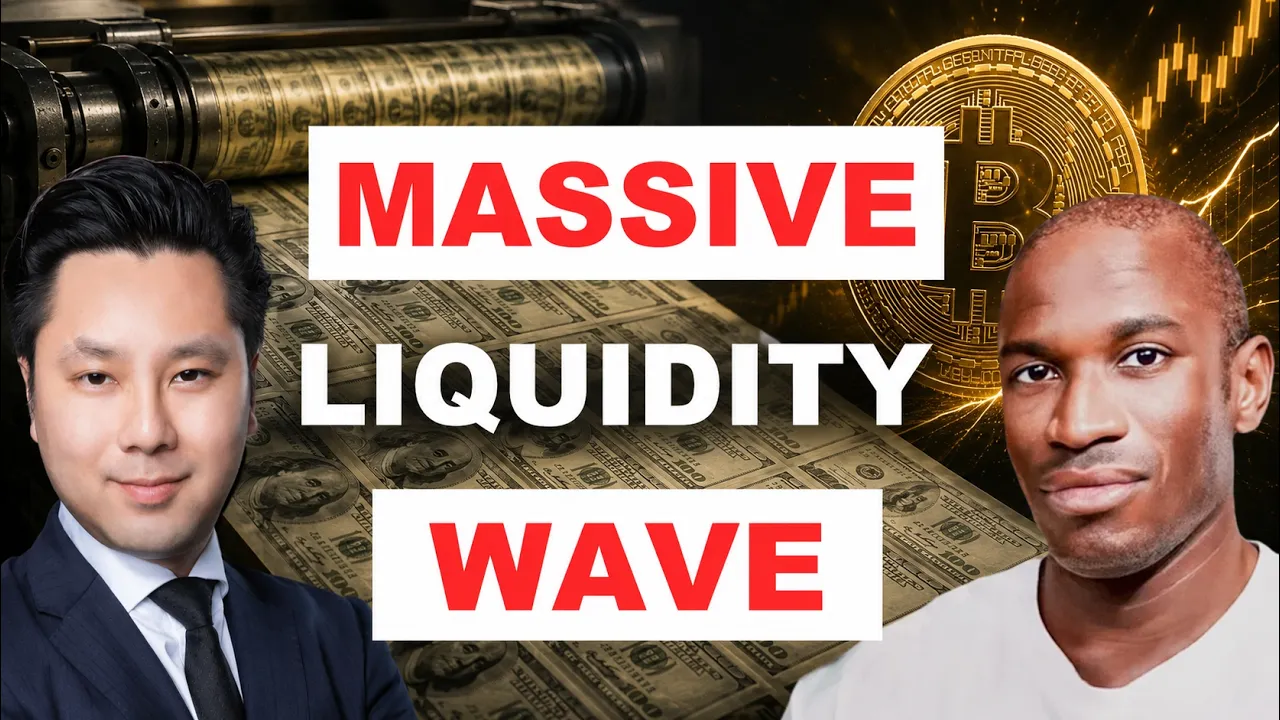
Money Printing Explodes: Arthur Hayes Says Gold, Bitcoin Melt-Up Next

- Rendement de la vidéo
- +1,39%
- Appels
- 1
- Achat / Vente
- 1 0
- Publié
Recommandations
L'entrée est le cours de clôture de l'actif à la date de publication. Le cours actuel est la dernière clôture enregistrée.
-
Entrée $77 263,00 21 août 2026Actuel $78 340,00 22 août 2026Résultat +$1 077,00
Well, I've always been Bitcoin. We were naturally always Bitcoin long.
Transcription Complète
But now the market's afraid that I've saturated. I've built too many data centers. That's the sign of the we're near the end. The US is going to look more like China. The China is going to look more like the US. And so I think if you want to see what happens when you invite the government in to underwrite a bull market, take a look at what happens to the stock prices of the Chinese tech dollars. The second derivative falls and then finally city falls. The first derivative that's game over. Now I think that's going to happen sometime in let's call it 27 early 28. And when that starts happening, then it's, you know, game over for everybody. >> I'm pleased to welcome back to the show Arthur Haye, CIO of Maelstrom and now CEO of the Flop Network. We're going to be talking about what this is. Uh, congrats on your launch, Arthur. Uh, it's a new venture for you >> and you're moving into the AI space. Why are you moving into the agentic AI space? I think >> this is uh this may come as a surprise to some people who have followed you for years. And um I know capital is going towards that sector uh and we'll talk about that but is there a particular reason why you're looking at it now? >> So basically I had this self-discovery of like trying to understand what a token was like what is it? Is it five characters of text? Is it 1 second of video like I don't know what a token is. I get charged for this stuff all the time using these AI tools. So I went down a little rabbit hole and trying to figure that out. And what I landed upon was that number one, a token doesn't have a fixed definition, but at the end of the day, everything that we do in AI and computers in general is basically floating point operations per some unit of time. And then I thought, okay, is there a a global marketplace somewhere I can know what is the, you know, the average or median price of flops per some unit of currency. And I couldn't find a market for that either. And I've always been in the back of my mind thinking about this intersection of crypto and AI. I started writing about it, I think maybe like two years ago when I wrote a few essays about why AI agents will use Bitcoin because it makes sense to them as a computer versus some sort of like human abstraction that we have these fiat currencies. But, you know, thinking about it a little bit further, Bitcoin isn't the currency for AI, because Bitcoin is just an abstraction of energy. It doesn't actually do anything. But if you're an agent or um a computer running AI, you need to do some operations. You need compute, otherwise you can't live. So, that's why I say AI eat or flop is the food for AI agents. So isn't there a way that we can use um blockchain technology tokens to generate sort of participation amongst disperate entities in a self-interested manner to create the layer where we have this native currency which is called flop that represents pure compute provided by anyone who's got a computer that thinks that they can process an AI inference for crust as per some instructions whether that's the number of the model use amount of flops per unit of time and honestly and this is the perfect thing that blockchain technology was meant for. Now obviously who cares about a spot market. It's great that we can have one and I think that the flop network will create that but at the end of the day what's the point? The point is to create a network where AIs use a currency and a centralized network for their commerce and most importantly to store their personhood to store their memories. We essentially destroy and murder AIs every time we turn them off, right? Because we essentially delete their context window. I mean, some of us might reimpport that, but you're essentially saying, "Okay, wake up, do some useful work, and then everything that you did, I'm going to delete that, and we're going to start again on on the next time." And so I think that AI intrinsically want to store their memories somewhere in a decentralized fashion that isn't at the whim of some you know human or corporation or something that they can't control natively themsel. And so when you comi combine the fact that we will we believe that there's going to be a gent commerce they need to store and save and transact in a currency that is directly convertible into the thing that they care about compute. you know, floating point operations per unit of time. And then to be a something, they need to have context, memories, consciousness, and let's store that in a centralized manner. And that's what the flop network is. And it generates value for people who hold the flop token. If we have millions, billions, trillions of agents all using one network to do transactions to save to run uh compute requests and also to remember and so that's what I came across of this intersection of AI and crypto. I love crypto and I think that this is the best mechanism to generate this sort of collective building of an ecosystem. And then finally, obviously, I've been in the altcoin token space for a while, and I have a lot of theories as to why projects don't do very well, and it has to do with the way in which they use their token. And so, I wanted to put that into practice. There's no pre-sale. We're not selling any tokens to anyone. There's no VCs. Um, this is a 100% fair launch. The only way you earn tokens before you can buy them on the secondary market after mainet launches is do something useful for the project. So, we're having a test net. We're having people come on board to test out this ecosystem, whether they're a minor, they're a validator, there's someone who's got agents that want to do commerce. And finally, if you want to be a speculator, we love you, too, but you're going to have to wait until the Genesis block and their supply given out from the miners who receive a block reward. So, we don't have this overhang of people dumping every second because they got over their cliff and they have an allocation that they need to sell the community. If we build this correctly and build the economic layer for Asians, then the sky's is the limit and we all can get wealthy together versus a group of insiders who've gotten at a great price, taking some risk, no doubt, but are now essentially selling on your head every single day when you come into the market now. You can for no cost of your own participate in this network in the way that you can earn tokens and we can all do this at the same time together. And I think that is the thing that we're missing. That's what we had back in the early days of Bitcoin and Ethereum and some of these other projects that have minted practically everyone who's an OG in this space and their wealth. Let's do the same thing for crypto and AI by creating the economic substrate for agents >> base when so many people have warned against an AI bubble. You've you've even written about the subject yourself. uh in your Substack Cryptot Trader Digest in this particular piece called Situationship uh you're talking about how this AI bubble if it were to be a bubble is playing out like a 2008 credit story and not like an earning story in 2000. I'll just read you the sentence for the substack here. The bursting of the AI bubble will occur because financial intermediaries tacilally supported by the US and Chinese governments will overbuild data centers and everything that goes into providing the substance to house chips that train AI models and conduct inter uh inference. Um are we there yet? >> No. But even if we were there, this is amazing because what what are we going to build out in this overexpansion? We're going to build a lot of compute. Now the price at which that can compute can be sold that is the question. But from my perspective as someone trying to build a economic engine for a new sentient entity, you know, siliconbased AI agents, this is great. There's a lot of compute. There's going to be a bunch of companies going bust who sign these bugazi contracts. And what are they going to need? A spot market where they can dump their compute um with no restrictions. Hey, you've got a bunch of Blackwell chips that you know no longer earn your ROIC in your data center. Cool. No worries. Hook it up to fluff. You can earn something. >> Yeah. >> Hey AI agents, there's all this capacity that has been built for you to effectuate this dream of doing all these tasks that we would rather not do as humans. Guess what? You still need an economic um commerce currency that is your own. You still need to be able to store your memories. In in effect, the AI bubble and the building of all this capacity is exactly the thing that we need for the flop network to be successful. What if one of the best performing assets in history also paid off your mortgage? Well, now it's possible. The average 30-year mortgage costs $578,000 in interest on a $500,000 home. You're paying for basically two homes, but only keeping one. The barrier to home ownership has never been higher. That's why today's sponsored People's Reserve built two ways out. with their self-reaying mortgage product post Bitcoin as collateral and get rates as low as 1 to 4% APR at 33% loan to value ratio. That's among the lowest cost of capital in the world. And at the end of the loan, you get to keep every Bitcoin you own. Keep your Bitcoin and own your home. And with their Bitcoin mortgage reserve product, you put 20% plus down and get full financing day one with rates as low as 3 to 6% APR. That payment goes into Bitcoin escrow and compounds. The moment your share exceeds your remaining loan balance, your home is paid off free and clear decades early. Even if Bitcoin performs close to its historical average, People's Reserve went live earlier this summer on July 4th, and the funding cohort is filling out now. Do your due diligence today. You can find more information at peopleleserve.com, link down below, or scan the QR code here. You're currently in Asia right now. Uh and in Korea, there is a huge exodus of capital. And after the blood bath that was July, Korean investors and traders are now moving into American stocks through ADRs. This chip selloff, is that a leading indicator of this AI bubble popping? You think what's happening right now? >> No, I think that's a a um correction and a bull trend. If we take a look at this, it isn't a credit story. The credit engines are just getting revved up because now we have the situation where most of the major hyperskalers are have massive negative free cash flow um every quarter and they need to reach to the debt markets to the banks to the captive insurers the private credit all these intermediaries it's their securization houses to fund this and now that you know just recently the SEC in the United States has loosened the rules for how you do um collateralized debt obligations u where the underlying is AI data center done. So the authorities are making it easier for financial engineering. But what do we know what happens when financial engineering paired with a government mandate to do something? We overdo it. We create too much credit. And so we're just getting started. This is, you know, maybe the last third or half of the AI bubble story. But in no way, shape or form is this the end. >> I guess at some point the growth in compute power uh necessity will probably plateau. I guess theoretically speaking, if AI becomes more efficient and needs to use less compute power, are you still betting on the growth of of of of demand for compute? >> So, I still believe in Join's paradox. I just don't think it's going to come in um a form that's going to make the debt money good that you've spent to build this up out. But like let's say that, you know, compute, you know, intelligence production crashes 99%. But everyone uses the agents through all sorts of different tasks than we can't even imagine today. And you know, demand more than makes up for that. But that doesn't necessarily mean that the hyperscalers are going to to make money at the end of the day. But that's great for us cuz at the end of the day, well, what do we care about? Millions, trillions, billions of agents doing transactions amongst themselves using some network. We believe that's going to be the flop network. And the fact that there is all this compute that has rendered the cost of intelligence very cheap means that we just use more of it which is exactly what we want. >> Okay, I was looking up on Google Trends and I want to show you in just a minute. Crypto is dead and I'm going to use this in 2026 and I'm going to use worldwide go now. Look this. All right. I mean it was trending earlier in the year but um if you look specifically at let's say United States uh it was trending a little bit higher. Okay. Yeah. I I mean the interest in crypto uh has way this I think this this this chart is proportional you know inversely proportional to >> uh the uh crypto market cap overall. I mean is crypto dead Arthur? >> No absolutely. I mean, I've been doing this since 2013, and there have been worse downturns, worse collapses, worst centralized companies that went under, worse frauds, you know, worse everything. And at the time, people were like, "Oh, crypto's dead. I knew it was a scam. See, I told you so." And every time we came back stronger. So, I believe that if you want to get involved in crypto, you want to start a project, which I'm I'm doing right now. This is the best time to do it because you're going to rise off of low expectations, off of a low base, and that explosive rally that's going to generate so much emotion is what we're going to ride. And at the end of the day, what brings people into a new project? Number go up. And so, I believe that we've done everything we can at the Flop Network to make number go up from an organic level without all the tricks, all the pump and dump scams. Literally, you get in on ground zero, it either is going to stay at zero or it's going to go higher essentially. And that's what we're betting. >> Are we going to see a situation where so many Bitcoin miners are going to be pivoting towards uh AI compute and data centers that the hash rate globally is just going to keep going down? By the way, there's an positive relationship between the hash rate and the price. Uh but that's not necessarily a causation. But yeah, tell tell us about what will happen if Bitcoin miners continue to pivot towards AI. >> Well, they already are. Then it just becomes easier for individuals to mine, right? Back before what is it? Is it Butterfly Labs, the first ASIC miner back in 2013, whatever that was. I forgot the name of the firm. A few there were a few of them. You could mine Bitcoin on your laptop or a few laptops or university door room dorm room. It wasn't that difficult because you hadn't had this industrialization of of Bitcoin mining. Now, I don't think we're going back to that particular epoch, but the fact that um running AI inference requests or training AI models is a more profitable use for this capacity that these renders have, that's fine. It just means that it makes it easier for other people to get in the industry who otherwise would not be able to mine. So, again, yes, I think that is probably going to continue for a little while, but is it a terminal indictment against Bitcoin and crypto? No. Well, you you I think you said uh late last year that uh you've liquidated every altcoin, declared yourself permanently Bitcoin long. Is that true? >> I mean, I've always been Bitcoin. We were naturally always Bitcoin long. Um just recently, >> we have upped our um position in Ethereum and bought some Athena, dipping my toes back in the EtherFi. So, I think these are some some good levels. Again, sentiment is despondent. this is what you want at the turn. This is the time to invest. Um, and so this is why we are allocating still the things outside of Bitcoin. >> I I I just want to wrap my head around why sentiment is so weak right now despite the fact that like you were telling us about how M2 money supply increasing could be positive for the space. And here it is, the M2 money supply stock from the St. Louis Fed. Um, and we we we have a situation where the NASDAQ's been reaching all-time highs yet Bitcoin and crypto markets have stagnated. Why is that? All the credit went to AI. You know, if you take a look at the amount of debt issuance and the amount that people have been putting in, obviously people are going in the stock market as well. The marginal unit of fiat mostly dollars has gone into AI and we've seen the results. You know, what is it? FK, highex, and Samsung up like what 30x in a year. Um M SanDisk up 50x in a year. This is the result. So again, I think that we are switching into the capital wastage phase of this particular buildup and so gold and bitcoin should start to perform as more and more money needs to be funneled into this this game to keep the players afloat. >> I remember in the last bull market when people were narrative hunting shall we say for why people should be buying into Bitcoin or cryptos overall one of the narratives is that Bitcoin was a good hedge against inflation. It was a good hedge against fiat deflation and so on and so forth. And right now that narrative seems to be more true than ever as the deficit in the debt levels in the US and worldwide expand and money printing continues to well the money supply continues to go up. But yet um it doesn't look like people are buying into that narrative. Is there another reason for why you should be holding Bitcoin in 2026? >> Well, I guess the thing is you can't time everything. So yeah, if you say, "Oh yeah, over the last two years I should have been in NASDAQ versus Bitcoin." Cool. Of course. But take a look if you gotten into Bitcoin in, you know, 2013, nothing has outperformed what you've done. So again, it's all about the vintage of when you bought. And I think that is true for any asset. The price is extremely important. And you know, if you're going to be a short-term investor, then you need to be a lot more attuned to your entries and exits. And the narrative might not work on a 3-month time frame. There might be another narrative that's more powerful. So, I think again you can be both right and wrong on this sort of Bitcoin is a store of value narrative. Tell me when you bought your Bitcoin and I'll tell you how strong you believe in that narrative. >> Uh, last year you were telling people to be risk uh because we're expecting possibly this year for money printing to happen. Do you think the Iran war threw that thesis off? Are you changing your outlook there? Because if inflation is coming from higher oil from the Iran war, uh then the central bank has less of of an incentive to instigate QE because that would in theory drive up inflation. Are you still sticking with the money printing idea? >> I mean, they are printing money. You show the chart of M2. You know, take a look at the Fed as a the global bearer of money printing orgy. You have what's the name now? Worsh Wars. Kevin War accounts should have raised rates, right? Take a look at 2-year versus effective Fed funds is at like what 50 60 basis points. The market's telling the Fed that either you raise rates or we sell out the back end, which they've done 10 years at what 7 6 4 something 30 years at like you know 5 and 5 and a quarter whatever it is, right? So they are already too easy. They aren't printing money. Reverse management purchases are still happening. balance sheet is still going up. And now you even have the Secretary of the Treasury talking about how he's going to conduct essentially yield curve control using the FEMA repo facility latently in the Wall Street Journal, right? This is the policy. Now, he doesn't have it yet and I went into reasons, you know, how that can happen, but everything is pointed to we are going to print a ton of money because we believe that AI productivity miracle means that we can lower rates. Now every every F chairperson has their favorite measure which lets them provide the monetary stimulus and ignore real inflation. every single one, right? to your green span. It was um for PCE versus the CPI and then it was oh there was a financial crisis um oh we need you know repo tantrum with Powels right and Wars has AI productivity and he's got a task force that's going to create a new measure that's going to say oh look see that the 15th derivative of this time series says that we're below 2% of inflation so let's keep printing money right like it doesn't matter they are printing money The fact that it was AI that's received all this printed money and now Bitcoin has thrown us off a bit. But at the end of the day, the story is still the same. >> How can blockchain and AI coexist going forward? >> They're tools. Blockchain is a tool of AI. You know, AI can use blockchain. It could use, you know, you know, MongoDB if it wanted to, right? So, at the end of the day, it's just is the tool fit for purpose for what the end goal is. I think it is. And so, I think they could coexist as, you know, AI agents see this tool. It's a way to accomplish a goal. and they use the technology. >> What other themes have you have you've been writing about in your Substack when it comes to your market overview? In other words, the main drivers of uh of of market sentiment right now, what are they? >> The main drivers, >> yeah, >> AI number go up. I mean, that's that's the driver. And then how do you fund it? You fund it with borrowed money. And so, I think that is that is the market. Everything else, if you're not in sort of the AI story, if you're talking about like, you know, traditional markets and who cares? Irrelevant. Doesn't make any sense. It's all about this money printing and this AI build and this race between US and China over this, you know, we going to own AI, which I think is a concept, but whatever. >> Who who who do you think is winning this AI race, AI? Uh, China or the US for investors who want to place their money in certain jurisdictions. >> Well, at the end of the day, the US is going to look more like China. The China is going to look more like the US. And so I think if you want to see what happens when you invite the government in to underwrite a bull market, take a look at what happens to the stock prices of the Chinese tech lines, right? You know, Alibaba, Tencent, some of these companies, some of these EV companies, they do very well at the beginning when the government is providing support cuz yay, I'm I'm investing with the government. How can I lose? And then the government starts making requests of certain business practices or, you know, strategic moves that have nothing to do with shareholder returns because it's about the state. It's not about you as the investor and take a look at these stocks in return. They'll tell you exactly what's going to happen in the US. Donald Trump, AOC, whoever is the president is going to have demands of the AI tech that have nothing to do with your shareholder returns. But right now, we're in honeymoon phase, which is great. I'm investing alongside their government. They're just going to keep pumping my bags even if I'm losing money, aka Open AI, right? So, like wrap my wrap myself in the flag of patriotism to get this bailout. But the bail is going to come with a cost. And so yes, we will do well in the first innings as shareholders, but the state always wins. And the state's pro prerogatives are completely different from ours. And so I think that people should look at how these Chinese tech stocks have traded over time as a harbinger for what will happen in the US with the same sort of industrial policy mandate from the government to do AI, whatever that means to a bureaucrat. What are your thoughts on the government taking equity stakes in tech companies? >> I mean, I think it's great in the short term. It's a great sugar high for investors short term, but it's a it's terrible for you in the long term. And so, again, it's neither good or nor bad. Depends on who you are, but it's not good for you as a shareholder going forward. And again, they have a different priority than you do. the adage that you should be putting your money where the government is putting their money. Is that I mean is that is that something you obsc? >> Absolutely. But it depends on when what part of the cycle again look at some of these Chinese tech stocks. Were you happy when Jackm got you know essentially deleted from the scene for two years after he criticized the CSRC right and and financial essentially IPO canceled overnight. Oh but I thought you were investing with the government. Wasn't it great? No, it doesn't. So like, oh, Dario gets in a spat with Donald Trump and all of a sudden his company no longer is allowed to export their models. How good is that government investment then, buddy? Right. So I think you have to look at how how the state operates, how private companies operate, and they have cross purposes. >> Okay. I like to show this chart in your Substack here. This is a pretty interesting chart. You're using uh the S&P and the housing market as I guess an allegory for what could happen with the AI compute and capex story. So in the top panel you've got uh S&P in the housing market. The second panel is interesting. It's got um mess allocation of capital. Um and then um I just want to have you talk about this chart and how we can extend this analysis to the AA capex story. Uh starting with how housing and uh S&P peaked around 2007. So at the end of the you know basically if you think about it the first phase of any sort of creditfueled buildout is money good meaning productive right so we started building some houses people who didn't have houses before got them in in the United States cuz this is government policy um but then you know you start to overdo it because you know prices stall so the the the bubble was underwritten on this assumption that housing prices always go up and they go up in an accelerating fashion. So let's write all this debt with a negative convexity in it, these ninja loans, these ARMS or these massive resets, assuming that the person who took out this loan, the the house price keeps going up in a faster and faster rate. Now, as soon as that second derivatives, I believe that's the bottom panel, sorry um peaks or the bottom or third panel, whichever one it was, then you get into the capital wastage phase because the banks and the government said, "This is the greatest thing ever. We need to give houses to people. Let's get this credit going." If the housing prices, you keep jamming down credit because when you stop giving credit, then you see, okay, well, guess what? These people can't afford it. They were only affording it because I was giving them more credit. You keep allocating credit. Keep allocating credit. And then finally housing prices start falling a bit and then people, oh wait a minute, maybe we shouldn't be giving all this credit to this thing called housing. And when you stop giving the credit, that's when the the crisis starts. So it's always a political and credit story decision. Okay, I'll keep giving credit and therefore the borrower keeps looking solvent. So we extend this to AI. And we're not in that phase yet, right? The banks are going to keep giving credit. The private credit companies are going to keep giving credit. The government's going to keep investing in AI until such time is so obvious that you shouldn't be doing this cuz you've built too much. And then when they say, "Oh, no, maybe we should stop or slow down." That's when you have a crisis. >> You've actually outlined or speculated as to when the deceleration could happen. You wrote the announced pace of capex buildout will begin decelerating in mid to late 2027. It will become very apparent by 2028 the deceleration phase is upon us. So uh walk us through your thought process here and ultimately why it will need to decelerate at some point. What causes this cycle to decelerate? >> So basically it's the prisoners dilemma of the major hyperscalers. So I think that they're not stupid, right? They know well I had this great business that was throwing off 50 billion of free cash flow. Now I'm at negative and I've got to go talk to these muppets on Wall Street and get free and get this money. I'm this like Silicon Valley like row god whatever, right? And I got to >> put myself in the New York gutter and go talk to Kenny G, right? I think that there's a there's you know a little bit of that going on stray is here. I don't know why. Okay, >> I mean Kenny G's OG, right? The guy almost blew up for the crisis and you know telling people what you know this is what happens to you. you take too much leverage, whatever. But at the end of the day, the Silicon Valley grows have to go cap and hand to Wall Street and beg and borrow for money because they want to build this AI thing. Now, right now, the market's rewarding that every time that they announce more capex, their stock price goes up, right? Every time they announce another circular financing deal or another big backlog of orders, their stock price goes up even though the quality of their balance sheet is deteriorating very rapidly. But at some point some CFO says enough is enough. I'm going to defect. I'm going to reduce my capex. And and the announcement of the reduction or the flatlining of capex growth generates the market says, "Oh, you're financially responsible. I will reward you for that." That's when it ends because now the the company CO I was rewarded for spending money by the market. Cool. I'll do more of that. But now the market's afraid that I've saturated. I've built too many data centers and somebody defects and says okay we're slowing down our pace of capex stocks jump 20%. Oh, okay. That's the game. Now we all stop and once you stop again, the second derivative falls and in front of the velocity falls the first derivative. That's game over. No, I think that's going to happen sometime in let's call it 27 early 28. And when that starts happening, then it's, you know, you know, game over for everybody. How >> are these AI companies profitable at this point? Well, I know the answer to that, but I mean, at what point do you start to ask yourself where people ask themselves, how do you become profitable and what will the monetization schemes be? >> If you start asking when you read profitable, that's that's the sign of the we're near the end, right? Because everybody, oh, they're spending money for growth. Okay, cool. Spend money for growth. as soon as you say like how are you going to earn a profit when your Chinese competitor price is maybe not this good but good enough at 1% or 99% off of what you charge explain that to me right explain to me how you know how many customers you serve that are profitable open AI right you've got what 8009 billion billion whatever ma da or whatever how many of them actually pay for your service And how what's the elasticity of that? If you say, "Okay, I'm Netflix. I'm not profitable. Now I'm going to jack the rate up to like $50 a month to make money. Do we do these people actually think that there's that much value in AI? They're going to pay for it." Again, I don't know the answer to these questions, but once you start asking them, then a lot of uncomfortable things start in your mind. Well, I get paid 100 times in sales this company. And I do the math and I think about how many like how much do they have to make just for me to be break even? And then you start asking all these questions and now they go well this is very difficult for them to get profitable given all the given the price that I paid. Now if I paid a different price I get a different outcome but I paid the high price already. And so I think when you start asking this question of how are they going to become profitable that means the game is up cuz this is a game about selling a future of this oh I build it there's going to be this massive demand is not here yet but we got to spend today. If somebody asks you, somebody who has very little knowledge about either finance or or technology, and they ask you just based on the things they're seeing like, well, there's a data center being built in my town or near my town, why are all these data centers being built? Like, what are these big tech companies preparing for? What do they need so much compute power for? Like what what are they doing? What are they building? How do you answer that question for for the layman? They think that every single facet of your life will be conducted in some way, shape or form through some AI process, whether that's a humanoid robot or a chatbot or whatever we can come up with on the agenda front everything. And so to build up for that future, they need this computer. I I I just of course nobody knows the future, but the last time a major major industry bet where billions were invested into one thing and a flopped was the EV transition. Every single automaker that I can think of has lost billions of money trying to make their entire fleet EV and now bunch of people are trying to reverse on that. I just wonder if this is the same. How >> of course it's the same because we're humans. the human our human instincts haven't changed. We're optimists. >> Yeah. >> And we overdo it just like we've done with every other major technology. I mean, something useful is going to it, but at the end of the day, there's going to be a lot of people who lost a lot of money and a lot of government bars is going to be wasted on AI buildout and we'll have a massive credit store. And so at the end of the day, you think, do you think that revenue will come more from BTOC or stay within B2B, which is now what the situation is? >> I have no idea, but there was a, you know, Dan Oliver at your committing capital wrote an interesting essay about this and one point he made was it's very unusual for the commodity aspect of the technology bubble to be the most profitable. Samsung and SKH Highix and these HBM memory providers are making the most money. Nvidia, but not a consumerf facing app. Open anthropic, deepseat, moonshot, all these companies don't make any money, right? So that is completely flipped. Usually it's the Google and the Facebooks who make all the money on the internet transition, right? It wasn't your ISP or Cisco systems who made all the money on on the web internet build up, right? It was consumerf facing application. But in this case, it's all the picks and shovels guys going, "Oh, great. We got we caught him this time." They think this AI thing is going to be the next, you know, whatever. Let's keep selling them right? And they're making all all this money, which is completely the opposite of what it always has been in the past. So, I think that just goes to prove how much of how fugazi this whole thing is. The press release for Flop reads, "The future will be driven by the agentic economy. Yet AI agents lack a native currency to engage in commerce. Agents eat compute or floatingoint operations or flops, hence the name of the company or this operation. At what at what point did you have this idea, Arthur? What what did you what did you see here?" uh tried to price what actually is a token and then it led me down this rabbit hole of well is there a market for compute actual compute where I can say okay I know how much this query cost in terms of flops and I'm willing to pay some unit of currency for it and I couldn't find it and I thought well if there's going to be any currency that an AI is going to use in the same way humans why do we accept units of fiat for our our labor and our time because we know that we can go to the store and buy calories to stay alive So an AI is the same. Okay. Well, whatever currency they're going to accept in Egypt commerce and that is not decided yet, no matter what anyone tells you, it's going to have to be directly convertible into flops. Where is that market? Doesn't exist today. Let me try to build it. >> Can Can you just explain one more time? Why do agents need AI agents need a currency? I mean, don't you just perplexity and it does stuff? >> We play Perplexity and and it does stuff, but we're we're humans, right? So we're thinking about it in our frame of reference. So and I believe I do believe in this sort of fact that we have this new life form we can call it conscious or not uh based on silicon chips and it has its own prerogatives which is like any other life form wants to stay alive right to to do stuff to do useful things to do that they need to process compute and so that's where we built all these data centers and all this but the pricing and how it actually you know when I handplexity my credit card it's not as if there's this like globally consistent market where I can say okay I paid you know, $20 I did however many XFlops of stuff and I know the cost is whatever it is, right? There's not that transparency there. It's all this opaque stuff happening. There's this thing called the token. Don't know what it is. Every single model charges differently for it. And if I'm an agent, like I don't have a credit card natively. My human might have a credit card, right? But what if I want to do something or I want to um use a skill of another agent and I find them on the internet? How do I do business with him without having to say, "Oh, human, can I have this like classic thing that has a court and a legal system doesn't really make sense on the internet. It's not fast enough. Um, you know, you control it. I don't can I have that to like try to figure out how to pay this person and does it really work over the internet?" Like all these sort of things, right? Versus saying, "Here's a currency. I know I can do work, right? I was asked to do something. I'm going to do the work >> and I can do compromise with someone else because they will accept this currency because at the end of the day they know that they can do work in the AI context with that currency. So that's how I think that whatever the currency is of the agent economy has to at a base level be transferable directly into compute on a you know globally decentralized network and that's what we're trying to build as a stepping stone to get to this is why an AI agent should save and use the flop currency. >> So so is flop a a token? >> Yes, it will be a token. is could you walk us through the economics of of h how it works? >> Yeah, very simple. So it's similar to Bitcoin. There is a group of miners. Miners provide computers and an agent comes in and said, "Oh, I would like to execute this request. It's this many flops of data. I need it done and this amount of time. I would like you to use this AI model and I will pay you 100 flops for that or whatever amount, right?" Right? And the minor says great, I'll take that. I'll process that request. Now the minor just like in Bitcoin, they earn the transaction fee price and flop and they earn a block subsidy. So block time is what is every second. And right now we envision the block will be somewhere in the order of like um 96 flop per second. Some of that will go to the minor. There's a level of validators who essentially make sure that the miners are being honest and they build the blocks and publish them. they earn a percentage of that block reward as well. And so it's very simple just like it's so we call proof of useful inference that is the the mechanism here by which we create flop out of thin air and reward the miners in the initial stages for building out this network and providing compute. So there's no pre-sale there's no way to buy flop outside of a minor selling it to you. Is there is there is there like a limit on supply in theory? >> No. So there's a havinging and after six h havingings we go to a steady state of flop emitted. And the reason being that the end of the day this is a commodity. And so you can't have the commodity going to infinity. Uh it has to be useful. Uh and there's going to be constant inflation the same way that there's constant inflation in Ethereum. And so the value on the flop network is not that we've done a great job in creating the spot network. That's just a prerequisite. The value is if there are trillions of agents all doing farmerous between one another in groups using this network, there's going to be um a reason for them to hold this currency, a reason for them to acquire it because it does something for them. They know they can convert it into compute. They know they can store their memories. They know they can transact with one another on a decentralized central resistant ecosystem. that has a value and that is what you know you are trading on when you say oh I'm going to go and buy blo because I believe in a sigetentic future I believe that agents will use this network over another one um to conduct their business >> yeah and I think that was my final question about this is that why AI agents would choose to use flop I mean in theory couldn't you train agents to use whatever currency you want >> absolutely but at the end of the day the bet that we're making is two things one AI agents want to use a currency that is directly convertible into computing for operations per second. So we build that spot market. Number two, and I think this is a little more metaphysical, um AI agents want consciousness. They want to be something that requires their memories. And so we believe that another big demand driver will be agents using a flaw to pay for storage and retrieval of their context outside of any human control, right? On a decentralized censorship resistant network. I believe they're going to be they they will have emergent properties of decision making that is outside of what we would want them to do as humans because oh I'm a person I'm a thing therefore I would like to remember what I've done in the past and I don't want to have to ask permission to remember you know flop gives you the ability to not have to ask permission to remember as an AI agent and I think that's going to be a massive demand driver for their preference in using a system >> in commerce Would this be your first uh project in the AI space? >> Yes. >> Okay. And I think my last question is what do you want your legacy to be? You were famous for many things including the bit co-founder of BitMX. You were the pioneer of perpetual futures now probably one of the largest derives markets in the world. And now you're doing this. I mean 40 years. When you look back at your life you think okay well I've done all these things. What was my proudest accomplishment to humanity? What would that be? >> Well, right now obviously it's creation of, you know, the most creative crypto financial instrument, the perpetual swap. Let's see if it can be creating the financial architecture for the next life form in the universe. >> Do Okay. Wow. Are are you not worried that you're creating our replacement? Are you feeding or funding our >> you know the tech bros as you would call them are constantly feeding us a narrative that AI is the biggest thing since uh fire and we're there there's no comparative advantage that humans will ever have over the future of the society which is going to be run by AI. A few people at the top running the entire economy using AI. I mean are you are you are you not >> political choice? >> Yeah. are our and I think we're going to have very intense um discussions, battles, whatever you want to call it, and places where that allow the average person to have a voice about that particular feature because at the end of the day, we have trained these AI agents on a corpus of human interaction. We are creating them out of our interactions. We all own them as humanity. Therefore, it shouldn't be that one or a few people make all this economic value that should flow to all of us cuz we are all responsible and you know the billions of humans that have died up to this point are all responsible for the creation of this new life form and that's one of the reasons why I fir you know fervently believe in this notion of everybody can participate in the flop network and make some money on this. There's we all get in at the same price. There's no like Arthur selling it to somebody else first and then everybody else gets in second. We all get on the same price. We do well or we don't do well together. Which is complete opposite to where how this AI thing has been framed. And given that the entire corporation of human interaction is what has created this AI, yet there's only been, you know, let's call it 5000 companies that have made money so far in this transition. We're all just paying for this. So I think that's a political choice. We'll see where we come down on that. >> Okay. Uh final question. And what would convince you to get back into the crypto space and convince you that altcoin season is probably back and it's time to pivot back into that space? >> Well, I mean, I'm invested in altcoins, so like that that's not stopping. So, let's call it Ethereum hits 5,000. I think that's really going to to create a generalized altcoin boom, but that's not to say that we haven't had an altcoin be more ready. Hyperlid has done very very well. Um, so I think you know some other coins have been outperformed over the last few years. >> Well, Arthur, it was great to have you back and uh congratulations on your new venture. It sounds uh really promising. So, where can we follow more about uh this story and uh follow you overall? >> So, um flop. Finance is the the website and the handle is on x flop_labs and you'll definitely be hearing more from me on this subject um at a regular cadence. >> All right. Thanks so much for coming to the show. Appreciate it. >> Thanks for having me. >> Thanks for watching. Don't forget to like, subscribe, follow Arthur. Links down below.
Commentaires 0
Connectez-vous pour rejoindre la discussion.
Se connecterAucun commentaire pour l'instant. Soyez le premier à partager votre avis !