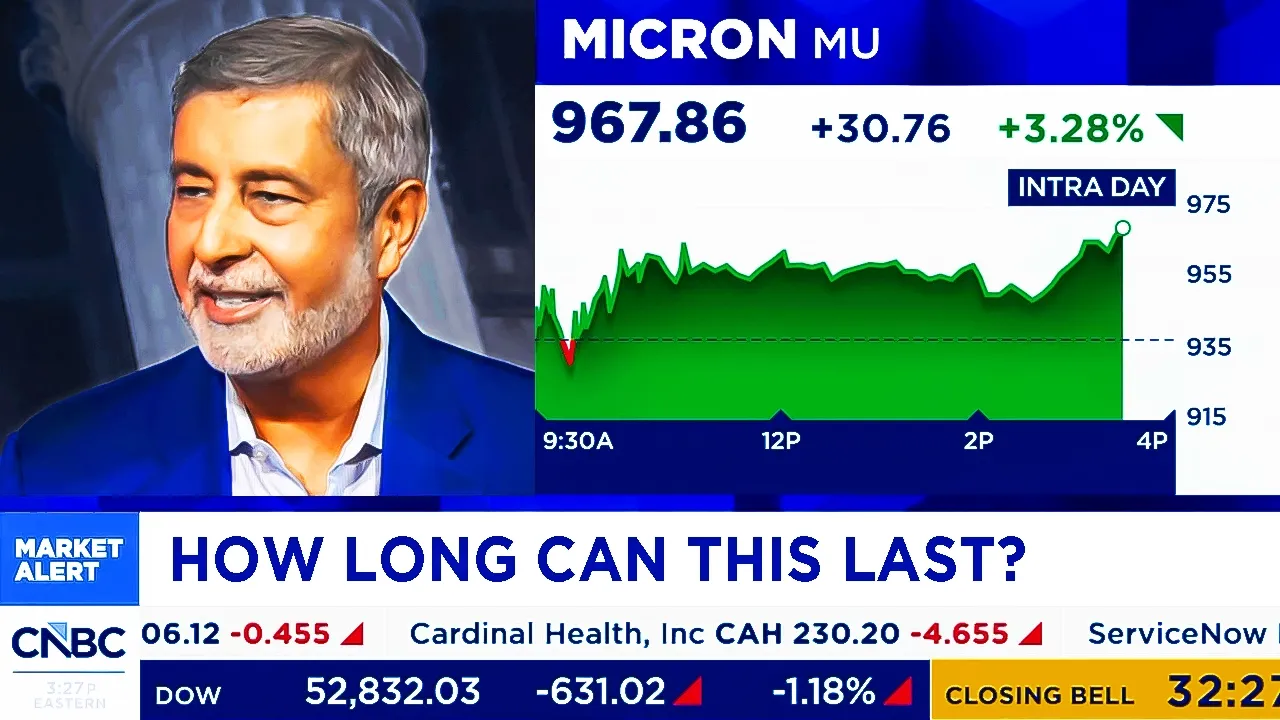
Micron CEO On Micron, Memory Demand, AI Demand, Micron Stock, NVIDIA - NVDA Update

- Rendement de la vidéo
- —
- Appels
- 1
- Achat / Vente
- 1 0
- Publié
Recommandations
L'entrée est le cours de clôture de l'actif à la date de publication. Le cours actuel est la dernière clôture enregistrée.
-
Entrée $214,72 21 août 2026Actuel $214,72 21 août 2026Résultat +$0,00
That said, the stock is arguably cheap versus the company's future growth.
Contexte Now, I'll be completely honest with you. I expect results and guidance to be strong, but I don't know for certain how the stock will react. It's very common for Nvidia to trade higher ahead of earnings in anticipation and then to trade lower after earnings. So, that's definitely a possibility and we've seen it happen many times before. That said, the stock is arguably cheap versus the company's future growth.
Transcription Complète
Sanjay, a lot of people could see behind me and say listen, there's a lot of concrete, a lot of steel, a lot of people with hard hats. I look at it and I think national treasure. >> Jim, I have always considered Micron a national treasure. Nearly 50 years of leading with innovation in memory. The only memory company that is here today in US driving global leadership and now memory has become a critical infrastructure for AI. Without memory, there is no AI. You want to advance AI, you need more memory. All invented here, you know, 62,000 patents created, you know, with the leading work done here. And now we are building leading edge memory manufacturing here. Very excited Jim and thank you for coming here to see the action here as well as bringing your whole crew here. >> I like to see American greatness and innovation. I like it when I think our country is winning because of Micron. Tell me what would happen if I went to Clay, New York, if I went to Manassas, the other places you're doing these things. It's not just Boise. This is a big effort. >> Absolutely correct. Micron is investing 250 billion dollars. >> Big. Big. >> Big numbers and >> Big billion, not million. >> And totally totally committed to making these investments here in America to bring up leading edge memory manufacturing as well as what we call long life cycle memory products for automotive, industrial medical defense aerospace markets. So what we are building here in Boise, Idaho are two large fabs. Jim, each of these fabs will be the size of 10 football fields. That means the size of two Eagles stadiums. Each fab will be the size of >> winning >> Two winning fabs, that's right. Absolutely two winning fabs. It starts here. We are building in Syracuse, New York, in Clay, New York, as well. We are earlier a month or so ago we poured concrete moving as fast as we can over there as well. In Manassas, Virginia, we have brought modernizing the technology there to meet the requirements of those end markets. So, from data center to edge for data center, consumer, automotive, industrial, we are bringing up memory supply as fast as we can. >> Okay, so are there people are there people right now is it Jensen Huang is there Amazon who's saying, "Listen, when are those chips going to be done?" And when are they going to be done? When are we going to see something from here? >> All of our customers want more memory. They want >> They want more memory >> faster. I we are I'm engaged directly engaged and our teams are engaged directly with our customers. They appreciate that Micron is betting on American worker. Micron is investing in America. Our US supply that we are working hard to bring up is very important to all our customers. So, yes, I mean, this Boise, Idaho fab which has right now about 8,000 construction workers are here. This fab will have first wafers out middle of 2027. Jim, these fabs take a long time to build. You cannot flip a switch and have a fab constructed. >> But but how can you afford to risk building something this big given the way the industry has historically been like this and this and this? >> Jim, AI has changed the demand profile for memory. >> It's not boom bust? >> AI memory has secular demand with AI across data center, across consumer markets, and of course industrial automation, and in future robotics, which by end of the decade, each of these robots and they will be over time hundreds of millions of these robots, they all require tons of memory. So, memory demand is tremendous. Supply is constrained. We see 2027 even tighter with respect to 2026. What we are building here, first wafers out in '27, production ramping in 2028 time frame. Clay New York, production ramping it, you know, by 20 9, 2030 time frame. The second Boise fab will start ramping up production late 2028 time frame. >> me that you have line of sight for demand beyond '27. >> Absolutely. I mean, we see we have done five-year strategic customer agreements, right? These strategic customer agreements have given commitment of demand from our customers over these five-year period. >> Did you ever dream even least for these three years that you strategic customer agreements where they lock in and they take or pay? >> They are take or pay. >> No outs. >> With no outs for customers. >> say, "Sanjay, I'm having a hard time here. Give me a break." >> And can I tell you, they are take or pay, customers have made cash deposits or you know, other similar financial commitments amounting to 22 billion dollars and our customers wanted more of supply than what we could commit to them in the SCAs. >> So, incredible. >> Even for data center, today customers want 50% more memory than what we are able to commit to them. >> Well, look, I I was reading on X that Elon Musk said he would buy everything that you made. What would happen if he called you and said, "Listen, Sanjay, I want to buy everything that you make and I don't want anybody else to have it." >> I'll tell you, all our customers across our end markets will buy everything that we can build. >> these agreements before someone like that comes in and sweeps. >> I mean, these agreements are critically important. They give us, of course, the visibility to supply and confidence in that supply, enabling us to invest 250 billion dollar commitments here in America. These agreements give our customers assurance of the supply that we are able to commit to them as well. >> But, what happens if some board member says, "You know what, Sanjay? This whole thing you got with America, I think it's great, but let's do this in the Philippines and just crush it. Make a lot more money." What do you say to that to that board member? >> Look, we are an American company. We are We have We are where we are with American innovation. Memory has become a key enabler of AI. It is Memory is the intelligence behind artificial intelligence, right? So, it is critically important. We are very proud as an American company that we are investing in America. Of course, we have large-scale manufacturing overseas as well, and we can We need to invest and continue to advance our overseas fabs as well. All of this is needed, Jim, to meet the customer demand and still I cannot see when supply will catch up with demand, despite all our efforts to bring up supply as fast as we can. >> Okay, now, I look around here and it contrasts with the view a common view in our country, unfortunately, that it's too expensive to make things, there's no workforce to make things in this country, and no ethic. That can't be true. Here. >> Look, Micron has been around here in America for 50 plus nearly 50 years. We have been building memory here in America. 8,000 construction workers with tremendous work ethic are here every day building the fabs. We have 7,000 plus engineers and workers that are driving innovation and driving leading edge R&D roadmap. >> you're training training some of these workers and careers they're building right here, right here? >> Absolutely right. I mean, you know, we have just built our training center, workforce training center, where not only we are training workers, our suppliers are training workers to support us here, as well as we have College of Western Idaho that is bringing students here to train them. Micron is investing in apprenticeships. We are partnering with veteran institutions. Lot of our workforce is made up of veterans as well. We are partnering with universities to advance semiconductor curriculum. So, innovation is thriving here in America, and this is where, you know, Micron now invest in Micron >> [snorts] >> research labs, because there is no better innovation hub than here in America. >> to you and I think, well, isn't this what the government used to do for us? >> Look, I mean, partnership with government and industry is critically important. >> that we let the corporations do it. You know, they're going to do a great >> Totally, it's our responsibility to lead advanced research working with the ecosystem. This $10 billion Micron research lab announcement that we made here. This is Micron is convening the ecosystem partners to lead with breakthrough innovation. Universities startups customers industrial bodies, government, we are partnering with them to drive the advanced research for the next generation. So, Jim, think of Boise as the hub for innovation that will be 10 years plus for subsequent decades. Boise as the hub of near-term roadmap of technologies, and now Boise becoming the hub of leading memory manufacturing here as well. >> Boise, I got to move here. It's too great. >> It's a great place to move here. We are able to attract top talent here. >> All right, we'll be right back with Sanjay Mehrotra, he's chairman, president, CEO of Micron. For as long as I've followed this industry, I've always felt that your particular end, memory chips, just weren't given its due. The balance of power has shifted dramatically in your favor. How come? >> You know, today there is no AI without memory. AI systems need more memory, they need higher performance memory, they need lower power memory. So, the value of memory has that equation has totally changed. They our customers, to drive their own growth, they need more compute, they need more memory. So, memory really has become a key enabler. And Jim, this is not only in data centers, even in your phone, you know, to have richer experiences in AI-enabled phone, you need more memory content. Your PCs, your self-driving cars, all of them now need more and more memory content. So, the need for memory is ever greater. And now, in AI, it's not just the devices and the servers, now you have agentic AI. Agentic is all the agents, all the context windows that are getting larger. >> all global. More memory as well. >> Okay, so, uh we have a lot of shareholders of Micron. So, I know I've talked with you positively for years and years since the show started. And they're probably saying, "Yeah, that's great, but are they able to make enough money?" In fact, you're making the most money I've ever seen Micron make. Uh do the customers think that's fair? Do they understand that it's just that there's nothing you can do, you got to spend a lot of money to make a lot of money? >> You know, our customers recognize the value of memory because memory is what is enabling them to deliver, to design products that are driving growth engines for uh for them that are enabling value for their customers, right? So, our customers recognize the value of memory. And of course, you know, they are paying the value of memory. And what's important to them is availability of memory. >> So, that's why more than 16 companies, big companies, the companies everybody knows, have said, "Look, I want to do a deal with you because I want to be assured I have supply." >> That's absolutely correct because they need the supply and they see the value of memory. Therefore, they are willing to pay for the memory. Of course, they decide how they going to manage their profits, how they going to price their products. And by the way, we had 16 customers with whom we had signed the strategic customer agreements announced at the time of our last earnings call. Since then, of course, we have signed more strategic customer agreements as well. >> So, how do we get away from the idea that well, wait a second, the data center is slowing down, AI is slowing down uh Anthropic good month, OpenAI bad month. How do we get away from that? Because you know that's missing the big picture. >> All right. It's not about any one customer. It's about diversified end markets and Micron is important for us to support all of our end markets to the best of our abilities, data center, consumer, automotive industrial and we have a wide range of customers. We have strongest portfolio today in the industry going across these end markets. And the demand across our our end markets are high. Memory industry is not able to keep up with the demand. >> Okay. Now, come September 9th, your deal with the government, it'll be 2 years. I understand that after that, you're allowed to buy back stock. I know you can't right now. Your compadres, Sandisk, Western Digital CA, are buying back huge amount of stock. Do you see a situation where you too can buy back a huge amount of stock? >> Jim, we have said before that of course we are growing the business, we are investing in the business, we are investing in advanced research, R&D roadmap of for our products, investing as you see here in building out the memory supply base. So, we will of course invest first in growing the business. We had 25 billion dollars of net cash positive last quarter. Free cash flow this quarter will even be greater. Of course, excess cash we will return to shareholders, and we are best positioned ever to grow the business as well as provide return to our shareholders at larger levels than before, and yes, we are committed to doing that. >> Okay, now there are a lot of people talking about how there's a real overbuild that could happen. That you of course are going to overbuild. I spoke to you three years ago. We had a very pointed conversation where you said, "Jim, I got to rein in. You were too bullish." Well, I mean, you got me excited then you told me not to get too bullish. I mean, you you weren't that you were not all that bullish three years ago, and now obviously everyone's gotten too bullish to some degree. What do you think? Where Where is it Where is it? Where are we in the cycle? >> Look, I mean, we see no end when supply catches up with demand. >> No end. >> We do not end the demand continues to grow here. >> the best and best story ever. >> And again, it is reflected in those strategic customer agreements. They are five-year agreements with our customers where they have committed to taking the supply, and can I just also point out that these strategic customer agreements can also be extended by our customers. So, this gives us assurance of demand. Of course, you know, nothing ever goes in a straight line. There can be ebb and flow. This is what Micron has shown that these when we partner with customers over a multi-year horizon, it gives us opportunity to make adjustments as well. Today is supply is so tight that we have to build out the clean rooms. Of course, how we equip the clean rooms will always be in a disciplined manner based on the latest assessment of demand we have. But our customers when we work closely with them and you know, Jim, you're working closely with them earlier and earlier in their development cycle. This is our unique advantage. As an American company, as a technology leader, America driving AI innovation, it's our unique advantage to be able to work closely with our customers. What we see is that the demand of memory from today's data center, you know, tomorrow, autonomous vehicles, self-driving cars, robots, and across consumer devices, the demand for memory continues to increase and we are working hard to meet the requirements of our customers. >> I want to talk about your commitment to America. You obviously committed to making careers for people. You're committed to tremendous amount of work be people getting jobs. But you're also committed to country. And one of the ways you're committed to country is that you yourself have uh driven the Trump account in terms of your commitment. $250 million, other companies have to step up. >> Absolutely right, Jim. We are very proud that uh Micron is investing in the future of Americans through this $250 million commitment to the commitment to secure the financial future of American children with $250 commitment in seven different states in counties where the income is below $150,000. And with the Trump account launched about a month ago, what we are seeing is that 50 million of that 250 million dollars of commitment is already being deployed. Of course, we are working with Treasury to get that money into the accounts of the state. But we are seeing already 50 million dollars, you know, in these seven states. And by the way, it's not only this 250 million commitment through Trump accounts. Micron here in Boise, Idaho, 75 million dollar commitment toward community investment fund to work with the community to address working with the community to support the community through housing needs, transportation needs, and of course, for the welfare and quality of life improvement in the community. In Clay, New York, Micron has commitments of 250 million dollars, again working with the community for education, for schools, for STEM education, worker training, and yes, transportation, as well as housing. So, Micron really works closely with communities where we have operations. >> Okay, now, one last thing on your tremendous labs announcement, Jim. Micron is taking on one of the greatest challenges of the AI era, reinventing memory technologies and architectures to fuel the next generation increasingly powerful AI systems. We won't be able to do the robots that we want without you. We won't be able to do the self-driving cars. Maybe we can't put people on Mars without you. All of this stuff is determined by memory right now. >> So correct, Jim. Memory is today essential. I mean, it That's why I call it strategic infrastructure of the AI era. Memory is essential across devices, across technologies, across product solutions, and we are very proud to be able to partner with this ecosystem. You see in our press release today on Micron research lab, leading institutions and leading entities from US are partnering with us to drive America's leadership in semiconductor technology. Making America the innovation leader. >> We will remember. We remember what you did. >> We going to play our role here. We are being responsible and we look forward to other companies joining us not only in driving advanced research but certainly partnering to advance the communities. You know, we look forward to other companies joining. >> Well, maybe hopefully the watch will get and they'll get their act Well, there's many companies doing great things but they should do them alongside of you. Sanjay Mehrotra, chairman, president, CEO of Micron in Boise. Thank you for having our team. Thank you for what you doing for the country. >> Thank you, Jim. >> All right, I hope you're all doing well today and staying calm in this market. Thursday was a rough day throughout much of the market due mainly to macro concerns. So on Wednesday the Treasury announced that it would increase its purchases of long-dated bonds which provided some temporary calm as market participants have been worried about elevated yields. And then on Thursday yields moved higher, oil moved higher and inflation concerns resurfaced. I noticed the 10-year moved back up to where it was before the Treasury's announcement. That weighed on stocks Thursday. Micron and SK Hynix were two notable exceptions to the red action as we got news from both companies. Let me address those news stories and then I'll cover Thursday's Nvidia news after that. So on Wednesday SK Hynix announced that it would buy back more than 24 million shares. So about 3.3% of total shares issued and cancel those shares. That's roughly $28.6 billion. SK Hynix also said it intends to return over 50% of 2025 through 2027 cumulative free cash flow to shareholders. And then on Thursday we learned that JP Morgan thinks SK Hynix could return at least $130 billion to shareholders in 2027. That's in addition to the buyback they just announced. Also SK Hynix buyback program began this Thursday. Also on Thursday Micron unveiled Micron research labs, a US-based long-horizon innovation hub to shape the future of memory and AI. Micron plans to invest $10 billion in the initiative over the next decade, uniting academia, government, startups, and industry to advance memory and compute breakthroughs that will define the AI era. Key research areas include critical memory technologies, advanced memory and compute architectures, packaging, and future semiconductor manufacturing. Two things really stand out to me from this announcement. First, this research hub is specifically aimed at finding breakthroughs that will drive AI forward. And second, Micron is talking about working directly with customers to co-develop new technologies. It reminds me of what GM said on their recent earnings call, in which GM CEO spoke about the company's partnerships with Samsung and Micron, and the fact that they would work with memory makers to co-develop new technologies. This is a very important topic when considering the cyclical versus secular and commodity versus strategic infrastructure debates. We're talking about Micron working directly with large customers to co-develop new technologies that address those customers' unique and specific needs. Long-term, we're talking about new technologies developed by Micron that are woven into the product roadmaps of Micron's largest customers. That level of collaboration and co-development should help weaken the commodity narrative that says all the memory makers are the same, and that they're all producing interchangeable products without any moat. This is a long-term initiative that should strengthen Micron's strategic position in future years. Micron anticipates breaking ground in calendar 2027 on a state-of-the-art Micron Research Labs facility capable of hosting hundreds of researchers. On Thursday, The Information published a story claiming that Nvidia was planning to begin small-volume shipments of a new China-specific chip by year-end. The Information claimed the chip was a version of Nvidia's LPU. And then Reuters reported that Nvidia denied the report, with a spokesperson saying, quote, "The reporting in The Information on Nvidia's LPU is incorrect. We have no LPU sales in the China market today, and no China-specific LPU product in our roadmap." As I've said so many times on this channel, this has repeatedly been an unreliable source on Nvidia China rumors. In contrast, The Financial Times has a very good track record on accurately reporting on Nvidia China rumors. I have no affiliation with the information or the Financial Times. I'm just calling it as I see it. On Wednesday, the FT reported that China has begun allowing limited shipments of Nvidia H200s in a mainland China with both ByteDance and Tencent receiving roughly 10,000 H200s each. Several other Chinese tech companies could soon receive similar size shipments. Regulators are allowing H200s to be deployed in Hong Kong and Nvidia has roughly 500,000 H200s set aside largely for Chinese customers. So, if restrictions do ease materially, then Nvidia is ready to go with a decent amount of H200s for Chinese customers. The recently reported shipments are small, but they do signal progress. Also, the US government is taking a 25% cut of Nvidia's China sales. That said, most analysts are not modeling any China revenue into their current models given the repeated back and forth on this topic over the past year. Any China revenue would represent additional upside for Nvidia that is currently not factored into most analyst models. Given the FT's track record of accurately reporting on Nvidia China rumors, I'm really interested to hear what Jensen and Collette have to say about China sales on the Nvidia earnings call. Looking ahead, we have Nvidia earnings on Wednesday, August 26th. Last I checked, consensus expectation for the quarter were revenue of roughly $91.93 billion, EPS of $2.08, and gross margins of 75%. As for next quarter revenue guidance, it appears that the consensus is $104 billion, but I've noticed that multiple analysts are expecting Q3 revenue guidance closer to the range of $107 to $108 billion. Q3 gross margin guidance is expected to be in the mid-70% range. Keep in mind that those are the expectations the last time I checked, so things could have changed since then. Now, I'll be completely honest with you. I expect results and guidance to be strong, but I don't know for certain how the stock will react. It's very common for Nvidia to trade higher ahead of earnings in anticipation and then to trade lower after earnings. So, that's definitely a possibility and we've seen it happen many times before. That said, the stock is arguably cheap versus the company's future growth. Regardless of how market participants react in the short term, I expect this earnings report and earnings call to reaffirm that the long-term thesis is intact. I'll be very interested to hear what leadership have to say on earnings call regarding rumors about reduced memory content per GPU. Frontier model company's profitability, China sales, and the rollout of Vera Rubin among other topics. I'll try to provide a recap of the highlights from Nvidia's earnings and earnings call on this channel on the night of Wednesday, August 26th. So, be on the lookout for that. That video will probably be posted either late Wednesday night or early Thursday morning, depending on how long it takes to make the video. I'm expecting that video will probably take 8 hours or more to make. So, please bear with me on that. Now, in case you're new to the channel, I want to make sure that you have at least a basic understanding of the underlying long-term thesis. So, let's cover that now. I don't know what's going to happen in the short term, but from a long-term perspective, I am very confident that Nvidia will be worth much more in future years than it is today. When Jensen was on the Lex Fridman podcast not that long ago, he was very seriously raising the possibility of Nvidia becoming a $3 trillion revenue company in the near future. If that happens in the coming years, then it is very plausible that Nvidia could one day be worth tens of trillions of dollars in market cap. That might sound crazy, but that's what Jensen is implying when he raises the possibility of Nvidia becoming a $3 trillion revenue company. I guess the question at that point is what multiple the street will be willing to give Nvidia. I don't know the answer to that question, but I truly do think that Nvidia will be worth much more in future years than it is today based purely on the fundamental growth of the business. Based on everything I'm seeing, the world is still compute constrained, and I expect that it continue at least through the first half of calendar 2028. In a compute constrained environment, developers will use whatever viable compute they can get their hands on. Today, there are no GPUs that are sitting dark due to a lack of demand like there was fiber sitting dark due to a lack of demand at the height of the dot-com bubble. Back then, companies were laying fiber in the hopes that use cases and demand would eventually show up. Today, we are seeing the complete opposite. As I've said many times, when market participants compare this AI revolution to the dot-com bubble, they ignore the fact that the internet is already here this time. This means that mass adoption of the technology and new use case development at scale are immediately possible. We don't have to wait years for it to show up. It's already here. The world is compute constrained, which means there is not enough supply to satisfy demand. New capacity is utilized as soon as it comes online. The hyperscalers are monetizing capacity as soon as it comes online. Each of the hyperscalers spoke about being supply constrained on their most recent earnings calls. Additionally, many of the clouds are building out into contracted demand. They're not blindly building in the hopes that demand will eventually show up. No, they're building out because they have signed contracts and in some cases significant prepayments from their paying customers. This AI revolution is fundamentally different from the dot-com bubble. In 2026 will be a pivotal year for the AI industry thanks to the rapid adoption of agentic AI and the proliferation of agentic systems in the world's leading enterprises. The leading AI labs revenues are surging right now. Agentic coding and the implementation of agentic systems in large enterprises are new use cases that are increasing inference demand significantly. That subsequently is increasing compute demand. The rapid adoption of agentic AI is why we're seeing an inflection in inference demand. It's why we're seeing the leading AI labs revenue surge. I wish both Anthropic and OpenAI were public so the public could see the ramp in their revenues. I think the leading labs surging revenues may be the initial proof point that grabs market participant attention and causes them to realize that there will be a clear ROI on AI infrastructure. I think the leading labs surging revenues will also help assure investors of the longevity of Nvidia's growth since these labs revenues are directly tied to compute. If they had more compute, they would have greater revenues. It really is that simple. Demand is not the problem. The problem is a lack of supply to meet the demand. As I've said previously, I expect the world to be compute constrained at least through the first half of 2028, possibly longer. And so regardless of what happens in the short term, it's important for long-term investors to remain focused on the fundamentals, maintain a long-term perspective, and remember that we are only in the early stages of agentic systems being adopted at scale. This will increase compute demand significantly. And after that, the next surge in compute demand will likely be fueled by physical AI. We're no longer talking about digital agents performing digital tasks. With physical AI, we're talking about physical AI agents performing physical tasks in the real world. Nvidia CFO has called physical AI, quote, a multi-trillion dollar opportunity and the next leg of growth for Nvidia. This industry will fundamentally transform society and Nvidia has positioned themselves to benefit massively. Nvidia sells the hardware for the data centers where the models are trained. They offer Omniverse where the models are taught and tested. And Nvidia also sells the hardware that allows on-device real-time inference through Nvidia AGX, allowing robots to have intelligent interactions with the real world even when they are not connected to a data center. Notice that Nvidia is taking a holistic platform approach to physical AI and they're embedding themselves as the underlying foundation supporting all of it. Over 2 million developers are already building on the Nvidia robotic stack and this is not getting enough attention. As for production ramps, Blackwell Ultra has ramped quickly and remains in high demand. Rubin is on track to launch in 2026. Then we're expecting Nvidia Grock 3 LPX in the second half of 2026. Later on we're expecting the launch of Rubin Ultra in 2027 and Feynman after that in 2028. We have a clear data center product roadmap stretching into 2028. Jensen believes that AI infrastructure spending will reach 3 to 4 trillion dollars annually by the end of the decade. That means Jensen is expecting growing AI demand and an expanding total addressable market underpinning all of this. I don't think we are anywhere near any type of bubble bursting type of event. With all of this in mind, I seriously think that Nvidia still has plenty of runway ahead of it. And I think this company will be worth substantially more in future years than it is today. At least that's my view of the situation. Quick note before I wrap up. All of the compilations on this channel are edited by FinVid with original structure and commentary. Occasionally, the same edits appear elsewhere on YouTube. If you're looking for the original version, it's always here on this channel. Thanks for watching FinVid. I appreciate your support. Remember to stay calm in this market. Remember to maintain a long-term perspective and do not make any hasty or irrational decisions. With all of that being said, I hope you all have a great rest of the day and I'm curious to hear your thoughts about Nvidia in the comments below. Please leave a like on this video so more people will see it. And while you're down there, please consider subscribing. It's free and you can always change your mind. Thanks for watching and hopefully I'll see you in the next video.
Commentaires 0
Connectez-vous pour rejoindre la discussion.
Se connecterAucun commentaire pour l'instant. Soyez le premier à partager votre avis !