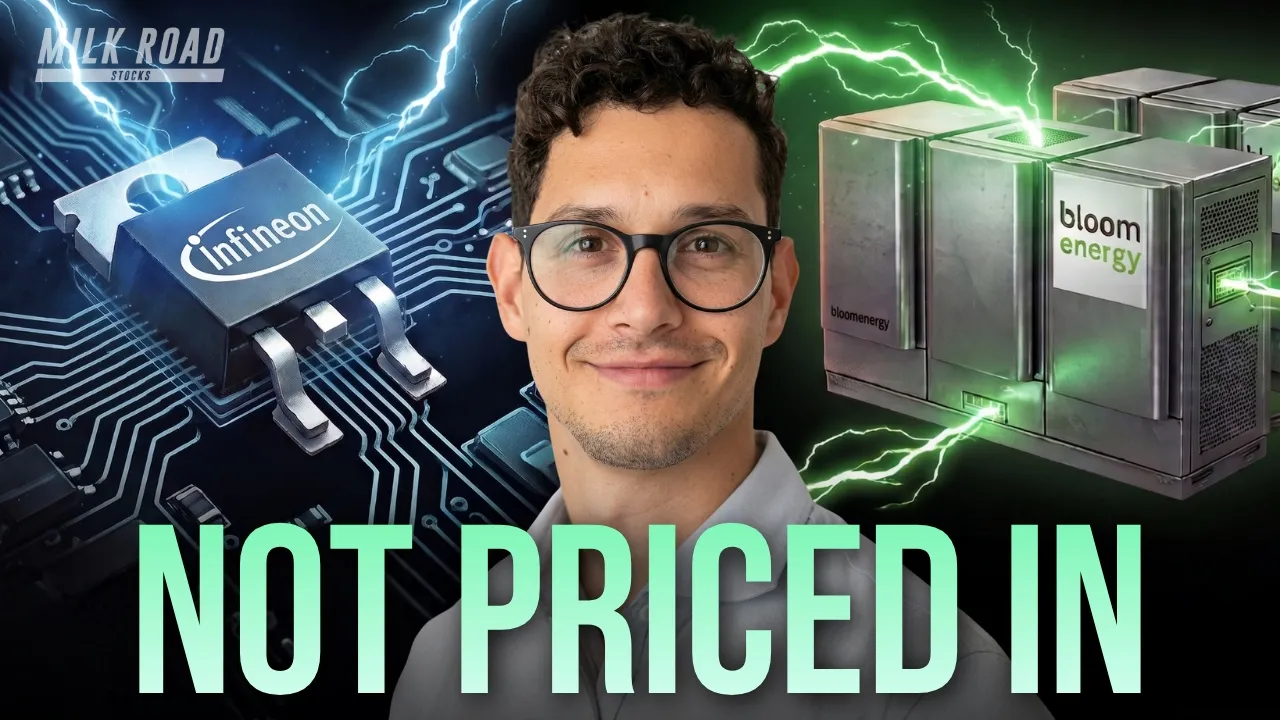
“Power Is the #1 Bottleneck” - The Next Big AI Trade Starts in 2027

- Rendement de la vidéo
- —
- Appels
- 2
- Achat / Vente
- 2 0
- Publié
Recommandations
L'entrée est le cours de clôture de l'actif à la date de publication. Le cours actuel est la dernière clôture enregistrée.
-
Entrée $201,45 21 août 2026Actuel $201,45 21 août 2026Résultat +$0,00
Bloom Energy remains the more valuable play here, but it's the much more expensive company.
-
Entrée $261,95 21 août 2026Actuel $261,95 21 août 2026Résultat +$0,00
You can also think about Vertif as an interesting company or a Schneider Electric that you can look at. Those are kind of companies that are positioned really well from this.
Transcription Complète
The AI data center trade is about to change in a big way this fall. Nvidia has a massive rack upgrade coming online within months. One that could dramatically increase the amount of power AI data centers really need. The question is, has the market crisis in yet? And if power becomes an even bigger bottleneck, who are the biggest winners? What's up everybody? It's LG Set here and welcome to Milk Road Stocks, the daily market show that can rattle off a 40-minute episode about energy and data centers, but actually has no idea where my own power comes from. Today is August 21st, 2026. Recording on August 20th. AI racks are getting dramatically more powerful. Nvidia's upcoming Vera Rubin architecture has two and a half times more compute than Grace Blackwell 200s and requires roughly 1.7 times more power. The problem is you can't just keep pumping more electricity through today's setup. So Nvidia is moving towards a new 800vt DC architecture with supply beginning in the second half of this year. So today, our lead AI researcher, Vincent, is going to walk us through how this architecture works and how there are two companies who are set to benefit as this big change happens. He also already holds both of these companies in his Milk Road Pro portfolio. So, if you want that cheat code, just hit the link below to see what he's holding. And a note that our pro subscription is about to go up 60% next week from $25 a month to 39. So, you only have a few more days to lock it in at this current price. A reminder that our podcast today is free and that it wouldn't be possible without our partners at Saber.money, the stablecoin payments platform built for Asia. Keep an ear out for more information about them later in the show. Vincent, welcome back. We just had a conversation the other day on our rollup about power. Uh, and you guys were kind of sounding the alarm andor the opportunity about, you know, the US is really struggling to keep up on the power side. Uh, and I feel like this is is is a massive bag to unpack. Uh, and we're going to learn about kind of one specific part of it today. >> Exactly. Yeah. No, it's nice to be back, LG. Today, we're talking about the major change that is coming in terms of not how much power we're going to need, but how we are powering data centers in in the future. Uh because Nvidia is actually moving toward a completely new um energy design of their Rex called 800 volt DC. The supply of those racks will start in second half of 2026. They just confirmed that last week and this is completely changing in terms of who are the winners of the power stack and uh yeah we're going to break that down today. >> So Nvidia is changing a huge part of their actual racks. Okay, I didn't know this. So this is we'll dive into it. This seems like it's going to be a pretty big deal when it once it actually starts to happen. So let's uh let's get to learning about it. >> First couple of slides I want to give you guys some context on it. Right. So so what's the problem today? [snorts] Basically, scaling AI is not only becoming constrained by memory and all that stuff, but actually by how much power can physically be delivered into each rack. What does that mean or where is this coming from? We're moving into the world of Nvidia where a Ruben architecture, right? That those are the the new chips and they're 2.5 times more compute intensive than the Grace Blackwell 200. the old version of the chip. So we're increasing the the the the rack density because there is so much more compute in in each of those rack. Now because there is so much more uh compute in each of every rack also or that also means we need much more energy in terms of powering. So the where Ruben uh chip architecture requires 1.7 time more power than uh the the older chip arch. So, so not only more compute but a lot more power as well so that they actually uh work and provide compute right and now the real issue is if we were to stay with the existing kind of power setup or power design we would substantially demand more infrastructure in terms of copper cabling space cooling everything to to to deliver that type of power right and and and and this is basically the entire reason why Nvidia decided to switch toward a new kind of design in terms of how we're supplying energy to those racks in the future. >> Okay. Yeah. I mean, so this this is something I guess I guess has been on the radar for a long time, but it's interesting to know that that this is going to really ramp up like that the power need. How many I guess I guess my question for you before we kind of uh talk about Nvidia and the fact that they're going to be using this too is how many do you know how many different racks or data centers this affects like how many of them are doing this >> all of them in the future >> all of them in the future but okay >> that's also core of the teases right we are moving into a world where we need much more compute and because of that Nvidia but also all the others who are designing and producing chips, right, need to press much more compute into every wreck because space is limited. So we need we need to press more compute in that constrained space that we have. And because we're doing that, we need much more power in a really constrained space. So we not only need to redesign how we're we're producing and designing the GPUs, the memory chips, etc., but also how we get much more of that energy into that constrained space, right? And then we need to think about what that actually means, more heat, etc. But we're talking about that down the road. >> And is and is power the biggest bottleneck for that like or is it like you've noted here um that jumping this massive jump requires a lot more copper and cabling in space. So is it is it is and obviously energy where does energy rank in how big of a bottleneck it is for this kind of evolution? >> So generally it's number one it's the number one bottleneck is at least in the US right in China it's different but here the the story line is slightly different. It's not really about the volume of energy but the electric electrical equipment, the power semiconductors, etc. that are going to benefit from this change in design of what Nvidia is is is about to do, right? Um, and this is actually the story we're coming. So, it's a it's it's it's part of the energy trade, yes, but it's not about the volume of energy that we supply, but actually how we supply that energy once we got it. I think that's the right uh kind of framing here. >> If you're not a pro member, what the hell are you doing? Melvin's portfolio is up 41% since February. 10 grand behind his moves in that time would have made you roughly $4,000 and 5 months of pro only costs 125 bucks in that same period. Is there a better ROI on any investment right now? Milk Road Pros price goes up from 25 bucks to $39 a month on August 26th. So join before midnight on August 25th and you keep today's price for as long as you're a member. >> Mhm. Mhm. Okay. Okay. That that makes sense. So I guess the I guess the question is you're saying that we need to put a lot more power into each rack. So what has to change about how we deliver that power? >> Exactly. So, and and and and and this is what Nvidia with this new 800 volt DC architecture is trying to solve, right? They're trying to solve for how we're delivering that much much power. And it's the idea is really simple behind it because physics determine um on on what you want to solve for here. Basically, you you have two options here. You can either um solve for voltage or to solve for the current. as you can see on the slide to to increase the power. Now the issue what I was referring to earlier with with the copper the cables etc is if you decide to go for more current you need way more copper cable space. So you're just complicating the entire uh power architecture around it because you need much more product versus when you solve for voltage because that means less heat, less loss of electricity, fewer cable and and and therefore fewer cables, copper etc. Right? And this is why Nvidia is going for 800 voltage uh DC so direct current architecture. Right? That's kind of the the technical stuff from this podcast podcast that that that you need to understand what what Nvidia is trying to solve here for, >> right? And that so so just increasing the voltage is what solves the problem. Increasing the voltage is is solving the issue that we can power those racks of the future that are much more compute inensive and therefore need much more power without over um uh engineering the entire data centers, right? Because if again if we were to stick with the old uh kind of power architecture or the design of how we delivered power from the grid to the wreck, we would need so much more cables, so much more uh copper, so much more um of those materials that a it's much more um expensive. It's becoming much more comp complex in terms of designing the data centers out and where to put physically put all that stuff. So, so we needed a new solution and that's 800 volt DC. What uh what's solving that, >> right? And this is and I guess this is the obvious question and and obviously that's why we're doing a show about it is that this is seen as a long-term solution at least for now, right? Like longterm being 5 years, 10 years. I I guess what I'm asking is that naturally these racks evolve so much, right? And they're getting new chips, they're getting new power solutions, they're getting new wiring and everything. And it's all to just kind of like you said to keep compressing all of it into as small and powerful a space as possible. >> Exactly. >> How so this 800 volt DC is a like is a pretty big and long-term solution to what's coming as well. Like it's accounting for the size of chips that are coming or at least the power of the chips the power that those chips will need. >> Exactly. It's it's it's this is like if you think about the evolution of of AI and the data centers, right? End of last year, we had the agents coming and this was the major kickoff for for memory, right? Because agents require so much more memory. 800 volt DC is a similar change or or step up in terms of what new products and new materials we're going to need, right? And that and and and that's why I'm so focused on this uh because it's something that people it's it's you can really compare it to like last year September October November basically before the agent craze came where the whole memory trade kicked off. Now I don't know if if if this trade will perform as good as memory will but um it has similar implications. This is a complete step up, a complete change in design of of how we're building and designing Rex and data centers. >> Okay. And I I I want to get back to timeline because you did say I think you mentioned earlier that this is happening pretty soon. >> Exactly. Um so there was a lot of rumors about this and and and I was looking for the day where Nvidia is coming out saying, "Hey, okay, we're doing it this year." and and last week was that was that week where they came out saying, "Hey, we we're rolling out 800 volt DC in the second half of 2026." Now, that doesn't mean we have like all the data centers that we're building right now will have 800 volt this year. What this means is that 80 plus suppliers that are that are part of this buildout in terms of helping Nvidia designing uh all the bits and pieces that are needed to to bring that new uh design um and and and and energy supply are are getting ready to to to benefit from this because as we're moving into 2027 and beyond there will only be those 800 volt see uh wreck architectures and there are a lots of different yeah companies that are going to benefit from this um and that's why I think now is a great timing to talk about it as as as now we have confirmation of the story that is really coming but it's not yet here right the the the companies that are supplying the 80 plus suppliers there's Google there's Microsoft all the power semiconductor companies etc in this they they in in their bottom line in their P&L or in their earnings call, they did not talk about 800 volt DC yet, but it's on our radar. So, it's a great time to to think about buying into this Jesus. >> Okay, I like that. Uh I'm just going to pause right here, Vincent, because um we are running a campaign right now, right? And we are about to get into the juicier part of the podcast. And when Vincent comes on, I feel like it's like 99% of the alpha is free from him. Uh so this is I'm seeing this slide Vincent is like there's a warning sign here that it's like a huge part of data centers is about to change into something much stronger. Nvidia is in the middle of it. Uh and we're going to spend the second half of the podcast learning like what kind of companies can benefit from this what the effects will be. Um, but I do want to pause to say that if you want to get Vincent's calls, um, you want to see his portfolio, how he expresses this types, this type of thesis and all the the stuff that he talks about every week, all that is in Milk Road Pro. And and that stuff has become so good, Vincent, that we're actually raising the price uh at the end or middle of next week. So, for a long time now, it's been 25 bucks a month to go Milk Road Pro. Uh, it's going to go up to 39 bucks a month. So, 60% increase. Um, and we want the people that listen to the show, the people listening to this episode who've been listening to us for a while or newbies to get in at that that old price because it'll be gone soon. It'll always be a lot more expensive. Um, it's also more beneficial if you do the annual one, right? It's it's only going from 250 to 299. So, it's actually a really good deal if you do an annual subscription. And again, in there uh in Milkroad Pro, you see Vincent's portfolio. You see, uh, Vincent writes pro updates several times a week of when there's news, when there's earnings, uh, when there's new things that are happening in the market. Vincent is on top of it writing about the the companies that he's tracking, the ones that he has in his portfolio, and a lot of them related to or a few of them related to this trade that we're discussing today. So, check that out at the link below. Um, Vincent, I'll I'll let you continue from here. >> And you can ask me questions at any times on the platform as well if that helps. >> That's also helpful. Yeah. In the updates, you can ask Vincent questions and and he'll respond. He probably won't respond to YouTube comments, but he'll definitely respond in pro if you ask him there. >> Yeah, for sure. >> I'll let you continue from here. I guess I guess what's interesting to me about this part, Vincent, before we talk about like who the winners might be from this um is how this is this seems like a largely Nvidia initiative, right? And obviously they're they're the primary chipmaker. So is this something where I guess I guess they want to do the why does Nvidia want to do this? Because they want to be able they want to enable people to really use their chips, right? that they want they this is a huge effort for them to to to remain the dominant player and they want to continue padding their lead in a sense in terms of being you know right at the center of the AI trade. >> Yeah, exactly. Why Nvidia is doing this is that they can sell their future wreck architectures um or or or chip architectures I should say with with where Ruben and and and then then the even more complex ones and they realize that the more compute they press into each of those stacks they need more power to to actually energize them right for their customers to actually be able to use them and their customers are data center operators Now, if they cannot deploy those new wreck architectures because they just need so much more cable or actually they can deploy less of those wear Ruben chips because they need more space for cables um and and all the other infrastructure just to be able to energize those then this was would obviously harm Nvidia right so they're not only thinking about how how they can provide better GPUs and CPUs but also about how they can efficiently energize them so that the Nvidia customers can buy and deploy more of them. That's why Nvidia is doing it. >> That makes sense. And this is something that I mean naturally as the biggest player this will become standard. >> Yeah. This will I mean all of them need to think about the the this because all of them are pressing more compute into each rack because again space is a limited source, right? We we the biggest issue is data center buildout. They're not an infin an infinite amount of of data centers out there, right? So we need to press more compute into each of those data centers. So naturally Google, Microsoft, Amazon and all the others need to also think about um how they can power those more compute dense racks and it's easier for them to just use and and and follow the lead of Nvidia here because it's because it's working um and because they do not themselves need to think about a another kind of power systems design, right? [snorts] So, yes, this will be a standard moving forward. >> So, who benefits from this, Vincent? >> The the question we've we've been waiting for, I guess. Um, so [snorts] there are four clear value pools from this and um I'm I'm just going to cover them high level and then in two of them I I really have a strong opinion and we're going to dive deeper later on. But first, it's power infrastructure. It's power semiconductors and electrical equipment that wins because much more power has to be converted, controlled and kind of distributed before it kind of goes from the grid to the rack and and and and the GPUs itself. So that's number one. Um number two is cooling especially liquid cooling. Uh this is going to win because concentrating close to 1 megaww that's like a lot of power uh into a single rack also leads to a lot of heat that we're producing and kind of legacy non-liquid cooling solutions are not enough for that anymore. So cooling is a really liquid cooling is an really interesting space here. [snorts] And then finally what you need to understand is the grid is supplying a data center with AC. So alternating current type of energy but we're talking about 800 volt DC. So direct current energy and there are native DC so direct current uh power generation solutions that can be used and obviously this removes a lot of conversion steps between direct and current along the way and is more efficient for a data center and and they are going to benefit as well. >> That makes sense. So so I mean we're we're here to talk mainly about power companies. So maybe we can do a separate episode about liquid cooling which I feel has been floated in Milk Road by you guys a few times but uh I don't know if anybody holds any liquid cooling companies or are there liquid cooling companies? Are there companies that just do that? >> No, there I mean yes there are but they're they're more integrated companies like a company like Fertif instance or I think Schneider Electric has cooling as well but but they're integrated. They're like they're doing electrical equipment like which is on top of the slide here but then also liquid cooling as well. Um my my personal focus and and and that's also what we're covering in in today's story is really first the the the native 800 volt DC supply. Um I think listeners who who listen to to to my podcast know already what I'm talking about uh because uh we did one show talking only about this and then um another one is is is the power semiconductor chain is where my core focusing is because I think those two will be the biggest winners from 800 volt DC. You know one thing we've talked about a lot on this show is that crypto is quickly becoming a huge part of the global payments infrastructure and nowhere is that more obvious than in Asia. But if you're actually running a remittance company or a payment business, you know that the hard part isn't moving the stable coins. It's dealing with local banking partners, compliance, liquidity, and all of the operational headaches that come with sending money into places like India and Southeast Asia. That's why today's partner is Saber. They give payment companies stable coinpowered infrastructure to collect and make payouts across Asia without having to build all of that complexity themselves. They've already processed more than $3 billion in transactions across 40 different countries. So, this isn't just a concept. These guys are actually doing this for real. If you're building payment infrastructure or expanding into Asia, make sure you check out saber.money. >> Yeah, maybe we can the native 800 VDC like we will talk about at the end because there is one company you've been you've been really hot on for a long time since you've been at Milk Road since we've had portfolios and and that one has done really well. But I think um kind of these power semis is something that we haven't we haven't heard from you much about. And maybe what you can walk us through and I feel like this is on the next slide too is like h what does that increase look like for the power semis as this gets built out as we make this migration to the 800 VDC. >> Yeah. So there two ways of how power semiconductors are going to win from this and from my opinion only one is actually priced in by the market now. So let's start off with the first one um that is priced in as we're moving to much higher uh power density into those racks the power that has to be converted and controlled increases by a lot. So it's actually just a a volume story. You we just need many more power semiconductors as we're increasing the power density into those rack. And this is the story that is priced in. Um and and you can see that in the earnings of companies like Onsemi or Infinian because they already came out and showed the the the growth stories of of power semiconductors that they're selling into AI data centers. Um and and and there show some some nice growth numbers there. So this is I think more or less priced in. What is not priced in is the 800vt DC story because this is changing what that that we're not only needing more chips but actually what kind of chips um so so shifting the the focus toward kind of higher value uh silicon and and and nitro chips um um that are used and or that are required to to to hold firm through through this higher power density So essentially from from an investor perspective, it's a mix upgrade. Companies that are focused on those specific power semiconductors can ask a higher price or or or sell higher value power semiconductors, right? And this mix upgrade um I think is not priced in yet because people don't understand 800 volt DC and what type of power semiconductors. So from from kind of an EPS or earnings per share leverage perspective, right? Um the suppliers um can grow their earnings materially faster than revenue um and can surprise to the upside from an earnings perspective because they they they shift their mix towards those higher value chips or power semis that are needed in in 800 volt DC. And >> when do you think that would start to show up? latest 2027. Um, okay. I mean, we're now starting with Nvidia shifting this, right? Um, and and and and and with that, they need those higher value chips, right? This will obviously slowly scale, but from 2027 onwards when we're really moving to moving to this, it's called the Kyber Rack architecture. It's basically the 800 volt DC architecture. Then really the and and and and you can see it on the chart here, right? the the the step up and this is um a screenshot from the the onsemi one of the power semiconductor companies um they're basically selling that or saying that we're increasing the volume by 8x that that we can sell right um and that's a major argument um for for for those power semiconductors. >> Yeah. And you've got it here like even just like the the per rack opportunity, right? Um is that it's it's b it's almost Yeah. It's like an 8x on it where they're able to make 15k per rack, but now that'll increase to 115k. So that's something where and that that will come online start to come online as as they make this shift later in the year as some of these will start to come online. >> Exactly. Yeah, that's that's going to happen. And I mean me personally there there many maybe this is worth talking about as well uh and and give some more alpha to to people here. There are many power semiconductors companies out there. I mentioned onsemi, there is infinion and there like five to six others um that you that you can think of of of of buying here. Me personally, I like infinion the most um because it's the most hidden AI play out of all of them. They have exposure to those higher value chips silicon carbide and gallium nitrite. So, so SIC and GAN, they have that in their portfolio. So, they they're positioned for that 800 volt DC kind of uh step up and Infinian is included in the Nvidia, it's called MXG ecosystem. Basically, the ecosystem around designing the 800vt DC architecture. So they're working with Nvidia to design h how and which power semiconductors are required um in there. And then one final point on of on Infinion, Infinian has 50% of its business in kind of legacy nonAI sectors and and the rest is kind of exposed to AI in different forms. Um whereas other power semiconductors have all of their business in in um in in AI. The problem is those that have all of uh all of or basically selling all of the power semiconductors into data centers and and other AI businesses grid etc. their multiple is much higher and because Infinian is designing the wreck with Nvidia, I think the surprise to the upside could be much bigger um in terms of expectations, investor expectations and that's why I like the name. >> Right. And Infinian just to kind of recap on them, they I guess they had an all-time high in June along with a lot of other stocks, but now now sitting, you know, 40% off all-time highs. >> Yeah. And you think that this and and again that this will this will start to show up especially because they're designing this with Nvidia that this is like a 2027 play right that this will start to show for them as an example as one of the companies that are part of >> yeah and there's and there's much more on Infinian this is just power semiconductors for data centers right I I wrote the whole investor notes on Melcro pro on how they're exposed to the grid as well to the grid buildout which is core how they're exposed to humanoid robots as Well, they just bought the company there. So, uh yeah, I I leave that to the Milk Road owners, but uh yeah, it's it's a really interesting company from my perspective and something that is not on the radar of many people. >> So, what the other play we want to talk about, which we've talked about many times, is and you kind of alluded to it on the last one, is is basically a company that lets these data centers have access to DC power on the spot, right? like just localized rather than needing to rely on the grid. >> Exactly. Yeah, it's it's it's Bloom Energy. Surprise, surprise. [laughter] Yeah, I there are many different TE's. This is on the company. I'm I'm sticking to the 800 volt DC one here. The Bloom Energy boxes provide energy in form of 800 volt DC. So if you're a a data center operator, you have the choice of connecting the data center to your grid or you connect your data center to the grid. Um and then you need much more conversion steps to deliver the right form of energy to the rack. You can also choose bloom energy which natively provides 800 volt DC and then you need then you have just much less complexity in your data center and it's cheaper to operate uh because invid uh Bloom Energy meets the future standards of of Nvidia right it's a it's an it's another angle to the Bloom Energy story um versus the typical kind of scale speed to energy thesises that people know um it's kind of a more hidden angle that I think people are underappreciating when talking about yeah bloom energy >> and you think that they will be heavily relied upon as we go through this massive like power shortfall over the next couple years like that's what your chart on chart on the right here is kind of illustrating >> yeah I mean I believe that and Morgan Stanley um agrees with me on that as well right they're saying Bloom Energy is supplying somewhere between 5 to 8 gaw of energy which does not sound much but for Bloom energy. It's it's it's massive. And they're saying that they they're saying it's it's coming through 2028. We have more or less end of 2026 now, right? Or let's say mid 2026. Today, they have only one gawatt of uh boxes that they can produce per year. >> Morgan Stanley is forecasting between 5 to eight uh annual output production. So, you can see how they're scaling from here. I guess I'm just trying to understand why Bloom I guess because they already have DC, right? Like that's their advantage. It's not just that they can provide they don't need they don't rely on the grid is that they're already DC, right? Like that's that's >> No, it's not. >> It's part of our story today that they're also 800 volt DC on top of everything else. >> But it's not the core story to Bloom. I just want to highlight that here. >> You can cover Bloom from so many different angles. There's so many bullish signs around Bloom. So, it's natively 800 volt this year. You're you're they're able to power a data center site within uh 60 to 90 days. Now, even faster based on on on yesterday's news, right? Uh where they said we're actually cutting down uh the time we can bring energy on site by another 40%. Right? So, we're down to what 30 to 40 days where they can bring power to a site. Um they're off the grid. Then you have the whole policy development saying that or in in Texas at the moment mainly right where they're saying if you do not have your own behind the meter energy solutions you you're not able to connect your data center to the grid right so there a lot of different angles and 800 volt DC which is the story of today's podcast is just one of them and and I want to I just want to make sure that people understand that >> that's very helpful these two companies they seem intertwined they seem to trade the same way Vincent so how do and How do you distinguish between them? I and we understand the the architecture side like we understand how they are different, but it feels like they're kind of being traded the same way. So, how do you if you're weighing these two companies, how do you decide which offer is going to be more valuable or report kind of more earnings? Like, do you go Infinian because they're direct like Nvidia is literally working with them directly on their product? No, I think you can see from the multiples of those two companies that Bloom Energy is the much more valuable play here because power shortage is as I said in the beginning of this podcast the biggest bottleneck right and Finion is providing power semiconductors which will increase a lot in value because we're moving to 800 volt DC but it's not the bottleneck number one Right. So, Bloom Energy remains the more uh kind of valuable play for the broader AI uh trade, but it's the much more expensive company. Of course, it's the much riskier play uh just in terms of stock valuation. Um, and I think kind of from a riskreward perspective, especially uh, Infinian down 15% over the last two or three kind of trading days is is more is is more interesting. It's a nice diversification play, right? It's it's it's it's lower risk. It's a really interesting entry price here. I did a a full model of the company where the stock price could be much much higher by 2028 again on the Milk Pro uh, platform. Um so yeah that's that's how I view both of them. >> What are what is the downside of this 800 vault architecture coming out Vincent? There have to be some companies that are going to be losers or Yeah. >> Uh there has to be some kind of risk for these businesses because it it you know one thing we haven't talked about is like this is a huge architecture change right so there's not I it doesn't it must be more complicated than just flipping a switch. [laughter] >> Yeah and and I think you put it already correctly. It's not the risk that 800 volt DC is not coming or or failing. I think Nvidia took that off the table last week. It's just that from a stock selection perspective, investors get the wrong part of of of the power stack, which I think is is is the biggest risk because what you need to understand is AI growth expands the overall power market. But what 800 VDC is doing is that it's red redistributing the spend um and it's not lifting every supplier of that equally. So there's some winners some some companies like the power semiconductors like anfinian that are selling those specific power semiconductors that are needed for that architecture that are going to win. Right? But what it is also doing it is simplifying the power architecture. I talk about we need less cable cables, we need less copper. Um so there may be some companies that are actually disadvantaged from that kind of shift, right? Um and that is a risk that people need to understand as well. Uh also from a downside perspective. Um, so to me the the the best opportunities in this trade that are are those that are like to to frame it conceptually that those best positioned are yeah the companies that are going to benefit from a material enough margin change and those that are in a competitive position in terms of the products that they're having right um to me that's an infinion to me that's a bloom energy You can also think about Vertif as an interesting company or a Schneider Electric that you can look at. Those are kind of companies that are positioned really well from this. Um, so it's really a stock selection story. You you right it's not similar to memory where you can say okay they're free memory companies and it does not matter which you buy of them more or less uh you you're going to do well. Right? It's it's not that easy. It's a more nuanced story and that's the biggest risk from as an investor here. >> Okay, cool. So, what I guess my last question for you now that we've kind of understood the risk as well is like what is the play, right? Is it just like for these kind of com companies? Is it to are you basically telling us that we have an opportunity to frontr run this change and that for some of the companies like the power semis uh infinian it's like there's a whole part of that that hasn't been priced in yet uh or andor that you know or or or is your narrative play as well like your thesis that it's like well this they're they're just part of a larger pullback that seems really unfair considering what they do and how big of a part of the bottleneck they are. >> Yeah, both actually. So if we're talking specifically the power semiconductors, it's it's priced in that they're going to sell more. It's not priced in that they're going to sell more valuable stuff because of 800 volt DC. So it's front running that 800 VDC story. And then and then kind of the second point you mentioned I think this broader AI midcycle slowdown that we saw over the last let's say one or two months, right? where where those stocks are still down somewhere between 20 to even 50% for some names, right? Provides great entry opportunities. Um, so it's both of the things you mentioned, >> right? Okay. Okay. So generally if you're bullish on all that capex and these being bottlenecks to or these types of companies being really well positioned for the next level of racks um that's something that you'll you'll see in their earnings in 2027. >> Yeah. Yeah. Exactly. Earnings per share will grow. Um and that's how they're going to win. >> Excellent. Well Vincent, if anybody has questions for Vincent again all that is in Milkroad Pro. You can ask him questions. Anything else we should think about for this Vincent? >> Yeah, I think as an investor you we're at the point in time where and this is beyond the 800 volt DC architecture. This is kind of more general view on the markets now. Memory, Bloom Energy, those companies have performed massively, right? Um and I think investors are at that point where they're like, can this go further? Where is the value? Do we need to shift into crypto now? Because it performed really well over the last two days, right? It's really a diversification play and if you go to Milkart and you see my portfolio I'm I I'm having exposure to the infernames uh like an infinion like a bloom energy memory etc but I also have exposure to other more downstream adoption side of things digital asset side of things things that are going to benefit from AI agent starting to transact right it's really a building a a kind of more risk diversified portfolio because not only has have infra names performed really well, but volatility is increasing a lot. So, uh I I I still think there's this this AI infotrade has a lot of room to run. Just a more nuance trade and maybe those companies that have won the first inning of this trade. Yes, they may be winning in the second inning as well, but maybe there are others that are winning as well. And this was basically the story of today and and and why I like this. >> Well, that's really helpful. Always good to hear some of your thesis and your philosophy for this, Vincent. Thank you, man. Uh, I'll see you next week. >> Thank you, LG. Thanks for listening to Milk Road. If you enjoyed the show, make sure you like and subscribe. [music] And if you're struggling to find winners in the market, that's exactly what Milkroad Pro is built for. [music] Our analysts have called some of the biggest winners early. And Pro lets you see what they're buying next, every trade they make, and the [music] research behind every position. Check out Milkroad Pro at the link below. Everything you hear on Milkroad is forformational purposes only. These are our personal opinions, not financial advice, and we may own some of the investments we talk about. Always do your own research and make the decisions that are right for you.
Commentaires 0
Connectez-vous pour rejoindre la discussion.
Se connecterAucun commentaire pour l'instant. Soyez le premier à partager votre avis !