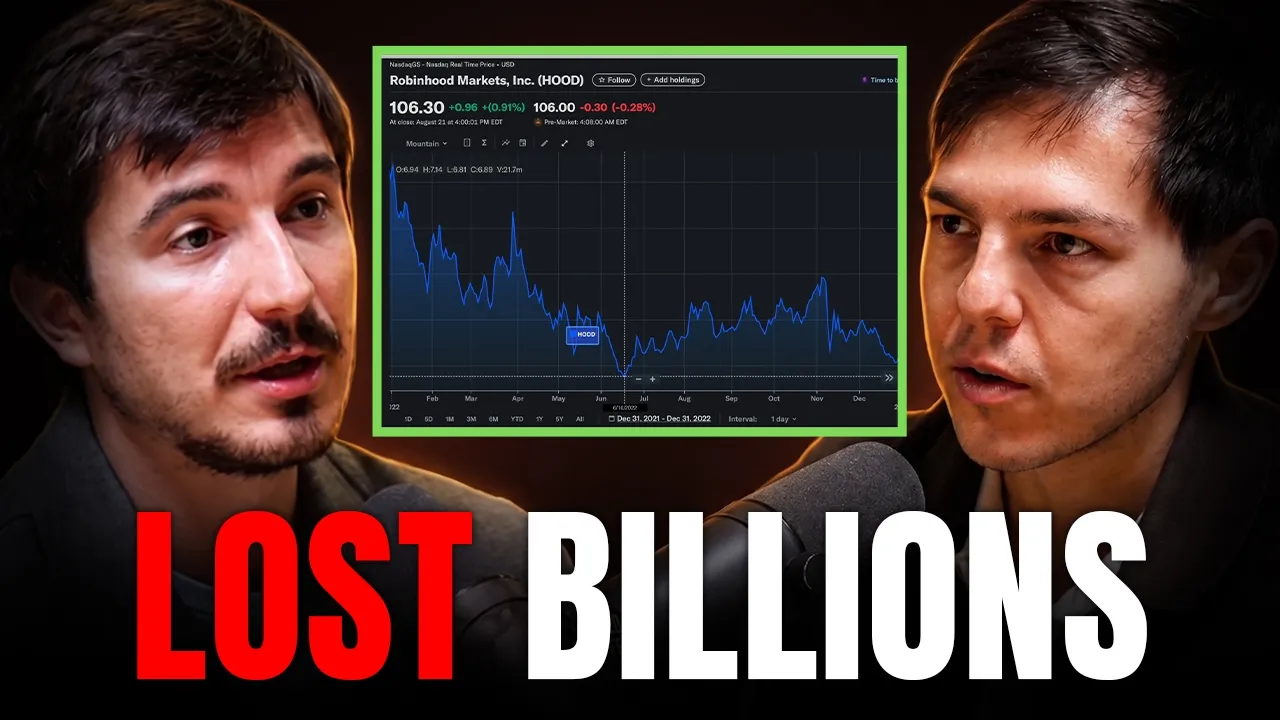
Robinhood CEO on Watching His Company CRASH 80%...

- Rendement de la vidéo
- —
- Appels
- 1
- Achat / Vente
- 1 0
- Publié
Recommandations
L'entrée est le cours de clôture de l'actif à la date de publication. Le cours actuel est la dernière clôture enregistrée.
-
Entrée $108,13 23 août 2026Actuel $108,13 21 août 2026Résultat +$0,00
how how is this not a buy at this price because you're basically buying dollar for dollar the cash you have.
Contexte “I remember seeing that and thinking how how is this not a buy at this price because you're basically buying dollar for dollar the cash you have.”
Transcription Complète
So, we went public in July of 2021 at sort of like the peak of the secular bull market before things went really south. And we were actually one of the last IPOs before the window got shut. >> I think Ribian went after us by a couple of months, but I think the IPO window shut for many, many years shortly after us. And you you could tell the vibe was shifting right around the time we were going public. like we didn't have a particularly hot road show. Um it wasn't, you know, >> like some IPOs where it was 60x over subscribed. So, you could tell there was a little bit of a vibe shift like everyone was kind of understanding government's printing a lot of money. Inflation >> is creeping up, so something's going to have to change. And so, pretty soon after our IPO, uh our stock took a a pretty big hit. you know, we went public at $38 per share. Uh we traded I was actually looking recently when when was the exact day we hit the bottom? Mid 2022. Uh we closed at like 680 something. So a huge drop right there. >> What did that feel like at the time to see that? >> It felt rough. Uh it felt rough. And I mean they they tell you that you should ignore the stock price uh and focus on building your business. It's especially hard for a company like Robin Hood, whose business is the stock market, to ignore stock prices, especially our own. And and also, I think it's harder to ignore on the way down than on the way up. Um because on the way down, you know, people get concerned about, you know, the the long-term viability of the company, their compensation if if you look at employees. So, hard to ignore, uh especially on the way down. And I think they really look to leadership to uh point a way out, right? Like show direction and and inspire people so that they know it's a company that's that's worth betting on. So I don't think it was the IPO itself, but going through a hard time post IPO where we went public after the GameStop stuff. there was a little bit of like short-lived euphoria around the time of our IPO >> and then afterward like the reality set in of um we're a business that was compared to now much more fragile. Um we went through co we transitioned to being a remote first company. We blew out our headcount and grew our headcount 5 6x. Um people weren't working well together. we weren't shipping and then the macro environment which was a tailwind during co rapidly reversed and and became a big headwind and and people stopped trading. Uh so you know all that happened simultaneously and uh so so I didn't have the problem that you were suggesting which is oh my my job is done like mission accomplished. It it was more just like being hit by several freight trains of like unique challenging problems and you know having to like stop them or dodge them and uh and having to navigate that. So so I felt uh there was no loss of purpose. It was in and >> it was like a slow burn of like different mini crises. >> Do you think do you think that was an overreaction? Because I remember at that time you were trading at a market cap that was equivalent to your cash on hand. >> Yeah. >> And I remember seeing that and thinking how how is this not a buy at this price because you're basically buying dollar for dollar the cash you have. >> Yeah. >> How does that make any sense? >> I don't know if it was an overreaction as much as sort of us having to build trust with a new set of investors. And I felt like we had to do this when we were a private company. you know, we we raised as a private company, we raised different rounds of funding, seed, series A, all the way up to series G, which was our our last round before IPO in 2021. >> And in a lot of those rounds, you you bring in a new investor for the first time. And I I I always felt like there was a period of having to earn the trust of the new investor. Maybe they don't really understand how we operate. They're trying to figure out did they make a mistake with the did they overpay for the company? Um >> uh they don't really know us that well and um I felt like for each new one there was a period where okay we had to prove ourselves. This is a new person. They don't know us. We had to build trust and I think when we went public it was very much the same. You know different set of investors. uh you know you had the hedge funds, you had the longonies, you had retail, which for for Robin Hood is a big chunk, but you know, you'd think we'd always have retail, but no, as a private company, we didn't have any retail. So that was new for us. >> And and I think that there was a period where we had to earn the trust of that shareholder base. And I think we've managed to do that. Finally, I could see the the tide turning in 2024 kind of last year. >> Yeah. From my perspective, it seems like there's still that discrepancy between Robin Hood where people still associate to some degree with more like childish or like ah it's a bunch of early 20s with something like a Vanguard or or a Schwab that seems to have more that like legacy push behind it. How do you intend to bring Robin Hood to that level? >> A couple years ago, our best customers maybe would have hundreds of thousands of dollars in their Robin Hood account, maybe millions. But then as we've added more things and we become more established, I started talking to customers who are moving over tens of millions, you know, now I'm talking to customers that are moving over hundreds of millions into their Robin Hood accounts. Um, and you know, my my aspiration would be someone like me, uh, you know, uh, whatever classification I'm in should be able to have all of their wealth in Robin Hood and that should be just optimally managed at the lowest cost. If we can serve someone like me, all of their financial needs, that should then acrue to to everyone. And I I think the problem that the incumbents are ignoring is there's a a great wealth transfer that's uh that's underway. Uh according to to some statistics, over 120 trillion is going to be handed down from baby boomers and silent generation to younger generations. And and I think I I see increasingly that Robin Hood has the potential to be the main beneficiary of this, right? The young people already have Robin Hood accounts. We're increasingly building tools to make Robin Hood more useful to you if your family members are on it. Not just your kids and your spouse, but also your parents. And and nobody's thinking about that problem. The incumbent brokerages, they kind of get worse for you if you if you add family members accounts. But Robin Hood's going to get better. We already have this with banking and with credit card, but it's going to it's going to come to investing as well. There's going to be a multigenerational experience. And I I think Robin Hood eventually for for the mass market will play a role similar to what a family office would do for a high net worth individual. We can put a family office in your pocket that can manage not just your finances, but like all of your strategic life decisions when it when it comes to to your family. And I think I think we'll get there much more rapidly and with a much higher quality product than you know anyone in our industry. So on a personal level, how has your approach to money changed? Going from someone who didn't have maybe a ton of money to now someone who has plenty of it, especially post IPO and with the recent stock growth of Robin Hood. >> How has your approach to money changed? And also on top of that, we had Michael Sailor on the podcast a while ago. It was very interesting because that day micro strategies went down like a few%. and we had calculated he had lost like what millions hundreds of millions of dollars in personal net worth and and we're sitting with him and then after the podcast he checks his phone probably checks Micro Strategy stock for the first time that day >> and he was just you know meanwhile he's losing hundreds of millions of dollars like how how does this work for you on a personal level and once again the approach to money how has that changed >> now really quick every business is asking themselves the same question how do we make AI work for us. The possibilities are limitless, but guessing is too risky and sitting on the sidelines is not an option. Because one thing is certain, if you're not doing it, your competitors are already making their move. And that's where our sponsor Netswuite by Oracle comes in. It's the number one AI cloud ERP trusted by over 43,000 businesses to manage everything from financials and inventory to commerce, HR, and CRM, all in one unified system. When all of your data is in one place, your AI becomes a lot smarter. It doesn't just guess, it knows. Netswuite intelligently automates routine tasks, delivers real-time insights, and helps you make fast, confident decisions that actually help drive growth. And it's not just an add-on. It's AI that's literally built right into the system that runs your business, helping you cut costs, improve accuracy, and stay ahead of the competition. Whether your company is making millions or even hundreds of millions, Netswuite gives you visibility and control to keep moving forward. Honestly, if I were building a business of this size, Netswuite's the only company that I have 100% confidence in. So, if your revenues are at least in the seven figures, get our completely free business guide, Demystifying AI, at netswuite.com/clip. Again, the guide is free for you at netswuite.com/clip. netswuite.com/clip with the link down below in the description. How does this work for you on a personal level? And once again, the approach to money, how has that changed? I think one thing that hasn't changed is um you know I I I'm an immigrant. I grew up in a household where we were very conservative about all of our spending. Um and I think that imbued in me once once I got a little bit of money. Um I still have this deep need to make sure I'm getting a good deal on stuff even if it's irrational. So, every time I purchase anything, um, I look at it from an investment lens. Am I getting a good deal? Am I buying some asset that'll depreciate? Um, I would be very reluctant to buy a new car, right? The only time I would consider buying a new car if it's literally like the first one in a model and it's so good and like I can't find a used one. Yeah. >> But, you know, I buy used cars. >> You buy used cars. >> Buy used cars. What What's the last used car you bought? >> Uh a 2021 uh 911 Turbo S. Actually, I didn't buy it. That's a lease. That's a lease. >> Why'd you lease it instead of buying it? >> I got a good deal. >> How often do you look for good deals? And like where else do you save money? >> In everything that I do, I look for good deals. >> What does your wife think of this? >> Um >> does she think like, you know, come on, we can get the new car. We can we're at the point now we don't have to worry about these things. Don't need to buy the manager special flank steak for 70% off. That was >> I think she complains about it a little bit but sort of jokingly because she also understands it's you know the way the way that I've always been the way that I am. And so it's you you take the it's it's what she loves about me. >> So it's the principle of it though. It's like you don't even though you can waste the money you shouldn't. >> Yeah. And you know, I think I think there's a bit of confidence. Um, it's a good feeling to feel like, all right, at least I don't have to worry that someone's going to take advantage of me financially cuz this guy's just going to like uh do a colonoscopy on any potential transaction. Does that ever hurt? >> So, I think that's very comforting in a way. >> But when you go and negotiate something, does it ever hurt when they look you up and they're like, "Ah, this guy could afford it. Like, I could charge whatever I want." >> Yeah. You can just look up your name and net worth and if there's a B after your name like it's you know I feel like that's a different >> from car salesman to buying a house to like having tradesmen over like everybody I feel like would just give a premium just because they can. >> Yeah. Yeah. But you know there there's ways that you can turn that into a positive too. >> Yeah. I mean, if you think about wealthy people, a lot of times they get free stuff because, you know, you can just be like, well, how awesome would it be to tell other customers of your business that, you know, >> you're, you know, selling Lady Gaga a dress, right? So, they get they get luxury items for free a lot of times. >> What's the craziest free thing you've ever gotten? Do you ever have a really successful trader make a bunch of money? They're like, I got to send him a gift. >> Yeah, I'm not allowed to accept those, unfortunately. I think I I think we have to donate them to charity. Um by and large. >> Yeah. Change that. >> Yeah. Um Yeah. So yeah, I don't I don't get a lot of gifts or at least not a lot of gifts that I can keep. >> And so what about your own personal investing philosophy? How has it changed now? Do you go into more like asset protection mode or how do you view money as you've climbed up this this money ladder? It hasn't changed very much because still uh the like vast majority of my net worth is in Robin Hood shares. >> And how does that feel then like on a swing up or a swing down? I mean Robin Hood was like up 1% today. >> Yeah, you hit an alltime high this morning. >> Oh, amazing. >> You didn't know that? >> Uh I didn't know that. I I mean I knew in the past week we've been doing well, but uh >> how do you not check the share price every day? I cuz even on my account I check I feel like it would drive you crazy multiple times a day if you were >> I I do I I don't want to make it seem like I don't check the share price cuz I do uh even though I try not to but but I do try not to. Yeah. cuz it can be really distracting. Like I don't want to feel because if it's down, you know, four or 5%. Which sometimes it is for no reason. I don't want to have a bad day, right? So, um, and I also don't want to get too excited and think that I'm winning if it's up for no reason. >> That's exactly true. Same thing for the podcast. It's like if we have a video that does really well, I try not to let myself feel good because I know if I do, then when videos do poorly for who knows what reason, then I try not to let myself feel bad. It's like you have to remove your emotions from the reality of the situation. >> It's exactly like that. Yeah.
Commentaires 0
Connectez-vous pour rejoindre la discussion.
Se connecterAucun commentaire pour l'instant. Soyez le premier à partager votre avis !