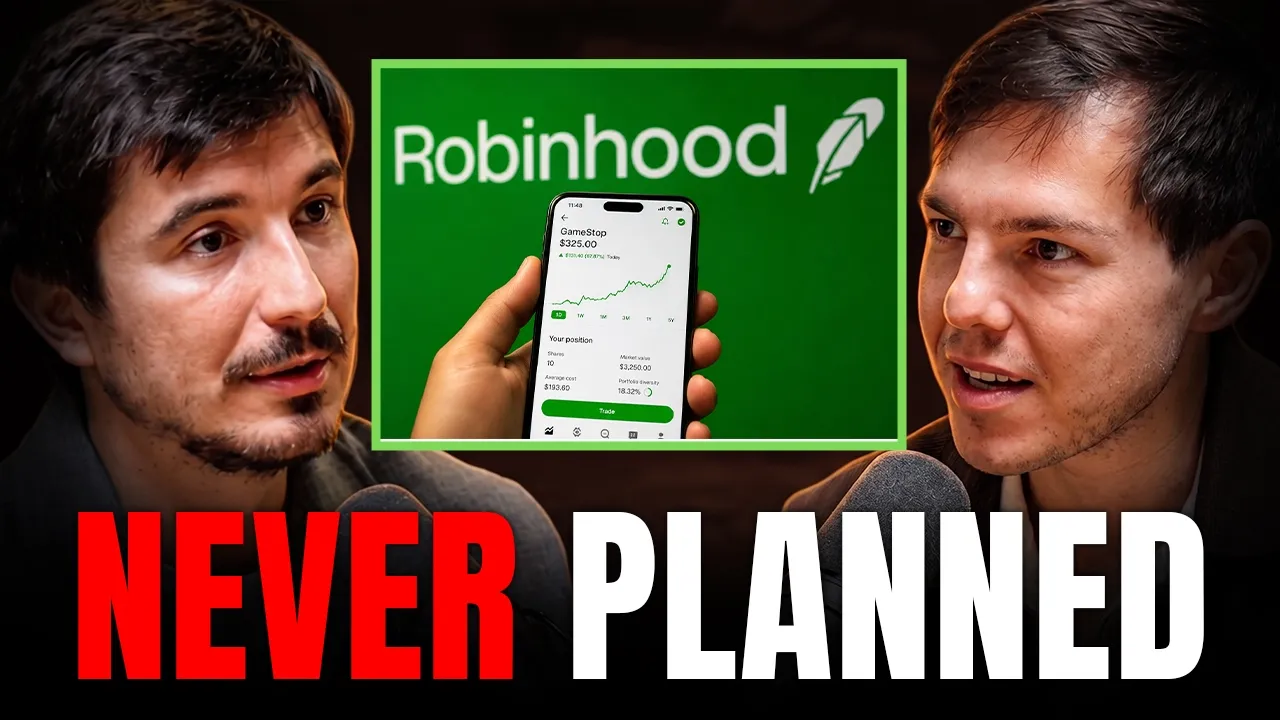
How Robinhood Accidentally Became a $100 Billion Company | Vlad Tenev

- Rendement de la vidéo
- —
- Appels
- 1
- Achat / Vente
- 1 0
- Publié
Recommandations
L'entrée est le cours de clôture de l'actif à la date de publication. Le cours actuel est la dernière clôture enregistrée.
-
Entrée $108,13 23 août 2026Actuel $108,13 21 août 2026Résultat +$0,00
how is this not a buy at this price because you're basically buying dollar for dollar the cash you have
Contexte “I remember seeing that and thinking how how is this not a buy at this price because you're basically buying dollar for dollar the cash you have.”
Transcription Complète
when Robinhood started, uh I don't know if you guys know this, but we we launched in 2013 as a social network. So, the name uh before we changed it to Robinhood was Analyst. And the idea was that um we have all these retail investors on social media and the internet, and they should have the ability to share their point of view uh of stocks. So, we took the idea of an institutional analyst, you know, the folks that rate stocks buy, sell, or hold, set price targets, and the attempt was to like democratize that. So, anyone can be an analyst. Uh we created the social network where people could rate stocks and write comments. Um and our our initial vision was that once we got approved to be a broker, we would sort of like layer [snorts] on trading. So, you can not only analyze a stock and but but you can also, you know, buy it, and you can see your real portfolio. And sometimes I think about we we ended up making the decision that like these are two very complicated businesses independently to put together. And the demand for for commission-free trading was uh was so high that we just like abandoned all of that for the time being and just focused on making the the trade button as simple and streamlined and easy as possible. But sometimes I think about that because very much in our DNA to to build those types of products. And who knows? Maybe maybe some point we'll revisit. >> I would love to see that and be able to track people based on their percentage return, dollar amount return, and account value. >> And would you would you uh you'd sign up for that network and be willing to you you'd be willing to opt in and share your trades with followers? >> Yeah, but as long as it's anonymous. As long as people didn't know it was me. All it would show is the account size and what I'm buying and selling. I do not want to be associated or tracked. I think you can choose to be anonymous or not. Cuz I personally wouldn't >> care if I was, you know, if I could show my trades being Jack Selby just made this trade. >> you and then you do the opposite. >> do the opposite of whatever I do. That's true. >> I think most people would probably want to be known and they could build a following, but yeah, I mean I think I think if if you I could see the use case for wishing to remain anonymous, too. But but I think there that raises a question of like who is this person and why would I follow them, you know? >> So we've spoken to a lot of people on the podcast that have either been acquired or they've IPO'd and they said after that massive landmark event their quality of life can slip a little bit and they can feel, you know, some sort of like purposelessness or meaningless ness because they you know, this is that was their entire existence was building up this company and then you have this massive event to kind of for- forego a lot of your equity and ownership of of the company. How have you noticed that work with your life? Did you notice after you guys IPO'd there was a quality of life slip or would you say that that was not your experience? >> There was definitely a little bit of a quality of life slip, but I don't know if it was the IPO itself or the timing of it. Um so we went public in July of 2021 at sort of like the peak of the secular bull market before things went really south. And we were actually one of the last IPOs before the window got shut. I think Rivian went after us by a couple of months. But I think the IPO window shut for many many years shortly after us. And you you could tell the vibe was shifting right around the time we were going public. Like we didn't have a particularly hot road show. Um it wasn't, you know, like some IPOs where it was 60X oversubscribed. So you could tell there was a little bit of a vibe shift. Like everyone was kind of understanding government's printing a lot of money, inflation is creeping up, so something's going to have to change. And so pretty soon after our IPO uh our stock took a a pretty big hit. You know, we went public at $38 per share. Uh we traded was actually looking recently when when was the exact day we hit the bottom mid-2022 uh we closed at like 680 something. So huge drop, right? >> that feel like at the time to see that? >> It felt rough. Uh it felt rough. And I mean they they tell you that you should ignore the stock price uh and focus on building your business. It's especially hard for a company like Robinhood whose business is the stock market to ignore stock prices, especially our own. And and also I think it's harder to ignore on the way down than on the way up um because on the way down, you know, people get concerned about, you know, the the long-term viability of the company, their compensation if you look at employees. So hard to ignore uh especially on the way down. And I think they really look to leadership to uh point a way out, right? Like show a direction and and inspire people so that they know it's a company that's that's worth betting on. So I don't think it was the IPO itself, but going through a hard time post-IPO where we went public after the GameStop stuff, there was a little bit of like short-lived euphoria around the time of our IPO. And then afterward like the reality set in of um we're a business that was compared to now much more fragile. Um we went through COVID, we transitioned to being a remote-first company, we blew out our headcount and grew our headcount five, six X. Um people weren't working well together, we weren't shipping, and then the macro environment which was a tailwind during COVID rapidly reversed and and became a big headwind and and people stopped trading. Uh so, you know, all of that happens simultaneously. And uh so so I didn't have the problem that you were suggesting, which is oh my my job is done like mission accomplished. It it was more just like being hit by several freight trains of like unique challenging problems and, you know, having to like stop them or dodge them and uh and having to navigate that. So so I felt uh there was no loss of purpose. It was and and it was like a slow burn of like different mini crises. >> Do you think Do you think that was an overreaction? Because I remember at that time you were trading at a market cap that was equivalent to your cash on hand. >> Yeah. >> And I remember seeing that and thinking how how is this not a buy at this price because you're basically buying dollar for dollar the cash you have. >> Yeah. >> How does that make any sense? >> I don't know if it was an overreaction as much as sort of us having to build trust with a new set of investors. And I felt like we had to do this when we were a private company. You know, we we raised as a private company we raised different rounds of funding, seed, series A, all the way up to series G, which was our our last round before IPO in 2021. And in a lot of those rounds you you bring in a new investor for the first time. And I I I always felt like there was a period of having to earn the trust of the new investor. Maybe they don't really understand how we operate. They're trying to figure out did they make a mistake with the Did they overpay for the company? Um uh they don't really know us that well. And um I felt like for each new one there was a period where okay, we had to prove ourselves. This is a new person, they don't know us. We had to build trust. And I think when we went public, it was very much the same. You know, different set of investors, uh you know, you had the hedge funds, you had the long only, you had retail, which for for Robinhood is a big chunk. But, you know, you think we always have retail, but no, as a private company, we didn't have any retail. So, that was new for us. And and I think that there was a period where we had to earn the trust of that shareholder base. And I think we've managed to do that. Finally, I could see the the tide turning in 2024. >> And really quick, every business is asking themselves the same question. How do we make AI work for us? The possibilities are limitless, but guessing is too risky, and sitting on the sidelines is not an option because one thing is certain. If you're not doing it, your competitors are already making their move. And that's where our sponsor NetSuite by Oracle comes in. It's the number one AI cloud ERP trusted by over 43,000 businesses to manage everything from financials and inventory to commerce, HR, and CRM all in one unified system. When all of your data's in one place, your AI becomes a lot smarter. It doesn't just guess, it knows. NetSuite intelligently automates routine tasks, delivers real-time insights, and helps you make fast, confident decisions that actually help drive growth. And it's not just an add-on, it's AI that's literally built right into the system that runs your business, helping you cut costs, improve accuracy, and stay ahead of the competition. Whether your company's making millions or even hundreds of millions, NetSuite gives you visibility and control to keep moving forward. Honestly, if I were building a business of this size, NetSuite's the only company that I have 100% confidence in. So, if your revenues are at least in the seven figures, get our completely free business guide demystifying AI at netsuite.com/clips. Again, the guide is free for you at netsuite.com/clips, netsuite.com/clips with the link down below in the description.
Commentaires 0
Connectez-vous pour rejoindre la discussion.
Se connecterAucun commentaire pour l'instant. Soyez le premier à partager votre avis !