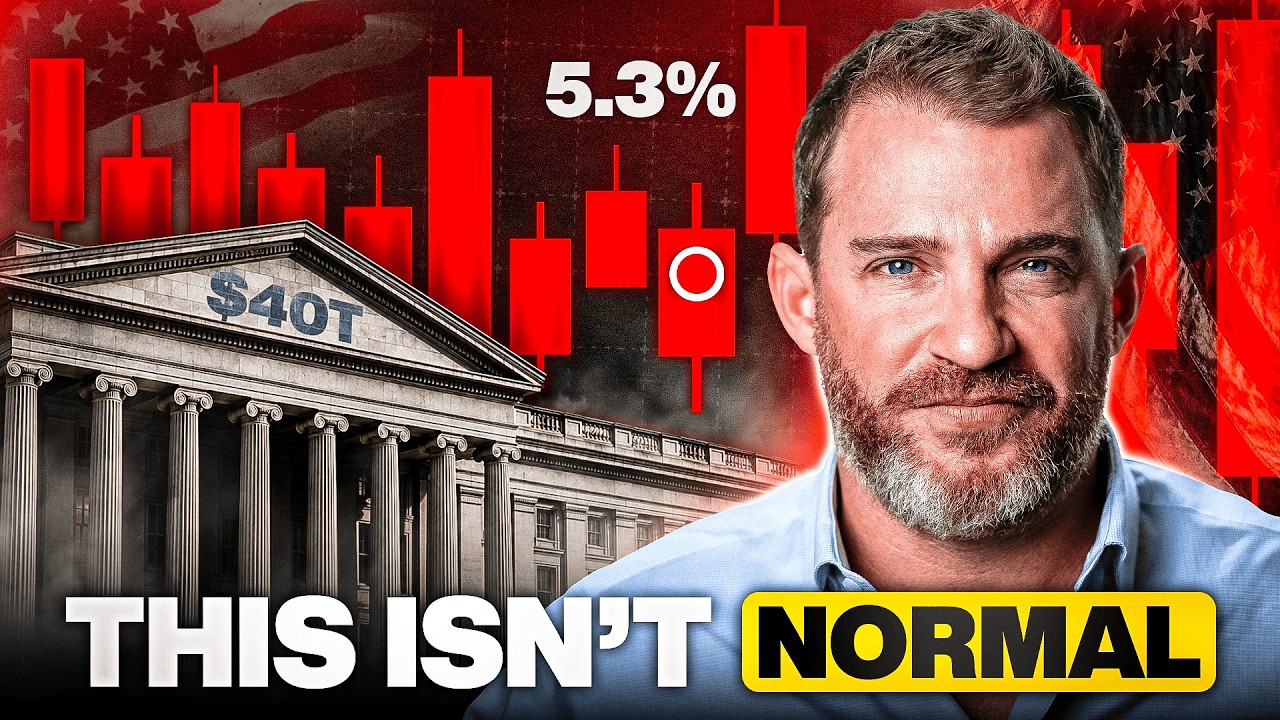
The U.S. Just Started Buying Its Own Debt... This Is a HUGE Warning

- Rendement de la vidéo
- —
- Appels
- 2
- Achat / Vente
- 1 1
- Publié
Recommandations
L'entrée est le cours de clôture de l'actif à la date de publication. Le cours actuel est la dernière clôture enregistrée.
-
Entrée $83,13 27 août 2026Actuel $83,13 27 août 2026Résultat +$0,00
go through your retirement account and sell anything that is tied to long-term treasuries.
Contexte “Take a look at this. This is the 20-year Treasury Bond ETF. The ticker is TLT... go through your retirement account and sell anything that is tied to long-term treasuries.”
-
Entrée $100,66 27 août 2026Actuel $100,66 27 août 2026Résultat +$0,00
If you want fixed income, you want guaranteed yields by SGOV.
Contexte “If you want fixed income, you want guaranteed yields by SGOV. That is the zero to threemonth treasury bond ETF currently yielding about 4%.”
Transcription Complète
There's a moment in the life of every borrower when a lender stops asking how much you'd like and starts asking whether you can pay it back. And last week, the United States of America hit that moment. It started buying its own debt. Healthy borrowers don't do that. Now, let me put this in terms that actually mean something to you because most of us cannot picture a trillion dollars. So, let's shrink the entire federal government down as if it were a single household. Imagine that household owes $400,000 not on a mortgage, on credit card. And the interest payments alone have gotten so big it is now the third largest expense in that house. More than the car, more than the groceries, only the mortgage and the $2,000 a month health insurance costs more. Now imagine that to keep the credit card company from raising the rate on them, that household takes out another credit card to pay down some of the first one. They use new borrowed money to pay off old borrowed money. Well, you would tell that person that they are in serious trouble. And you'd be right. Folks, on August the 18th, the United States crossed $40 trillion in debt. And the very next morning, the Treasury announced it was doubling the size of the operation it uses to buy its own bonds back off the open market. So, it's the same move. It used the money from the new credit card to pay down the old credit card. just add eight zeros on the end. Now, a couple of weeks ago, I showed you how this government essentially refinanced America into an adjustable rate mortgage. I told you then that the bill was coming due a lot faster than anybody in Washington was admitting, and it came due in about 10 days. Today, I'm going to walk you through what is happening because this is very serious, and you need to know how to protect your money from the events that are unfolding. So, make sure to subscribe to the channel if you don't already. So, the US Treasury, which is the federal government's checking account, started doing buybacks. Now, when a company like Apple or Microsoft does a buyback, what they are doing is using their profits to buy back shares on the open market and retire them. That leaves fewer shares of stock remaining, each worth slightly more of the company. They are a good thing. They make the stock price go up. That's not what Uncle Sam is doing. Not even close. The government is issuing new shorter term bonds and using that money to buy back older longerterm bonds. The total debt doesn't change. So why would they do that? Well, it's to manipulate interest rates. You see, when a big buyer, like, I don't know, the US federal government starts aggressively buying something that pushes the price up. And this is something you need to understand for the rest of this video to make sense. When the price of a bond goes up, the interest rate on that bond goes down. They move in opposite directions always. The coupon payment is the same, but it is a lower yield on the higher amount you invested. So the government is buying its own bonds to push the price up. So the interest rate comes down so it doesn't have to pay as much interest and it can kick the bankruptcy can down the road for yet another year. But folks, think about what's happening. The debtor is bidding on his own debt and they were already doing this. But even that wasn't working. So last week they doubled it from $2 billion per operation to at least four billion. And Secretary Bent says they'll go higher. Now the Treasury says this is routine. They call it liquidity support, which is a fancy way of saying they're just smoothing out a market that gets a little choppy sometimes. And there are people who were dumb enough to believe it. Rebecca Patterson at the Council on Foreign Relations called it more signal than substance and pointed out that $4 billion is a rounding error next to what this government borrows. She's right about the size. 4 billion is nothing against 40 trillion in debt. But it's not just the amount. It's what the action tells you. You see, 6 days before that announcement, the government held an auction to sell 30-year bonds. It went badly. They had to pay 5.2% to offload the debt, the most expensive 30-year auction since 2001. Bonds went out the door at a worst price than the market expected, right up until the bidding closed, and the big banks got stuck holding more of it than usual. 5 days later, the debt crossed 40 trillion. And that same day, the 30-year rate in the open market pushed through 5.3%. The highest since 2007. And the next morning, the very next morning, they doubled the buybacks. And mark my words, it's going to get worse. They will double those buybacks again and again and again. Even Bloomberg's own headline that day read, quote, Bent deploys debt buybacks in a sign of concern over yield rise. Folks, this is not routine. This is a situation where no one wants to lend the US government money, and the ones that will are demanding more interest, higher rates to do so. Now, quick break before I get to the part that hits your account, how to protect yourself. Listen, if you're ready to take your trading, investing to the next level, if you want to understand these things and how to both protect yourself and profit, join my Black Ops trading service. It is $5 for the entire year. Five bucks. We'll get together live every single week for a year for an hour. You, me, and the other members where we go through the leading stocks in the market, the best opportunities, even review your names. another live session on Thursdays of my analyst, plus bonus reports and indicators and access to my support team. Ton of stuff, just five bucks, no strings. So, click the link in description, scan that QR code, or just go to tradewithross.com to get signed up. And I promise you will be glad if you did. All right, so why is Washington so desperate to hold that rate down? Well, one reason. Through July this fiscal year, the federal government paid almost a trillion dollars in interest. Just interest. Not one penny of that paid down the balance. That is now the third largest line item in the budget. We spend more money on interest than we spend on the military. The only things we spend more money on are social security and Medicare. Now, go back to that household for a second. 400 grand in credit card debt and the interest payment alone is the third biggest bill in the house. That family isn't getting out of that with a good budget. They're getting out of it with a miracle or a bankruptcy. Now, let's talk about the money printer because this is where the internet seems to lose its mind. And I want you to know the truth here. Now, I've seen some people saying that the federal government is already printing money to buy up government bonds and prop the thing up. That's not true. It's not happening. Not yet. What the Fed is actually doing is this. They are buying about $10 billion a month and they're buying bills. The the the shortterm stuff, the paper that comes due in three months or six months or a year. And the reason is technical and it's boring. It just keeps the right amount of cash sloshing around in the banking system. But money printing, the real printing, the 2009 to 2020 version, that was the Fed buying these longdated bonds on purpose to force long-term rates down. So short-term bills and long-term bonds are two completely different tools. Anybody telling you to do the same thing either doesn't know what they're talking about or hopes you don't know what they're talking about. So no, the Fed is not currently bailing out the 30-year bond, but eventually it will. The government has to borrow roughly $2 trillion of new money every year and roll over trillions more that keep coming due. A4 billion dollar buyback doesn't touch that. Treasury can double it again and again and again and it still won't matter because Treasury doesn't have a printing press. Every single dollar it uses to buy a bond is a dollar it had to borrow first. And you can't borrow your way out of a borrowing problem. There is exactly one institution in this country that could create dollars out of thin air. And if long-term rates keep grinding higher and the interest bill keeps eating the budget alive, I believe the Fed is going to get pulled back in by the long end. Not because it wants to, because the alternative is a federal budget that no longer works. It is an insolvent treasury. And when this happens, when the Fed starts printing money to buy bonds and hold rates down, it will be inflationary. It always is. They'll do it anyway because they have no choice. Washington never solves a problem that they can just hand to the next administration to deal with. So anyway, that's the government's problem. Here's yours. That 30-year rate doesn't just stay in Washington. It is a number the entire lending world prices off of. The average 30-year mortgage in this country was 6.65% for the week of August 20th. Six months ago, it was only 6%. Now, why did it go up? Nobody in Congress voted for that. The Fed didn't raise rates. That's just what happens to a young couple trying to buy a house when the bond market decides that Uncle Sam is a riskier customer than it used to. And then there's your retirement account. Take a look at this. This is the 20-year Treasury Bond ETF. The ticker is TLT. Now, treasuries are supposed to be the safest investment you can make. And if you made it six years ago, you have lost 52% of your money, even more in purchasing power. And if you own a bond fund, a target date fund, a balance fund, an income fund, anything with aggregate bond in the name, part of your money is sitting in these long treasuries, whether you chose them or not. And these things have now been underwater for 2,25 days. And they may never come back. In fact, let's zoom out. If you go back to 2004, this is 22 years ago. If you bought this bond fund in 2004, you're down 22 years later. And just to be clear here, okay, if this is you, you didn't do anything stupid. You did the responsible thing. You were told your entire life that treasuries are the safe money, the ballast, the part of the portfolio that let you sleep at night. And for 40, 50 years, that advice was correct. It built a lot of retirements in this country. It's the rules that change, not your judgment. Here's a crazy stat for you. So far this year, junk bonds are up 2.6% at 6% while longdated treasuries are down 6%. Junk bonds, the debt of companies that might not pay you back at all is beating the debt of the United States government. It's not that the market thinks Washington might miss a payment. We know they'll just print the money, but again, that devalues the very dollars you're getting paid. So investors need to not just get interest, but get enough interest to offset the loss to the value of the dollars they're getting. And the worse this gets, the more money they have to print to meet their obligations. And the more they print, the more the dollar declines and the higher the interest rates, marble demand to play the government silly game and on and on and on. This is when it snowballs. So where does this go from here? I think long rates stay uncomfortable a lot longer than most people are ready for. I think the Treasury keeps raising these buybacks and I think it keeps not being enough because four billion or eight or 20 does not move a $2 trillion a year problem and I think the Federal Reserve eventually has to step in on the long end and the bill for that gets paid in the value of the dollar in your pocket. Essentially, they're going to try to inflate this debt away. That's the oldest play in the book and it's not a conspiracy theory. It is just arithmetic. When you owe $40 trillion in a currency you control, making each dollar worth a little less is the least painful exit available to a politician. The problem is it has never once worked. It didn't work in Germany, Austria, Greece Argentina Zimbabwe or Venezuela. And guess what? It won't work here either. So the question becomes, what can you do? How do you protect yourself? Well, first here's what I would do. go through your retirement account and sell anything that is tied to long-term treasuries. I would not want to be holding target date funds. Definitely not the old 6040 portfolio. Any government debt outside of short-term treasuries, I want gone. If you want fixed income, you want guaranteed yields by SGOV. That is the zero to threemonth treasury bond ETF currently yielding about 4%. Personally, as I've been saying for a while, I believe some of the best opportunities over the coming years are going to come from the most boring corners of the market. Gold, copper, energy, infrastructure. Real things in limited supply that cannot be created with a keystroke at the Federal Reserve. Because when a government reaches the point of bidding at its own auction, the things that hold their value tend to be the things nobody can print more of. Productive land is another example of this. Farmland, timberland, those will continue to produce food and lumber regardless of what happens to interest rates. And those outputs, that timber, that food will rise in value alongside inflation. It will protect your purchasing power. And look, you don't need millions of dollars to go out and buy a forest. Wirehouser, ticker Wy, is the biggest Timberland REIT in America. It trades at $24 a share and it is now sitting near its lowest price to book value in decades. The worst thing you can own is US dollars. The dollar has lost 96% of its purchasing power since the Federal Reserve was created in 1913. It is the only asset guaranteed to lose value. Every year, those dollars will buy you fewer goods and services than they did the year before. gold, commodities, maybe crypto, productive real estate, high quality stocks. These are the only assets that win when the dollar loses. Folks, don't forget to subscribe to the channel. And again, if you want to learn more, five bucks, I promise it's worth it. Click the link in the description. Uh, or go to tradewiths.com. Live weekly sessions every week for a year. My weekly newsletter delivered to your inbox, plus bonus reports, indicators, a ton of stuff. I promise I'll get you where you want to be. Uh, so click that link to get signed up and I'll see you in the next
Commentaires 0
Connectez-vous pour rejoindre la discussion.
Se connecterAucun commentaire pour l'instant. Soyez le premier à partager votre avis !