I really like the ion regetti and dwave, but I also really like that 40% of the total fund weight is really in those top 10.
Transcription Complète
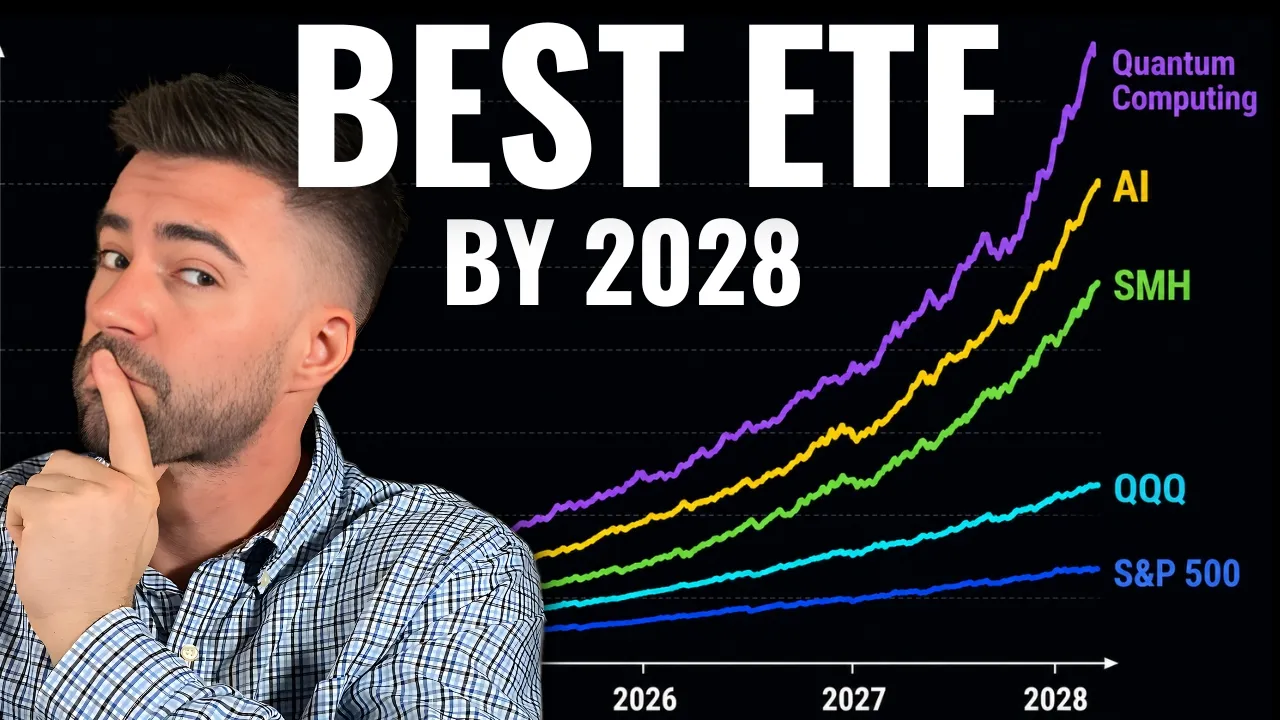
If you wish that you would have got in on the ground level for AI, here's your chance with an even stronger technology that's emerging. Nobody really knows which stock is going to be the clear winner in quantum computing. So, it's the smartest to get a basket of all the major players in the form of an ETF. Had you taken this strategy just 5 years ago and bought into SMH, which is the semiconductor ETF, just 5 years later today, you'd be up over 350%. You didn't have to choose which semiconductor stock would win. You could just own them all. I'm going to quickly explain why quantum computing is the future and why you need to pay attention if you want to get rich off of this technology. Then I'm going to highlight my favorite ETFs in the space right now. And if you'd like me to do a video on specific quantum computing stocks, please comment that down below. My name is Nolan Goa. My students call me Professor G, and I made this channel to make investing simplified. Remember that all investing carries risk. So do your own research. This is not financial advice and I'm not a financial adviser. So what the heck is this quantum computing thing and really why do we need it? We need quantum computing because classical computers have a ceiling. There are certain types of problems that are so complex that even the world's most powerful supercomput would take billions of years to solve them. Imagine a delivery company trying to find the most efficient route for a thousand trucks across 10,000 cities. The number of possible routes is greater than the number of atoms in the known universe. So the goal here is optimizing global supply chains, financial risk modeling, and air traffic control in real time. Another very important example would be current encryption. like what protects your bank account relies on the fact that it's incredibly hard for a classical computer to find the prime factors of a massive number. A quantum computer could theoretically do this in minutes. While this sounds scary, it's forcing the development of quantum resistant cryptography, which will make future data much more secure than it is today. Traditional computers use bits, basically the zero and a one. Every video you watch here on YouTube or email that you send or game that you play is just a massive sequence of these zeros and ones. Quantum computers use cubits. Because of two principles of quantum mechanics, superposition and entanglement, a cubit doesn't have to be just a zero or a one. It could represent a complex mix of both simultaneously. So basically, quantum computing is a bet on solving complex problems that classical computers can't handle, such as molecular modeling, advanced cryptography, and hyperefficient AI training. With AI going crazy and all this technology just boosting through the roof, we're going to need computers that can actually handle this type of movement. So these funds are going to focus on the next evolution of computation. Just remember that these are definitely higher risk. They're still new technology and so anything can happen. It could be very volatile. Many of these companies within these ETFs are pre-profit. They're not profitable. They're not making a lot of money. They're still in the very research stage and they're not anywhere near mass commercialization. But we've all seen what happens with the AI world. And as soon as that did get adopted, it went crazy. And I'm thinking the same thing's going to happen in quantum computing. So number one would be the Defiant Quantum ETF QTUM. This one's for sure the most cited and most liquid quantum ETF that's out there. It tracks the Blueest Star Quantum Computing and Machine Learning Index, which means it doesn't just hold the pure plays, it also holds the companies building the specialized chips and cooling systems required for quantum to work. Since inception about 8 years ago, it's had an average return of about 25% per year, which is crazy solid. This last year it's up 80%. It has 86 total holdings and it has an expense ratio of 0.40 which is highly competitive for a thematic fund. Some of the top 10 include Intel, Micron and AMD. When we look at the full holdings, you can see companies like ion and D-Wave which are pure quantum computing but they're pretty far down there. Now this ETF is a top pick because it uses modified equal weighted approach. This is crucial because it prevents giants like Google or IBM from drowning out the explosive growth of smaller stocks like ION Q. And one thing that just gives me pause on this ETF is it's supposed to be a quantum ETF, but really the top 10 and really the top most of the companies that are within this fund altogether are not necessarily pure play quantum at all. There are a lot of companies that you're going to find in like a QQQ or an SCHG or maybe a VGT. So, while this is a good fund and it does have some quantum computing and it does have a lot to do with quantum computing, there are better ones out there. Number two is WQTM, which is the Wisdom Tree Quantum Computing Fund. The strategy combines pure play pioneers with diversified global leaders using a proprietary framework co-developed with Classic, a leader in quantum software. The returned year-to date is up 26% so far. It has 41 total holdings and the expense ratio is 045%. If you can see here in the top 10, it has aggressive exposure. Its top 10 holdings including ion, regetti, and d-wave account for over 40% of the total fund weight. This means when pure play quantum stocks move, WQTM captures that movement more intensely than more diversified competitors. Now, this one's been around for less than a year, and I usually don't like ETFs that have been around for less than a year, but I understand this one actually has technology that hasn't been around that long either. So, it's one that I definitely like, and it's one that I'm definitely keeping my eye on. Another good thing is that if you already have a high technology ETF, something like a VGT or a QQQM or SCHG, this one's going to have very little fund overlap with those. whereas QTUM from before will have much more fund overlap with that. Number three on this list, this one's mainly for people outside of the United States, and you'll see why in a second. This is actually two different ETFs. QT from Eyesshares called the Quantum Computing UCITS ETF or Q&M, which is the Vanet Quantum Computing UCITS ETF. Looking at the top 10, both of these, you can see why these are truly quantum computing with high percentages in ION Q D-Wave Regetti IBM Intel and more. Now, both of these ETFs are UCITS ETFs. These are primarily for European and international investors or people outside of the United States. You need a brokerage account that provides access to international exchanges if you do want to invest in this within the United States. Many standard US brokerages do not offer these by default. A couple examples that do would be Interactive Brokers and Saxo Bank. Those are common choices for accessing European doiciled ETFs. If you're a US resident, buying UC IT ETFs can carry significant tax complications. I just wanted to show you these because I do have a worldwide audience. And so for those of you that can get these, you're in the minority. And that's great because these are two of my favorite quantum ETFs by far. They have the highest percentage of actual quantum computing companies within the ETF. And I'm thinking that these are going to be available in the US at some point or at least there's going to be a fund that's very similar to these. But as of right now, those two are very solid. So let's talk about one now that you can get in the United States. And this one is amazing, but it's not purely quantum computing. It's going to have AI and quantum. And this one's the iShares future AI and tech ETF, which is ARTY. This one's up almost 100% in just the past year. It does have a 47% fee. And like I said before, this one is a bit heavier in AI than Quantum. But if you'd like a bit of a safer bet rather than going allin on Quantum, especially as it ramps up, the AI within it has already proven itself and has already been going crazy, which is why it's up 100% in a year. So, by investing in ARTY, you get to invest in both. As of early 2026, the fund maintains exposure to several stocks that are dedicated almost entirely to quantum hardware and software. These typically carry smaller individual weights, often around just 1% each, but provide direct exposure to the sector. Ion Q, D-Wave, Regetti Computing, and Quantum Computing Inc., The fund's largest holdings also include massive tech giants that are currently the primary drivers of quantum research and cloud-based quantum services. IBM, Google, Microsoft, Nvidia. Arty also holds the picks and shovels companies that manufacture the equipment necessary for quantum labs. That would be Pterodine and Lamb Research. Compared to a fund like QTUM or WQTM, ARTY is significantly more weighted towards AI infrastructure, you'll get incidental quantum exposure here, whereas WQTM would be a more concentrated bet on the quantum sector specifically. Moving on to number five, this is the Wisdom Tree AI and Innovation Fund, WTI. This one does include quantum computing stocks, though its primary focus is on the broader artificial intelligence value chain. Unlike its pure play sibling that WQTM from before, which is specifically dedicated to quantum computing, WTA views quantum as a supporting innovation theme that enables more powerful AI development. Over the last year, it's up over 90% as well. The expense ratios45%. The key holdings here have all the big names like Amazon, Google and Micron, but then you also get very heavy in Samsung and SKHENX which are very intriguing and you don't get exposure to those in US ETFs. It's a top pick because WTI is heavily weighted towards semiconductor giants like Micron and SKH. It will be less volatile than a pure quantum fund, but won't capture the full moonshot potential if a quantum only company like D-Wave has a massive breakout. So, you can kind of see a theme here. Some of these ETFs, they're going to be purely quantum. Some of them are going to be quantum with AI. And just like anything, if something's more proven, it's probably going to be a bit safer, but also won't have as much upside. Let's talk about this last ETF, cuz it's a little different than any of them. This one's definitely intriguing. I have a lot of people in my Patreon group that have been investing in this one and I myself have been eyeing it as well. This one's called the Roundhill Memory ETF, DR AM, and year to date, it's up 68%. This is a pure memory ETF. Specifically, the Round Memory ETF targets the dynamic random access memory and NAND storage industry. This is the hardware that allows computers and AI servers to access data quickly. This is a bet on the picks and shovels of the AI boom. Large language models and data centers require massive amounts of high-speed memory to function. This thing is highly concentrated, often only 10 to 20 holdings in the dominant global memory producers like Micron, Samsung and SKH. Unlike broader semiconductor ETFs like SMH or SOXX, these exclude chip designers like Nvidia or AMD to focus exclusively on the manufacturers of storage and memory. So for those of you that have been investing in AI and things like Nvidia or AMD or any other type of semiconductor specifically, adding in DRAM, that ETF might be a very solid move. So, if I had to pick one of these, my favorite for today, specifically for quantum computing, because that kind of is what this title of this video is all about, I would go with number two, which was that WQTM. The only con that I can see with that, other than the fact that it's risky, because this technology isn't necessarily proven yet, is that it's been around for less than a year, and I like to see ETFs that have a bit more data. But the pro is definitely the holdings. If I'm going to make a bet and I'm going to use a portion of my portfolio to go very high risk but hopefully highreward, I'm going to go allin. So if I'm going to bet on quantum, I want to hit mostly quantum computing stocks. And again, this thing has aggressive exposure in the top 10 holdings. I really like the ion regetti and dwave, but I also really like that 40% of the total fund weight is really in those top 10. And so if quantum computing becomes all that it's supposed to be, this thing is going to move a lot faster than ones who have very small percentages of those quantum computing stocks in them. For now, this one's my favorite, but I'll definitely keep you up to date. Remember to comment down below if you want me to talk about some of those specific quantum computing stocks, and I'll make a video about that. Remember to keep investing simplified.

Commentaires 0
Connectez-vous pour rejoindre la discussion.
Se connecterAucun commentaire pour l'instant. Soyez le premier à partager votre avis !