Robinhood’s CEO Explains How AI Will CHANGE Investing

- Rendement de la vidéo
- —
- Appels
- 1
- Achat / Vente
- 1 0
- Publié
Recommandations
L'entrée est le cours de clôture de l'actif à la date de publication. Le cours actuel est la dernière clôture enregistrée.
-
Entrée $316,85 31 août 2026Actuel $316,85 31 août 2026Résultat +$0,00
If you're like, I use the iPhone, great product, I believe in it. I want to own some Apple stock.
Transcription Complète
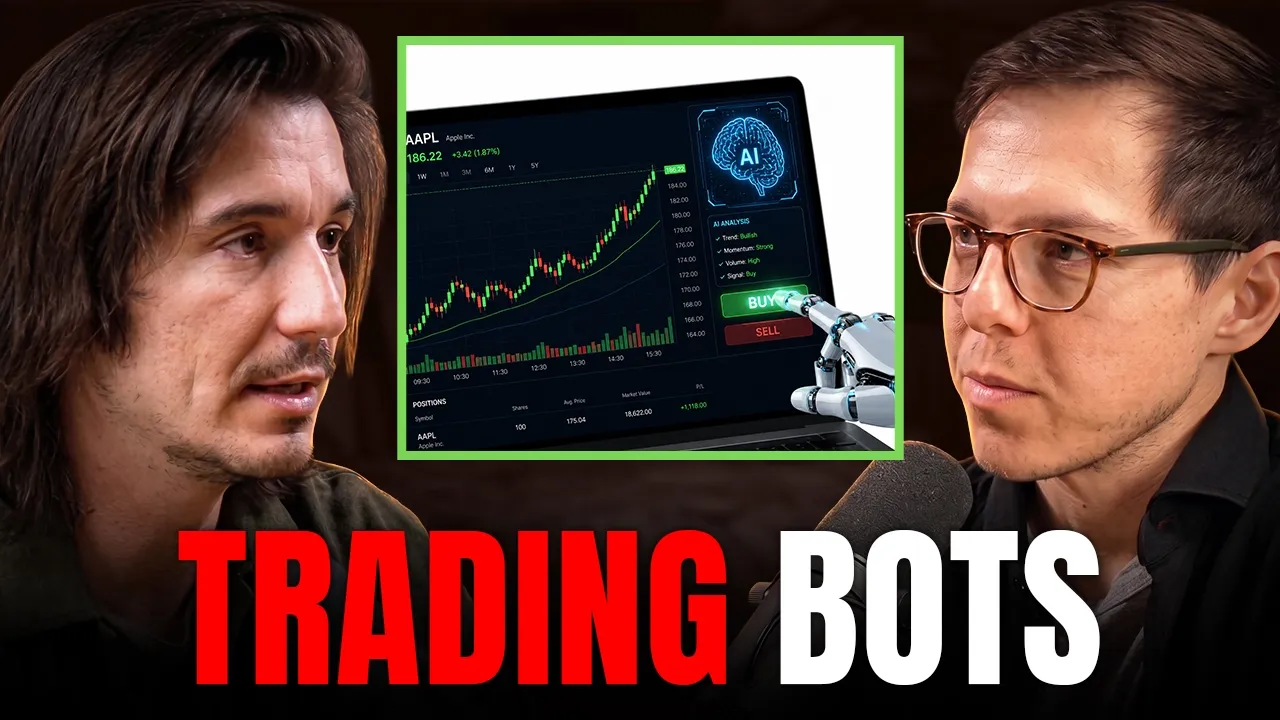
Congrats on launching the AI investing. As soon as I saw you guys launch that, I was looking over Twitter or X and I saw it everywhere. Everyone was talking about it all over Reddit. Congrats on that. That I felt like was a huge leap forward in terms of what brokerages are able and willing to do. I'm curious, how does a deal like that actually come to fruition? And with AI investing agents, are people actually making money? >> Yeah. Um, so we uh we don't really have a partnership per se. Um, basically I think what you're referring to is we launched two things, a Gentic trading and a Gentic card. And what that allows people to do is if you have your your Clawed Code or your codeex or your other AI agent, you can access the Robin Hood tools. And the idea is anything that you can do on your phone with Robin Hood, you should be able to have your AI agent do through kind of the paved path of the MCP server. And so we launched with equities trading. And since then, we've expanded into options. We've we've announced crypto, so that's coming soon. And we keep adding little tools here and there. Like recently, we rolled out the ability to see your tax lots. So for those that uh can use AI agents and are reasonably sophisticated, it gives you kind of the the power of Robin Hood at your disposal. >> And what data are you seeing with people that are using AI agents to invest? Like are they are they making money? Are they losing money? How like how does that work out with with broad data? >> I don't really look too closely at their returns. Um but we we're getting a lot of people trying it out. Uh we've had over 100,000 people actually create Agentic accounts and and they're driving decent volume and they're doing really sophisticated things like you know they're they're uh pulling together all kinds of data sources from all over the internet and kind of combining it into strategies. I I'd say um my background is from algorithmic trading. So before I started Robin Hood, I would write trading strategies and it was a incredibly challenging thing because you'd have to be a programmer. You'd have to worry about all sorts of things and you needed um really deep integrations with legacy financial companies to even get access to the markets because back then you couldn't trade through a normal broker. They were charging you $10 every trade. So I think what's happening is it's making that power the the ability to trade algorithmically much more democratized. But there's still challenges. For example, sometimes these agents themselves aren't optimized for trading. They'll tell you, "I don't want to trade right now. I don't think this is a good idea." And then you really have to work hard to make sure it does the thing you want to do. But what if it's trying to save the person from losing money and it just sees something it's like, "Hey, this is a bad trade." >> Most of the time when they don't uh trade, it's not actually for that reason. I think it's just >> doesn't want to. It just feel doesn't feel like it. >> Yeah. It just doesn't feel like it. >> Didn't have coffee that morning. >> Yeah. It's like, h, you know, I recommend that you actually open up your Robin Hood app and and and put the trade in that way. Yeah. Because I I don't think that trading activity is in the training data. like you don't have like aentic trading traces like you would programming traces. So this is just a new thing that hasn't been done before. >> Given the way things are going though, do you think eventually financial advisors are going to be obsolete? >> Um I think there's always going to be some need for humans. Um like financial advisor provides very different services. It's kind of like um consigary to you, right? And it's someone that is responsible and can help you um make life decisions. A lot a lot of people have financial advisors and they're like um almost a member of the family. I think in that sense some people will always want a human. I don't know if that type of like close emotional relationship is going to be replaced by AI. I think right now people are using AI to sanity check um certain things and you know they say okay is my advisor are they telling me something that makes sense but um there's like a human need that makes it really really hard uh to trust machines for everything because at the end of the day you want someone to be responsible and and I think it's it's hard to have the AI I take responsibility. In fact, you know, if if you can own something, if you're a fiduciary, it's it's a different bar. So, >> yeah, but even if someone is held responsible for something, it doesn't necessarily fix the actual problem if they make a mistake. Like, I've had mistakes made before for myself. And it's like, yeah, they might make a problem, but then actually correcting that problem is more work than just dealing with the problem. >> Yeah. I mean at a certain level you're always responsible for >> your own financial decisions even if it's like hey I've hired if if it's an adviser I've hired this adviser I choose to keep working with them so it's it's my responsibility as well >> I think still a lot of people just don't want to think about it you >> um you know you come across a lot of people and a lot of a lot of them have made money and they say I just want to spend very little of my time thinking about finances and they're not they're probably not going to prompt a claw agent or or open AI. They just want a a person that takes that entirely off their plate. I think the more likely scenario is is you'll see fee compression in that industry. >> You'll see fee compression um because basically for a while there have been two models. There's been kind of robo advisory, which is asset management, but you don't actually have at your disposal the full comprehensive estate planning, financial planning, tax planning. It's just very siloed toward um >> financial advice and investment management. And then you have fullervice financial adviserss that kind of take over. They're a person that abstracts all of your finances, including budgeting and spending for a lot of people. And you know the the robo advisor market has kind of consolidated around something like 25 basis points of your assets. So a quarter of a percent of all of your assets are charged as fees typically. Some are more, some are less. And full service financial advice has been in like the 1% plus range. And if I had to guess, probably there's some middle ground where on average as more AI tools come in and start to blur these two. I I think it'll probably consolidate to somewhere in between. Really quick, I got a fun story here. I uploaded my entire portfolio to Claude about a week ago and I said, "Rate my portfolio. Tell me everything I'm doing wrong or any improvements." It gave me a whole list and believe it or not, it saved me $16,000 a year after tax because it said one of the funds that I was holding was paying a slightly higher expense ratio than a near identical fund that I could buy from Vanguard. Yeah. And it said if you sell this fund, you could realize it was a very small loss. Realize this tax loss, move it into this other fund that has a lower fee, and that fee works out to $16,000 a year. I did it. I mean, I I researched myself in addition to that, but that pointed in the right direction. It's like, wait a second, that's such a no-brainer. I didn't think of that. I just wasn't paying attention. There you go. 16 grand a year saved. >> Yeah. And I think for some for a lot of things where it's it's really clearcut, it it's super super useful, right? Like um Yeah. If you have a fund with a high expense ratio uh and there's a similar fund with a lower one, of course, that's a that's a straightforward one. or you know if you've got cash in a savings account earning 0% and there's this other account here that can get you north of three of course the rational thing is to move all of that cash a lot of that doesn't even need AI to be honest it's just a very very simple algorithm to just see you know if you if you have funds that are underutilized and and can be moved elsewhere. So, a lot of our investors ask us about this like cash sorting AI idea, which is, >> you know, is in the future is the AI just going to move your cash to places that have >> high interest? Um, >> oh, eventually you'll lose track of that. Oh gosh, imagine if it just >> Well, my thought is that's not even AI. You can just have a screen that says, well, and and we try to do this. Hey, we offer 3.5% APY. you could be, you know, you could be making incrementally tens of thousands of dollars per year just by doing this. Um, and and despite the fact that those products exist, people still like their legacy banks and, you know, banks still have trillions of assets that are earning almost zero because, you know, the the inertia and the strength of that relationship is is so high. Do you think investing will fundamentally change when everyone is using like a AI investing agent and these AI agents can tap into all publicly available information instantly and so like it it automatically just knows like is that sometime down the time horizon? If so, like how long? Or do you think that's just not even feasible? Now, really quick, every business is asking themselves the same question. How do we make AI work for us? The possibilities are limitless, but guessing is too risky and sitting on the sidelines is not an option. Because one thing is certain, if you're not doing it, your competitors are already making their move. And that's where our sponsor Netswuite by Oracle comes in. It's the number one AI cloud ERP trusted by over 43,000 businesses to manage everything from financials and inventory to commerce, HR, and CRM, all in one unified system. When all of your data is in one place, your AI becomes a lot smarter. It doesn't just guess, it knows. Netswuite intelligently automates routine tasks, delivers real-time insights, and helps you make fast, confident decisions that actually help drive growth. And it's not just an add-on. It's AI that's literally built right into the system that runs your business, helping you cut costs, improve accuracy, and stay ahead of the competition. Whether your company is making millions or even hundreds of millions, Netswuite gives you visibility and control to keep moving forward. Honestly, if I were building a business of this size, Netswuite's the only company that I have 100% confidence in. So, if your revenues are at least in the seven figures, get our completely free business guide, Demystifying AI, at netswuite.com/clip. Again, the guide is free for you at netswuite.com/clip. netswuite.com/clip with the link down below in the description. Do you think investing will fundamentally change when everyone is using like a AI investing agent and these AI agents can t tap into all publicly available information instantly? And so like it it automatically just knows like is that sometime down the time horizon? If so, like how long? Or do you think that's just not even feasible? >> There's lots of different investing behaviors. I don't think that someone who is buying a stock of a company that makes a product uh they use is going to be all of that all that affected by AI. If you're like, I use the iPhone, great product, I believe in it. I want to own some Apple stock. AI is unlikely to change that investment behavior significantly. What are you going to ask it? Right? I mean, maybe if you're really kind of having second thoughts and you're not sure whether it's a good one, you'll ask some questions. But by and large, I I think that that's um uh that's durable. Active trading, I think active trading is going to look significantly different. A lot of active trading is now geared towards technical analysis on charts. AI tools will certainly augment that quite a bit. Um and then you can bring in more data sources. uh passive long-term investing and portfolio construction. Yeah, I don't think it'll change very much because in that particular example, it's really about making a infrequent asset allocation decision. And may maybe you'll have more data communicating the decision on what's going on, which is what we're doing with Robin Hood products, like what's going on in your portfolio? Why did we make those changes? Um, but I think fundamentally the the the asset allocation process has been automated and streamlined pretty well and I I don't think there's juice there. So, yeah, it's it's really trading. I think trading is where you're going to see the biggest change and and the biggest disruption, which is why we're focused on agentic trading first. >> What about for productivity within Robin Hood as a company? How much has AI changed the game? I changed it uh very deeply. I mean I think our AI adoption is close to 100%. If you're a software engineer and really software engineers are building all the products. I think the the workflow has shifted from, you know, humans writing the code and humans reviewing the code to generally humans overseeing agents uh and and those agents are writing the code and reviewing the code. and your job as an engineer is shifting to making sure your agents are well-managed and and seeing, you know, how many agents you can employ and can you keep them busy all the time, including when you're sleeping. >> So, do you think though with Robin Hood eventually you could have just a few people running the entire company from home? >> It's not our goal for sure. Um uh I I think sometimes we do um we do think about these things. Um but I think that someone still has to be running the agents and at the end of the day it's like my financial fiduciary point. Uh it's hard to imagine a world where a human is not like responsible for decisions. >> Yeah. And so I think we've been we've been focused on doing more with the teams that we have and and giving people more leverage. Um but yeah, less focused on just reducing headcount. >> What's the biggest mistake that you've made over the last year? >> You know, I'm I'm sure I've made lots of little mistakes. I think my my my approach to things is really just how can I move forward? like I don't like thinking about the past very much. I think we can kind of get stuck relitigating decisions, but um really it's it's about okay, where are we now? You know, I I even in some cases prefer to be behind and to be an underdog cuz I think it gives us something to work towards and and to really push on. I mean the past year if I had to think about what we've done okay uh for active traders we've launched prediction markets and that that's a interesting business for us because usually we're not the first to launch a new asset class you know equity trading was a thing for multiple decades even electronically before Robin Hood came along we improved it we we brought it to the smartphone we brought it to zero zero commission, but you know, we we weren't early to it. Crypto trading, we weren't particularly early either. I mean, we launched in 2018, which was early relative to the Tradfi companies, but a lot of cryptonative companies started in 2012 or even earlier. Bitstamp, which we acquired, was, you know, I think the longest continuously running crypto exchange. So, we were we were uh not the earliest there. prediction markets. We were one of the first to to roll out that product as soon as they got legalized for the presidential election. We were kind of there within weeks with a product and then we had to really expanded over time and >> uh you know it's it's it's grown to hundreds of millions of annual revenue or fastest growing business line of all time. Um so active traders we've done well banking uh has been a really quick roll out. I think that the challenge that I'm spending a lot of time thinking about is now that we're doing all of these things, how can we make sure the core experience is coherent? And we've been investing a lot more in personalization in making like the app clean. And you know, I can say, well, maybe maybe I should have thought more about these problems earlier, but a year ago, we probably didn't have so many new products shipping. So,
Commentaires 0
Connectez-vous pour rejoindre la discussion.
Se connecterAucun commentaire pour l'instant. Soyez le premier à partager votre avis !