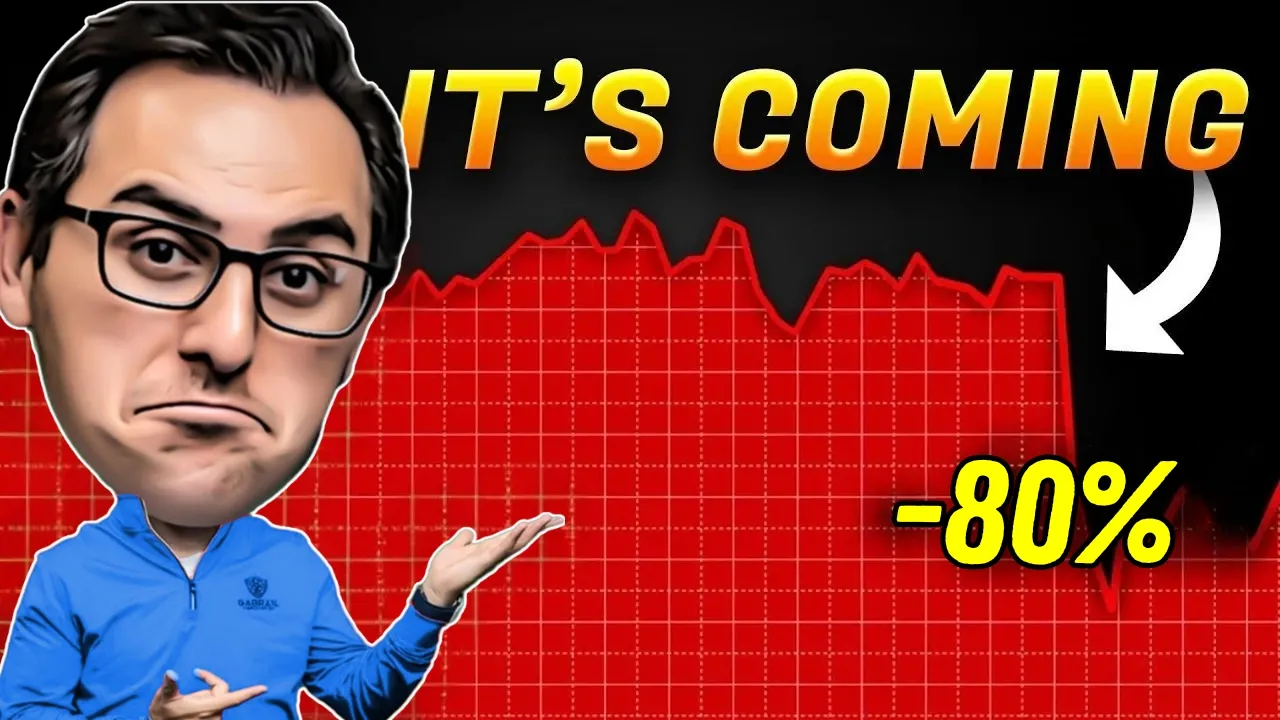
This Has "ALWAYS" Ended in a Stock Market Crash. It's Here Again

- Rendement de la vidéo
- -15,59%
- Appels
- 2
- Achat / Vente
- 0 2
- Publié
Recommandations
L'entrée est le cours de clôture de l'actif à la date de publication. Le cours actuel est la dernière clôture enregistrée.
-
Entrée $136,88 23 mai 2026Actuel $175,89 24 août 2026Résultat −$39,01
He's bet against Palunteer and Nvidia
Contexte Here's what Bur is doing right now. He's bet against Palunteer and Nvidia, two of the darlings of the stock market in recent years.
-
Entrée $215,33 23 mai 2026Actuel $208,48 24 août 2026Résultat +$6,85
He's bet against Palunteer and Nvidia
Contexte Here's what Bur is doing right now. He's bet against Palunteer and Nvidia, two of the darlings of the stock market in recent years.
Transcription Complète
Warren Buffett has $400 billion dollar in cash and has been a net seller of stocks for the last 12 quarters. Michael Bur, the man who predicted the 2008 crash, has opened a massive short position against the AI market. Paul Tudtor Jones says buying the S&P 500 right now could produce negative returns for the next decade. These are not random people on the internet. These are three of the most successful investors alive and they're all saying the same thing at the same time. Today I'm going to walk you through exactly what they're saying and then tell you honestly what I think you should do about it. Now before we get to what these investors are saying, I want to show you a data point that I think deserves serious attention. It is called market concentration and it has just hit a level that has only ever appeared before major market crashes. Here is the idea in plain English. Imagine the entire US stock market is a big pie. The pie is divided up into hundreds of pieces, one for each company. When the market is healthy and balanced, no single slice is too big. But sometimes a small number of companies get so large that they start crowding out everyone else. Their slices of the pie get bigger and bigger. And history shows that when the top 10 companies own 40% or more of that entire pie, something bad tends to follow. In 1929, the top 10 stocks made up 44% of the entire stock market. The Great Depression followed. In 1965, they hit 40%. The market went nowhere for 17 years. The bubble burst. In 2000, they hit 41%. The dot crash followed. The NASDAQ lost 80% of its value. In each case, the same thing happened. The top got too heavy, and when it fell, it dragged everyone down along with it. In 2000, while the NASDAQ lost 80%. The broader S&P 500 still fell 50%. The pain was not just for the companies at the top. Everyone felt it. Today, the market is being driven by lowcost ETFs that everybody buys in randomly. So, as they keep buying up, these stocks keep getting more and more investment. And right now, the top 10 stocks in the S&P make up 40% of the entire S&P's market value. Apple, Microsoft, Amazon, Nvidia, and Google alone make up 25%. This level of concentration has only been seen at the peak of the largest bubbles in history. Now, that doesn't mean that the crash is coming tomorrow. We have no idea when anything's going to happen, but it does mean that the risk level in this market is at an extreme. And that is something every investor needs to understand. Now, let's talk about Warren Buffett. And if you don't know who Warren Buffett is, I ask you one question. Where have you been living? Because he's widely considered the greatest investor who's ever lived. He's been running Birkshire Hathway for over 60 years. and he turned a struggling textile company into one of the most valuable businesses on earth by buying great companies at great prices and holding them for decades. At Berkshire Hathaway's most recent annual meeting, Buffett said something that stopped a lot of people in their tracks. He said, "We've never had people in a more gambling mood than right now." And then he did something that speaks even louder than the words. He built a cash position of almost $400 billion, guys. $400 billion sitting in cash and short-term treasury bills, not in stocks. In fact, the stocks he did have, he's been an ongoing seller of them for the last 12 quarters. Now, here's why that matters. Buffett is not someone who sits in cash because he's scared of short-term volatility. He loves volatility. He spent most of his career pretty much fully invested. He bought stocks during the 1987 crash, during the dotcom bust, during the '08 and '09 financial crisis. He loves buying stocks when they're cheap. The fact that he's sitting on this much cash right now tells you something important. He's not finding enough stocks that meet his price requirements. And Buffett has said before that cash is not just a position, it's an option. It's the ability to buy when everyone else is panicking. He is loading the gun. And this is not the first time we've seen this. In 99, Buffett warned that euphoria was the enemy. He walked away from the late 1990s rally and people called him out of touch, a dinosaur, etc. They said he'd lost his edge. And then the dot crash happened and the companies he avoided lost 78 80% of their value. His own portfolio held up because he refused to overpay. And now in 2026, he is sending the same signal. Cash, not stocks. Now guys, as I always say in every video, do not take our titles literally. We put in many titles. I don't know which title you came in on, and I have no idea what the title is. We're here to teach a lesson. We bring you in on the title and teach you the real lesson in the video. So, stick with it, and I assure you, you'll be a better investor because of it. Now, Michael Burray is the investor whose story was told in The Big Short. In the mid 2000s, when every bank, every rating agency, and most of Wall Street said the housing market was fine, Bur spent months reading through thousands of mortgage documents and concluded that the entire system was built on loans that were going to collapse. He bet against it. Everyone called him crazy. Banks laughed at him. And then in 2008 when the housing market crashed and nearly took the financial system with it, Bur made over $700 million for himself and his investors. Here's what Bur is doing right now. He's bet against Palunteer and Nvidia, two of the darlings of the stock market in recent years. And he has said publicly that the market today feels like the last few months of 1999 and 2000 bubble. Not the beginning of the bubble, the last few months. and he has said something even more direct for any investor holding stocks that have gone parabolic. For any stocks going parabolic, reduce positions almost entirely. Is Bur always right? No. And there's going to be lots of comments saying Bur's called 18 of the last three recessions and yeah, his timing has been off. That is absolutely true. He has made calls that were earlier wrong. And shortselling is extremely risky and even great investors get it wrong. But when someone with his track record, his research processes, his willingness to go against the entire market says it feels like 1999, you should at least listen to why that is. He might be early, but he's probably not going to be wrong. Now, Paul Tudtor Jones is one of the most respected macro investors in the world. He has been trading in the markets for decades and is known for making big calls on major economic turning points. And what he is saying right now about the US stock market is worth understanding carefully because he's doing something different from Buffett and Bur. He is not just warning about a crash. He's showing you the math. Here's what he said directly. We're currently at 252% of the stock market to GDP ratio. In 1929, we were 65%. In 1987, we got to about 85 or 90%. In 2000, it was 170%. So if you think about the periodicity of significant bare markets since 1970, we get a mean reversion about every 10 years. Let's say the mean reverts the past 25 or 30-year PE. That would be a 30 to 35% decline. Well guys, what's a third of the 250% of GDP? It's about 90% of GDP. Almost the entire US economy. He goes on to say 10% of our tax revenues are capital gains. They basically go to zero. So you can see the budget deficit absolutely blowing up. You can see the bond market getting smoked. You can see this kind of negative self-reinforcing effect. And I think his point is the trickle out effect is insane. Tutor Jones is saying that if the market reverts even to normal historical valuations level, not crisis levels, just normal, that would be a 30 to 35% decline. And decline of that size in a market this large would have massive ripple effects for the economy. He also says something that I think is the most important line for long-term investors. If you buy the S&P at this current valuation, the 10-year forward return is negative when you buy the S&P with a PE of 22. That's what history shows. Listen, read that carefully and listen to it carefully. He is not saying the market will crash tomorrow. He's saying that if you buy at current valuations, history suggests that your returns over the next decade would be negative. That is not a short-term warning. That is a long-term valuation argument. The S&P 500 is absolutely spectacular over a 100red-year view, and it's never had a down 20 years, but that average includes decades when you could buy at six or seven times earnings. Buying at today's valuation levels is a very different bet. And that's what people always forget. Now, I want to bring this closer to home for a second because earlier this week in our Everything Money community, a conversation started that I think is worth sharing because it reflects what a lot of investors are feeling right now. One member opened it up by saying, "I've been seeing a lot of videos popping up saying crash in May. What is your take?" Another member said, "I think a crash is coming. I don't know when, but I've noticed the videos, too." And then someone else said, "With how the market has been behaved and since the pandemic, it's probably going to surprise everyone and rip 20%." And then one of the most honest things I've read in a while, a member pointed out that even though it seems like the index has risen, his portfolio is pretty flat. That last one actually hit me because that's the reality for a lot of investors right now. The index is up on paper, but so many individual portfolios are flat or going nowhere because the gains are concentrated in a handful of stocks and the crash video that's flashing on everybody's feed. That's what happens at market extremes. Fear and excitement both peak at the same time. Some people are convinced about to rip higher, others convinced a crash is coming. And most regular investors are stuck in the middle watching their portfolios balance between the same two numbers trying to figure out what to do. So let me put this in historical context because the comparison to to 2000 keeps coming up from Bur from Buffett from Tutor Jones. So let me make it concrete. In 1999 and into 2000 the stock market was driven by extraordinary excitement about the internet. Every company with a.com in its name is worth billions even if it had no revenue. The NASDAQ went up over 400% in 5 years. Investors were convinced that the old rules of valuation did not apply anymore. That this was a new error and traditional metrics like earnings and cash flow were irrelevant. The Schiller PE ratio, which measures how expensive stocks are relative to 10 years of earnings, not just one random year, 10 years, hit 44 in late 1999. And that was the highest reading in history by a lot. Guys, today the Schiller PE is 42. The Buffett indicator is well above 200%. The highest it's ever been in history, significantly above even the 2000 peak. The top 10 stocks make up 40% of the market, matching the concentration level that preceded every major crash in the past 100 years. And the AI narrative has driven certain stocks up hundreds of percent in a matter of months, mirroring the internet narrative of the late 90s. Are there differences? Of course. The big tech companies today make a lot of money and loads of it. Microsoft, Apple, Google, Amazon, Meta are genuinely profitable businesses with real earnings and high returns on capital. That is different from the dot era when many of the most hyped companies had no revenue at all. But I want to keep in mind when people say this, if we're comparing top 10 to top 10, even the top 10 companies in 2000 were highly profitable businesses that are still around today. But here's the thing, a great business at the wrong price becomes a bad investment. And as Tutor Jones pointed out, buying the S&P at a one-year PE of 22 and a 10-year PE of 44 has historically produced absolutely abysmal 10-year returns, negative returns to be precise. The businesses being great does not actually and automatically mean that the price being paid today is a great price. That being said, I think some of the highest valuations in companies like are companies like Costco and Walmart. Slow growth, but twice the price where they should be. Now, I've walked you through the concentration data, what Buffett is doing, what Bur saying, what Tutor Jones is worrying is worrying about, and how this compares to 2000. Now, I want to give you my honest view because I think the most important thing I can do is be straight with you. The risk of the market is real. I've been preaching about overvaluation for quite some time. I'm never going to stop preaching about valuation. We will get to the point in the market where I say the market's undervalued and people are saying, "Paul, you've been saying it's undervalued for so long." Guys, it is what it is. That's what happens in these extreme pendulum swings. I cannot tell you when the market will fall. I will not tell you when the market will fall. I have no idea. It could happen today, could happen tomorrow, it could happen five years from now. Nobody has a clue. But there are valuation signals because every investment is the present value of all the money it will make over the future. And right now the price you're paying for that future cash flow is way too high. And the only way it works out today is with massive inflation which would jack rates up. And if rates are eight or 9% why would you ever be okay with a market where take even if it makes you 11 or 12%. You would need more. But here's the bottom line. I will not call for a crash. I'm calling for caution. I'm calling for you to become a smart investor that when you do see this happen, you're calm and say, "We expected this." You continue to dollar cost average today because when things are panicky and crazy, you dollar cost average going forward. The right response is not panic. It is discipline. It is education. It is learning. Be careful about paying peak prices for individual assets at a moment when three of the greatest investors alive are raising red flags. And of course, the most important thing I want you guys to remember, stick to the process. I buy SCHD every single month, month in and month out. I never deviate. On top of that, I do buy individual stocks and I sell cash secured puts consistently on companies that I believe are trading at discounts to their value, even with the overall market being high. If you've ever made an investing decision based on a gut feeling and lost money, this software was made for you. Everything Money built the software that replaces gut feelings with a real process. Our stock analyzer tool helps you figure out what a company is actually worth based on the assumptions that you put in. The eight pillars check the health of the business from almost every angle. You stop guessing and you start investing with actual data and conviction. You'll finally know what you own, why you own it, and the right price to pay for it. Not because someone told you to buy it, not because you have FOMO and you saw somebody else make money, but because you ran it through a process and the numbers made sense to you. This isn't complicated, guys. If you can make a thoughtful decision in everyday life, then you can do this. So, start the 7-day trial for just $7. Click the link in the description below and see everything this community and software has to give you today. Every time the market gets to a moment like this when the warning signs are loud, the euphoria is high and investors are unsure what to do, I come back to the same five principles because having a framework written down is what protects you when emotions are running hot in either direction whether absolutely high and euphoric or low and depressing. Bill Aman has his version of it, Monry has his and here is ours at everything money. First tenant, we are investors not speculators. Right now, the market has a lot of people in it who are absolutely speculating and gambling. Buying stocks because they're going up, not because the underlying businesses are worth more than the price. Tenant two, every investment is the present value of all its future cash flow. Tutor Jones made this point with the numbers. When you buy the S&P at 22 times earnings, you are paying a lot for the future earnings that are not guaranteed. The price you pay is going to determine your return because the future cash flow is going to be what it is. The businesses may be great, but they're going to be great whether you pay $500 a share or $50 per share. The question is, what price are you paying for them? Tenant three, if we don't understand it, we don't invest in it. A lot of stocks that have gone parabolic in this AI cycle, the ones that Bur specifically said to reduce are stocks whose valuations are built on assumptions about future AI revenue that nobody can verify yet. Tenant four. In the short run, the stock market's a voting machine. In the long run, it's a weighing machine. What that means is in the short run, what's popular is going to go up. What's unpopular will go down. But in the long run, what's going to drive is the weight behind the business, the actual earnings, the actual fundamentals. The weighing machine always wins eventually. Your job is to be patient enough to let it. And tenant five, and probably the most important one, a great story becomes a bad investment if you pay the wrong price. The dot companies had great stories. The internet was a phenomenal story, but investors who bought at peak 2000 valuations waited over 15 years to break even on the NASDAQ. The story being right does not protect you if the price is wrong. So guys, I encourage you to download our principal-driven investing PDF. It's in the first link in the description below as well as the first pin comment. It's a great way of having something there to protect you as a guard rail when things are getting crazy and you're feeling emotional. Read these, own these, make them part of your core. Now, three of the greatest investors alive are sending the same warning at the same time. Buffett with $400 billion in cash, Bur with a huge billion dollar short on AI stocks, and Tutor Jones with math that shows that buying at today's valuations has historically produced negative 10-year returns. The 40% market concentration rule has triggered for the first time since the dot crash. None of this means you sell everything tomorrow. It means you pay attention. It means you know what you own and what you paid for it. If you understand it, it goes down in price, you keep on buying if it still makes sense. Stop chasing what goes up and start asking whether the price makes sense. It means you have a process because when the market gets scary or euphoric, the process is the only thing that keeps you from making the most expensive mistake of your investing life. So, what I want you to do now is click right here to watch our next video. Because even with everything we talked about today, there are still specific situations where I buy stocks aggressively and without hesitation. And I want to show you exactly what that looks like. Click right here. Thank you for your time.
Commentaires 0
Connectez-vous pour rejoindre la discussion.
Se connecterAucun commentaire pour l'instant. Soyez le premier à partager votre avis !