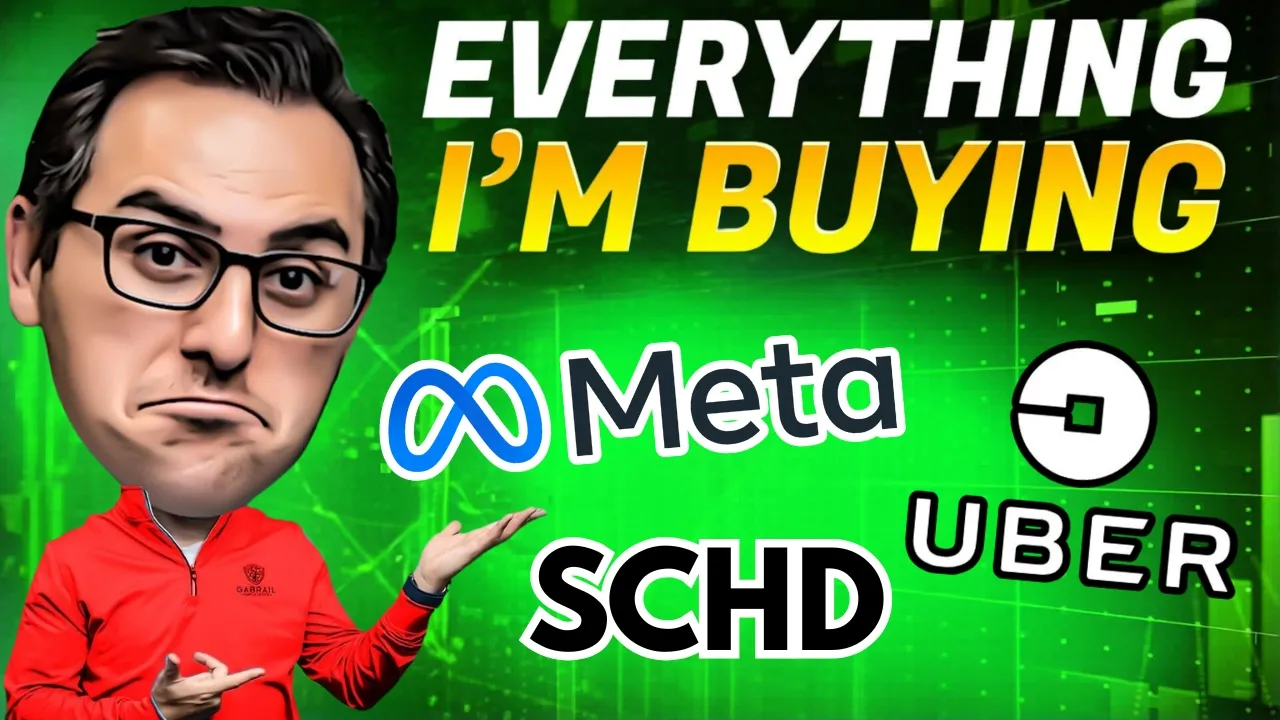
I'm Buying Meta Stock at an Unthinkable Price & 2 New Buys!

- Rendement de la vidéo
- +1,09%
- Appels
- 2
- Achat / Vente
- 2 0
- Publié
Recommandations
L'entrée est le cours de clôture de l'actif à la date de publication. Le cours actuel est la dernière clôture enregistrée.
-
Entrée $612,34 26 mai 2026Actuel $559,02 24 août 2026Résultat −$53,32
Now, instead of buying the stock straight up, I'm actually going to be selling cash-secured puts. ... It's basically a strategy where I commit to buying the stock at a price that I'm happy with that is lower at a future date.
Contexte Meta section — discussing how he plans to get long Meta via options at a lower entry price.
-
Entrée $70,12 26 mai 2026Actuel $79,29 24 août 2026Résultat +$9,17
Our community members have this as a buy along with Meta.
Contexte Uber section — explicit statement that the community rates Uber (and Meta) as a buy.
Transcription Complète
Guys, I'm making three major moves in my portfolio right now. Two of them involve companies that just reported some of the strongest earnings number in the entire market. And the third is something I do quietly every single month, no matter what the market is doing month in, month out without fail. So, today I'm going to show you all three. I'm going to walk you through my analysis on each one, and I'm going to show you exactly how I'm positioning myself for the future. So, let's get into it. First move, Meta. And I want to start by telling you what Meta actually is, because I think a lot of people use it every day without thinking about how the business works. Meta owns Facebook, Instagram, and WhatsApp. And for a lot of people in the US, they don't necessarily know what WhatsApp is, but it's probably the most popular used messaging app in the world, and it's actually my favorite. I love it far more than iMessage. As of March 2026, 3.56 billion people open one of those apps every single day. The way Meta makes money is very simple. Businesses pay Meta to show ads to those people while they scroll. The more people use the apps, the more ad slots Meta can sell, and the more money they can make. Now, let me share what just happened in their first quarter 2026 earnings report. Revenue was 56.3 billion, up 33% from the same time last year. Income from operations was 22.9 billion with a 41% operating margin. That means for every dollar Meta brings in, they keep 41 cents as operating profit. Ad impressions across their apps were up 19%, and the average price per ad was up 12%. So, not only did they show 19% more ads, they also got 12% bump on every single one. If they just had the same number of ads, that alone would have been a 12% increase. But, it was 19% more ads and 12% more revenue per ad shown. Both going up the same time means the business is becoming far more valuable in both directions and they have $81 billion in cash and investments sitting on the balance sheet as we speak. Here's something worth noting. Bill Ackman, one of the most well-known hedge fund managers in the world, has a significant position in Meta. Now, instead of buying the stock straight up, I'm actually going to be selling cash-secured puts. Now, let me explain that very simply. It's basically a strategy where I commit to buying the stock at a price that I'm happy with that is lower at a future date. And the market, someone in the market is going to pay me to make that commitment. Now, guys, one of the biggest lessons I ever learned was on Meta. I was smart enough to be buying Meta as it fell. I was smart enough to ignore the noise, but it didn't matter because I sold Meta too quick. That is a major mistake that I made. You can be smart and disciplined enough to buy it as it falls, but if you're not going to hold on to it as it compounds, it is almost as bad. Now, even though I have that history of buying Meta as it fell, I even got lucky enough and bought it on the lowest day in 2022, which was November 4th at $88 per share. That was my last purchase. I can't get myself anchored to that price. Why? Because as a company gets bigger and bigger and bigger, it is going to be worth more money. Just because you paid some low price for a company doesn't mean it's not worth what it's selling for today, and that's what's going to be interesting. So, let's pull up Meta and just try to determine what do we think this the company is worth right now. So, a lot of people look at Meta and say, "Oh, it's selling for $604. That's the price." That's not actually the price. That's the price of the share. So, guys, the actual price is right here, the market cap, 1.55 trillion. That's all the shares multiplied by the share price. One thing I always look at is I compare it to enterprise value. This essentially tells me how much debt there is. And based on my calculation, there's $70 billion dollars of debt. Guess what? This company generated 48 billion dollars last year in cash flow. So, they can easily afford that debt, easily. I love that. They have great returns on capital, high teens. What does that mean? It means they get good returns on the money that gets invested in their business. This is a sign of quality for a company. This company deserves a premium. 32% bottom line margin, 82% gross profit. Every extra dollar of revenue they bring in, 82 cents of it goes to the bottom line before taxes and overhead. Guys, revenue growth is insane right over here. Now, it is selling for 32 times free cash flow, but their cash flow is a lot lower than their net income. They're only selling for 22 times their earnings. So, let's go pull up their eight pillars. Right now, it's all checks and a couple of X's, but remember, the X's are PE and price of free cash flow. It could be overpriced, but if they're growing like crazy and they can grow their profit 30, 40% a year for five or six years, this is nothing. And you got to remember that when you're buying a company. 15 PE doesn't mean this company is cheap. Uh 50 PE doesn't mean it's expensive. It's about understanding the story behind it. Very, very important. Now, I threw a lot at you. If you're new to the channel, and you might feel overwhelmed, don't worry, you're not alone. Everybody in the history of the world has been overwhelmed when going over these numbers to start, including Warren Buffett and Charlie Munger. But, I want you to stick with it just like they did. You will become a lot smarter and you'll understand a lot more, and what will that lead to? When you understand, you don't fear. That's what we're trying to get here. So, here's what I'm offering. Absolutely free. Click the first link down below in the description, as well as in the first pin comment, and download our free PDF that explains all of these key metrics absolutely free. You'll get the explanation, the calculation. That way, you're prepared so we can speak the same language and you can understand what we're talking about. Now, guys, the most important thing I'm here to teach on YouTube is the difference between price and value. The story could be awesome, but if you overpay for it, you make a bad investment. We're here to determine the value of the company and then compare it to the price the market is telling us right now. So, let's go look at analyst estimates. What do analysts think about this company going forward? Well, they think this year they're going to make roughly $30 per share, growing to $56 per share in the next 4 years. That's a lot of growth, guys. Well into the double digits. And revenue growth? Look at this. 25%, 18%, 16 and 1/2, 12.8, and 13%. A lot of revenue growth. They are analysts. They are looking at the future, which is unknown. So, take that with a grain of salt, but the bottom line is I do see a a world in which their revenue and profit can increase dramatically because they have not maximized their revenue on ads overseas or even on WhatsApp. So, here, we have a story, we have numbers, we put it together in our stock analyzer tool. This is why this tool is so popular amongst our users. It allows us to make assumptions about the future. Here is the last assumptions I made about Meta. I did 7, 12, and 17% revenue growth for the next 10 years. Profit margin, I did 29, 31, and 33, and very close on free cash flow, a little bit lower. I could probably make them the same and be fine with that. Remember, though, they differ a lot right now because Meta is spending a lot of money on capital expenditures, data, AI, data centers, etc. That eats up your free cash flow. But, I'm not worried about that right now. Next, PE and price to free cash flow. What PE would you assign to this company 10 years from now? Guys, good returns on capital, great business, great moat. The market average is 15 to 16. I definitely think this company deserves higher. I did 20, 24, and 28. If you did 18, 21, and 24, makes sense. I think I'm being optimistic here, but as this company grows, I think it's going to establish themselves more as a moat status business. And finally, guys, 9% desired return, no margin of safety, only intrinsic value. I'm not here to say this is the price I'm going to pay, it's to say this is what the business is worth. So, I hit the analyze button. The stock's currently at 605. This is why it's interesting. I have a low price essentially of 600, high price of 18 and 1900, middle price about 1,000. That gives me potential returns of 16% from here. If my numbers above make sense. And don't ever buy just because this says it. What this tells me is, Paul, do a little bit more research, make sure you feel comfortable because this is an incredible opportunity potentially. Make sure your assumptions actually make sense. So, for our options, if I like the stock at 605, what I'm trying to do here is pick a date in the future. Let's go out 1 month. Let's go to the 12th of June. Now, let's say I want to get a little discount on this company cuz I just want it to be a little bit lower. I could pick 575. Guys, somebody's going to pay me $9.74 per share to buy this company at 575. If I do this over and over and over again, I'm getting a 20% return on my cash on an annualized basis. Now, what does this mean? Well, if the stock stays above 575 on this date of June 12th, I keep the 974 and I don't get the shares. If the stock falls below 575, I still keep the 972 per share, but now I've got to pay that person five So, essentially, I'm paying, call it $565 for the stock. What's the risk here? What if the stock falls to 400? I'm still paying 575. So, what's key here is only do this if you're very comfortable paying this price. I always tell people if I would pay this price today, then I do it. Because if it falls to 400, and I bought it for 575 today, I'm still the same loss, but at least now I get $9.70 along the way. Guys, the one of the most common things I see is people who sell puts and either don't want the shares or they get FOMO when the shares fall. I do not do that. It's a very tough world to be in, but you got to make sure that you're only selling puts on companies you want at prices you want. You should be excited that you get it. And don't forget also, I've looked at Meta. I have puts on them, but don't ever buy anything because anybody on the internet or even Warren Buffett has it. We're here to teach a process that you can apply to companies that you know and understand. And on top of that, the title of this video has probably changed a dozen times since you since it was listed and you clicked on it. Don't take our titles literally. We're here to get you in in the title and then teach you a lesson. So, company number two, Uber. Now guys, this is also a stock I did recently, but we all know Uber. It is the app you open when you need a ride. But here's what some people don't know. Uber is actually two massive businesses running on the exact same platform. The first is rides. You open the app, a car shows up. That business is still growing fast. The second is food delivery, which is Uber Eats. You order food, it comes to your door. That business is growing even faster, and Uber also has a freight business that connects truck drivers with shipping companies. What a brilliant move. So, here's what the first quarter of 2026 earnings report showed. Uber completed 3.6 billion trips in one quarter. That's up 20% from the exact same time the previous year. Gross bookings, which is the total dollar value of everything moving through their platform, hit 53.7 billion. Free cash flow was 2.3 billion in that one quarter. And just like Meta, Bill Ackman has a very meaningful position in Uber as well. I believe it's his number one position. That is not a coincidence. He's probably seeing something similar to what I'm seeing. A business growing at extraordinary pace that the market has not fully given credit for. Now, Waymo, Tesla FSD autonomous driving, that's what's taken Uber off of its highs over $100 not too long ago. So, let's go break this down. Again, 155 billion dollar market cap. Guys, this is a lot smaller than Meta, about 1/10 the size. But look at this, their free cash flow is way more than 1/10 of Meta's. So, that alone tells me there's a lot of potential potentially there if Uber can still keep dominating. Now, they have a lot more debt, about 30 billion dollars in debt, but again, a lot of free cash flow along the way, and their free cash flow is higher than their net income. They've got a low return on invested capital, but it is getting better. It was negative for the last five years, now 8.3 uh 6%. Gross profit of 41%, and look at this profit margin. It was 6 and 1/2% a year for the last five years, and now it's 15.9. That's a big jump. If they can sustain this, that is really solid cuz they're selling for 18 times earnings. That is very important to look at. Our community members have this as a buy along with Meta. So, let's look at the eight pillars. Not as attractive. Low returns on capital, shares outstanding up about 6% year I'm in the last five years, but that's starting to decline. And then the five-year in PE and price to free cash flow. But again, you don't buy or sell based on the eight pillars. It tells you a story, and the story to me is okay, it looks like profit and free cash flow are up a lot lately. Shares are up, but starting to decline, so I'm not as worried about the eight pillars here. So, let's see what the analyst estimates are. What's interesting is they have a lot of growth here in the next couple years and then flatlining. So 350 growing to 620 in the next 4 years, even though revenue they have growing at 12, 14, 12, 9 and 1/2, and 8 and 1/2%. So not a sexy a story as not a sexy a growth and there are concerns about Waymo and other self-driving cars. I want to make sure everybody remembers that as they look at this. So, let's go check out our stock analyzer tool and the assumptions I made last time I did Uber in our software. I did 6, 9, and 14% revenue growth for the next 10 years. I did 18, 22, and 26% profit margin and free cash flow margin. I did 18, 22, and 26 PE and price to free cash flow 10 years from now and my 9% return. Now, there's something I have to let you know before we finish the stock analyzer. Most people don't fail at investing because they lack information. The information's all out there. They fail because when the market feels unpredictable and every decision feels like it could be the wrong one, they freeze. I have been there. Everyone has been there. But that anxiety, it costs us way more than bad trades ever could and misunderstanding creates fear and fear creates those mistakes. So imagine knowing the right price to pay for a stock based on your own assumptions about the future, not someone else's guess, your assumptions. Imagine having eight clear pillars that tell you the story of any business so you always know the right question to ask next and imagine a screener that quietly watches the market for you so you can sit back and wait with confidence until the perfect price arrives. That is what we have built at Everything Money. Just like I was demonstrating for you in this video, our community is a place where clarity replaces confusion where your next step feels obvious instead of overwhelming and where you're never making decisions in isolation. You're going to stop second-guessing yourself. You're going to start trusting your instincts a little bit more because they'll finally be backed by the right tools and the right people inside of our community. Guys, this isn't just about growing your money. It's about becoming someone who's in control of their entire future. So, what is that feeling worth to you? So, here's what I want you to do. Start a 7-day trial. It's only $7. If that feeling is worth over a dollar a day for you, this is a no-brainer. So, click the link in the description, get full access today, run whatever you've been thinking about buying, see what the numbers actually tell you before you spend a single dollar or a single minute researching it. So, guys, I hit the analyze button. Uber's currently at $75 per share. This is why people like it. Low price of 100, high price of 350, middle price of 176. That's a 21% discounted cash flow return based on my middle assumptions. So, let's go to this options chain and see what I can do here. Let's pick the exact same date of June 12th. And the stock's at 75, and let's say I want it for 70 bucks. I'm going to get paid a dollar five per share, which is 18.4% annualized return if I do it over and over and don't get the shares. Guys, I can be even more conservative. $65 a share pays me 39 cents, which is an annualized 7.3% per year on my cash. So, third move, and this one is very different from the first two. This is something I do very quietly every single month without debate. On the first of every month, I get my notification, Paul, buy this. It is SCHD every single month. This is an ETF, which stands for exchange-traded fund. Think of it like a basket of stocks that you can buy with one click. Instead of owning just one company, you own a small piece of many companies all at once. SCHD specifically tracks the Dow Jones US Dividend 100 Index, which is a collection of 100 high quality US companies that pay consistent growing dividends. Now, let me tell you why I like SCHD specifically for me. First off, the expense ratio is 0.06%. That means for every $10,000 I invest, I'm only paying $6 per year in fees. Compare that to a financial planner who might charge between $75 and $150 per year. Most actively managed mutual funds can even charge even higher than what the financial planner is going to charge. It's 20 or 30 times more than what I'm paying, and it adds up over time. Second, the dividend yield is typically in the 3 to 4% range. It's currently at 3.3%. That means if you own SCHD, the companies inside of it are paying you cash consistently just for owning it. And third, the holdings are high quality. Think of names like United Health, Coca-Cola, Chevron, Procter & Gamble, a diverse group of highly profitable companies paying out strong consistent income. Now, let me explain why I have it, cuz I always criticize those dividend lovers out there on X and Instagram. I own it because of my personal financial situation. I have 1,000 apartments that I own. I have multiple businesses. My goal, my desire is to make as much money as I can, but I don't need to take undue risk on that. I just need to be able to generate dividends that help me live my lifestyle, and SCHD does it. In fact, when I talked to my associate on the channel, Dalton, and said, "Dalton, I want to buy SPY and QQQ." His comment was, "Paul, I've done the research. Why don't you just buy SCHD? You don't need to make 20% returns a year. You just need to have consistent capital growth in good companies and that pay a good dividend." I was like, "Sounds good. Let's do it." Now, let me explain what dollar cost averaging means, because it's one of the most powerful and simple ideas in all of investing. Dollar cost averaging, which DCA for short, means you invest a set amount of money on a regular schedule, no matter what the market is doing. For me, the first of every month, an email goes out to my guys at Merrill Lynch and say, "Guys, buy me X amount of dollars of SCHD right now." And they do it. And over time, this averages out my cost per share and removes the pressure of trying to perfectly time the market. Yes, I feel like I'm overpaying right now, but there'll be a time in the future that because of my habit, I will be underpaying. And I over time, I will pay the right amount of money for SCHD. And here's why that's so powerful. Most investors try to buy at the perfect moment. They wait for the market to dip. They hesitate. They second-guess. And by the time they feel confident enough to buy, the opportunity has often times just passed them up. Dollar cost averaging removes that emotional decision entirely. You don't have to think about it. You just buy every month, no matter what. Now, I want to remind you, SCHD is not for everybody. I don't think it's for people who are in their 20s and 30s that are trying to grow their money for retirement. That's my opinion. It might work for you. You might sit there and say, "Paul, I just like seeing that cash come in every single quarter, every single month." Great, more power to you. I get it. But remember, it isn't for everybody. So guys, if you enjoyed today's video, and you want to see all seven stocks that I picked to go up against the Magnificent Seven and find out how the portfolio has actually performed, click right here to watch that video. You might be surprised by the results. Thank you for your time.
Commentaires 0
Connectez-vous pour rejoindre la discussion.
Se connecterAucun commentaire pour l'instant. Soyez le premier à partager votre avis !