
- Rendement de la vidéo
- -3,64%
- Appels
- 1
- Achat / Vente
- 1 0
- Publié
Recommandations
L'entrée est le cours de clôture de l'actif à la date de publication. Le cours actuel est la dernière clôture enregistrée.
-
Entrée $222,82 02 juin 2026Actuel $208,48 24 août 2026Résultat −$14,34
Cit buys Nvidia.
Contexte Left then promoted Nvidia as a favorable investment to Citron's Twitter account, stating, "Cit buys Nvidia."
Transcription Complète
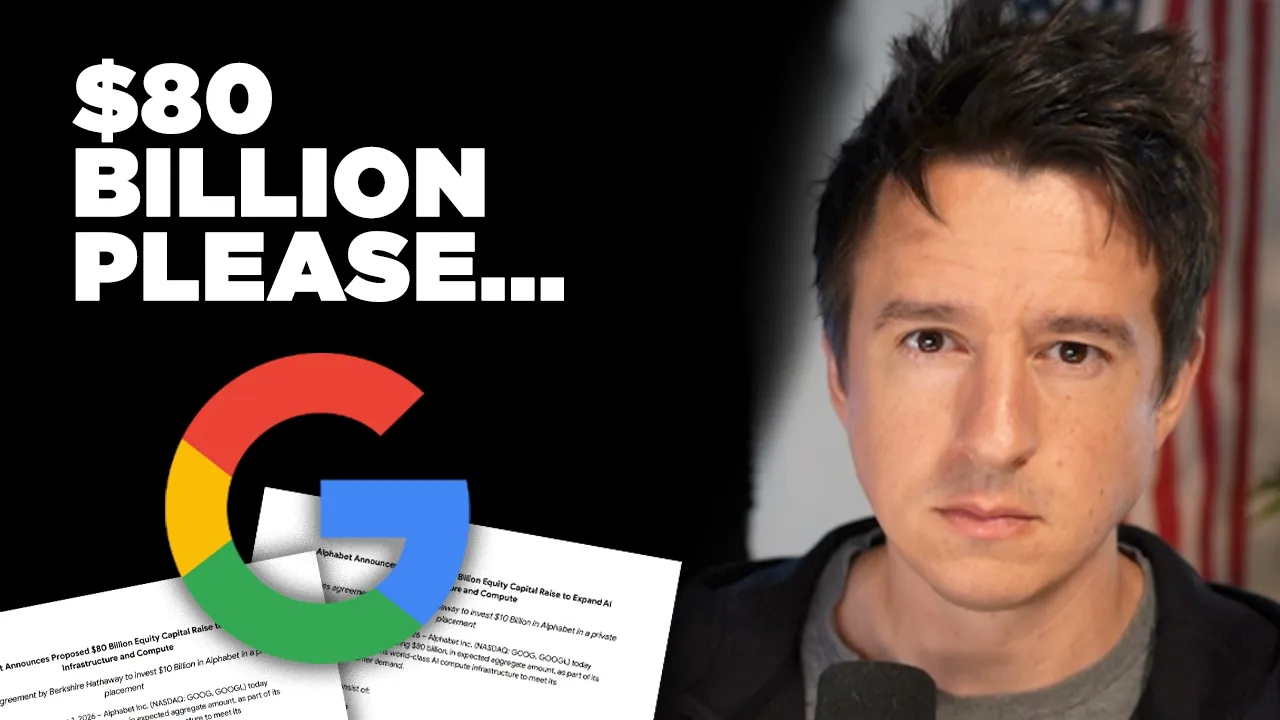
Today on the Joseph Carlson show, this is not something you see every day. Google is seeking $80 billion for an AI buildout. They're actually raising capital through selling shares delution. This is incredible. This is one of the biggest equity raises I've ever seen from a publicly traded company. In fact, it may be the biggest ever. And we're going to be going over all of it. A lot of people have this news wrong. There are tons of tweets that are giving analysis and takes on it and hot takes on what Google's doing. Many people say that this is a time to be bearish, that what we should be doing is being scared of what Google's doing now. And I don't believe that's the case. In fact, this is one of the most strategic moves that Google has ever done. And we'll be going into all of it this episode. Now, of course, we have a lot of other news to get into. For example, Tom Lee recently went on to CNBC and he upped the ante. He said that the stock market may go on to the biggest run that we've ever seen over the next couple of years. We also have news that two YouTubers are turning the box office upside down. We have two YouTubers that just made the movie The Back Rooms and Obsession, and both of them are massive hits at the box office. In fact, there's now Variety and different magazines saying that YouTubers are taking over Hollywood. What does this mean? We'll be looking at this as well. And then finally, we get to the fail of the week, which in this case is Andrew Left, the infamous shortseller. He's taken contrarian positions on many companies. He was found guilty of scheming to manipulate stock market via media campaigns. This short seller, Andrew left, will very likely face jail time and a lot of it up to 25 years based on this conviction. But what did he do? Was it so bad? We'll be going over the whole case in this fail of the week. Now, just a quick mention. If you haven't tried out qualum.com, give it a try. We're always adding new things. Qualrum, of course, is the stock analysis website. It's this one that I constantly use because, well, I created it and I own it and I think it's really easy to use. It just displays all the fundamentals of a company in beautiful visual format. It has an advanced chart builder. It's super easy to use. You can mix and match metrics and add any of them that you want at any time. It has a full earnings week calendar. You can click in and learn about any company's upcoming earnings. And the newest addition in Qualrum is Qualrum Studio, which allows you to click in and see in-depth video research on different companies. This is a whole Netflix-like library for investors. For example, I just recently did an entire episode on Door Dash. This is an hour-ong deep dive on this company as well as other ones like my top stock picks. This goes over 10 different ones that we do analysis on. Uh we have a recent video here about saving. A lot of people thought this one was so good that I should make it a public episode. So, I've been considering that. There's literally dozens of videos you get access to and new ones added every single week. And that's all included in the single membership. So, you can try it out now risk-f free at qual.com. Now, to kick things off, we have to jump into what I believe is some of the biggest news that we've seen all year. This is massive and it's actually unprecedented. We have a company the size of Google, the balance sheet of Google, the financial strength of Google that doesn't have enough money. And in fact, they don't have enough money to the extent that they're going to the equity markets. They're going to delution to be able to raise money. The Wall Street Journal says that Google's seeking $80 billion for an AI buildout. From the Google press release themselves, this is from Google themselves. They say Alphabet announces a proposed $80 billion equity capital raise to expand AI infrastructure and compute. Now to put this in simple terms, this means that Google is willing to dilute the shareholder to issue more shares worth $80 billion so that they can transfer those shares into cash and to be able to use that $80 billion for compute and infrastructure and whatever they want. They have to dilute the shareholder to be able to get this cash. And immediately this raises a lot of questions. For example, Google is one of the most profitable and largest companies in the world. Typically when we see companies that are diluting shareholders, you think of a much smaller, less profitable company, one that hasn't reached its operating leverage and its scale and its profits. Those are typically the ones that are diluting shareholders. But Google is neither small nor unprofitable. Google is massive and highly profitable. In fact, Google is one of the most profitable companies on planet Earth. To illustrate this, we can take a look at Google's net income. This really shows off how much money this company produces every single quarter and every single year. If we look at the net income on a trailing 12-month basis, this is what it looks like. It's up to 160 billion. Now, part of this is because of a one-time investment recognition. If we even normalize from that, Google still makes on a normalized basis over 130 billion per year. 130 billion every year in net income. Google's operating cash flow was 174 billion in the trailing 12 months. That puts them as one of, if not the most profitable company in the world. They'll probably be beat by only Nvidia this year. So Google is massively, massively profitable. Like this is a company that makes the money that nations do. It it is an insane level of profitability yet they don't have enough money and that again is a headscratcher. Why does Google need to raise money? Now the reactions to this were equally perplexed and in many cases a lot of people were concerned about Google. We have people like this Gary Marcus on X saying why things will eventually fall apart. Everybody, even Google, seems to be treating AI as if it were some kind of winner take all competition like web search was in which Google can take over 95%. But everybody is building essentially the same technological solutions and essentially the same data. So there is no mode. He continues on showing how Google is overspending and they're not going to have good returns. We have other people on Twitter sharing these tweets of of skepticism and shock. We have liquidity here saying that Google is raising $80 billion in equity a week before SpaceX is trying to raise 75 billion a few months before Anthropic and OpenAI are trying to raise 100 billion from investors. And you're laughing. This is a cataclysmic exit liquidity avalanche. And then he has the meme of the big short of him Michael Bomb in this saying that it's a bubble. Jerry Capital saying Google equity raise summarized and it's a a meme of the joker burning cash. And there's more and more of that. Twitter and X are full of people that are completely shocked at this. People that are saying that this is the end of Google. It's the beginning of the end. It's a bubble and everything is going to come crumbling down. But as I've done many times in the past, and it will come as no surprise to you, I am once again going to defend Google. No, I do not believe that Google is lighting money on fire. No, I do not believe that this is the beginning of some big bubble that's going to burst. And no, I do not believe that Google's spending hundreds of billions of dollars to build an undiversified nomote business. All of that is wrong. What's going on here actually makes Google a much better investment. And I'll be going over why. Now, first of all, to look at my position with Google, I think is important. I have here in the passive income portfolio, which I made it so you can just see all the holdings here. So, this is the passive income portfolio, and I have a position in Google here. It's a $130,000 position with 65,000 of that being in the green. So, this one's up over 136%. So, Google in just that one portfolio is already a fairly large position, but that's not the only place that I hold it. I also have the story fund and I have another large position in Google here. $85,000 worth and 57,000 of that is gains. This one's up 382%. So, when I look at this combined, Google's around a 16% position. It is fairly large. It's around a4 million dollar position with over half of it being gains. And I've held this company for years and I've consistently defended Google over and over again. And I believe this is another case worthy of defending Google for a few different reasons. First of all, we can actually look at what Google's doing here. They are raising $80 billion in equity capital to expand AI infrastructure. So, they're basically diluting shareholders to make it so that they have more cash to invest in AI. And right off the bat, that tells me a couple things. One of them is that Google's belief in AI is absolute. It is without question. They don't just simply have a suspicion. They don't simply have some speculation that AI is a real thing. No, they believe it 100%. They're 100% convinced. So, if you have any type of speculation or any type of question that AI is going to have attractive returns and it's going to have demand, Google's already a bit ahead of you. It's no longer a question in their mind. They have a million data points at their business, maybe a billion data points. Of course, they have search, they have Gemini, and then they have their massive cloud business that they have tons of enterprise clients. And every single data point they have, their entire business is telling them they need more capacity. They need more compute. They cannot fulfill on all of the projects they're trying to do across their vast empire without the capacity. So, to them, this is not a speculative bet. It's not something that they're rolling the dice on. Sundar Pachai did not wake up and say, "You know what? It seems kind of risky, but I think I'm just going to roll the dice, invest $80 billion into AI, and hope things turn out well." That's not what's going on here. They already know. They already have the answer. What they're signaling to investors here is that Google is absolutely certain of AI demand without any question. There is no way Google would be putting this much capital at this scale and this size without that absolute certainty. And this isn't something that was decided overnight either. Google has for a long time period their management has said and signaled over and over again that right now their biggest concern by far is the unprecedented demand for compute capacity. And the biggest concern for Sundar Pachchai is not being able to fulfill that compute capacity. He's repeatedly mentioned this. In fact, Sunder Pachai said just in February of this year, quote, "What keeps us up at night, we've been at this AI first trajectory for over a decade." Pchai said, pointing to years of investment in custom chips like tensor processing units, the TPUs. He went on to mention that this current momentum in this demand presents a unique challenge. Quote, "The top question is definitely around capacity." Pachai said all constraints bet on power, land, supply chain constraints. How do you ramp up to meet this extraordinary demand for this moment? He says that we got our investments right for a long time and we've done it all in a way of driving efficiencies and doing it in a world in a worldclass way. Google has been in the right place at the right time over and over again. Look at their investments that they did in Whimo. Were those poorly illustrated investments? No, they did quite well. Look at their investments that they did in artificial intelligence and models. Chachbt got the release first, but Google had been working at that for a long period of time and now Gemini is one of the top used models. Look at their investments in TPUs. Google is decades ahead of that and comparison to companies like Microsoft. Another present investment for Google. Sundar Pachai has been on top of this for a long period of time. And right now he feels like the unprecedented demand in AI is their single biggest constraint. It is the single biggest thing preventing them from winning this entire race, from consolidating an enormous amount of AI demand under Google. Now, you may question whether or not Sundar Pachai is right. What if this is just a bet that they're getting wrong? But in Google's mind, what they're seeing right now as they're running their business is that they have all of the tools, they have the TPUs, they have the best models, they have the cyber security, they have all the infrastructure, they have all the distribution, but they do not have the compute capacity. And Google's in a situation where they're turning away great customers, saying, "You know what? We can't take your money because we don't have enough capacity to fulfill your demand. They are turning away enterprise clients because they can't provide enough capacity." Can you imagine how frustrating it is as a business to sit there with all all this planning that you've done, all this research, owning the best models, having the TPUs, having everything already baked to this point. It is ready to go. But then you don't have the physical infrastructure to be able to back up the unprecedented demand. That must be incredibly frustrating. It is giving away a massive advantage that you've built for decades. Senator Pachai does not want to do that. He believes it's critical not to do that. So they are building and they're building fast. Google is wanting to build faster than Meta. They're wanting to build as fast as Amazon in this AI demand. And to do this, they need to raise a lot of cash. And that brings us to the next big question. A lot of people are looking at this saying, "Well, if Google makes so much money, $170 billion in operating income, over $130 billion in net income, why can't they just afford to do this themselves?" And there's a couple reasons why. First of all, they outline this in this segment here called investing in a balanced way. AI is driving an expansionary moment for Alphabet. The company is experiencing strong demand for its AI solutions and services from enterprises and consumers at levels that are exceeding the company's available supply. By scaling its investment, the company seeks to expand its foundational infrastructure infrastructure to support the significant growth opportunity ahead. During its Q1206 earnings call, Alphabet announced that its 2026 capital expenditures are expected to exceed 180 to 190 billion and that it expects in 2027 capital expenditures to significantly increase from 2026. Now, let's just look at these numbers here. Yes, Google makes like $170 billion in operating income. It's a lot of money, but the number that they said they're going to spend this year is 180 to 190 billion. That's more than what Google makes. They're spending that in 2026 alone. Then they mention in 2027 they expect this number to go up significantly. They literally say significantly. We don't know what that is, but it's going to be a lot higher. These numbers, by the way, in and of themselves are already way higher than analysts expected. Analysts were expecting numbers that were in the range of 130 billion and they're already at 180 to 190. And they're saying that this number is going to go way higher in 2027. Google makes a lot of money, $170 billion, but they don't make 200 billion per year. They don't make $250 billion. So Google quite literally cannot afford upfront to pay for all of these investments. They have to get money in other places. And when a big company like Google's raising money, there's two ways to raise it. You have the debt markets and you have the equity markets. And we can look at what Google has done. Google has already tapped the debt markets. They've already tapped it dry. In terms of debt issuance over the last year, Alphabet has raised $85 billion of debt across six major currencies and markets, bringing its total debt balance to over hundred billion. So the people saying, why doesn't Google just raise more debt? Why are they diluting shareholders? They already have. They've raised $85 billion of debt in just the past 12 months. If they went ahead and raised another $80 billion, they would have $180 billion of debt, which is a lot of debt, even for a company the size of Google. That's a lot of debt. And unfortunately, when you do that, it makes your balance sheet, your debt rating go down. They don't want to raise that much debt. They don't want to pay that much interest. Furthermore, there's a lot of analysts looking at this and banking analysts saying that the debt markets in general are somewhat tapped. Like it's a lot harder to get debt right now than it was previously cuz lenders are being a lot more strict with their terms. So Google got debt already. They got $80 billion of it. While the debt markets were good, now that the debt markets are sour, they're turning to the equity markets. And this is another thing that Google's doing in an incredibly intelligent way. They're getting ahead of the equity markets. And by that I mean that Google is now raising $80 billion of equity with Delilution right before SpaceX goes for their IPO. And wouldn't you know SpaceX IPO, the 5% that they're wanting to raise from the public is around $75 billion. So Google's saying, "Hey SpaceX, before you get to market and get all that juicy money from all the public investors, we're going to get there first. We're going to dry up that liquidity before you have access to it. We're also going to get there before the anthropic IPO and before the OpenAI IPO. Google's going to be first to the equity markets, not last. This means that Google has the advantage. They're beating all these massive companies looking for public money before they get there. And Google will likely be able to raise this money easily again because investors aren't already putting money into SpaceX, into OpenAI, and into Anthropic. What Google's actually doing here is more of a preemptive strike. They are going for the equity markets before they have been tapped by all these other major AI companies like the SpaceX, like the OpenAI, like the Anthropic. We know that these companies are going to be doing staggering level of IPOs, raising hundreds of billions of dollars in aggregate. There is a finite amount of capital available to invest in AI companies. Google knows this. They know that if they wait too long, they'll be the last in line trying to raise capital from a market that doesn't have a lot more capital to give. They will be sucking all the oxygen out of the room for these other IPOs. Not only helping Google, but damaging their competition and their ability to fund these competitive threats in the process. See, what Google's doing is not only advantaging themselves, but they're disadvantaging these other companies hoping to raise capital as well. They're making it more difficult by sucking away all the available capital before they even have a chance. This is a double whammy. It is a preemptive strategic strike at their competitors. Google is saying that we are going to invest endlessly in AI. We are going to make it so that open AI and anthropic struggle to gain any level of profitability and pricing power. We're going to build out a massive moat because Google has something that these other companies do not have. See, Google is not just a commodity reseller of AI. They're not a company that just spun up some servers and created a server farm and is reselling AI. Google is a vertically integrated enterprise of AI features from the security to the distribution to the TPUs to every part of this. They have the entire layer as well as Google has many ways to benefit from this personally. So Google can soak up all this capital build out this massive moat with artificial intelligence distribution. They can infuse it in all the features throughout all of their business at the same time making it so that they have a highly differentiated product. At the same time, they are sucking up both institutional and retail money in the process. This is both a defensive and offensive move by Sunundar Pachai. When you really think about what they're doing here, it is strategically brilliant. It's something that you would have to plan for, but Google seems to have already done this and they're executing it well. Google already knows that they have a massive lead in this category. They know that all they have to do to protect their lead and protect their moat is keep momentum going. Keep the ball rolling. Keep this snowball getting bigger and bigger and definitely don't let it crumble to pieces because you don't have capacity. That'd be a very stupid reason to give up the lead. And Google knows this. They say that their AI momentum is picking up pace. Alphabet's planned investment will support its business momentum, including Alphabet's revenue growing 22% year-over-year to $ 110 billion in Q1. That's over 110 billion in a single 3-month period. Google search and other revenue grew by 19%. Cloud revenue grew 63% year-over-year in Q1 with backlogs nearly doubling quarter over-arter to more than 460 billion with approximately 50% expected to be recognized as revenue over the next 24 months. Google's subscriptions Google reached 350 million paid subscriptions with Q1 2026 representing the company's strongest quarter ever for consumer AI plans. Google now has over 8.5 million developers building new experiences with its models monthly and its first-party model API are processing 19 billion tokens per minute. A six time increase year-over-year. The metrics are staggering. And these aren't the only ones. When you actually look at what's going on with Google, like when you literally just visually look at it, it literally looks fake how much demand they have. Their demand is outscaling their revenue growth. it's outscaling what they're able to provide at an unprecedented pace. And that's why they need more cash today. I think it's good to just take a minute and simply think about what's going on. Instead of looking at the headlines and becoming concerned that they're selling shares and it's a lot of money, I really want to just take a step back and consider for a minute simply what's going on. Google believes that there is an investment they can make that is so good, it's so good that they need to literally dilute shares of their own company to raise equity to make this investment. That's how good it is. And that's an investment that's so good that they've already raised $80 billion by going to the debt markets. And that's an investment that's so good that they've already spent all of their operating cash flow and their net income. All their discretionary money is being spent on this investment. That's what Google's doing here. So, in terms of whether or not they believe this investment is worthwhile, that shows you where they stand. They're willing to do whatever it takes to make this investment and make sure they continue to lead in AI. And I have full reason to believe them. Like we highlighted, every metric for Google is already showing that this is paying off. Buffett once talked about the ideal business. He described what he believed was the perfect business. And this is what he described. This is a hypothetical of Buffett's ideal business. >> Sure, it's a good question. The the ideal business is one that earns very high returns on capital and can keep using lots of capital at those high returns. I mean, that becomes a compounding machine. >> So, those are both important ingredients. It's not enough just to have high returns, but you have to have high returns with a lot of capital invested. And that's where you get the compounding machine. So if you have your choice, if you could put a $100 million into a business that earns 20% on that capital, say 20 million, ideally it would be able to earn 20% on 120 million the following year and 144 million the following year and so on that you could keep redeploying capital at these same returns over time. But there are very very very few businesses like that. the really unfortunately the good businesses you know take a Coca-Cola or seas candy they don't require much capital and incremental capital doesn't produce anything like the returns that this fundamental return that's produced by some great intangible Google historically was one of these companies that earned so much more money than they could adequately reinvest. So what did Google do during that time period? Well, they just bought back shares. They just returned it back to the shareholder. They said, "Hey, look, we have these profitable businesses. We generate way more cash than we need to adequately reinvest back in our business. So, we're going to just return all this extra back to you, the shareholder." And they did that for a long period of time. Google was a cash flow generative, highly profitable, cash returning business for years and years and years. But then something happened which made the equation flip. Google has a unique opportunity to invest enormous amounts of capital today at what they believe with high conviction will be very attractive returns for their shareholders. Now again, Google's not just racing out looking for investments. They're not just racing out throwing money left and right willy-nilly hoping that it turns out well. This is something that just happened. It was fate. It was fortune. It was a lot of preparation and building out the TPUs and building out the AI models. But having this massive influx of AI demand was also just a part of fate and Google is wellprepared to take advantage of it. They're now saying once we finally found something that's in our wheelhouse that we know very well that we don't have to look outside of our business to earn high returns. We're not just doing acquisitions. We're not buying some random company with very low prospects. This is something that happened that's a one-time thing. The AI influx is a dynamic change in the market. We have a huge advantage here and a huge opportunity to invest increasing amounts of capital and get very attractive returns. This is the ideal business that Bergkshire is looking at. And funny enough, even though Warren Buffett said that years ago, now they're investing $10 billion in this ideal business. Bergkshire obviously believes that the money that they're investing today will have attractive returns. And I believe that Google's intuition here and the management conviction is correct. They are likely to have incredibly high barriers to entry for their AI solutions. Although companies can spin up server racks, there's very few that have the entire stack like Google. They have the TPUs, that have the security, that have the distribution. Google's also a very uniquely positioned company to have the billions of users in distribution natively to integrate all of this computational power within their services. They're already giving you previews of what they can do already just with their basic applications like how AI's integrated into YouTube. It's integrated into your documents, into Drive, into PDF viewing, all of this type of stuff. But there's far more that they can go. There's far more runway. So Google is in a position to have a massive capital barrier mode. They're in a position to get all this capital before their competitors with XAI, before their competitors with Anthropic or with OpenAI have access to this capital. They're in a position to build out an incredibly powerful full stack AI solution. Google is a very uniquely positioned company to benefit from this. So, as far as I'm concerned, I'm staying in Google. Now, moving on, let's get to some news. Here we have Tom Lee recently going on to CNBC and explaining why he believes that the next three years will be the best years for investors in the stock market. Let's go ahead and listen to his reasoning. >> Well, I think a couple things are coming together, Joe, um that are going to really support a few things that may only happen like once in our lifetime. One is I think this the US economic growth rate is actually starting to step up. Um you know in other words we could grow at 4%. And for a you know a mature largest economy in the world to start to accelerate growth that that's pretty um astounding. Um the second is the US is one of the biggest exporters of the most important tool in the next 10-15 years which is AI products and that means we are a net essentially exporter of a highv value product and there's so much capital I think misallocated today because so much of it is held in private alternatives but it's going to move into the public market. So I do think that plus the demographic tailwind of millennials and Gen Z uh adding to the workforce but then also beginning to inherit generational wealth. I think that is going to set up for after 2026 perhaps you know like you know over the next 2 years some of the biggest gains of the stock market in our lifetime. >> So Tom Lee points out a couple important things here. One of which I completely agree with which is the United States has become a massive exporter of AI which if you look at historically why the US has done so well if you just look at the US economy and the stock market and why it's really thrived a lot of it has been software the United States has been a massive exporter of software services which are high margin very profitable consistently build services now we have the SAS apocalypse software stocks are going down software is the old news. But then we have the new thing. The new shiny thing, of course, is AI. In this case, AI is a very real product offering enormous amounts of value. It's so powerful that it's literally disrupting many software companies. And which country is investing by far the most into artificial intelligence? Well, the United States is. It's not even close. And then the last thing that he points out, which I again agree with, is there is going to be a lot of generational wealth, a lot of pass down wealth that should spur economic growth. I believe that younger demographics spend money in different ways. They spend on different services than older demographics. So, you're going to see a lot of boom. And I believe a lot of stock market companies do well as a result of that. So, even though this seems a little bit far-fetched to have the best years of our life ahead, it also doesn't seem impossible. With what's going on with AI today, the massive influx investment in capital, I believe that there is a chance we'll have incredibly good gains in the stock market over the next three years. and I think it's a great time to stay invested. Now, next we get to news of what's going on in Hollywood. This is something that I I think a lot of people are overlooking. This is a dynamic change happening to movie making and it specifically has to do with YouTube. YouTubers seem to be taking over the box office, especially over the past week. AMC had its best month ever, the most traffic ever had in history. Cinemark also did exceptionally well. These movie theaters are pulling in the mass amounts of people to see movies. But it's not for the new Mandalorian movie. It's for movies that YouTubers are making. Backroom is a horror film born out of 4chan creepy pasta and produced by around $10 million is what they spent to produce this film opened to an extraordinary $81 million. Smashing records for distributor A24. And Obsession, a horror film made on a budget of 750,000 gross 26.4 million in its third week after release, a 10% jump from the previous weekend. and crossed $100 million domestically. So again, this movie Obsession, it cost $750,000 to make and they're now grossing well over $und00 million. Now, I saw Obsession the first weekend that it came out. I was looking at movies to watch. I'm not a huge horror fan, but I'll I'll watch them if they look interesting enough, and this one had an intriguing premise. I saw a couple of the commercials of them like looking at this wish gone bad and then I looked at the ratings on it and notice right here this is Rotten Tomatoes. Now I get it. The critics can be wrong sometimes. The users can be wrong sometimes as well. But when you have a 96% critic and a 94% user, that's a pretty good consensus that this is likely a a very well done movie. And it was. Obsession was one of the best horror movies I've seen in a long time. It was original. And even though it was created for $750,000, there's no way that I thought this movie would be made for that cheap. It looked good. It looked very good. In fact, I would say that this movie looked better aesthetically than many movies shot for like a hundred million. I don't know how they did it. The lighting, the ambiance, the acting, just everything looked really upclass for a movie made for less than a million dollars. Now, the incredible part of this is that this movie that again costs less than a million dollars to film, is actually doing better than The Mandalorian and Grou, a Star Wars spin-off with a $165 million price tag. That one came in third after the two YouTubers films. It tumbled 70% in its second week, and its opening weekend, it was the lowest ever for a Star Wars film under Disney. So, look what's going on right now. The company that has Star Wars, one of the biggest pieces of IP ever. Like it seems like bulletproof IP, just came out with their new movie, which is a new one in a long time, The Mandalorian and Grou. They spent hundreds of millions of dollars to make it. And they're being outplayed and outmatched. They're being beat in the box office by two YouTubers movies that are both created for less than $10 million. One of them created for less than 1 million. That is an insane underdog story. So, I believe this is the time that Hollywood will wake up. They will use this as a shocking way of now turning to YouTubers original stories, lowerbudget films that feel very good because they're led by storytelling, acting, and character development. They're not led by CGI and AI explosions. These movies were entertaining because of the story they told, because of the pacing, because of how they were directed. So, I believe we're going to see a lot more of this. Hollywood is going to be turning to YouTubers to make more of these movies, and I'm all for it. Now, moving on, we get to the fail of the week. In this case, it is Andrew Left of Citron Research. He has been found guilty from scheming for scheming to manipulate the stock market via media campaigns. Andrew Left used his TV appearances to disguise his intentions, manipulate the stock market, and pat his pockets, said First Assistant United States attorney. So, the government goes after Andrew Left. They catch him and they say that you've been really bad at manipulating the stock market. That's illegal. So, we're going to throw you in jail. And at first glance, you may just look at this and think, "What did he do that was so bad? Did he just pump his stocks? Was he just bearish on different companies and that's why they're throwing him in jail?" That's not really what's going on. What Andrew actually did was much worse. One of these examples is very damning. In 2018, Andrew Left wrote a portfolio manager about Nvidia Corp. He said, quote, "Do you want to make some fast money? Put together a thesis of why Nvidia is oversold. We can destroy it. Just read the analyst note from this past quarter and assemble your best ideas. Later that morning, Left took financial positions in Nvidia, including a short-dated call options that expired three days later. Left then promoted Nvidia as a favorable investment to Citron's Twitter account, stating, "Cit buys Nvidia." This is the first time in two years the stock has an appealing riskreward to investors. We see 165 before we see 120. Despite his representation that he expected Nvidia share price to rise to 165 less than two hours after announcing Citron buys Nvidia left sold all his pre-weeted positions. Nvidia was trading within a range of 150 to 151 and he sold for a profit of $960,000. So Andrew left says Citron's buying Nvidia and I have a price target that's like $20 higher and I'm very bullish on it. It's not going to go down. And then within 2 hours of that announcement, he cashes in on short-term options for a million-doll gain and is completely out of the position. That is textbook market manipulation. He had no intention of keeping Nvidia and riding it up to his price target. He was just trying to bump the stock up so he could immediately exit and sell into the liquidity that the market was providing. And Andrew Left repeatedly did stuff like this. He would take short positions and he would say that the stock is going to go down. But then immediately after releasing that news that he believes the stock was going to go down, he would immediately close those positions for a quick gain. And he wouldn't tell people that he had exited those positions. This is exactly the type of behavior that is short-term manipulation. Andrew Left was fine making money from his followers at their expense. He was fine trading against them, having them buy into the liquidity of a position he was selling. So he'd make money for himself at the expense of his followers. So, this is an unfortunate case for Andrew Left. It shows that even when you can make a lot of money in the short term, the $20 million or so that Andrew Left has made is just not worth it. Manipulating the stock market, trading against your followers is just not worth it. It's a bad game to play. It's completely dishonest. And even though the government isn't perfect at applying these rules equally, they are going after these people doing this. And I think that overall that's a good thing. That's it for this episode. See you in the next one.
Commentaires 0
Connectez-vous pour rejoindre la discussion.
Se connecterAucun commentaire pour l'instant. Soyez le premier à partager votre avis !