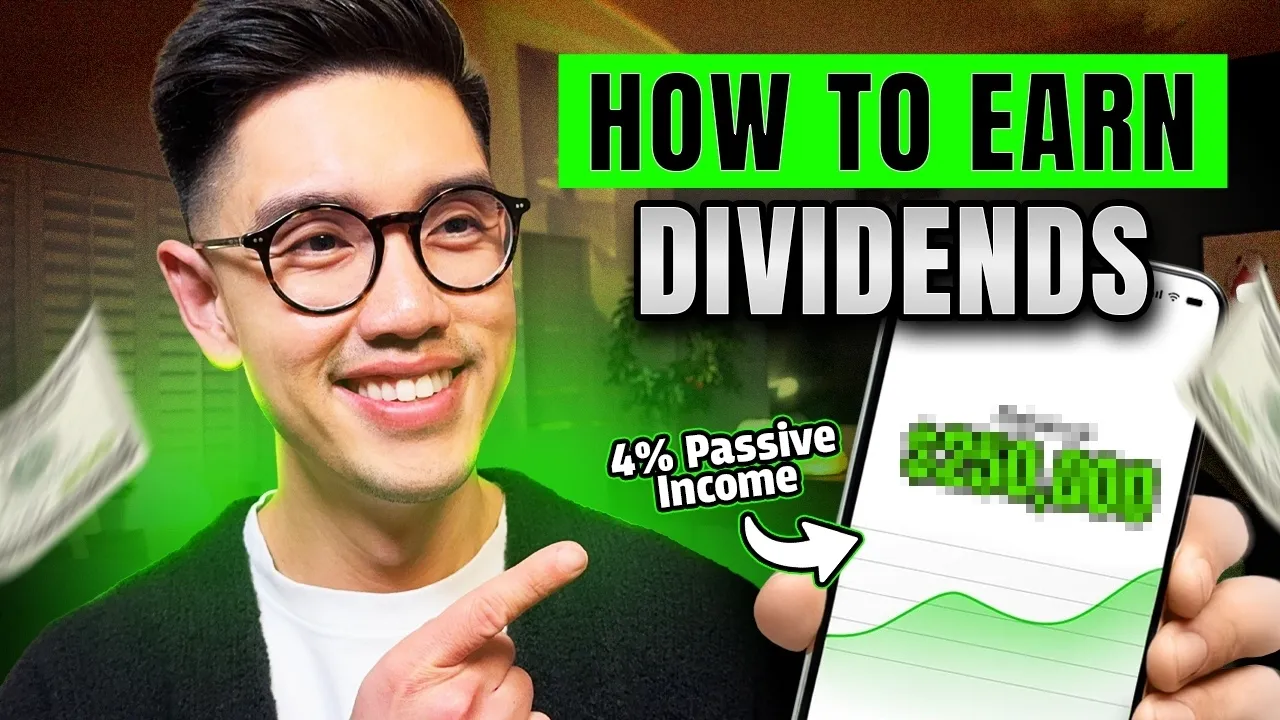
Dividend Investing and 4% Passive Income Explained

- Rendement de la vidéo
- +5,59%
- Appels
- 1
- Achat / Vente
- 1 0
- Publié
Recommandations
L'entrée est le cours de clôture de l'actif à la date de publication. Le cours actuel est la dernière clôture enregistrée.
-
Entrée $155,40 05 juin 2026Actuel $164,40 24 août 2026Résultat +$9,00
If you have no clue on where to start with investing in dividend-paying assets, some of the most popular dividend-paying ETFs are SCHD, VYM, SPYD, DVY, and HDV.
Transcription Complète
So, everyone talks about growing their portfolio, their Roth IRA, or their taxable brokerage accounts to maybe 1 million, 2 million, or even 5 million dollars. But, the problem is no one really talks about how to actually use that portfolio to pay you. How do you actually get income from your investments? So, in this video, I'm going to break it all down and show you step-by-step on how you can get paid from your investments either through dividends or even using the 4% rule. How to take out that income, how to withdraw from your accounts. So, I'm going to share my screen here, and again, if you haven't downloaded my worksheets, my study guide, I highly recommend that you do so. I left the link somewhere on the screen or down in the description so you can follow along. So, first of all, let's talk about what is a dividend. Well, essentially, a dividend is something where whenever you invest in a stock, a company, or an ETF that holds a whole bunch of companies, the companies will say, "Hey, thank you for investing in us, and in return for your, you know, being a share holder, I'm going to pay you a couple of cents or a couple of dollars per share that you have invested in us, and I will pay you out every quarter or so, okay?" So, when you are building out your dividend-paying portfolio, if that's your goal, okay, there are two things that you want to look at, okay, two main things. The first is you want to make sure that the dividends are in between around 0.50% to 4%. I talked about this in the other video, and generally, this is kind of like the sweet spot. So, if you have no clue on where to start with investing in dividend-paying assets, some of the most popular dividend-paying ETFs are SCHD, VYM, SPYD, DVY, and HDV. I listed it all here. It's all in my Google Sheets where I linked it all in my Google Drive, so feel free to check that out. But, essentially, you want to make sure that you are investing in something that pays you a high enough dividend yield so it can fund your lifestyle. So, let's use some actual numbers to see how this looks like. So, for example, we're using that $100,000 example where you started investing $100,000, you are very disciplined, consistent with contributing money bi-weekly, monthly into your IRA, into your taxable brokerage account, maybe even in your HSA for the next couple of years, and you grow it to $2 million. Great. Just to keep the numbers nice and round and simple here, okay? And that's what I'm trying to do here because this is just for educational purposes. If we get a 4% yield with your account, this means that you're able to withdraw 80,000 or collect 80,000 dollars of dividends per year. Pretty good. Now, if we were to use an actual example, let's just say that we have SCHD, right? So, let's say that with SCHD currently, let's say the dividend yield is around 3.3%. What does this mean? Well, it just means that for every $100 you invest, you get around $3.30 of dividends each year, okay? You can divide that by four, and that's going to show you what the quarterly payout is. So, if you want to check the dividend history, the dividend payouts, all these numbers, then you can go to this dividend analyzer here on stockanalysis.com. I linked it on my study guide, so you can go check it out yourself. But, essentially, there are two main things that or actually three main things that you want to focus on. The first is the ex-dividend date. So, this is the date where you need to make sure that you hold onto these shares before this date so that you get paid the dividend on the payout date. Okay, so you can't just buy dividend paying ETF or a stock and just go, "Okay, I'm going to get paid the next day." No, no, no. You need to make sure that you hold onto these shares, purchase these shares before the ex-dividend date so that you can get paid out on the next payout date. So, this is again the ex-dividend date that you need to be aware of. The second thing that you also want to focus on is how much cash are you supposed to collect, right? So, it's going to tell you right here. So, right here for every one share, uh you'll get paid around 25, 26 cents per share, okay? And the last thing that you want to know is the pay date. So, if you hold onto the shares before, say for example, March 25th, 2026, the pay date where the dividend is going to land into your brokerage and your portfolio is going to be March 30th, 2026. Again, check out this website, it'll show you the dividend history of everything, so you can type in your ticker symbol and see when the ex-dividend dates and your pay dates are, okay? Great. So, remember, that is the first thing that you want to look at whenever you're investing in dividend-paying assets, what the dividend is, what the payouts are, ex-dividend dates, and the payout dates. The second thing that you want to focus on is the actual asset appreciation. A lot of people neglect this for some reason because they'll say, "Okay, I have this dividend-paying ETF asset that gives 10%, 20%, 30% a year." And they think in their mind, "That's amazing." However, if you take a look at the actual asset itself, a lot of times, you'll see that the price of the share actually declined over time. So, this is something that you don't want. You want to make sure that the dividends are increasing, right? That the dividend payouts are consistent, that they are increasing over time, and that the asset itself is also increasing, too. So, for example, if we take a look at SCHD, okay? You can see that over the last 5 years, there has been a 28, 30% growth, okay? So, it's been on a little bit on the slower side, but it still is going up over time. If we want to take a look at the nitty-gritty details, again, you can go to YahooFinance.com, and you can check the performance, click on performance, and you can see all of these numbers here. You can see the one-year performance, it was around 28% for this year. A three-year performance, 14% per year, okay? The five-year performance, the average yearly performance, it was around 9% and the 10-year performance, which is around 12 to 13%, which is pretty good per year, right? And again, you can also see the historical returns here, too. So, I like to relate this to real estate investing, okay? Because as you've known, house prices have gone up, right? So, when you say invest in a home, in a piece of real estate right now, sure, the house might be worth $500,000 right now. I'm just using round numbers for educational purposes, just for an example. And you want to rent out your home for any collect $1,500 of rental income per month, right? So, this is very similar to dividend investing where you buy stocks, you buy ETFs for $500,000 and you're able to collect that dividend income per month or per quarter or so. Now, here's the thing. With real estate investing, of course, the asset itself, the home itself is also going to appreciate over time. So, I know this might sound silly now, but that $500,000 home that you see on Zillow, that you see outside in your neighborhood, in the next 10, 20, 30, 40 years, it's going to appreciate in value to maybe even $2.5 million. And not only that, that rental income is also going to increase. It's not going to stay at $1,500 a month. It's going to increase to maybe even $7,500 a month. So, when we are investing in dividend-paying assets, it is important that, of course, we want to make sure that the actual asset itself, the home itself is increasing over time and that the dividend payouts are also increasing. So, how do we check this? Well, if we take a look at the dividend analyzer here, you can scroll down to I'm just going to use this as an example. Back in 2021, one share of SCHD paid around 19, 20 cents per share. And then you can see, okay, in the next quarter was 20 cents, and then 17, 23 cents, 21 cents. And if you keep going all the way up to 2025, 2026, it's around 25-26 cents. Has the dividend yield, has the dividend cash payout increased over time? Yes, it has, right? The actual cash amount has increased. So, we want to make sure, again, the asset appreciation increases and the dividend payouts also increase alongside with it. Okay? So, hopefully this makes sense. Now, of course, this is one form of payouts, and the second form of payout, which I really love, is using the 4% rule right here. So, let's use a $5 million portfolio as our example, because that's what I talked about in one of the previous videos, where that is your freedom number. And that's what you want to retire with. So, once you hit that $5 million portfolio, again, just using round numbers here just to keep the math simple, you can actually sell 4% of your portfolio each year. And see, this is where it's really powerful compared to why stock market investing, ETF investing is very powerful over, say, real estate investing, where if you invest in real estate, you can't exactly just sell a wall, or sell a door, or sell a doorknob, or sell a kitchen. You actually have to sell the entire thing. But, with investing in stock market, in ETFs, you can sell a portion of it. You can sell your shares. So, instead of selling 100% of it, you can sell 4% of it, if that makes sense. This is why I gravitate towards stock market investing than real estate. So, with your $5 million portfolio, you can actually sell 4% of your shares, which is going to amount to around $200,000 per year. That's the money that you can take out, withdraw, and use for your lifestyle. This is what a lot of wealthy people do. Whenever they need money, they sell their shares, right? And that's what they use. But, with the 4% rule, this is where it's pretty powerful here. Based on the Trinity study that you can Google, 4% is generally the safe range, the safe percentage of where you can withdraw your money while letting your portfolio continue to grow over time. Because we know that the average stock market is around 10% average annual returns, it's usually between 7 to 12%. Again, using round numbers, we'll use 10%. If you were to sell 4% of your portfolio, you can still allow your portfolio to grow the rest of the 6%, right? 4 + 6 is 10, right? So, hopefully that makes sense. So, this is very analogous to planting an apple tree in your backyard. I talked about this in the another video where I said, "If you were to plant an apple tree, it grows to a really big size, starts bearing fruit, you're able to eat the apples, but if you want to hit traditional fire where you just want a whole bunch of abundance, you just want to have a portfolio that keeps growing and growing, then you can start eating the apples, and you're going to recognize that as much as many apples that you continue to eat, you're not able to eat all of the apples on the tree because it just produces so much fruit, right? So, you just live in a life of wealth, in a life of abundance, right? So, this is where the 4% rule really stems from where you grow your portfolio to a point where it's just giving, producing so much fruit for you so that you can't use it all, okay? Now, let's take a look at some numerical examples because again, I am a teacher at heart. I used to be a math teacher. Let's take a look at some of the actual numbers. So, what does this actually look like? Well, you can use this with any numbers. I'm just using $5 just as an example. In year one, let's say that you get $5 portfolio and you withdraw that $200,000 at 4%. Well, guess what? Your portfolio will continue to grow another $480,000. Isn't that crazy? So, that by year two, your portfolio goes up from 5 million to 5.280 million dollars. And then from that, what's 4% of that? It's not $200,000 anymore. It's $211,000. And your portfolio continues to grow another $506,000. So that by year three, your portfolio is not 5 million dollars anymore. It's not 5.2, it's now 5.5, 5.6 million dollars. And then you give yourself another pay raise when you take 4% off of that portfolio, well, it's $223,000 and it continues to grow because you kept it in the stock market. If you zoom all the way down to year 10, your portfolio continues to compound, right? This is the power of compound interest. It grows to 8.1 million dollars where you're now able to withdraw 4%, the new 4% of $326,000 and it continues to grow year over year. And folks, this is why I go back to the idea of why investing is so powerful and why all wealthy people do it because we're not just working for our money. At this point, we need to make sure that we are intentional. We have this structure, we have this plan of where we direct our money so that it grows for us so that we're not just working for our money, our money is working for us instead. Especially at this age range, if you're a 40, 50 years old, we want to make sure that we are very intentional with where we put our money, where we grow our money, okay? So, hopefully this makes sense. You can collect money through dividends and through the 4% rule. In the next video, I'm going to talk about other strategies that you can use with cover calls, cash secured puts, which are my favorite income generating strategies. And yeah, I'll walk you through that, too. But hopefully this video makes sense, it gives you more clarity on how you can structure your portfolio so this way you can generate that monthly or quarterly income. If you have any questions, let me know. And if you want the study guides, it's down in the description and I will see you in the next video.
Commentaires 0
Connectez-vous pour rejoindre la discussion.
Se connecterAucun commentaire pour l'instant. Soyez le premier à partager votre avis !