We also have other analysts that I'll note like Mark Mahaney that highlights both of these companies as substantial buys today.
Contexte
Watch-list additions: DoorDash described as down from highs, bottom of 52-week range, and highlighted as a buy by analysts.
Transcription Complète
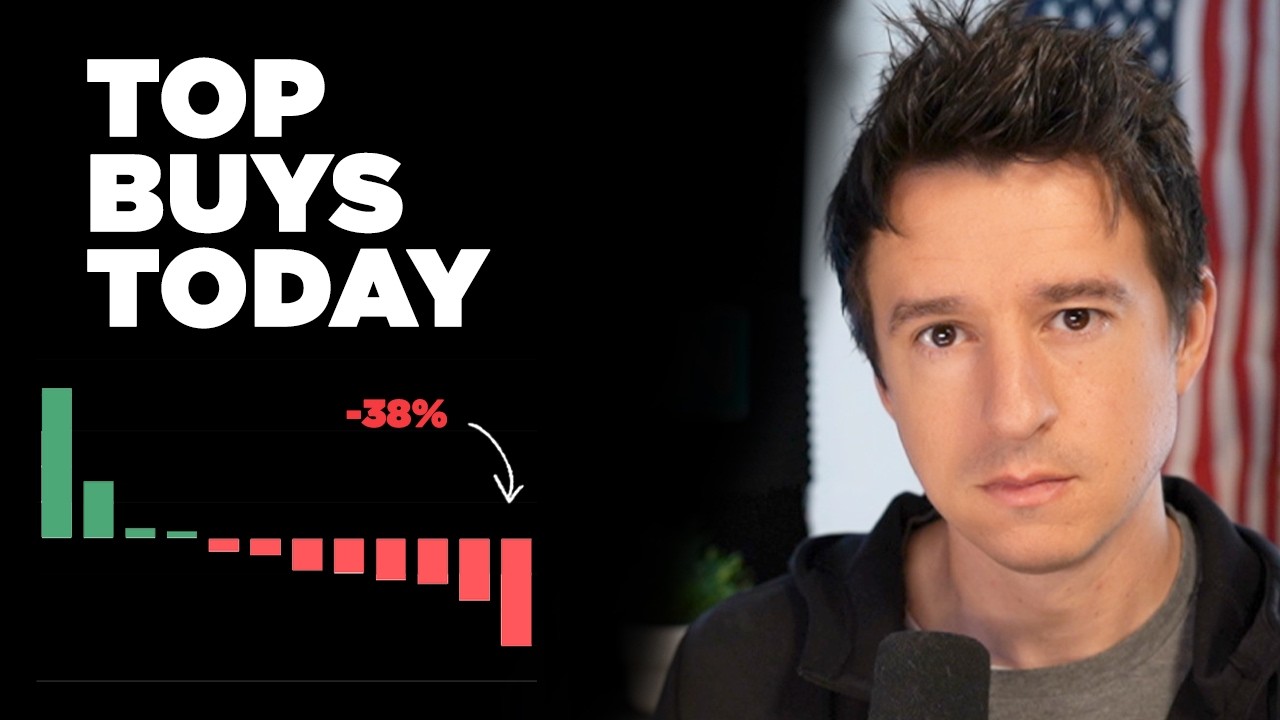
With the market racing up, the S&P 500 up 7% and the QQQ up 14%, you may feel like there's no good deals left in the market. That's not actually true. Even though this market overall is being pulled up by a number of companies, there's still many great quality companies, many great high-quality compounders that are at attractive valuations today, ones that I consider well worth buying. We're going to be looking at 11 of them. These are 11 companies that are incredibly high quality, well- vetted. They're great companies that are being left behind in this rally and I'll be going over each one of them with a look at their valuation. Now, in addition to that, we have a lot of other news to get into. For example, we have seen some stocks really take hold of this rally. ASML being one of them. ASML has been one of the most impressive compounders over the past couple of years. The stock has raised up well in excess of 150%. The company's now the biggest company in all of Europe. It's one of the most, if not the most impressive uh company that I think I've ever seen, the machines that they build. Most investors realize that ASML is critical in GPUs and chips, but they don't really realize it's critical in memory as well. With the explosion in memory prices, ASML has become even more important in the future, and we're going to be going over it. Plus, we have the inflation report. Inflation is going up. We have Tom Lee's commentary on the market jitters, what investors should be doing now. Dan Ies gives his opinion on the impending SpaceX IPO. We have a trailer I'll be reacting to to the sequel of The Social Network. Mark Zuckerberg is being played by Jeremy Strong in this movie and the trailer reveals a little bit of his voice and the way that he acts. We'll be looking at that. And then of course we have the fail of the week which in this case is ProShares. They're an ETF company and they've made a brand new ETF that's expected to launch the day of the SpaceX IPO that targets a two times daily return of whatever the SpaceX IPO does. We're going to be going over this as well. Now, we start off by going over 11 companies that I believe have been left out of this market rally. Like I said, we have a 7% return in the S&P 500, a 14% return in the QQQ. And to many people, they'll believe the market's actually going up really well broadly across different companies, and that's not really accurate. A lot of this gain is being led by only a handful, a select few of semiconductor and AI companies. Most companies outside of that are actually pretty flattish or going down and it leaves many opportunities for investors to be selective and buy highquality companies that are being left behind. This is something that happens in many market rallies. When the market gets pulled up by a select few massive companies, it leaves opportunities for the ones that are less exciting today. They're less exciting, but they're great companies nonetheless, and they'll have their exciting day in the future. Now, when I look at this, first of all, before I highlight these 11 companies, I just want to say that I recommend overall having a hybrid approach where you have some of your money generally in ETFs. In fact, I believe the best strategy overall for investors is the core satellite strategy where you have your core positions. This is typically like the S&P 500 with SPY or VU or you have SCHG. That's a really good growth ETF. Those can be your core positions which you have around 50% of your portfolio in. Then you have satellite positions. Those are your individual stocks that you think are market beating stocks. So you have your core positions that you can kind of fall back on and then you have your satellite positions which you give extra emphasis to and it gives you the opportunity to outperform. So I see many investors break this up 50/50 where they have around half their portfolio in individual companies and half in ETFs. I think that's a good thing. Now if we look at which companies I believe are particularly good value, the first place I look is within my portfolio. And you could say that that's just bias that we look within our portfolios. But the truth is that in your portfolio, there's likely good deals. There's likely some stocks that haven't moved as much that you've already done research on, that you're already familiar with. Now, if we're looking to buy more of a company, we want to make sure that we've already audited it. We've researched it. We've done the due diligence. We know that it's a quality company. I've done that for the companies within my portfolio. For the Story Fund as well, I've done extensive research on every one of these. I know they're great fundamentally. I know they have great futures. So, this is the first place that I look is within my portfolio. And I do find right within my portfolio a number of companies that I believe are good value. We first start off with S&P Global. We have that one right here. This one's down 26% from its highs. The stock is at the lower range of its 52- week range. So, it's trading down. You're not buying it at top dollar. And then when we look over the past 5 years and look at the historical valuation range in which it's traded at, we have it right now. Over the past 5 years, it's the cheapest it's been historically on both a price to earnings and a price to free cash flow. Very bottom of the range. Meanwhile, this company has actually been doing great fundamentally. I rate S&P Global a buy. I think the company is very strong. And unlike many other software companies that may be being disrupted, that's just not happening with S&P Global. In fact, when we look at S&P Global, the valuation is so low that it trades at a 21 Ford PE. This is almost unheard of for a company this high quality. If you were to take out all of the the part that's supposed to be in trouble, the disrupted part, the market intelligence, then it would still trade at around a 25 to 26 forward PE. So, even if you took out the earnings of that disrupted so-called business, this stock is still at a good deal. Next up, we have Mastercard. This one has been moving down. It's 18% off of its highs. It's at the low end of its 52- week range. We have it at the very bottom of its 5-year historical valuation on both a price to earnings, so trailing PE ratio, as well as a trailing free cash flow yield. The company is as cheap as it's been over the past half a decade. The recent earnings report of Mastercard is very strong. Revenues growing, earnings per share is growing in the high teens. The company continues to show dominance in its market share, and it continues to issue more cards and grow its network. I rate this one a buy. We look at Costco. So, this is a big holding of mine. This one's in the middle of its last 52- week range. It's also trading in the middle of the valuation range for its PE and its price to cash flow over the past 5 years. This one I do not rate as a buy. Costco is ultimately still at an expensive valuation. The company's stock price has moved way ahead of its intrinsic value. The intrinsic value needs to catch back up with the stock price. So, I would pass on Costco. We move into Texas Roadhouse. This one is 15% off of its highs. It's towards the middle of its 52- week range and it's in the middle of its historical valuation on a PE and a price to free cash flow. I think Texas Roadhouse is a buy today. I look at the stock and I think they're doing quite well. Beef prices are expected to go down in the future as the catalot sizing gets bigger. We also have Texas Roadhouse continuing to organically grow, open new restaurants. The moat still seems intact. People love Texas Roadhouse and the valuation is reasonable. We move on to Microsoft. This is where we get into more dicey territory. Along with Microsoft, Amazon, Meta, and Google, we have the four hyperscalers, the companies that are investing the half a trillion dollars in capex. Now, whether these companies are buyers or not does depend on your thoughts or opinions on that capex spend. For example, if you believe that it's incredibly unpredictable, that you believe it's going to be low returns, that they're overbuilding capacity and it's a big bubble, then obviously don't buy these companies. They're just not for you. In my case, I've made the argument multiple times. I've made my case multiple times that I believe for these four companies in particular, their capex spend is actually far more predictable than investors believe because they have so many in-house ways of monetizing it. Three of them can resell much of the capacity. So, they have options of reselling it and then all of them have different ways they can use it within their own business. Microsoft has so many Fortune 500 tools and kits that they can use AI to better their own products. Google is intertwining AI into everything. Like even look at YouTube. There's so much AI and YouTube as well. Right now we have Meta of course driving more ad efficiency and we have all these companies using AI in productive ways. I also have addressed the argument with these four hyperscalers. Many people say that AI is a commodity, but commodities can still drive pricing power when you wrap a commodity in an ecosystem and a framework that's very unique. Similarly to what Spotify does with music or what Texas Roadhouse does with stakes or what Netflix does with content or even what Amazon did with AWS and cloud storage. All of those things are somewhat commoditized, but these companies make excess returns because of the way that they're able to brand it, the way that they're able to distribute it. So, I'm on the side of owning these companies. I think they're going to be worth it to own over the next 5 to 10 years. Now, having said that, we still need to look at their current term valuation to determine whether or not they're buys. When I look at Microsoft, this one is down 27% from its highs. That's quite a ways from from the highs. A lot of times these companies trade 15 to 20%, but when you're 27% off your highs, that's a pretty big dip. So, it's towards the bottom end of its 52- week range. And on the 5-year historical valuation, Microsoft is very bottom of its PE ratio. But on the free cash flow yield, it's towards the middle because they're spending so much on capex. Their cash yield doesn't look as good. But when we look at the earnings under a PE, the company is cheap. I consider Microsoft a buy. I still think it's a good time to pick up shares of this company, and that makes four of the 11 buys so far. Next up, we have Moody's, the counterpart to S&P Global. This one is in the middle of its 52- week range. It's only 17% off of its high. It is undervalued based on the historical price to earnings and the price to free cash flow. This one I also consider a buy because the data and the services that Moody's providing I believe are going to be very difficult for Anthropic to disrupt. I don't think that that's going to happen. After Moody's we have Google. The standout winner Google is only 11% from its high which is very normal for a company to trade about 10 to 11% off of their highs. In fact, a lot of companies just naturally trade around that range. So, this is towards the higher end of its 52- week range. It is undervalued based on a price to earnings ratio because Google has traded up to very high PE recently. On a price to free cash flow, it's super expensive. I don't rate this one a buy right now. I think investors should hold on and just wait a bit. Find a more attractive entry point. Now, having said that, there's many investors like Berkshire Hathway that are buying $10 billion worth of Google. So, I understand if you do. I don't think it's the worst thing to buy Google today. It is my largest position by far, but I think that there's just just been better times to buy the company. It's had a massive run up. Uh I think you can wait around and try to find better entry points than today. After Google, we get into ASML. My biggest winner over the trailing year. I'm around $80,000 in gains in this one. So, it's really done well. It is 3.2% off of its highs. So, it's at the very tippy top of its trading range. We're up to $1,800 when in the past 52 weeks it's traded as low as $683. Just consider that range from $600 under $700 up to almost $2,000. Incredible performance. Now, this is driven by fundamentals. This isn't just momentum. ASML is getting better by the day. The demand is in insane. They're selling more machines. They're getting far more orders. So, this is much deserved success from ASML. I think this is one that you wait on. you find an opportunity where investors aren't quite as excited about the company. For me, it's still a great company. I'm still going to hold it, but I'm not piling more money into ASML at 3% off of its highs. Next up, we have Meta. Meta is 27% off of its highs. That's a quite a sellown. It's towards the bottom of its 52- week range under the 5-year historical valuation. Like many of these hyperscalers and big capex spending companies, Meta looks cheap on a PE ratio and looks expensive on a free cash flow yield because every nickel and dime that Meta is making is going towards capex just like with Google, just like with Microsoft and Amazon. All these companies are spending basically every dollar they make on building out more compute infrastructure. I think that's a good thing in the long term of the business. Meta is a super profitable enterprise. I think that this one's a buy. Amazon's one that's worked out well. I'm well in the green on this one. It is only 14% off of its highs. It's trading in the middle of its 52- week range. Amazon also on a historical valuation looks very cheap based off of its PE ratio. It's at the very bottom range over the past 5 years. The cash flows are non-existent. Amazon's going into the red based on its free cash flow. But if we look at Amazon and the strength of this company, all the markets that they're in, to me, it's like a less expensive SpaceX. They really have almost everything. They have a Starlink business like Leo. They have Zuks, which is robo taxi. They have an enormous robotics business. Amazon has millions of robotics and they're going into all sorts of different types of robotics. Amazon, of course, has their logistics. They have their retail business. They have the ad business. They have Amazon Prime Video and on and on and on. I really just love all the levers this company can pull, all the ways that they can win. For me, it's a great long-term story. The valuation is attractive here. I think the company will go above $300 per share. So, I rate this one a buy. We have Netflix. This one has traded down a lot from the highs recently. It's down 38% from its recent peak. It's at the very low end of its 52- week range. It is undervalued based on its historical price to earnings and historical price to free cash flow. Remember what happened with Netflix? The company said it was going to buy Warner Brothers Discovery. The deal didn't go through and the stock price raced back up after the deal was cancelled. Netflix got this big payout of $2.8 billion in cash for the cancellation prize and then they moved on. Investors seem happy. The stock raised up above $100 per share and then without really any reason at all, the stock went back down to $82 per share. The PE ratio is only 26. The company's growing in the mid teens. Their earnings per share is growing strong. They're gaining market share and subscribers. Uh Netflix, I think, is firing on all cylinders. So, I believe this one's a buy today. Now, of course, another stock we can't forget about is Dolingo. I still hold every share of Dolingo. I haven't sold a single penny of this stock. In fact, I've added more and more to it as it's gone down in price. I know lots of people don't agree, but I want to give this one a few years. I want to let this story play out. I believe that the market for a scaled education solution, a digital platform for education, is substantial. And even though many people look at Dualingo as just an app, there's many companies that have been just an app that have done really well. Spotify is just an app. It really is. Lots of companies like that are. So, when I look at Dualingo, this one I I like the story of. I want to give it time. And it has been seeing positive momentum over just the past couple of weeks. It's moved up to 126, but it's still 74% off of its highs. So, this company's still way down. When we look at the trading range, it's near the bottom of its 52- week range. Its lowest was 88. Its highest was 489. So very volatile, very massive range here. It is at the very bottom of its 5-year valuation. Like the absolute bottom at the price to earnings ratio and the price to free cash flow yield. Nobody wants to own this company right now. Well, I do and I still rate it as a buy. One thing you'll notice with all of these companies that have moved down over the past year is they're not in the new exciting thing. The new shiny exciting thing is artificial intelligence and especially the bottleneck stocks. The ones like ASML, Nvidia, TSM, any company that has a bottleneck. You have memory stocks. Those are a big bottleneck today. The market loves those type of companies. Many momentum investors are pushing into those stocks. Many crypto investors have sold their crypto holdings and have now moved to become semiconductor and memory investors. They want to move to where the money's going. That creates immense momentum. And again, many great companies get left behind when that happens. Netflix is still a great company. Mastercard is still a great company. S&P Global is still a great company. All of these ones that I highlighted, I still believe are great companies fundamentally, and eventually the excitement will wear off for the new shiny thing. It'll move back to quality companies with durable earnings. We've seen this market cycle many times before. You don't know when that will happen, but if you wait until the excitement comes back to these high-quality, durable companies, it's going to be priced in. So, I'm buying and adding more to these stocks before that happens. Now, you may have noticed that so far I've only highlighted nine stocks. That means that we have two more that I consider buys today. Those two are in my top considerations. This is a watch list of just which companies I'm looking at and actively researching. And I want to highlight two more that I think are are very good buys today. Uber. This is the first one that I think is just a good buy. Now, I don't own it in the portfolio, but I don't own every good stock. There's there's lots of stocks that I don't own that are going to do great. Uber, I believe, is one of them. Uber is 31% off of its highs, so it's way down from its peak. It's at the low end of its 52- week range. On a price toearnings ratio, it looks expensive, but don't be mistaken by this. This is a range of 12 times to like 18 times. So Uber remains very cheap and it's growing its earnings very quickly on a price to free cash flow yield. It's also at the very bottom of a much bigger range. So I believe Uber today is a buy. The other one that I would add to this list that I think is less talked about, at least in my community, is its direct competitor Door Dash. Many investors that live in Wall Street or big cities, they like Uber because they're using Uber all the time. You're using it for transportation. You're using Uber Eats. But if you move out to more rural areas, smaller towns, even just smaller cities and the big ones, you're going to be using Door Dash. Everybody uses Door Dash outside there. And Door Dash has a a very good operation. They have a lot of expansion. They're moving into grocery. They have food delivery down so well. This company does a lot of things right. And Door Dash is 46% off of its highs. It's at the very bottom of it 52- week range. It has a very low PE ratio historically. The price to free cash flow is also low historically. It's still a company that's trying to meet operating leverage and scale and it has a lot of growth path. We also have other analysts that I'll note like Mark Mahaney that highlights both of these companies as substantial buys today. He has price targets nearly double where they sit today. So I believe that those are are both very good. So those are some companies to look at. I think ones to consider today, but there's many more deals in the market that are still being forgotten about. Now let's go ahead and move on. The first piece of news that I want to get to was something that I just wanted to highlight that I think is important for ASML investors. Now, to break this up, if you're not a big tech person, you have the CPU and the GPU, which are different ways of processing information. So, they do math in different ways. The GPU does it in more of a graphical way. They have matrixes. The CPU does it in more of a linear way. That's why they have multiple cores. But in either case, CPUs and GPUs are used to process information rapidly. That's what ASML helps out with is making them very small so you can fit more processing in a smaller space and become more efficient. Now, all of that is great. ASML is playing this massive critical role in CPU and GPU development, but it's not the only important part of this whole ecosystem. As we found out, when you build enough server racks and GPU and and CPU processing units, there's actually uh time periods where they have to wait on information. So, as they're processing things, they have to store information. And as this more information comes, the simple way of putting this is they're storing a lot more information in the short term. They need very fast solid state memory. They need a lot of it. So these server racks that that Nvidia is creating, that AMD is creating, that all these companies are creating are requiring increased amounts of memory. That's why we have companies like Meta saying they're having to buy far more memory. Now, the demand for memory has surged so much that it's made companies like Micron Technologies become a trillion dollar stock. Micron this year is going to make almost as much money in net income as Google. So, these memory companies have massive demand. And these memory chip orders are exploding. They're exploding past logic for the first time. Meaning the ASML not only got the wave of the CPUs and the GPUs, but now they're getting like this additional wave of demand from memory. On top of that, the company just has wave after wave of demand throughout this entire process. Companies like Micron are actually ordering more uh EUV machines. They're trying to build more of them inhouse because they they say that they're going to have demand for a long time. They want to have these machines to help build this advanced memory. So, even though ASML stock has gone up like crazy, I'm going to continue holding. Now, moving on, we get into the big headlines of inflation. It says that it's at 4.2% in May as energy costs continue to bite. When we read into this, it first of all looks really bad. They say the month-over-month rate of increase cooled slightly compared with April, a sign that the sharp rise in energy prices may have peaked and be softening. So, ironically, the headline, like the headline looks super bad. It's up to 4.2%. 2% energy continues to bite, right? And then you read three paragraphs in, you're on the third paragraph and they say that it's actually may have it may have peaked and it may be softening. So what is the messaging here? What are they trying to get you to believe? The economist said May's reading, which was in line with expectations, is likely to be the high high water mark in the recent runup in inflation from this year's energy price shock. That's assuming gasoline prices which have ticked down in June don't accelerate on renewed conflict in the straight of Hermuz. So it really depends on what happens in the future. If things start to cool down a little bit in the straight of hermuz then inflation should be under control and actually tick down after this reading. But of course things could spiral out of control and get even worse in the straight of her. If that's the case then inflation will probably remain higher. Either way the market's reacting to this. So, we've seen over the past week the market be very volatile, going down a couple percentage and then recovering, going back down again. And we have Tom Lee giving his opinion on what the market is doing here. Well, Scott, I I think the market of course is showing a lot of signs of jitters to me. Uh, you know, the jitters in front of the SpaceX IPO and also just consolidating all these gains. Plus, we know there's a lot of future capital that's going to be raised by Google, Meta, Open AI, and Anthropic. So, I I think the market's trying to sort of price all this in front of the SpaceX IPO, which is this Friday. >> I agree 100% with them. I I think right now there's just so many moving parts in the market that investors are a little bit a little bit concerned. There's some anxiety in the market because there's just so much going on. We have IPO after IPO. All of them are like trillion dollar massive IPOs. Uh and then on top of that, we have all the other normal news and chaos that happens in the market. So he still believes that the tech trade is on. Things aren't going to really change. The same type of companies will be moving up in the future. Dan Ies shares a very similar sentiment. He believes that a lot of the market activity this week and what's been happening is is really just jitters. It's anxiety. It's investors bracing for what's going to happen over the next week. >> And look, this is it's it's a test for the market in terms of not just SpaceX, but the ripple effect across the rest of tech. And I think that's what you're seeing. you're starting last week in terms of the sell-off that we've seen semis. I think it's playing into just it's a little white knuckle moment that we're going through in tech just to see how this is the reception ultimately is going to be. >> Dan Ies views the SpaceX IPO as a test for the market to see how it will react to see what direction this market's going to go. So somehow the SpaceX IPO is like a barometer for for what direction we're headed. The question is there's so many companies asking for capital. There's there's anthropic, there's open AI potentially in the future immediately. There's SpaceX. We know that there's Google asking for capital. All these companies want money today. They want to raise as much money as they can. And can the market support all of this? Is there enough capital to go around all these big companies? >> I believe you do. And I think even if you look like Google after they did the offering, the view that you were going to have a big sell off, but instead I think actually took it, you know, pretty well in terms of the stock. Look, you it's $4 trillion. that's going to be spent over the coming years. This is an arms race playing out. I don't care whether it's SpaceX, Anthropic, Open AI terms of the capital raise that we're seeing. And I think these companies understand the demand's there. >> He believes the market can support it and these companies are going to be spending so much money that it makes sense even if there's some jitters. And we did have the example of Google. They announced this big equity raise. I didn't see the stock plummet. I I didn't see Google investors run to the exits because they know what Google's spending it on. They can see it in the numbers. If you look at Google's actual earnings reports, you know that Google's not done with the money that they're raising. They have so much demand uh that raising more money to fulfill demand is a good thing in business. It's not a bad thing. So again, I I agree with Dan Ies here as well. I think the market can support this as long as this spend is predictably good. In the case of the SpaceX IPO, it's not one that I'm going to be buying. Even though I realize SpaceX is an excellent company, but I have no way to wrap my head around the valuation. it. It's so extreme and there's so many assumptions. There's so many moving parts that I'd rather just own Amazon, a company that I understand a lot better. Now, moving on, we get to a movie trailer. We don't do this often, but this is a movie trailer about the sequel to The Social Network, which is a movie about the founding and starting of Facebook. It's how Mark Zuckerberg started it in his college dorm. Kind of that whole story very dramatized. Mark Zuckerberg in that movie is played by Jesse Eisenberg who does a wonderful job capturing just just how Mark Zuckerberg acts, some of his some of the social ways that he acts. But that one is is a great story and a great movie. I think it's worth watching if you haven't seen it. The dialogue in it is excellent. It is dramatized. It's not like a 100% accurate, but it's accurate enough and I think it's a great movie. This one, however, is a sequel, so it shows more of the drama of Facebook. the lying, the deceit, the bad Facebook, right? Facebook and Mark Zuckerberg are portrayed as the villain in so many different ways in social media and and throughout the news. And this movie plays off of that. Now, in this case, we have Jeremy Strong from Succession playing Mark Zuckerberg. And at first, I'm thinking, okay, he does look similar to him. He's got the the haircut, right? Mark Zuckerberg has that just flat hair. He even has, if you look at this, he even has the awkward way of sitting like where he's he's sitting kind of leaning forward just awkwardly. Mark Zuckerberg has a way of making normal normal daily things, things that you would just normally do like just, you know, sitting at a chair and he he somehow makes it feel awkward. I don't know how he does that. He's been trying to work on it and he'll even admit it himself. Mark Zuckerberg will say he's awkward with some things. It's just part of his personality. But Jeremy Strong has captured even how he just holds himself and sits with it leaning forward slightly. But then you have to you have to listen to his voice. Listen to the voice acting that Jeremy Strong does here. >> I'm a free speech absolutist. I'm not the one who's lying. And I'm not stopping them from seeing someone who is. >> It's It's good. That That's good. That sounds like Mark Zuckerberg. If we watch a little bit more, there's just more of this. And his his voice acting and his inonation, the way that he pauses and pronunciates stuff is so similar to Mark Zuckerberg. >> People around here understand that when I say no, that's the end of the debate. I'm not 2 years out of a dorm room anymore. Charlie, look around. >> The social reckoning, it it looks pretty good. I'm going to see it. I think it'll be interesting enough to see this story of Facebook. I expect it to be very negative on it. And I say that having a massive holding in in Meta. So I realize there's lots of things to criticize about Meta. I'm not even defending it that it's not a perfect company, but this is definitely going to focus in on those flaws and Mark Zuckerberg. I wonder how accurate will be, but but I'll see it either way. One thing I notice is in these movies whenever I see Bill Burr come out, it just takes me a little bit out of the movie. I don't know why, but I have a hard time looking at Bill Burr in a movie and not just seeing Bill Burr. of bad information you are injecting into the air supply is becoming jet pilot. >> I just see Bill Burr. Bill Burr of course can be funny and I think he's actually a decent actor but for me it's hard to to look past it mentally. I just see him. Maybe that'll change in this movie. Now moving on we get to the fail of the week which in this case is something that I I just read about this morning. And of course this would be the case cuz why not? Every part of this market has to be a casino. Everything we do has to be gambling and betting and levered and two times and three times. This is the latest from ProShares. ProShares is expected to launch an SPCF ETF targeting two times daily returns of SpaceX on June 12th. And this is real. Like this isn't fake news. This isn't an AI uh AI page. This is right from ProShares website themselves. They're the leader in levered and inverse investing. And today they're announcing plans to launch the ProShares Ultra SpaceX SPCF targeting two times daily returns of SpaceX on the same day that SpaceX is scheduled to go public. So just consider what they're actually doing here. SpaceX is expected to be one of the most volatile, crazy, unprecedented IPOs that we've literally ever had before. We're we're embarking upon new territory. And if that doesn't feel risky and unpredictable and like gambling in and of itself enough to buy a company like this on IPO day, we now have tools to two times the returns to two times whatever happens on this stock on the day of IPO. They're not even giving it time to settle. They want you to bet two times daily on this IPO. And I just wonder what direction this is going. Where are we headed with this? I feel like why not three times? Why not five times the the daily returns? If we're going to bet on it two times, why not just go all the way? Why don't we Why don't we 10x the returns? Would people say that's crazy? Why not? Why not take it all the way to 10 times? I'm sure we're going to get there eventually. A huge part of the market is becoming a casino. Warren Buffett said it himself. Just there's this market of great, durable companies. You can own them for the long term. And then there's this part of the market that's becoming a casino. And Warren Buffett and Charlie Munger before he passed on, he was very worried about the market becoming an increasingly bigger casino. And I see more and more of that happening. Now we know that Poly Market and the prediction markets, Koshi, they make it so you can gamble and bet on everything. But now we have even instruments within the market which are simply gambling. If you're buying a two times daily return ETF on the day of IPO for SpaceX, you are gambling. it it's simply what you're doing. You have no clue what direction it's going to go. You're rolling the dice and hoping for a levered bet on it. And unfortunately, it looks like this is becoming more common. That is why it is the fail of the week. That's all for this episode. Hope you enjoyed. See you in the next one.

Commentaires 0
Connectez-vous pour rejoindre la discussion.
Se connecterAucun commentaire pour l'instant. Soyez le premier à partager votre avis !