I've added $10,000 to Door Dash and $10,000 to Uber. They are a split buy, so I'm equally buying both of these companies, and I plan on continuing to buy them.
Contexto
Portfolio allocation section showing the initiated positions and dollar amounts.
I've added $10,000 to Door Dash and $10,000 to Uber. They are a split buy, so I'm equally buying both of these companies, and I plan on continuing to buy them.
Contexto
Portfolio allocation section showing the initiated positions and dollar amounts.
In fact, last Friday was the first time I've ever sold a share of ASML, and I just trimmed the position by 10%.
Contexto
Discussion of trimming ASML to fund the new buys.
Transcrição Completa
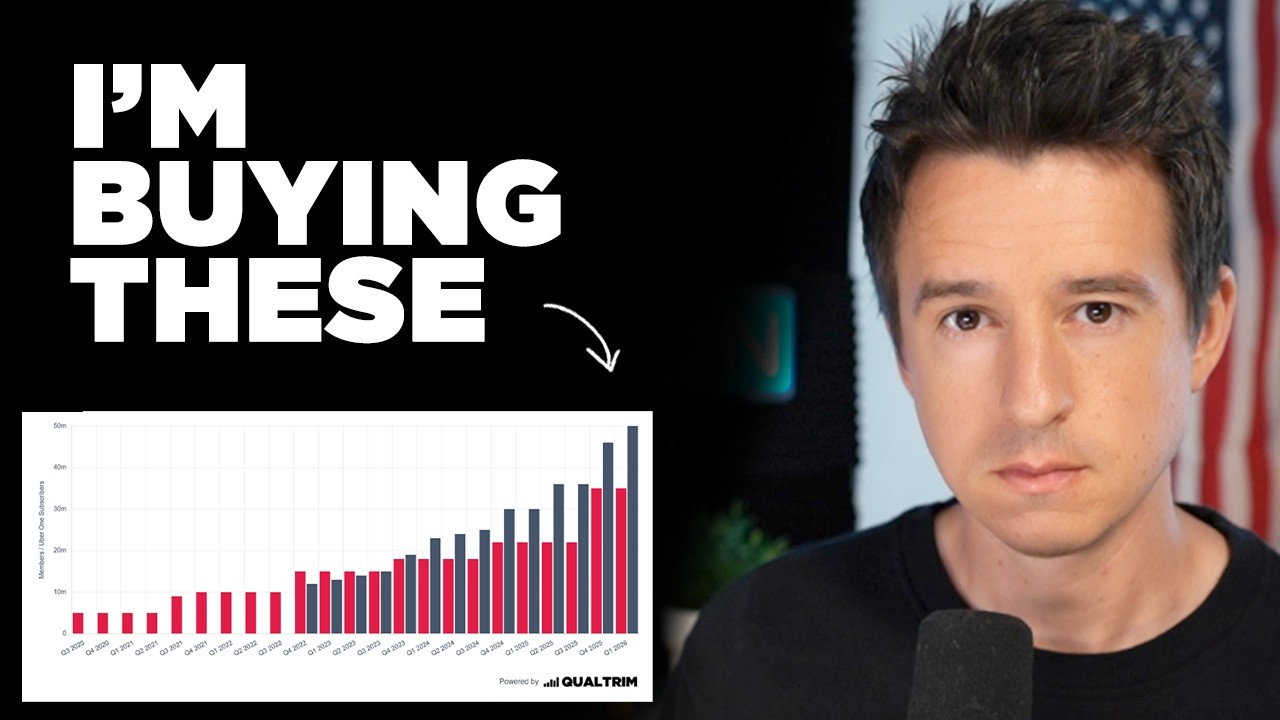
Today on the Joseph Carlson show, I added two new stocks to the portfolio. They are Uber and Door Dash. Now, this is not just me buying Uber and Door Dash. This is me expanding my portfolio into durable quality growth companies. And this is going to be the game plan throughout the remainder of 2026. These are not the only buys that I'll be doing. I'm going to be doing buy after buy after buy. But instead of going the direction where the market's going, where everybody's piling into AI companies, infrastructure plays, bottleneck companies, valuations are getting stretched, investors are getting skeptical. We have momentum investors piling into those stocks. While everybody's zigging, I'm going to be zagging and buying quality, durable growth companies that have been left behind. Uber and Door Dash represent the first of these buys. But I have a game plan going out throughout 2026 that I plan to go over in this episode. So, what we're going to be doing is going over these two companies, why I'm buying them today, how they fit into the portfolio, and the plan throughout the remainder of 2026. So, that's a lot to go into. And then, of course, we also have the fail of the week, which in this case is Poly Market. As we know, I hate prediction markets. I've been no fan of these from the beginning. They offer to pay creators obscene amounts of money to sponsor their videos. That's why virtually everybody's sponsored by Poly Market or Kouchy. You see it on every channel, every podcast, everywhere you go. I won't accept their money because I don't like their products. I don't think they're good for society, and I don't like that they're growing so fast. But what I also don't like is that these companies operate in deceptive and misleading ways. And the Wall Street Journal over the weekend published this incredible investigative journalism looking over how Poly Market used deceptive videos by paid creators to sponsor their products. The amount of lies in their sponsors and in their videos is incredible. It is actually much worse than you'll think and we're going to be going over all of it in the fail of the week. So, obviously we have a ton to get to in this episode. Now, just a quick mention. If you haven't tried out Qualrrim, which is the stock analysis platform that I've created, I think you're missing out. A lot of people have tried it out. In fact, the website says that over 10,000 investors are using it. This needs to be updated because now it's above 13,000 active paying customers. These are people that have tried out the free trial and they've decided that it's worth paying for. The reason that this has grown to such a huge size, the reason that Qualram has 13,000 active users is because it's a good platform. It gives you 30 years of financial history. It gives you KPIs on every major company. You have earnings transcripts. You have portfolio summary and analysis tools. You have advanced chart builders. You have earnings calendars and so on and so forth. It is a pretty comprehensive stock analysis platform. In addition to that, we recently launched Qualramum Studio, which gives you fresh, original content in long format, deep dives into different companies and stock ideas, portfolio analysis, as well as just general entertaining videos. All of that is an exclusive library on Qualrrim that every member gets access to. And then you also get access to a Discord community with thousands of investors. I'm on that Discord community every day. Interact. All of that is included at $10 or less per month. And of course, if you're not fully convinced, you have no risk. You can try it out with a 7-day free trial. So, try it out now at qualrim.com. Now, we'll start things off by addressing the two new positions that I added to the portfolio. It is Uber and Door Dash. I initiated an investment on both of these positions late last week, and you can see them added to the passive income portfolio. Here we have all the OG companies, the Mastercard, Meta, ASML, uh some of my Google here, S&B Global, Costco, Microsoft, Texas Roadhouse, Moody's, and then we have the two new positions here, Door Dash and Uber. I've added $10,000 to Door Dash and $10,000 to Uber. They are a split buy, so I'm equally buying both of these companies, and I plan on continuing to buy them. In terms of buying strategy, I'll be adding to these positions over the next couple of months. every single week. So, as I get more cash flow, as I earn more money, I'll be buying a little bit more of Door Dash and Uber every single week, every single month, and trying to build these positions up. I want to get them to the point where they're around $30 to $40,000 positions a piece. So, each one of them will be midsize positions. In total, they'll be a very large position split between the two. At 30 or $40,000, that is a meaningful position. If they get big enough at that point, they can really put the portfolio in a good spot. So, of course, there's the obvious questions. Why Uber? Why Door Dash? And why now? And I think to answer that, I first want to just back up a little bit and restate where I think we are in this market. See, Uber and Door Dash are just two companies, but they play a broader role in overall how I'm trying to position my portfolio. So, instead of just looking at this as these two companies will do good, and that's the investment thesis, I want to look at this more as a holistic portfolio allocation strategy. See, what I believe is happening is this is truly a bifurcated market. It is a market where you have a group of winners that everybody's focused on and then you have companies that are being left behind, being forgotten about, the valuation multiples are coming down and they are these so-called losers. Now, they're not losers because they're fundamentally weak, but they're losers because the jingly keys, the excitement, everything that's going on is going on with these AI bottleneck infrastructure stocks. Those are the ones that are getting all the attention. And this is readily evident in all the data. This isn't just conjecture. This isn't just my opinion. The data proves this out. For example, one of the companies in my portfolio that's done tremendously well. It is my best performer over the past year is ASML. ASML right here. If we can zoom in on this, it's up so much. I'm up 177% on this stock. This is time weighted returns. I'm up $13,000 in gains on this company. If we look into my actual position here, I'll show you some of the data. My average share price is $724. I bought $56,000 at that price. Now, this stock trades at $1,900 per share. So, I bought a bunch of it at around 700 bucks. It's gone up like crazy. They're buying back shares. They're growing. Demand's growing for this company. I initiated this position in 2025. So, this has been a wildly successful position. ASML has blown away my own expectations. I thought this company would do well. I didn't understand it would do quite this well, but I bought in enough to make a meaningful position and to get meaningful upside. I bought the position size that I like, which is that nice $40 to $60,000 range. ASML from there took off and continued to compound and I hadn't sold a share. In fact, last Friday was the first time I've ever sold a share of ASML, and I just trimmed the position by 10%. So, my position size was around $165,000, and I sold $16,000 and reallocated that $16,000 with $8,000 a piece to Door Dash and Uber. Last week marks the first time I've been willing to take any money out of the stock and I do so with reluctance because ASML is an incredible company. Nothing about this company has become weaker. In fact, ASML has become structurally a stronger, better, more monopolistic, faster growing company over the past year. Now, despite that, ASML is a company that has grown in valuation and multiple expansion and excitement and enthusiasm in the stock faster than the fundamentals have grown. The stock price has undoubtedly raced ahead. We can also see this in many of the metrics. The stock has traded up to a near 54 PE ratio. It's down to a 1.3% free cash flow yield. So, ASML represents one of the companies that is caught up in this AI hype. Now, there is a lot of hype and a lot of true fundamentals to justify the valuation. So, while ASML remains a monopolistic amazing company, and I recognize that fully, I think that it's prudent to take some off the table, and I've taken 10% off the table. I still believe the company will do fantastic. That's why I have $150,000 still remaining in this company. So, I want to be crystal clear here. I am not bearish on ASML. I'm not selling out of ASML. I did a 10% trim of this company to reallocate that money into companies that I believe are being left behind. ASML is not the only company that's in this dynamic of a stock that's in the right place at the right time. There are many companies across this entire industry, this entire vertical of semiconductor companies and related stocks that have gone parabolic and had explosive growth over the past year. Well, you can look at the other obvious example, ASML's primary customer, which is TSM. TSM is in the green today. It continues to go up. Like ASML, it's up 50% this year. If we look over the past year, it's up 122%. So, it's had performance just shy of ASML's. TSM is where all the action is. People love this bottleneck stock today. They love semiconductors. They love AI. We can also look at Micron Technologies. This is one of the ones that all the attention is going to. Not only has Micron caught the attention of true AI enthusiasts, it's caught the attention of just momentum investors. Lots of people are fleeing crypto, selling out of Micro Strategy and buying Micron. They're shifting from one exciting stock to another. And the stock price clearly reflects this enthusiasm. If we look at just the year-to- date, it's up 277%. Over the past year, the trailing year, it's up a staggering 875%. Now the fundamentals are also going parabolic. So part of this is very warranted. Look at their look at their last quarter. It looks like a mistake. It's not. This is truly how much their revenue is growing. But this is where all the excitement is. It's where all the attention is. Nobody's focusing on other companies besides the TSMs, the ASMLs, the microns. When we look at another company that's had this explosive bottleneck type of performance, we have SanDisk. It's a multi,000 share price. It's moving up hundreds of dollars per day. Investors are looking far and wide for any company that could be included in this basket of AI winners. Even companies as old as Intel, if they're making products that are relevant and exciting in the AI world, their stock price is going to reflect it. Intel is up a staggering 251% year-to- date. Over the past year, it's up 553%. Even if you look outside of the obvious winners, the ones that are directly making AI products, even the companies that are in construction that are building all of this stuff that you need to have AI serve to you, you find companies like Caterpillar. Caterpillar is now a $1,000 plus stock. It is up 70% year to date. In the past one year, it's up 176%. In the past 5 years, Caterpillar looks like a high techch growth leading AI model company. Since they make bulldozers, excavators, and a lot of other construction equipment, this stock is going up like crazy. This is another place investors are looking. And you could go down this list of companies that are not even directly AI companies, but they're just related. Even companies that make the air condition systems, the fan, and the water cooling systems for AI are going up. The companies that make the software to run server racks and AI are going up. Everything in this entire chain related to AI is going up. And the reason that I bring this up is not to say that this is unwarranted or that investors are dumb buying into these companies. I don't believe that. And I believe a lot of this momentum and price is justified. In fact, I own one of these companies. I'm a big shareholder of ASML and I believe that everybody should have a leg in the AI race. We should have investments that are exposed to this bullishness. If not, you're missing out on all the momentum in the market today. But like I said before, and I've noted many times, I don't think it's healthy to go all in on this because I already see some cracks that investors are becoming more skeptical of how much this AI momentum can last. We're seeing a level of enthusiasm pushing these companies to valuations that I believe put them in a more difficult to justify situation. And so, I'm not sure how much longer all of this hype can go on. I'm not sure how much longer momentum investors will push these companies up. Maybe six to eight months. It may be 12 to 18 months. We don't know. But it's going to end eventually. When some type of technology pushes the market up to this extent, there's always an end to it and there's always somewhat of a reversal. When we look at this, we can even see this not just by nitpicking companies here, but we can see it broadly in the data. For example, this chart here shows the different contributions to the S&P 500's performance. So, if we look at the S&P 500 overall, it's up around 8 to 9% year-to date. But if we look at the factors that are causing the S&P 500 to go up, it's broken down in this chart. For example, we have right here, we have energy. So, S&P energy, that's the the dark green here, that is above zero, meaning it's a positive contribution. and energy stocks are pushing the S&P 500 into positive territory. Then we have S&P AI. So any direct AI stock is doing the heavy lifting. You have right here in pink all the AI stocks that make up the huge majority of of the positive momentum in the S&P 500. Then we have everything else. So if you look at the S&P 500, you take out AI and you take out energy, it's negative. The the market would be in the red this year. And likewise, if you have a portfolio that is primarily not energy stocks and not AI stocks, your portfolio is in the red this year. That's just the case. That's the factors that's driving these markets. Now, when we look at this overall, this is the S&P 500. It's followed being pushed up primarily by AI and a little bit by energy stocks. And it's important to understand these factors because it explains a lot of the performance going on. Basically, if you haven't piled into AI stocks this year, you are underperforming the market. If you have piled into them, you're outperforming the market. But the warning here is that this type of momentum is almost always temporary. Unlike any type of strong momentum in the market that we've seen historically, it's almost inevitably followed with sharp unpredictable pullbacks. I don't know when those pullbacks will happen. I don't know when the momentum will fade. But rather than trying to predict when the pullback will happen and all of this AI momentum and this AI hype, rather than trying to buy these companies at everinccreasing valuations, I am rather buying the stocks right here, the ones that are being forgotten about. I'm buying a select number of them that I believe are highquality companies. The basket of companies that I'm focusing on building up my portfolio the most today are highquality, durable growth companies that are not inherently AI stocks. In essence, what I'm trying to do is buy the companies that the market is not focused on today, but I believe the market will be focused on once the AI hype fades. This is a strategy that Peter Lynch often employed. He said, quote, "Invest in simple companies that appear dull, mundane, or out of favor and haven't caught the fancy of Wall Street." Peter Lynch frequently talked about investing in companies that were great companies that were not in hype. They weren't the ones that were being focused on. He invested in boring industries and found great companies within those industries. Later on, the magic would change and investors would shift focus and then they would want to buy into those boring companies that he previously purchased. And that is what I believe we have the opportunity to do now. Right now, there's lots of them. There's stocks like Spotify, FICO, Shopify, Copart, uh you name it. There's a lot of companies that you could pick from and the list is growing. There's lots of nonAI companies that are getting left behind. But there's a couple reasons that I chose Uber and Door Dash in particular, and I want to go over them. Let's go ahead and just take a look at some of the data here. First of all, if we look at this chart, this clearly shows the price performance discrepancy between the semiconductors, which is SMH, that's a semiconductor ETF, and Uber and Door Dash's price. For example, if we look at just the past year, uh Uber is down 16%, Door Dash is down 23%. And semiconductor stocks are up 156%. That's the ETF of them. Now, if we look at Uber and Door Dash even more closely over a longer time period, they're well off their highs. Both of these companies have traded down. Uber was at $100 per share and now it's in the $70 per share range. So, so it's had about 30% of its market cap chopped off from the highs. Door Dash in a similar situation if we look over the past five years. This stock is down even more. It's down about 40 43% depending on the day. So both of these stocks have moved down big while the rest of the market is continuing to get led by these semiconductor stocks. But if we look at Uber and Door Dash's fundamental performance, what's actually been going on with the companies? I want to take a look at just a couple visuals here because they show the picture quite clearly. Now what I would point out here is both of them are just growing their revenue like crazy. Uber, you can clearly see the revenue is going up like crazy. The trailing 12-month revenue. Uber is a massive company because they have the ride sharing, they have the food delivery. Uh they're by far the biggest ride sharing company. That's where they get the majority of the revenue. Door Dash though, even though it's a smaller amount of total revenue, it's actually growing its revenue faster than Uber. So for example, if we look at Uber, it grew its revenue 26%. Ker Door Dash is growing it 56%. The revenue growth continues to be very fast. I believe over the coming 3 to 5 years that Uber will continue to grow revenue above 10%, maybe the 10 to 15% range. And I believe that Door Dash will continue to grow revenue in the high teens, 17 to 20%. Aggregate, both of these companies will grow revenue far faster than the S&P 500, like they've been doing over the past couple of years. If we look at other KPIs, for example, we can look at the amount of trips that Uber's doing. So, if you think that they're just growing revenue because of price increases, that's not right. Uber is maintaining the price. They have other ways of making money, but the amount of trips that they're doing is going up like crazy. It's been going up 15% per year, give or take. Uber's up to 14 billion, which is an insane amount. When we look at Door Dash, it's at a much lower amount of total deliveries. But these aren't really apples to apple comparisons because getting a a five minute ride in a car is different than having somebody pick up food for a half hour for you. The ticket prices that Door Dash deals with are are generally much larger. Um, but in any case, you can see the KPIs, the most meaningful indicators for both of these companies. Ubers is growing like crazy. Door Dashes is also growing like crazy. It's they're they're both just doing wonderful. These are really impressive numbers to look at for both of these companies. Now, another underrated aspect of these companies is they are subscription companies. They're membership companies. Similar to Costco, where you have a lot of revenue, people shop at Costco, but it's pretty low margin, and it's questionable how much money they actually make selling groceries or goods. Costco makes the majority of their actual net income by their membership model. Well, these companies have the same opportunity. They're building out a very good business where they have a lot of customers and a lot of those customers want added perks and reduction in fees. They sign up for Dashpass, the Door Dash membership or Uber 1, which is their their membership as well. And that gives them a bunch of benefits because this lowers the fees of many of the onapp fees. It makes it so that there's a clear value proposition, meaning the turn rate is very low for these memberships because people clearly see the value that they're getting. And both of these companies have been very successful in growing their membership. We have Uber here growing theirs to 50 million. We have Door Dash at 35 million. Now, they don't give updates every quarter on these memberships, but they release them when they reach different landmarks. So, when Door Dash releases 40 million, they'll probably give another another update. Uber, the same thing. But in any case, they have tens of millions, 35 million plus 50 million on these memberships, paying them every single month, $10 to $15 per month. And this is another way that these companies gain a lot of revenue at a very high margin. So, I very much view this similarly to Costco where you have the retail business, them selling different things. They do make some money on that just like these businesses make money on each trip and on each delivery. But you're building out an actual better business by having it so that they can have a membership and subscription revenue which is very high margin. And I believe that this will continue. They're going to be adding on tens of millions of members over time, giving them another way to monetize their application. When we dive in further to the historical numbers and seeing what these companies have actually done, the real data that we have today, it looks very impressive and I think it's very difficult to argue with. For example, on Uber, they give a KPI of active users on the platform that continues to grow. Now it's like 200 million. It's just incredible. Uh we have the gross bookings continuing to grow like crazy. Again, that Uber one membership continues to grow. And then you have the financial profile, which the free cash flow of Uber is a a very pretty graph. It goes up and to the right and you can see that it hit that point of operating leverage of having finally the expenses flatten out the margin profile improve and suddenly they hit this influx of rapid free cash flow growth. So Uber is a highly profitable free cash flow generative company. Uber is very well along very well established and they're growing bigger every day. We also look at Door Dash. Door Dash is a company that when we look at the historical metrics, again, it's difficult to argue with all the different metrics that you look at with their orders, gross volume, IBIDA, all of these graphs are going up and to the right. And Door Dash actually is a profitable company. Now, it's not as far along in its monetization and its operating leverage journey and its scale as Uber, but it's already reached profitability. They're generating $1.75 billion in free cash flow as of the trailing 12 months in the earnings per share. They also broke that point of going into the profits. When we look at some of the concerns, there's some questions about the moat and predictability of these these companies growing going forward. For example, if we look at Uber, the primary concern that I've voiced many times is AVs. In particular, we have companies like Whimo that pose a significant threat to Uber because Whimo is excellent self-driving technology. They have it down. They have a great app. They move into cities and lots of people enjoy using Whimos. Whimo has has chosen a path of partnering with Uber in part of their rollouts and they've chosen a path of doing it themselves. From what I can see, Whimo has done a good job in both cases. So, I don't necessarily think that they they have to use Uber. Whimo could choose to go their own way. That poses a threat to the forward-looking growth and questions into Uber. And that is the primary reason that Uber trades at such a low valuation today, such a high free cash flow yield despite its incredible success. It is the question and concern of Whimo, of Zuks and other robo taxis. Uber knows full well about these risks and they have invested aggressively into partnering with basically every robo taxi company that they can. Dra knows the importance of becoming the dominant aggregator and he is doing everything he can to shift this company into aggregation mode and that includes inviting robo taxis into the fleet of vehicles. >> Hey, good morning David. So Uber shares lowered this morning after the company said it will bring its own robo taxi service to Houston, a launch that would put Uber up against Whimo and Tesla in one of the only US markets where all three will be competing. Now commercial service is slated for next year, but testing is already underway with Lucid supplying the vehicles and Neuro providing the self-driving tech. It's the latest sign of how dramatically Uber has reversed course on autonomous vehicles. Six years ago, CEO Darra Kazro Shahi sold off Uber's in-house self-driving unit. Now, Uber is said to be spending more than $10 billion to re-enter the market through partnerships like this one. Uber's invested hundreds of millions into Lucid and Nuro and expanded its purchase commitment with Lucid to at least 35,000 robo taxis. But that is just one piece of a much broader AV partner web. from Rivian and Nvidia to autonomy companies in China as Uber really tries to bring more vehicles and self-driving systems onto its network. >> Uber understands the importance of having this technology within their own network. And although there will be some market share loss from Whimo or Tesla in the future, Uber has such a gargantuan lead. The numbers are are so significant at this point. Again, if we look at one of the metrics here, one of the metrics is that they have done 14.17 billion trips in the last 12 months, that is billing with a B. Uber has a lead that I believe is very difficult for any type of robo taxi company to completely take over at this point. So, while both of these companies do face risks just like any other stock, they do have a chance they could be disrupted or something could go wrong. With Uber, that risk is primarily AV disruption. But with how big Uber already is and the fact that they already control 70% market share of ride sharing in the United States, I think that that chance is very small. With Door Dash, they own 60 to 70% market share of food delivery within the United States. It's already a deeply entrenched market. Both of them are huge concentrated market winners within the US and they're the biggest ones going across Europe as well. So I look at them as rather insular winners. They're facing competitive technologies and disruptions like any other company. But I believe both of them will play hugely important roles in the future as this new type of dynamic of food delivery and ride sharing continues to grow. Now the first bit of news that we get into today is that Google stock it's going down. It's down 6% on the day. Huge red day. This is like a really bad red day. It's no exaggeration. So what's going on with Google? Well, the big news over the weekend is that Google has faced its worst day because of AI concerns after high-profile exits. So, a couple of their top AI guys have left the company. The brain drain concerns begin last week when Google's vice president of engineering and co-lead of Gemini AI models, Nome Shazer, announced Wednesday that he was leaving the company to join the rival OpenAI. Shazer's departure came less than two years after he returned to Google. Then we have another exit that came just last Friday when John Jumper, DeepMind vice president and engineering fellow announced he was leaving the company after nine years for rival Anthropic. Now when I look at this, I basically think that investors are way overindexed on how important a few top talents are at a company. I don't think that these top researchers, as magical and as smart as they are, are the biggest indicators of who's going to be the winner in the AI race. I really don't believe that at all. While I respect top talent and I think it's important to have smart people working at an organization, the real moat in AI doesn't come from having the best model. It it doesn't come from having a slight breakthrough of a different unique way to construct a model. That's really not what's going on and that's not going to determine the winner. The winner is how you're able to distribute the model, how many customers you have, how you're able to package it, and your entire infrastructure and process. When you look at Google, they have the full stack. They have the entire development process from the very bare bones. They have all the infrastructure, they have the cloud hosting, they have all the GPUs, the TPUs, uh they have all the the people working to power the AI in the first place. Then you get further up the stack and they have the distribution. They have all the software. They have all the millions of people uh billions of people using their thousands of products and integrating them in every different way. They can intertwine AI into Gmail into Google Maps. They can intertwine it into Google Drive into document reading. They can put it on the Gemini app and on the Android phone. They can put it into YouTube. They can put it into XYZ. Everything that Google owns. Then you have Google's infrastructure of their all their employees, not just these top talent people that have the big names, but all their employees that are in this entire cycle of developing models, testing them, deploying them, going and iterating over and over again, finding this entire process is what creates the moat. So when I look at Google overall, I do think it's important to have smart people, but I think just like a couple people, two or three leaving the organization is not some big indicator that tens of billions of dollars should be shaved off the market cap of the company. It's ridiculous and it means that investors don't fully understand what the moat of Google actually is. The entire time, the moat has been their full stack development, them owning the entire infrastructure for AI. And that doesn't change when one of these employees leaves to a different competitor. Another thing I'll just say when looking at the behavior of these employees is that they play hopscotch with different companies, jumping from one to the other every two years. How valuable can you possibly be when your loyalty extends 2 to 3 years at maximum? When anytime that you get a better offer from a different competitor, you instantly jump to them. Is that the type of person you want leading your organization? One that you can only keep for a maximum of two to three years. So, I'm overall not concerned about this. I think that we're going to get earnings reports in the future of Google continuing to win, growing like crazy. Uh it's going to prove that their their AI models and them being smart is one thing, but also the infrastructure is the real moair. Now, finally, we move on to the fail of the week, which in this case, we are highlighting Poly Market. And I'll lump in Koshi. I think it's just as bad or at least it's pretty close. But I don't like either of these companies. And it's no it's no mystery that I don't like prediction market companies because prediction markets I think is a fancy way of saying gambling. In most cases, what these companies do is entice you with the enticement of gambling. You're going to make quick money. You'll make money without really doing anything. It'll be fun and it's just forformational and entertainment purposes. In reality, what these companies sell is a highly addictive product. Gambling can wrap people into it. It can change their life and it puts them in a a lower economic state. When people gamble continually, they have less money at the end of the day. Poly Market and Cali run contrary to almost everything that I try to teach on this channel, everything that I try to motivate people to do. That is part of the reason why I don't like these companies. They by far lower people's financial standing. They suck money out of unsuspecting people that are trying to just participate and make a quick buck like they sell. Uh they are proven, in fact, gambling in this case is proven in many cases to cause more stress in the household, more domestic abuse, more financial strain. In fact, there's very conclusive evidence that gambling with prediction markets is something that's not good because there's many states that allow you to do so and there's many states that do not allow you to do so. Since it's relatively new, we could see the difference in outcomes by the specific states within the United States that allow it and the ones that don't. All of those type of things were better for the states that block these types of companies than the ones that didn't. So, we know by the numbers, statistically verified, that these products are not healthy financially. They do not help people get ahead or make money or have better lives. They do the exact opposite. But despite that, they've continued to grow at rapid pace. And part of the reason why is their advertising campaign. These companies have done a marketing blitz the size of and the scale and the speed that I've never seen before. It is truly astonishing how much money they're spending on marketing. Every podcast that I tune into, I I watch some golf channels on YouTube and they they talk about Ky Poly Market. They plug them all the time. They're all paid off by them. They won't say a negative thing about these companies because they're the the sponsors sponsoring all these all these products. Nearly every political channel, every talk show, every comedy channel, every comedy podcast, all of those shows sponsored by Koshi, sponsored by Poly Market. Everyone seems like they're taking a paycheck from these companies. The amount of money that they're dishing out to do this marketing blitz must be obscene. Even on X and different social media, there's constantly these viral memes that they pay with misleading titles. And they're always saying sponsored by Poly Market or a partner with Kouchi. they have them tied in. So online, you're not going to get a lot of criticism for these companies. And that's because they're lining the pocket of almost everybody with a voice. When you do that, you insulate yourself from criticism. Well, on this channel, obviously, I'm not accepting their sponsorship. I do not allow them to advertise on the YouTube ads embedded and as sponsors as well. In both cases, they are blocked. And that's because I have other ways of monetizing. I don't need their money. So, fortunately enough, I can speak clearly and transparently about how they operate. And what we have here is what I would say is one of the most disgusting and deceptive ways of growing a business that I've ever seen. We look at this as an investigative presentation from the Wall Street Journal. And I just want to go through some of it. In his videos, George appears to have a lucrative side hustle making bets on Poly Market. In January, the college student posted a video that showed him winning $100,000 on a wager that President Trump would publicly say the word McDonald's. The bet was one of 145 that George Macara appeared to place on Poly Market's website between January and midmay based on his videos. Bets adding up to almost $410,000. The problem here is that none of the bets were real. According to the Wall Street Journal investigation, Mara jumps up as Trump says McDonald's. We're going to eat some McDonald's. And then he jumps up, right? He's excited on the Tik Tok video, which he never said publicly that month. The clip was from 2 months earlier. So, this kid is uh you know, whoever this is, George here, he's reacting to this big winning of of him saying McDonald's. Only problem was that it didn't literally happen the same month. Mara, who declined a comment, is one of the dozens of mostly college age creators Poly Market paid to film themselves making fake trades and sometimes scoring fake wins. This is according to analysis of more than,00 videos by the journal along with instructional materials and interviews with creators who have worked with the company. So this isn't just them guessing like the Wall Street Journal has looked at thousands of videos and even got the materials that they were sent to fabricate these videos to deceive people and to believe they're making winnings that they're not. On Poly Market's actual site, more than 50 accounts made the McDonald's bet in January. Public data shows all of them lost. So, everybody lost money on this, but he's excited. He's celebrating his big win on the $100,000 bet. In its push to draw users to its unregulated platform, Poly Market has flooded social media with videos like Mars, which appeared genuine at first glance. In reality, Poly Market built nearperfect copies of its website, then instructed creators to make simulated trades on those dummy sites and hide that they were being paid by Poly Market. Do you understand how utterly disgustingly deceptive this is? How callous and bold this deception is? They constructed nearperfect copies of the website and instructed creators to make similated trades so they could literally lie to everyone watching. The assumption is that they're making big wins that they aren't. This is a level of deception not far off from scammers in some foreign country calling your parents and telling them that they're your bank and they just need your password to verify a few things. This is outright deception. There's no other way to put it. To get the videos to go viral, Poly Market then has recruited a social media army to copy and repost creators footage. Though the New York-based company has been banned from offering its primary crypto platform in the US since 2022, the social media creators have been paid specifically to target US users who can still access the website with VPNs. So, the ban doesn't really work because everybody just uses a VPN to to access this website. Now, the company said it plans a comprehensive audit on active promotional content. Yeah, they're going to really look into this and see what's going on. Poly Market hired and worked closely with a marketing contractor to promote the site. In a message reviewed by the Wall Street Journal, that contractor told its social media army to repost content made by 10 Poly Market creators in particular, Macara among them, these creators didn't initially identify themselves as paid by Poly Market. Although one offered one offered a $20 bonus uh code in his social media bio, the creators started adding quote polyarket partner. So before this, they'd even list that they are partners. No affiliation, which is just shilling for a product. When you're promoting something and then you don't mention you have any affiliation with it, uh that's just shilling, which is illegal to not disclose that you're closely related to something. Um it's also just deception, lying, basically scamming. Out of this, they say the journal reviewed 1,15 videos posted by 10 creators endorsed by Poly Markets contractor between December 25th or 2025 and midmay. In 70% of the videos, the creators placed a bet. Clues in the video showed that none of the bets, 1.9 million in total, were real. Most of the videos simply showed the bet being placed, but 118 showed the creators reacting to outdated footage, fake headlines suggesting that they'd won. These 118 videos depicted creators winning almost $900,000. And it was totally fake. Everything about this was fake. In fact, it wasn't just that they didn't win. In reality, had you placed those bets, they would have lost more than 166,000. This is far worse than just lying that you made gains you didn't. Had someone actually followed what you did, you would have lost a lot of money. The company instructed creators not to disclose that they are paid. So, it's not even an oopsy, we forgot to disclose. They literally instructed you not to disclose you paid. They're instructing you to do illegal things, to shill a product and not show any affiliation with it. According to the creators who have worked with the company, they were saying the same thing. They said the pay often added up to $2,000 to $3,000 a month. One of the earliest videos showing signs of fake trades was posted to social media in June 2025, and it was filmed inside Poly Market's New York office. The video showed someone betting $100,000 that Jerome Pal would say good afternoon during a press conference. The caption described the bet as a valid testosterone test and the bet would have won. The journal identified more than a dozen discrepancies between the real poly market and the simulated trades. So, let's go ahead and look at how sneaky they were with simulating these fake trades, attempting to trick you into using their crappy service where you're going to lose money. This is how they do it. One of the password protected websites that they used misspelled the URL as p oi y m a r ke. So instead of P O L Y, they swapped the L for the I cuz L's and I's look identical if the I is uppercase. So you can look at the URL here. And this is exactly what they did. And they even have screenshots of these videos. P O I Y M A R ke.com. The problem with the strategy is in the URLs from the browser, it automatically bumps it down to lowercase. Oopsy daisy. They left that in the video. The Wall Street Journal caught it. So, while this guy is posting this social media video pretending he's winning big on Poly Market, in reality, he's on a website called P I Y M A R K E T, it's a completely fabricated website to try to give the mirage that they're winning money that they're really not. They have a lot more of this. Poly Market built that site. According to a person familiar with the matter, here a price chart is attributed to source.com. No source appears on Poly Market's real website. There's more indicators that these were completely fake fabricated websites. In this example, buttons read yes and nir, short for Northern Ireland. On the real website, it just reads yes and no. So, this is again a different website than Poly Market. A handful of videos the journal reviewed also contained short glimpses of URLs indicating that the sites were test environments for Poly Market engineers. The PO market pi website was taken down after the journal reached out to Poly Market for comment. So the journal's like, "Hey, uh, we found this website that's not really Poly Market that you're using to fabricate trades. What's up with that?" And they're like, "Uh, take the website down. It never existed." You know, we'll just take it down after the fact and pretend that it never existed. That's not how it works, guys. We've already seen it. Like, the journal recorded this information before they reached out to you. The Wall Street Journal has gone to the Federal Trade Commission, which enforces advertising laws. They declined to comment on the journal's finding, citing the agency's policy of not commenting on potential investigations, which makes me believe that uh the FTC is looking into this and the journal found out about it, but I think the FTC is for sure it's caught their attention. The problem is for Poly Market with this investigation is that this isn't just like a couple instances that they caught. This is a widpread, intentional, systematic deception of spreading a product through lies. It's illegal. It's borderline. If it's true, this is borderline a scam. Creators have said that they send the finished videos to Poly Market for review. And if the video isn't engaging enough or if it bears obvious signs of being faked, Poly Market will ask the videos to be reshot. So, if Poly Market's able to notice that the video is fake, they'll say, "Hey guys, the this one the ruse would be up. This one's too easy. You'd give away that this is a fake winning, so redo the video." That's what they're doing there. They're not saying, "Hey, uh, you can't send us a fake video of a fake earnings. It has to be real and legitimate." They're saying, "Yeah, continue with the deception. That's totally fine, but just make it less obvious." Hon, one of Poly Market's top performing creators, has filmed herself trading on the platform from a San Francisco bedroom. In one video posted to Instagram, Naen celebrated winning $60,000 after it appeared to bet that Trump would say Olympics. with text reading, "Poly market funds my life." overlaid another video of her dancing on a beach by a Golden Gate Bridge. So, they're selling this fancy dream. Oh, she won $60,000. Polymark's funding my life. I'm on a beach. Another video appears to show her having more than $30,000 in a Poly Market account. Naen declined a comment and scrubbed the videos from her profile after the journal contacted her. Hey, it's the Wall Street Journal. Just wanting to figure out what you're doing here. And she wants to delete everything. Again, the common tactic here is just to remove everything as soon as the Wall Street Journal uh reaches out. Poly Market removes her fake website when the Wall Street Journal asks about it. This creator deletes and scrubs her entire profile as soon as the Wall Street Journal reaches out about it. Many of the videos share a template. The creators open Poly Market, place a bet, and frequently refer to their winnings as free money. Dozens of social media creators have posted videos with almost identical formats. Poly Market sends the creators bullet point guidance on what to say according to the creators who have worked with the company and the recruiting website. Popular phrases used in Poly Market's userenerated content videos, almost a quarter of them, 25% of the videos use the word free. Common phrases include free bread, free money, and just free. Other things that they say is, "Is this just free money?" Bro, if the pattern continues, "Is this free bread?" quote, "If I put $1,000 in Canada to win, is this just free?" Which is obviously ridiculous. All these people would be losing money. They'd be losing their savings if they were actually making these bets. Other things they say is, "Bro, what?" These are hook phrases used to capture viewers attention. Wait, what? Another hook phrase. Am I missing something? That was used in 237 videos. This stuff is just disgusting behavior. There's no way around it. They are intentionally deceiving youth on social media platforms, fabricating these wins out of thin air on fake websites with these hook phrases. They're paying people intentionally, according to all of this, this is all alleged, intentionally to deceive people. If any of this is remotely true, which we have really no reason to believe it's not. The evidence here is overwhelming. Um, if any of this is true, this is one of the biggest deceptions that we've seen in modern history. This companyy's spreading their destructive product all across the United States with these deceptive tactics by targeting young people. Polyarket has a social media army. Polyarket strategy leverages three groups of social media producers to get viral attention as a fountain of fast, easy cash. They have the streamers online influencers discuss poly market and sometimes trade during live video feeds that can last for hours on platforms like Twitch and Kick. And the creators, mostly college-age social media users, make short videos of themselves talking about Poly Market or placing trades. In Clipper, people across the world, often teens in Asia, redistribute the videos from streamers and creators. They clip the videos hundreds of times until they become popular. Poly Market employs Virality, a marketing firm, to manage the Clippers. Their campaign is aimed at Americans. Virality requires Clipper's post to seem personal and organic, according to the journal reviewed of nearly 20,000 messages from a chat group of Poly Markets online content creator and contractors and instructional documents and videos prepare them for it. Guys, if you have Poly Market in your account name, please rename them and remove it as soon as possible. The Verality employee told a group of Clippers in a group chat, quote, "Continuing to use it will violate our guidelines and may lead to submission rejection. Not even Poly is allowed in. So change it out as well. Meaning that they're trying to make this all look organic. Like everybody's just using Poly Market because it's great and they're making money when this is an intentionally deceptive viral marketing campaign targeted at young people employed by a multi-billion dollar organization selling a destructive product. These also aren't just like unknown small creators doing this. In many cases, it's gigantic, well-known creators, massive audiences. In one video targeting targeted for promotion, Ross said he could easily use inside information to trade on releases of dates of forthcoming album of the hip hop artist Drake, who Ross is an acquaintance of. So, he's saying how he could use inside information. Representatives for Ross and Drake declined to comment. Internal material show that Poly Market and Verality promote videos showing how easy it is to conduct insider trades on the platform. Poly Market has paid Clippers to promote at least 19 videos discussing opportunities to use inside information or other tactics to manipulate markets. So, they're actively paying people to promote insider trading and other manipulative market tactics. You don't want to think of companies as being evil and conspiring against people, but that's like what this company's actually doing. The tactics are just nefarious. These are terrible things. all of these. As the World Cup approached, some of the Poly Market creators pivoted to filming themselves placing trades on the company's recently launched US app, which is regulated. The first of those trades, too, appeared legitimate. The app interface shown in the social media videos was very nearly identical to Poly Market's US app interface, but on closer inspection, a closer look revealed discrepancies. For instance, while the markets on the official app were for quote 26 World Cup, markets on the simulated Poly Market US app were 2026 FIFA World Cup. The simulated trades continued. I hope that as more information like this comes out that all the people with different channels that have taken money from Poly Market and from Koshi that they'll look at this as a chance to renew and review their commitments with these companies. Yes, they pay a lot of money in sponsorship fees. No, it is not worth it. I hope that bigger channels, golf channels, comedy channels, politic channels, and other financial channels. I think you should take a real look at what you're sponsoring when you're plugging Poly Market and Koshi in your sponsorships. I would strongly consider trying to find a different sponsorship for a better product that doesn't engage in these behaviors. Hopefully, as more of this gets known, more people can see these company's true colors. That's going to be it for this episode. Hope you enjoyed. See you in the next

Comentários 0
Entre para participar da discussão.
EntrarAinda não há comentários. Seja o primeiro a compartilhar sua opinião!