Contexto
“We all remember in 2025 when people thought Google Search was dead and the stock was trading super cheap, and that turned out to be a great time to buy as Google Search continued growing, becoming even more profitable, and Google got its act together around AI.”
Accenture stock looks more like a buying opportunity in my eyes.
Contexto
“But when I look at the financials and kind of how the market's positioned, this large of a sell-off for Accenture stock looks more like a buying opportunity in my eyes.”
The same is true for stock number four, Adobe, ticker symbol ADBE.
Contexto
“So, if you think Intuit will be a durable business over the long term, it's a great buying opportunity. The same is true for stock number four, Adobe, ticker symbol ADBE.”
Contexto
“So, this might just be a great buying opportunity for a company that historically compounded and had great returns.”
Transcrição Completa
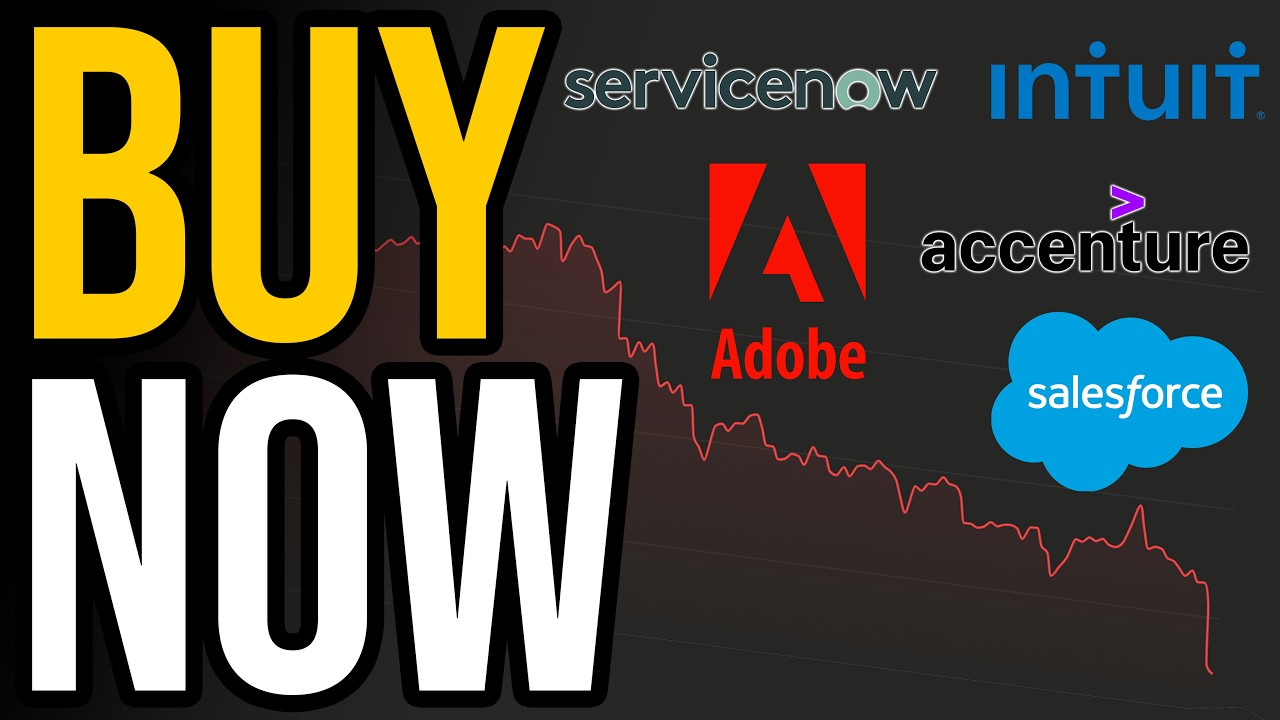
Today, I'm going to share the top five stocks that are currently at 52-week lows and that I think are actually good buys. All of these sold off due to AI fears around possible disruption. However, all of these have not actually seen a decline in their core business fundamentals. So, at this point, it's all predictions of disruption. If you haven't noticed, basically everything in the stock market is being driven by artificial intelligence. The best performers of 2026, like Micron and SanDisk, are up due to the memory shortage caused by AI. These stocks have surged thousands of percent in a single year, and they are currently trading at 52-week highs. Software stocks have had a massive sell-off in 2026, also due to AI. This is being termed the SaaS apocalypse, and it's impacting the entire industry's valuations. The massive advancements in coding agents have increased the ease and speed of creating software. And while for the individual software developer, it's a dream to use, the market is highly uncertain of what this means for software companies. They have no idea what the market for software will even look like in 5 to 10 years. Therefore, the valuation of all software companies has compressed over the past year, as a big part of how you value a company is the future cash flows a business will produce. Even top AI companies are not immune to negative AI storylines. We all remember in 2025 when people thought Google Search was dead and the stock was trading super cheap, and that turned out to be a great time to buy as Google Search continued growing, becoming even more profitable, and Google got its act together around AI. However, today, we saw a 5% sell-off in Google stock, and at one point, it was 7% intraday. And that was due to a negative storyline around AI. One of Google's top AI researchers left the company to go to Anthropic. That's the maker of Claude, if you're not aware. And if you're not aware what that is, you should be. And Google stock is selling off because you're starting to see a massive consolidation of talent into Anthropic. So much so that people are sharing the meme of like this convention back in the day with all the top physicists there. People are joking that that's Anthropic now today. So that's the impact just one employee can have on a stock price. But like I pointed out with that Google's dying, Google search is dying narrative that happened in 2025, the stock market often can be wrong and it can be great buying opportunities long-term. And today I'll highlight five examples that are currently trading at extremely deep value and where the market might be wrong. Now as I get into my top five stocks currently trading at 52-week lows, I want to emphasize that even though these companies are trading at a great valuation, they may continue to sell off over the short term. However, that can be an opportunity for the disciplined long-term investor. So with that said, let's roll the intro and get into today's video. >> [music] >> The following reflects the opinions of a man who spends far too much time thinking about stocks. Please do your own research before making any investment decisions. Nothing in this video is personal financial advice. Continue at your own risk. >> My name is Zach. This is Dividend Data and you should leave a like and subscribe to the channel if you enjoy the video. Now throughout I'm going to be using the next generation version of my stock research tool dividenddata.com. If you want to be one of the first people to use it when it comes out, click the link in the description and pin comment of the video and you can sign up for the wait list. Well, let's just dive right into it. Stock number one that I'm going to share today is Accenture, ticker symbol ACN. And this one is a little different than the other examples. The other examples are pure software companies. Accenture is a tech consulting company. So, they help the Fortune 500 and large enterprises with their data, technology, and AI solutions. But, the consulting space is another area where the market is very scared of AI disruption. And it makes a lot of sense. The work that you sometimes pay tens of millions of dollars to a consulting firm or theoretically can be done in like a day. And that's kind of the narrative that's scaring people around consulting. There's also the fear of a lot of these companies doing work in-house using custom solutions and using AI themselves. First, I'm going to dive into the financials around Accenture and then I'll explain why it's such a deep value after selling off 57% over the past year. And then, I'll give my thoughts around why Accenture may be able to adapt and they're probably not as screwed as the market seems to think. So, first off, Accenture earned $73 billion of revenue over the trailing 12 months. That is up 6.74% year-over-year. So, this company is still growing. And if we look over the past 10 years, the compound annual growth rate of revenue is 7.89%. So, Accenture's growth really hasn't slowed down. It's been pretty normal with their historical averages. Analysts are projecting continued mid-single-digit to sometimes even 10% annual growth. So, people are not expecting Accenture in terms of their financials to decline. There's not really any evidence of that. Accenture is also a free cash flow machine. They've generated $12.58 billion of free cash flow over the trailing 12 months. That's up 22% year-over-year. So, this company is getting more and more efficient. And their free cash flow growth is outpacing their revenue growth. Now, for context, Accenture currently has a market cap of $76.6 billion. That means the company is trading at roughly six times annual free cash flow. That is extremely cheap and well below historical averages. And let's dive into that and some of the key metrics. And what I'm looking at right here, it's called the value graph. It's a new tool on the next-gen version of dividenddata.com. So, with Accenture, let's look at earnings per share as an example. You can see that the company is currently trading 66% below what their fair value would imply. So, Accenture is historically a company where the median is 27.9 P ratio. And it's currently trading at a 9.4 P ratio. Now, if the company was shrinking, that could be a problem, and that could be a value trap. But there isn't any evidence that Accenture is shrinking. Now, if we take a look at the dividend, it's the same story. It's even cheaper, 72% below fair value. The current dividend yield for Accenture stock is 4.98%. This is a company where the median historical dividend yield is 1.48%. The 90th percentile dividend yield is 2.47%. So, we are well at all-time highs. Accenture is a well-known dividend growth stock. And these yields that you can buy the stock at are absurd. A 5.22% forward-looking dividend yield. And this is a company that has been raising its dividend for a long time. They used to have annual payouts, then they switched to semi-annual, then they switched to quarterly, and they increase it every single year. The five-year compound annual growth rate of the dividend is 13.12%. The most recent increase, 10.14%. Again, this is a deep value right now for the dividend yield. Purely in terms of talking about the dividend yield, this is the best buying opportunity ever in the history of Accenture. Free cash flow payout ratio, 34%. This is a very safe dividend. Earnings payout ratio, 48%. Based on all financials, Accenture is extremely deep value right now. And I'll give you my case here of why the market's probably completely not understanding what Accenture's business is going to look like in the coming years. Now, Accenture's consulting, they focus around technology. This is a technology solutions company. So, they've already been helping the Fortune 500 becoming more digitally native and all of those related things. And what's happening right now with artificial intelligence, it's really just like the next frontier. And a lot of large enterprises really have no idea what they're doing with technology, but they have money and they know they need to do something. So, as long as Accenture can adapt and acquire the right talent in-house, then AI could be an opportunity for them to provide AI solutions to those customers. And one of the main weaknesses going on in AI right now is that companies, the employees, they have no idea how to use the tools, they don't know how to adapt, the companies don't know how to become AI native, they have no clue. And this is why you're actually seeing the trend up for deployed engineering becoming even more and more prominent. So much so that OpenAI and Anthropic, they are investing in their own consulting kind of companies that are basically just for deployed engineers that go to companies and help them with AI. And this is a huge trend in the industry right now. It's even in the small business space. There are so many small entrepreneurs that like their big thing is basically AI solutions right now. And a lot of them are actually doing very well with that. So, it seems fairly obvious to me that that can and will be a large industry. And as long as Accenture can adapt, that can be part of their portfolio. Now, of course, like most things, the company will have to adapt, they'll have to be well run. But when I look at the financials and kind of how the market's positioned, this large of a sell-off for Accenture stock looks more like a buying opportunity in my eyes. The second example we're going to talk about today is Salesforce, ticker symbol CRM. This is one of the largest enterprise software companies in the world. They own a ton of different products. You might know them for Slack. You might know them for really countless products. And they have sold off 43% over the past year. And this is a company that has been a growth machine over the past 20 years. Revenue over the trailing 12 months is $42.83 billion. That's up 10.98% year-over-year. This company has become wildly profitable. Free cash flow over the trailing 12 months is $14.66 billion. That's up 15.92% year-over-year. And the company is starting to return that cash to shareholders. They just announced one of the largest buyback programs ever. And over the trailing 12 months, they've already bought back $37 billion of stock. So, they are doing the third most amount in buybacks in the stock market below Nvidia. So, the financial metrics, they look great. The stock price has sold off a ton. This is still a founder-led company. So, I think that gives them a lot more credence to be able to adapt and make high-quality decisions and transform the company, whether it's through acquisitions or just reorganization or slightly shifting the product portfolio. And you're already seeing them start to do that if you follow the company closely. And I'll contrast this a little bit to my Accenture example earlier. Accenture is a huge large enterprise. They are not founder-led. This is a as a very corporate company. Now, ironically, even though Salesforce sells to large enterprises and they are corporate, I personally am a big believer in founder-led companies. And I think Marc Benioff is a great entrepreneur. And I would not count Salesforce out at all. If you look at the forward-looking earnings for Salesforce stock, and this is would be based on non-GAAP, the company is trading 65% where their median multiple would imply. This is based on earnings per share. Historically, the company has traded at a 30 P ratio as their median multiple. And today we're talking about 10.62 for a high-quality growing company like Salesforce. If you showed that to someone 5 years ago, they would think you're insane. And that goes to show how much the market can adapt and that change how it values things. The market hates software companies right now. 5 years ago, software as a service was like the hot thing. These people thought these businesses would be so durable and it's such a reliable subscription revenue. Now it's being viewed as they might go out of business in like 5 years. Based on free cash flow, the company is trading 67% below the implied fair value. And again, historically low multiple based on free cash flow. This is a company that's growing too. It's not like they're shrinking. There's no signs of them shrinking. So I think Salesforce stock looks quite attractive right now. Stock number three is another software company that's into it, ticker symbol INTU. This is the company that owns TurboTax, Credit Karma, QuickBooks, Mailchimp. And again, it used to be a high-performing darling. Everyone used to love the software stocks. Now they're hated. It's sold off 66.2% over the past year. Meanwhile, revenues at $20.93 billion, up 15.07% year-over-year. So it's growing 15% year-over-year. The company generated $7.7 billion of free cash flow, that's up 26% year-over-year. And again, this is a long track record of growth. This company has been returning capital to shareholders via a growing dividend payment. And it's now trading at historically high dividend yields. The dividend's grown at a 15% 5-year compound annual growth rate. And you can see they raise it every single year. The most recent dividend increase was 15.38%. In terms of the historical dividend yield, this is off the charts right now. 1.86%. This is the highest percentile dividend yield you could have ever bought it at. Free cash flow payout ratio 19.5%. Earnings payout ratio, 30.7%. It's very sustainable. And if we're valuing into it based on its free cash flow, it's way deep value right now. Based on its historical median free cash flow multiple, it's trading 71% below the implied fair value. This company historically, the median free cash flow multiple was 32.5. It's currently 9.3. So, if you think Intuit will be a durable business over the long term, it's a great buying opportunity. The same is true for stock number four, Adobe, ticker symbol ADBE. The stock sold off 48.7% over the past year, currently trading at 52-week low. Everyone's worried about Adobe, their software becoming irrelevant somehow. And honestly, we could talk for an hour about how that may happen, how it may not happen, but we're just going to focus on the financials today. And I'll let you make the judgment call of what you want to do about it. Adobe revenue, $25.2 billion over the trailing 12 months, up 11.49% year-over-year. So, this is not a shrinking company, and you can see historically, it had fantastic revenue growth. And when they transitioned to subscription, the Creative Cloud, you know, where you had to pay every single month, that transformed their business, and they started trading at a super high multiple then, and that's why Adobe was a great stock for such a long period of time. But they are one of the ultimate victims of the SaaS apocalypse. This company though, they generate tons of cash, $10.63 billion of free cash flow over the trailing 12 months. That's up 12.61% year-over-year. And similar to Salesforce, this company's being priced as though they won't even exist 5 to 10 years from now. Or if they do, they'll be a complete shadow of their current self. If we value Adobe based on its free cash flow, and we want to trade at its historical free cash flow multiple over the past 5 years, the median multiple Adobe is 74% below the implied fair value. The company used to trade at a 28.12 free cash flow multiple. It's currently 7.37. If Adobe ever starts trading at that kind of multiple again, the stock will see huge returns. Stock number five is ServiceNow, ticker symbol NOW. This is also a large enterprise software company, similar Salesforce, and they are not at their exact 52-week low today, but it's close, so I figured I include it. They're down 53% over the past year. ServiceNow has $13.96 billion of revenue over the trailing 12 months, up 21.7% year-over-year. And this thing has been a rocket ship in compounding. When the software as a service business model completely works, it's a beautiful business. You rarely see charts like this. And that's why these companies used to trade at a premium multiple, and now they're trading dirt cheap. It was reliable subscription revenue. If you look at their free cash flow, ServiceNow generated $4.63 billion of free cash flow over the trailing 12 months. That's up 26.17% year-over-year. So, this might just be a great buying opportunity for a company that historically compounded and had great returns. Since it went public, it still has grown at 23.4% compound annual growth rate, even after selling off more than 50% over the past year. And if we value the company based on free cash flow, and it trades at its historical median free cash flow multiple over the past five years, the company's 59% below that. It was usually trading at a price to free cash flow ratio of 51. It's currently 18.63. So, today I shared five examples of large technology companies, mostly software companies. I did Accenture, that's one consulting kind of example. These are companies trading at 52-week lows that have sold off a ton due to AI fears. There's not any evidence in their current financials, and it could be a great long-term buying opportunity. With that said, you should do your own research before making any investing decisions. And my overall take right now in how you should play software is that it's a case-by-case situation. There are some companies they're not managed well, maybe they don't adapt, and perhaps they could see significantly increased competition due to AI. Then there's other companies that are well-run, they want to adapt, and they are making tons of cash, and they have sold off unfairly. It's up to you to decide which is which, but I gave you a five examples you can look into today. My name is Zach, this is Dividend Data, and you should leave a like and subscribe to the channel if you enjoyed the video. And if you want to use the stock research tool I showed throughout, sign up for the waitlist. This is the next-generation version of dividenddata.com. The link is in the description and pinned comment of the video, and I can't wait to get this out to the public for you guys. It's probably going to be a couple more weeks. With that said, thanks for watching, and I'll see you in the next one.

Comentários 0
Entre para participar da discussão.
EntrarAinda não há comentários. Seja o primeiro a compartilhar sua opinião!