He initiated short positions against Nvidia at $198
Contexto
Burry disclosed a fresh basket of short positions in his Substack newsletter. He initiated short positions against Nvidia at $198 and refreshed his puts against the iShares Semiconductor ETF with strike prices in the mid-400s expiring in March 2027.
refreshed his puts against the iShares Semiconductor ETF with strike prices in the mid-400s expiring in March 2027
Contexto
Burry disclosed a fresh basket of short positions in his Substack newsletter. He initiated short positions against Nvidia at $198 and refreshed his puts against the iShares Semiconductor ETF with strike prices in the mid-400s expiring in March 2027.
he has shifted his long exposure heavily into power producers and cloud infrastructure companies like Bloom Energy and Core Weave
Contexto
he has shifted his long exposure heavily into power producers and cloud infrastructure companies like Bloom Energy and Core Weave, while shorting the overextended semiconductor names.
he has shifted his long exposure heavily into power producers and cloud infrastructure companies like Bloom Energy and Core Weave
Contexto
he has shifted his long exposure heavily into power producers and cloud infrastructure companies like Bloom Energy and Core Weave, while shorting the overextended semiconductor names.
Transcrição Completa
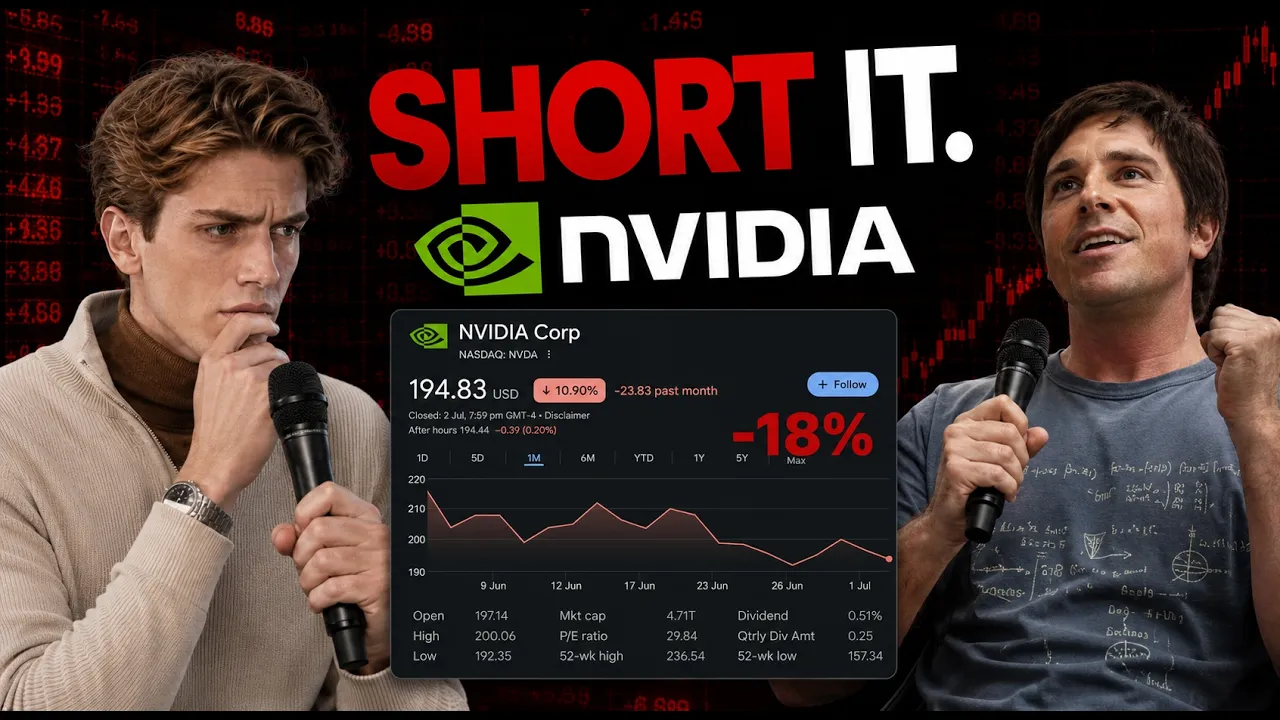
Good day to you, everyone. Welcome back to the channel. Today, we will talk about the truth behind Nvidia's 18% fall. And we are going to explore why some of the most famous short sellers on Wall Street are betting heavily against this chip giant. The stock has recently broken below the key $200 level, marking its worst performance relative to the broader semiconductor index this year. Many investors are left completely confused because the company is still reporting absolute record-breaking numbers. We are seeing a major divergence between the actual business performance and the direction of the stock price itself. And we want to break down exactly what the smart money is seeing that retail investors might be missing. To understand what is happening, we must look at how Nvidia actually generates its massive profits. They built the advanced graphics processing units that power the entire artificial intelligence industry. And they have maintained a near monopoly on these chips. Their gross profit margins sit at an incredible 75%, which is practically unheard of for a hardware company. They have created an interlocking moat through their CUDA software platform, which makes it extremely difficult for developers to switch to any other competitor. This has allowed them to secure a massive order pipeline for their Blackwell and upcoming Vera Rubin systems. But as the business prints cash, a strange dynamic is playing out in the public markets. Their recent fiscal first quarter of 2027 earnings report showed record revenues of $81.6 billion, which was an 85% increase year-over-year. Despite these massive numbers, the stock drifted lower right after the announcement, and even their chief executive officer called the decline a mystery that cannot be reconciled with their strong fundamentals. Hey, guys. Let's take a quick pause here. If you have not realized it yet, this person you are seeing right now is actually a digital clone of me. I am making these videos to share fresh perspectives and deep analysis on stocks and the markets. And if you are enjoying this breakdown, please consider giving me a follow since it helps share this content with more people. This lack of upward momentum shows us that the market is starting to look past current earnings. The big money is focused on future sustainability and how long this level of hypergrowth can realistically continue. We are seeing a growing group of elite investors who believe the peak is already behind us. And they are putting billions of dollars on the line to prove their thesis. We need to look closely at the two most high-profile investors leading the charge against the semiconductor trade. First, we have Michael Burry, the legendary manager who predicted the housing market collapse of 2008. Just 2 days ago, on June 30th, 2026, Burry disclosed a fresh basket of short positions in his Substack newsletter. He initiated short positions against Nvidia at $198 and refreshed his puts against the iShares Semiconductor ETF with strike prices in the mid-400s expiring in March 2027. Burry published data showing that the semiconductor index is currently the most extended relative to its 200-day moving average since the peak of the dot-com bubble, arguing that this is a classic example of index-level overvaluation. At the same time, we have Leopold Aschenbrenner, the 24-year-old former OpenAI alignment researcher. Aschenbrenner is famous for turning a $225 million hedge fund into roughly $9 billion by betting on the initial AI infrastructure boom. However, his latest regulatory filings show a massive unexpected shift. He has built a short position of up to 8.5 billion dollars across the entire semiconductor supply chain, including Nvidia, AMD, Broadcom, and ASML. But, here is the most critical detail of Aschbrenner's position. He is not shorting Nvidia because he thinks artificial intelligence is a temporary fad. In fact, he remains one of the biggest AI bulls in the world. His thesis is that the primary bottleneck of the AI revolution is rapidly shifting away from microchips and moving toward physical infrastructure, particularly energy, power grids, and data center space. He believes that the supply of advanced chips will soon completely overwhelm the capacity of our power systems to run them. Because of this belief, he has shifted his long exposure heavily into power producers and cloud infrastructure companies like Bloom Energy and Core Weave, while shorting the overextended semiconductor names. To evaluate if the big money is right, we must look at the actual valuation and growth projections of Nvidia. At a market cap of around 5 trillion dollars, a massive amount of future success is already priced into the stock. If we assume that Nvidia can grow its earnings by 15% annually for the next 3 years, the forward multiple begins to look more reasonable. However, the risk lies in the assumption that their massive customer base will continue spending at this historic pace. The market is currently wrestling with the return on investment for artificial intelligence infrastructure. Big tech companies have projected capital expenditures of over 630 billion dollars in 2026, and most of this is going directly to data centers and processors. But, if these massive investments do not quickly translate into profitable consumer products or enterprise solutions, these companies will eventually be forced to scale back their spending. We are also seeing clear signs of pressure in the real-time chip market. Data from specialized compute dashboards shows that the hourly rental price for Nvidia's flagship B200 GPU fell from $6.11 in late May to $4.22 by late June. This is a 31% decline in just 3 weeks. This slide suggests that compute capacity is being built out faster than immediate demand is growing. When rental rates fall, the profit margins of cloud providers shrink, which inevitably reduces their appetite to purchase more hardware from Nvidia in the future. This is the core valuation argument that Burry and other critics are highlighting. If the growth rate decelerates even slightly, the stock will struggle to support its current multiple. When you are priced for absolute perfection, any shift from hypergrowth to steady growth can cause a sharp correction, even if the underlying business remains highly profitable. Another reason big money is hesitant to pile into Nvidia at these levels is the rapidly changing competitive landscape. For the past few years, Nvidia basically had no real competition, allowing them to dictate prices and maintain massive margins. But that monopoly is starting to face real pressure. Competitors like AMD are gaining significant market share. In fact, AMD recently reported strong data center revenues of 5.8 billion dollars, driven by high demand for their MI450 chips. At the same time, the major cloud hyperscalers are actively trying to reduce their dependence on Nvidia. Google, Amazon, Meta, and Microsoft are heavily investing in their own custom silicon, such as Google's Tensor Processing Units. These custom chips are optimized for their specific internal workloads and cost a fraction of the price of Nvidia's flagship systems. As these internal chips become more capable, the hyperscalers will naturally direct a larger portion of their budgets toward their own designs, rather than paying a massive premium to Nvidia. Nvidia is trying to stay ahead of this trend by accelerating its product roadmap. They are planning to ship their next-generation Vera Rubin chips this fall, which they claim will deliver 10 times higher performance per watt compared to their current Blackwell systems. But this constant cycle of rapid innovation also has a downside. It forces Nvidia to continuously reinvest nearly all of its cash back into the business and the surrounding AI ecosystem, instead of returning it to shareholders. In their latest earnings call, management confirmed that they intend to keep investing heavily in early-stage startups and infrastructure partners, rather than launching massive stock buybacks. This choice has frustrated some value-oriented institutional investors who want to see direct capital returns. This explains why many big institutional investors are sitting on the sidelines instead of buying this 18% dip. They are observing a classic transition from the early infrastructure build-out phase to a more mature and competitive stage of the technology cycle. They are listening to voices like Michael Burry and Leopold Aschenbrenner because these short sellers are pointing out real physical constraints like power grid limitations and falling rental yields that cannot be solved simply by designing faster chips. This analysis is purely my own opinion and personal perspective, so you should always do your own research before making any decisions. We are presenting this data for educational comparison only, and it is vital to balance the incredible technological achievements of Nvidia against the growing macroeconomic and infrastructure risks. We want to know what your thoughts are on this semiconductor correction. So, please leave a comment with your personal stock picks and your strategy for this market. Thank you for watching and we will see you in the next deep dive.

Comentários 0
Entre para participar da discussão.
EntrarAinda não há comentários. Seja o primeiro a compartilhar sua opinião!