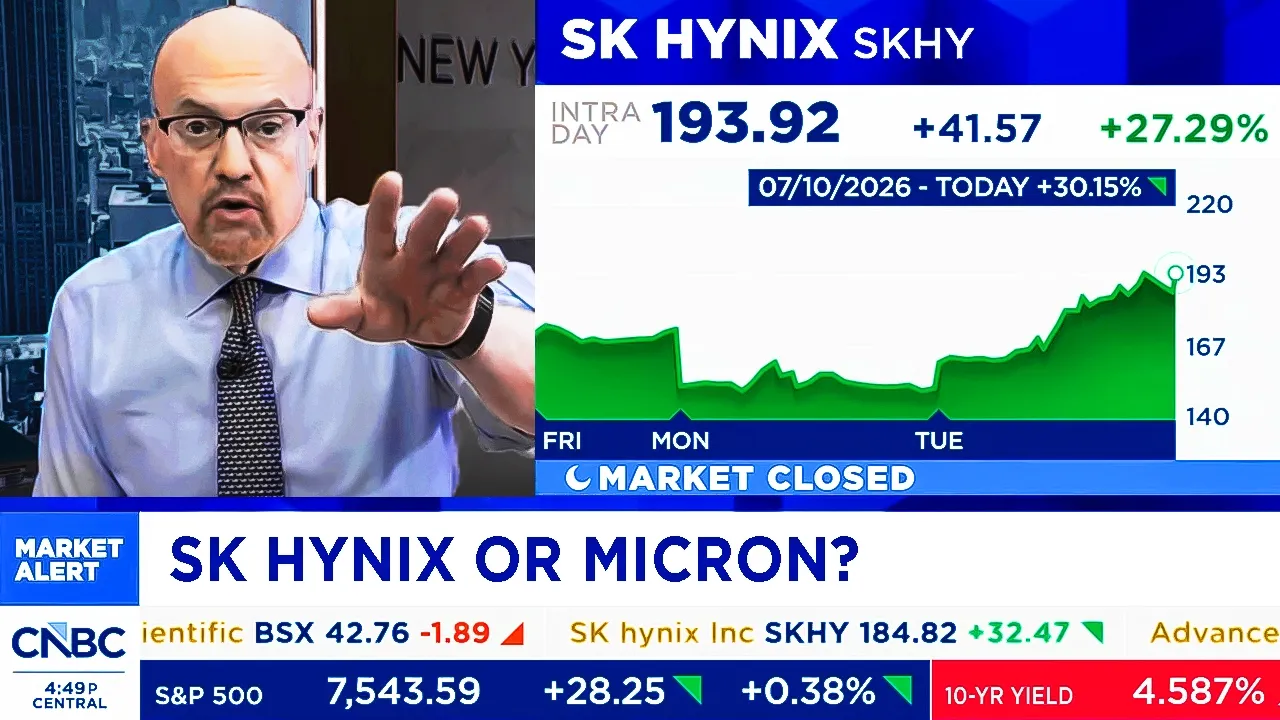
CNBC & Fox Today On NVIDIA Stock, Micron Stock, SK Hynix Stock - NVDA Update

- Retorno do vídeo
- -10,34%
- Chamadas
- 2
- Compra / Venda
- 2 0
- Publicado
Recomendações
Entrada é o preço de fechamento do ativo na data de publicação. Atual é o último fechamento registrado.
-
Entrada $983,12 14 jul 2026Atual $858,03 07 ago 2026Resultado −$125,09
If I was going to buy one stock right now, it would be Micron.
-
Entrada $983,12 14 jul 2026Atual $858,03 07 ago 2026Resultado −$125,09
I think Micron's a buy down in here.
Contexto "I think Micron's a buy down in here. I think the sell-off is too sharp on these names."
Transcrição Completa
So, I think in fairness, the Nasdaq has a lot of other stuff, which is >> It's not software. >> All the hardware, all the memory, all the chips. That entire complex is still going to make a ton of money. >> Right. >> The question is, again, eventually >> Right. >> if you buy oil, you need to put it into a new engine. That engine has to make you go faster, right? It has to >> But it sounds like you're It sounds like you're suggesting that the LLM complex at the high end, which basically is Anthropic and OpenAI in terms of the pricing of whatever that is, and that's still in the private markets, is going to break. Is that what you're trying to suggest? >> I think that's what you're trying to get me to say. >> No, [clears throat] I'm not. No, no, no, no no. >> be very clear. The hardware and memory complex is going to run for another couple of years because there are enormous constraints in that ecosystem. So, there's tremendous scarcity. Those things are going to continue to do well. Nasdaq will probably outperform the S&P. >> Okay. >> SK Hynix up sharply in the premarket, recouping some of the losses from yesterday's decline on those AI jitters. Jim, we got a couple days of trading under our belt. We'll now look for some options-related products that launched. >> Yes, and the Samsung story was denied, by the way, about them doing the same thing. >> considering anything else." >> SK Hynix is the best at something that everybody is short on. Now, you you do get this, I mean, the companies all need more computer. I mean, SK Hynix may be an example of what we're talking about with IBM's problem. People are spending far more on something that they didn't spend. And one of the things that I think people don't remember in the old I was speaking to someone who used to run a major capital equipment company. In the old days, SK Hynix was just like Samsung, which was just like Micron. They all were the same and interchangeable. You'd go to SK Hynix and say, "Listen, I'm getting a great quote from Samsung. You cut your price." That's over. Their stuff is now better and >> Joe T >> Nvidia bought the Joe T. >> Yes. >> Nvidia, we bought some last week. I bought some last week. I think you bought more, right here. >> Okay. >> Uh and here's the the semiconductor chart just for our folks. You look at it this way, it looks okay, not too bad. But just again, in the last 2 weeks, it's been, you know, 14 almost 14 six that's you know 2000 points. If we know it's unnerving, right? I want to bring up you like US over Europe. You like both, but you like US more over Europe. I'm sorry. Another DRAM chart. I was going to hit you hard on the DRAM stuff. >> We can talk about it for a second, right? >> because here's the thing. This is like sort of this is just the the needs, right? And this takes you out to 2030. Again, it feels like the fundamentals are hard to argue. >> That's right. And there's a one particular part of memory which is the high bandwidth memory. That's what the AI data centers need and that's exactly what we're short of. But as a result of we shift the capacity to build those, capacity also moves away from the other memory chips. And as a result, if you look at the average selling prices for all kinds of memory chips they're going down or going up, I should say. Shipments are going up and so that's actually where the strength is in the semiconductor trade. Now, that hasn't changed. And Charles, the last quick thing I want to say about that. A lot of these memory companies are now signing long-term customer contracts. And so as an investor, I have to wonder what does that do to the multiple? If all of a sudden you're not just a cyclical semiconductor trade, but you have a longer term customer base. >> It gives you more confidence that's >> More confidence and higher multiple potentially. >> And you know, listen, I'm in them. I'm riding a wave and to your point, we know it changes. HBM 4 is the next really big big deal. Let me pick up on the Hynix thing now because you know, I talked about this a lot. I think down with the Cosby sell-off which was more about you know, margin call liquidation. But think about Hynix, Samsung, Micron. Their businesses are absolutely killing it. And and again, it gets back to sort of what we were talking about with IBM. At the big picture, these emotionally charged sessions, how do investors deal with it? How do you tell investors to deal with it? >> Well, the thing I look at is fundamental valuation. I was following you on X recently, Charles. I do anyway. And someone had written into you and he said, "You've got to look at that PEG ratio, the price-to-earnings-to-growth ratio." And when you look at names like this, Micron, SK Hynix, out of forward price-to-earnings ratio, basically where they're trading out relative to predicted future near-term earnings, and you layer on the expected growth rate further out on top of that, these still look, I can't believe I'm saying this, but they still look relatively decently priced. And so, it's very hard to, you know, make very strong calls either to to buy or sell. It's hold them. If you get opportunities, get in them, but you've got to be disciplined over the longer term. >> Yeah, I've just got 30 seconds to go. What are your thoughts on these hyperscalers? Morgan Stanley said, "You know what? They're not going to spend 900 billion and a trillion in the next 2 years. They're going to spend 1.2 and 1.4 trillion." Everyone's saying they're nuts. I think it's a I think it's a good investment. They'll get most of it back. Nevertheless, what are you thinking here? Because you've been following this from day one. >> Look, the hyperscalers, I'm in them. We, by the way, are all in them. If you have a tracker, if you've been indexed, you're in them. I would hang on to it. Look, I think the continued build-out here is going to be inevitable. I think people have taken their eye off the ball on the returns on investment to these. That's the problems, frankly, of the customers of the hyperscalers, less so the hyperscalers themselves. So, I think they're in a good spot in the value chain. >> Yeah, I think the I think the ricochet on their free cash flow over the next 3 years is going to blow people's minds. >> But now, I'm not so sure what the market needs in terms of the CapEx and the guidance. I'm not so sure what the market wants in terms of the company's printing productivity. And I'm a little bit more twisted about how to interpret. Is it a good thing that they're firing people cuz they're they're going to get AI productivity or the you know, I'm a little I think that's the thing and I'm really kind of confused about what the market wants. I agree, the long-term picture's in place. There's going to be a lot more capital spending. There's still a lot of return on it. I think Micron's a buy down in here. I think the sell-off is too sharp on these names. I think semis will get another big leg higher at some point in the next 6-12 months from these levels. But I I I just I'm a little bit confused about what the market wants in the July earning season for the hyperscale capex. >> Today chips are higher including Nvidia. For more on that space right now we're joined by Alger Zanker Crawford, executive vice president and portfolio manager at the firm. Welcome back. >> Hi. >> So the first line of your notes, AI trade likely needs to rest. It does? >> Well, it already has rested. Um >> It looks like it's awake. It's awoke. >> Uh really? >> Well, the mega caps are kind of waking up no? >> Yeah, so look, I think the AI trade is a little bit different than the mega caps. Um in some ways like >> Oh, you do. Okay. Oh, so we're just talking about two different things. >> Yeah, so you know, to some extent there's the beta, the the kind of bottleneck trade in the AI world. So you look at Micron. Um a Micron went from 1,200 to 890 or something. >> Right. >> Um and that's the it's it's now resting. It's kind of like churning a little bit. Nvidia's is at 196 today. So I would say that's the AI trade. >> Okay, so that's how you look at the pure what what you think the AI trade is now is more related to these than the the mega caps. Have we kind of moved on? Have we squeezed all the juice that we're going to get for a little bit out of that? >> Um no. So I actually think like if I was going to buy one stock right now, it would be Micron. >> It would? Wow, Adam Parker said it was a buy also. He just left the set. >> I didn't That's why we're friends. >> Well, why why why do you have the confidence to say that now? >> Um because if you look at the cash flows that Micron is going to earn over the next even like 18 months, it will make up like 30% of their market cap. And if you extend it out another year, it's like 50% of their market cap today. Um the the memory market is changing and I think the biggest risk is that China actually comes and becomes a fourth player in in memory market, but that doesn't really happen or impact the market until 2029 or 30. >> I mean because Apple's been talking about tapping that market, right? >> They have been and we'll see if they're they're able to, but for lower-end NAND and lower-end DRAM, the Chinese DRAM and NAND actually can suffice. So, um but we are so short on the high-end DRAM that you have pricing power for a very long time. So, you have one part of the market that is losing pricing power with the software names and you have one side of the market that is going to have ever-increasing I pricing power for the next like 18 months. >> Why so much volatility then if the story, at least as you articulate it, pretty cut and dry? >> Um >> Prices are going to remain elevated, demand's going to remain robust, supply's going to be constrained. That's like a recipe for stock to to go up. What's been happening then? >> investors are creatures of habit. So, if you talk to any I'm I'm an ex-semiconductor investor and every semiconductor investor will tell you, "Oh, it's cyclical. You want to try to find the peak and you're going to put a low multiple on that peak." The problem is that the stocks don't actually peak until you see the peak earnings. And so, we think that peak earnings is into 27, potentially even at 28, you see peak earnings. >> Okay, so so you're making the argument essentially that what what people have historically looked at as highly cyclical businesses and industries is different this time. Especially as it relates to this because you're making a case that it's it's a secular grower, it's not a cyclical story anymore. >> Um I would say it's a secular grower until we have too much capacity and at some point we'll have too much capacity and it really depends on how much CapEx gets put in the ground. As of right now, we can't even put CapEx into [clears throat] the ground, so we cannot make as many chips as we need because we don't have the fabs. We don't have we can't fill the fabs that we don't have. So, building the just building the fabs is going to take a little while then outfitting the fabs will take a little bit longer. And then, as you get to the end of the decade, you have new growth drivers with autonomous autonomous vehicles and robotics, which are new like growth. >> One of the US listed shares of South Korean chip giant SK Hynix soaring today, back in the positive territory since Friday's Nasdaq debut. Options on the stock launched this morning to a surprisingly chilly reception among traders. Our Oliver Renick is live from the Cboe in Chicago with the action. Hey Oliver. >> Hey, Melissa. SK Hynix options had a solid first showing by the close with just shy of 220,000 contracts traded. That's more than the 190,000 contracts traded in SMH, but about half the options volume of DRAM, the ETF or Micron. Flows were almost perfectly divided between puts and calls by volume, but the top 10 trades by dollar amount were either neutral or bearish. That said, a few big call sellers we noted early in the day actually got run over as the stock ramped 27% by the closing bell. It's possible that the dozen leveraged ETFs that also launched on the stock today competed away some of the options volume, but there's also the possibility that actions traders may be rotating away from the memory trade a bit and into the SMH sector generally or Nvidia, both of which saw more notable bullish call skew today and in the case of Nvidia the past week, Melissa. >> Oliver, thanks. Oliver Renick. Really interesting action. I mean, may on evaluation basis that makes sense. >> yeah. Listen, the volatility I'll continue to say the volatility in these names, you throw SK Hynix in the mix over the last month-ish in Micron, SanDisk, up 8%, down 8%, not on a daily basis, but a few times a week for sure. To me, it's a little bit concerning. You typically see action like that on the lows, which we're not at, or at the highs, which I think we might be at. >> Yeah, the the premium that the US ADR trades to the underlying in Korea is extraordinary and it tells you that I think there are a lot of technical things going on because this is a a great case of share class arb. You know, you you can't necessarily own the Korean >> Technical in Korea. >> Yes. Yeah. And I and I think it's it's something you have to be very cautious about here. I think some of that that premium's got to come out. >> Well, in Korea there's all sorts I mean there's a lot of leveraged ETFs already. Margin calls etc. Yeah, so it's a it's like a spiral. >> Zero zero room for error on these names. So all of these other things we're talking about mechanical structured selling, structured buying, but the underlying these are priced truly for perfection, but this is a name that holds 60% of the high bandwidth memory. That's a huge share for them. I don't know they're not going to grow from 60%, but they cannot afford to stumble whatsoever with all those levered bets behind it because an 8% miss reacts with a 30% stock fall. >> Yeah, it is the biggest pure play memory name out there. Um >> And a beneficiary of the IBM news. >> Yeah. I mean doesn't that sort of underscore the notion that there is a longevity to this notion that the spend will continue in memory? >> And it just seemed to gain momentum I mean we're 3 days into a really volatile um history I guess, but I mean it's been public for a long time elsewhere, but I that arbitrage there's no way I would ever set that up. No way. >> Yeah. >> Semi equipment names start to report too. I mean you got ASML tomorrow and I think it's it's a really big print for sentiment which has been fragile especially in other parts of the world. >> Oh, so you're worried about tech then. You think it's way too high. Have you considered the 26.5 billion dollars that SK Hynix the Korean semiconductor company raised last Friday in our markets? What if I told you that stock even after it's skyrocketed $41 today. >> House of pleasure. >> Still trades at about four times next year's earnings, according to analysts at Barclays who initiated coverage today. Yes, it's that cheap. It's downright nutty cheap. It's like ridiculous cheap. I mean, you could like, I don't know, Gemini in it cheap and it should come up or maybe like, I don't know, Claude? Cherry-picking? You think I'm doing that? Hardly. Micron, another red-hot commodity chip maker trades at 13.5 times earnings. Sandisk, stock's up 642% this year already, but only sells at 27 times earnings, even though it has stupendous earnings growth. Finally, in tech world, let's consider Nvidia, the world's largest stock. It looks to be trading at slightly more than a market multiple by some measure. 23 times next year's earnings is the one that's prevailing. Dell, taking a lot of business from a flagging IBM, more on that one later, trades at 25 times earnings. And I think those estimates are way too low. Those stocks are going to turn out to be much cheaper than we think. >> All right, I hope you're all doing well today and staying calm in this market. Today was overall a positive day in the market after CPI came in lower than expected this morning. And it was an especially good day for many tech hardware and data center adjacent stocks after we got some news from IBM. I'll address that news in a moment, but first, let's cover today's Nvidia news. On Tuesday, a US commerce official told Congress that shipments of Nvidia's H200 China have begun, but the number is, quote, very few. We'll see what happens. Nvidia has shipped GPUs to China in the past only for Chinese customs authorities to reject the shipments. So, we'll see what happens this time. As I've said many times in previous videos, any China revenue will be additional upside for Nvidia that analysts are not including in their models. And at the same time, Nvidia's business is growing strong even without China revenue. Also, while we're on the topic of China, I'll briefly mention Chinese memory maker CXMT as they are preparing to IPO in China. There's been a lot of talk about CXMT in recent weeks as market participants are nervous about additional memory supply coming online. It's important to remember that CXMT cannot fully satisfy the domestic memory demand in China, let alone memory demand globally. Demand is far greater than supply. And so, while some people are worried about a potential dumping situation in which CXMT would sell cheap memory and threaten memory makers' pricing power. That's not something that we have to worry about for multiple years. There's simply not enough supply to satisfy the demand. In other news, the FT is reporting that Nvidia has more than half the number of Asian customers that are allowed to purchase Nvidia chips. The FT says Nvidia has created a list of companies that have passed tougher compliance checks aimed at preventing the products from reaching China. The FT says that many of the affected companies that were removed from Nvidia's customer list are neo clouds. In other news, it was reported overnight that Samsung was considering a US listing following the success of SK Hynix's US listing. But then a Samsung spokesperson denied the report and said that Samsung is not reviewing the possibility of issuing ADRs in US. SK Hynix had a very strong trading day in the US on Tuesday, trading at a notable premium compared to the shares that trade in South Korea. As a reminder, SK Hynix is the largest producer of HBM globally and is Nvidia's main supplier. Another big piece of news on Tuesday was a letter to shareholders from IBM CEO as the company released preliminary Q2 results early. This piece of news is very relevant to Nvidia, Micron, SK Hynix, and the AI ecosystem as a whole. IBM reported a miss on both revenue and EPS with revenue up only 1% year-over-year. According to IBM CEO, in late June, large customers unexpectedly redirected their budgets away from software and more towards servers, storage, and memory ahead of feared shortages and price increases. IBM CEO wrote, quote, "While we anticipated some supply chain-related impact in our expectations, we did not anticipate the magnitude of the CapEx re-prioritization. That is very bullish for Nvidia, Micron, SK Hynix, and other tech hardware stocks. IBM CEO is telling us that large customers began shifting their budgets heavily toward tech hardware in late June. I don't think we could have asked for a clearer signal than that. He is quite literally telling us where the money is going. Plus, it's happening faster and at a much larger scale than IBM was expecting. Again, that's very bullish for AI tech hardware stocks. Looking ahead to next week, we have the start of hyperscale earnings with Alphabet earnings scheduled for Wednesday, July 22nd. Meta and Microsoft both report earnings on July 29th, and we're waiting on Amazon to announce their earnings date. Overall, I'm expecting strong CapEx guidance and commentary from each of the major four hyperscale companies. Let's briefly cover each of them ahead of earnings. As for Meta, I'm expecting them to announce strong CapEx guidance. I know there was a bunch of hoopla on July 1st after Bloomberg reported that Meta was developing plans for cloud business. Some days after that report, Zuckerberg clarified that they do not have excess compute. It's just that some of the deals are very attractive and Meta could charge a premium if they rented out a portion of their capacity given the constraints throughout the industry. Meta also recently announced they're expanding their Hyperion data center in Louisiana from 2 gigawatts up to 5 gigawatts. Last earning season, Meta CFO said that they continue to underestimate their compute needs even as they've been ramping capacity significantly. Plus, Meta Superintelligence Labs just recently launched Muse Image, Muse Video, Muse 1.1, and a new model API. Meta is not dropping out of the AI race anytime soon, and I expect guidance to be strong. As for Alphabet, I think they're also likely to report strong CapEx guidance. Last earning season, Alphabet CEO said that they're compute constrained and would have had higher cloud revenue if they had more supply to meet demand. Also, Alphabet CFO said on the earnings call, quote, "We expect our 2027 CapEx to significantly increase compared to 2026." As for Amazon, I'm also expecting strong commentary and guidance regarding CapEx. Amazon CEO Andy Jassy spoke at length last earning season about Amazon having very high confidence that they will monetize the capacity they're bringing online. As a reminder, AWS is monetizing new capacity as soon as it comes online. Last earning season, Jassy said, quote, "The faster AWS grows, the more short-term CapEx will spend." And then on July 1st, AWS raised GPU rental prices by 20%, and they made that decision based on supply and demand. In other words, demand is very strong and outpacing available supply. As Jassy said last earning season, "The faster AWS grows, the more they will spend on CapEx." AWS is clearly growing, and so I expect strong CapEx guidance from Amazon. Now, let's talk about Microsoft because I think this is the most interesting of the four this earning season. I want to remind you of a few things. First, Microsoft will be reporting results for the end of their fiscal year. And so they're likely to provide commentary on the earnings call regarding CapEx over the next 12 months. This is going to be a very important earnings call for the entire AI ecosystem. As a reminder, last earnings call Microsoft guided fiscal Q4 CapEx at $40 billion. They also told us that for calendar 2026, they expect to spend $190 billion. Again, that's for the calendar year. And so calendar 2026 would include the third and fourth quarters of fiscal 2026, as well as the first two quarters of fiscal 2027. And so if Q3 CapEx was 31.9 billion, and let's just assume Q4 is 40 billion as Microsoft guided, that leaves $118.1 billion that Microsoft intends to spend in just the first two quarters of fiscal 2027. That would be an average of roughly $59 billion per quarter, much higher than their CapEx so far. What's the reason for that increase? There are two reasons. Microsoft is investing heavily in additional capacity for their cloud business. And secondly, Microsoft stated earlier this year that they want to have their own state-of-the-art models in-house by 2027. And they're going to need a lot of capacity to do it. As I said repeatedly ahead of Microsoft's last earnings report, I thought their CapEx guidance was going to be notably higher than what many market participants were expecting. That turned out to be correct. Now, I'll be completely honest. I don't know what they're going to say on the earnings call regarding CapEx over the next 12 months for fiscal 2027. If I had to guess, given the fact that they need additional capacity to compete on cloud, they need to have enough capacity to train their own state-of-the-art models. And also what we're seeing in rising component costs, especially in memory, I think we're likely to get strong next quarter CapEx guidance. But I just want you to know that market participants' main focus as it relates to CapEx is what Microsoft will say about CapEx over the next 12 months in fiscal 2027. That is what will likely have an impact on the stocks of companies like Nvidia, Micron, SK Hynix, the neo clouds, and many others. There is some important nuance in Microsoft's AI strategy. And so we need to listen in to the earnings call to get a better understanding of what's going on. If I could only listen to one earnings call from the four major hyperscale companies this earning season, I would choose Microsoft's. What they say about CapEx over the next 12 months will likely determine how tech hardware stocks trade the next day. Overall, I'm expecting all four of the major hyperscale companies to report strong CapEx guidance and important commentary regarding AI monetization this earning season. I don't know what's going to happen in the short term, but from a long-term perspective, I am very confident that Nvidia will be worth much more in future years than it is today. When Jensen was on the Lex Friedman podcast not that long ago, he was very seriously raising the possibility of Nvidia becoming a $3 revenue company in the near future. If that happens in the coming years, then it is very plausible that Nvidia could one day be worth tens of trillions of dollars in market cap. That might sound crazy, but that's what Jensen is implying when he raises the possibility of Nvidia becoming a $3 trillion revenue company. I guess the question at that point is what multiple the street will be willing to give Nvidia. I don't know the answer to that question, but I truly do think that Nvidia will be worth much more in future years than it is today based purely on the fundamental growth of the business. Based on everything I'm seeing, the world is still compute constrained and I expect that it continue at least through the first half of calendar 2028. In a compute constrained environment, developers will use whatever viable compute they can get their hands on. Today, there are no GPUs that are sitting dark due to a lack of demand like there was fiber sitting dark due to a lack of demand at the height of the dot-com bubble. Back then, companies were laying fiber in the hopes that use cases and demand would eventually show up. Today, we are seeing the complete opposite. As I've said many times, when market participants compare this AI revolution to the dot-com bubble, they ignore the fact that the internet is already here this time. This means that mass adoption of the technology and new use case development at scale are immediately possible. We don't have to wait years for it to show up. It's already here. The world is compute constrained, which means there is not enough supply to satisfy demand. New capacity is utilized as soon as it comes online. The hyperscalers are monetizing capacity as soon as it comes online. Each of the hyperscalers spoke about being supply constrained on their most recent earnings calls. Alphabet CEO specifically said that they are compute constrained and would have higher cloud revenues if they had more supply. Additionally, many of the clouds are building out into contracted demand. They're not blindly building in hopes that demand will eventually show up. No, they're building out because they have signed contracts, and in some cases significant prepayments from their paying customers. This AI revolution is fundamentally different from the dot-com bubble. And 2026 will be a pivotal year for the AI industry thanks to the rapid adoption of agentic AI and the proliferation of agentic systems in the world's leading enterprises. The leading AI labs revenues are surging right now. Agentic coding and the implementation of agentic systems in large enterprises are new use cases that are increasing inference demand significantly. That subsequently is increasing compute demand. The rapid adoption of agentic AI is why we're seeing an inflection in inference demand. It's why we're seeing the leading AI labs revenue surge. I wish both Anthropic and OpenAI were public so the public could see the ramp in their revenues. Anthropic's ARR has surpassed $47 billion, up from $9 billion just at the end of 2025. OpenAI is growing rapidly as well. I think the leading labs surging revenues may be the initial proof point that grabs market participants' attention and causes them to realize that there will be a clear ROI on AI infrastructure. I think the leading labs surging revenues will also help assure investors of the longevity of Nvidia's growth since these labs revenues are directly tied to compute. If they had more compute, they would have greater revenues. It really is that simple. Demand is not the problem. The problem is a lack of supply to meet the demand. As I said previously, I expect the world to be compute constrained at least through the first half of 2028, possibly longer. And so regardless of what happens in the short term, it's important for long-term investors to remain focused on the fundamentals, maintain a long-term perspective, and remember that we are only in the early stages of agentic systems being adopted at scale. This will increase compute demand significantly. And after that, the next surge in compute demand will likely be fueled by physical AI. We're no longer talking about digital agents performing digital tasks. With physical AI, we're talking about physical AI agents performing physical tasks in the real world. Nvidia's CFO has called physical AI, quote, "a multi-trillion-dollar opportunity and the next leg of growth for Nvidia. This industry will fundamentally transform society, and Nvidia has positioned themselves to benefit massively." Nvidia sells the hardware for the data centers where the models are trained. They offer Omniverse where the models are taught and tested, and Nvidia also sells the hardware that allows on-device real-time inference through Nvidia AGX, allowing robots to have intelligent interactions with the real world even when they are not connected to a data center. Notice that Nvidia is taking a holistic platform approach to physical AI, and they're embedding themselves as the underlying foundation supporting all of it. Over 2 million developers are already building on the Nvidia robotic stack, and this is not getting enough attention. As for production ramps, Blackwell Ultra has ramped quickly and remains in high demand. Rubin is on track to launch in 2026. Then we're expecting Nvidia Grock 3 LPX in the second half of 2026. Later on, we're expecting the launch of Rubin Ultra in 2027, and Feiman after that in 2028. We have a clear data center product road map stretching into 2028, and Jensen believes that AI infrastructure spending will reach 3 to 4 trillion dollars annually by the end of the decade. That means Jensen is expecting growing AI demand and an expanding total addressable market underpinning all of this. I don't think we are anywhere near any type of bubble-bursting type of event. With all of this in mind, I seriously think that Nvidia still has plenty of runway ahead of it, and I think this company will be worth substantially more in future years than it is today. At least that's my view of the situation. Quick note before I wrap up. All of the compilations on this channel are edited by Finvid with original structure and commentary. Occasionally, the same edits appear elsewhere on YouTube. If you're looking for the original version, it's always here on this channel. Thanks for watching Finvid. I appreciate your support. Remember to stay calm in this market. Remember to maintain a long-term perspective, and do not make any hasty or irrational decisions. With all of that being said, I hope you all have a great rest of the day, and I'm curious to hear your thoughts about Nvidia in the comments below. Please leave a like on this video so more people will see it. And while you're down there, please consider subscribing. It's free, and you can always change your mind. Thanks for watching, and hopefully I'll see you in the next video.
Comentários 0
Entre para participar da discussão.
EntrarAinda não há comentários. Seja o primeiro a compartilhar sua opinião!