had us pivot down our semi-exposure in the middle of June
Contexto
my co-head SHO is an amazingly talented investor. He had us pivot down our semi-exposure in the middle of June as these stocks were all ripping.
Contexto
you should believe that they are going to be innocent until proven guilty and be a buyer of those dips because you have enormous visibility now that you may not have had then multiple years out.
Contexto
Okay, just in other words, buy it and when it happens, I will tell you this, when these things move, they move so quick, you know, you find yourself tough like do I chase it?
Contexto
Micron is our largest position here. Um and it's just because we've been cost bas is like $70. But at this point I think that you're seeing it come in a little bit. ... I think this is a great buying opportunity
Contexto
This one absolutely does. ... Take advantage of this dip.
Transcrição Completa
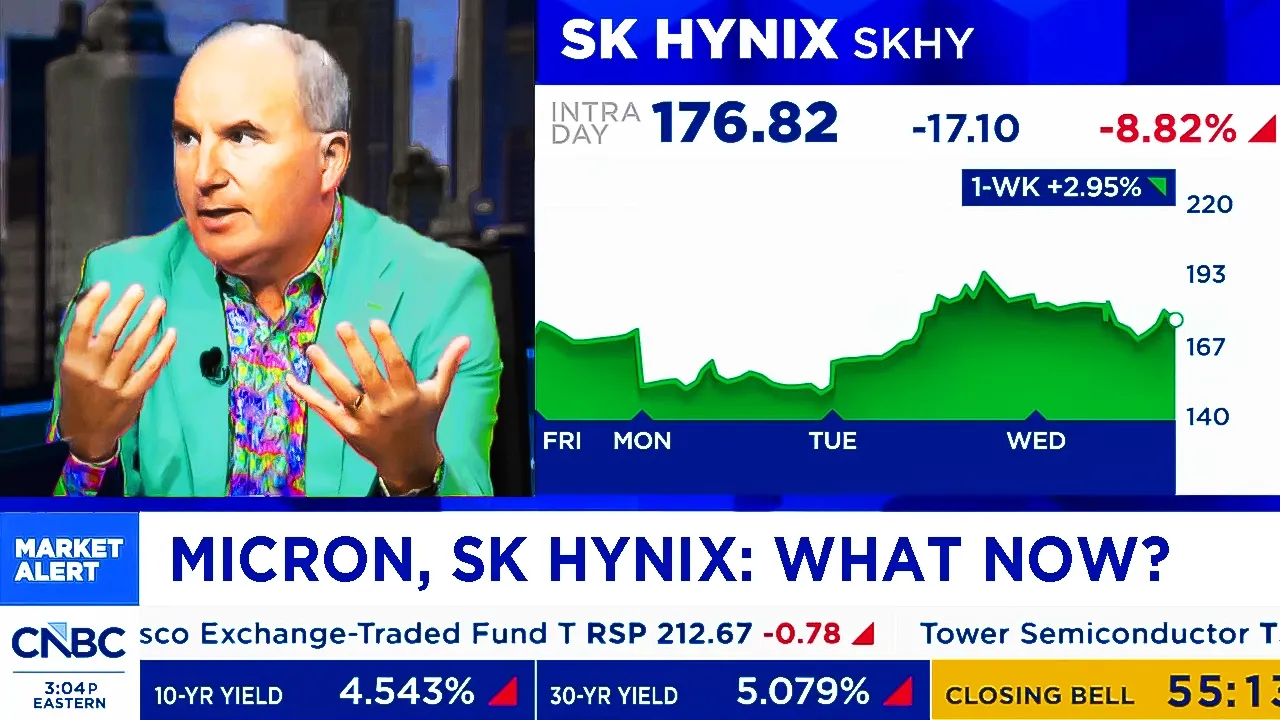
their biggest worry right now supply is not keeping up with demand as you and you see that showing up in the value of of the memory stocks. Okay, we have more demand for memory than we have supply. Obviously, they've been able to do big price increases. I don't know how sustainable that is. maybe in three four years we'll have enough supply but you know um and so what we see as a big investor in data centers the demand for compute is not slowing down it's growing faster the problem we have as a country we're not investing fast enough so I have an opposite >> so you're we're just not even we need to do even more >> I mean a trillion dollar capex spend from six companies not enough I I believe it's well not just there we're not investing our grids fast enough we do not have enough adequate supply of power and that's what's creating some of the issues at certain state levels that they're worried about electricity prices for the consumer which is a legitimate issue but other states that have more power and more capability of delivering power which and and delivering power that is not going to raise the price to the consumer are going to be the big winners for growth. >> Yeah. >> So, in the last quarter, we, you know, we contracted close to 1 gawatt of power in Pennsylvania. Okay. We're financing another big data center in in another state and in my conversation with every hyperscaler, demand is exceeding supply. And yes, you're right. These large companies used to be balance sheet light and now their business has changed and that is with but that's the role of the capital markets and I promise you these are going to be great investments for individuals if we could if but you got to know that the underlying business model ultimately that we get to is going to generate enough revenue and profit to be able to pay for all the data centers. They're not cheap. >> Yeah. They're 50 60 billion dollars for one gigawatt. What I worry about Dave is not the demand side. I worry about can all a society benefit from AI because right now compute is so expensive. My questions to everybody in the hyperscaler business is not whether it's not whether they have enough demand is how quickly can they bring down the cost of compute. I'm not worried about Black Rockck paying for um the the AI and I think you know we've been a huge investor in it and our systematic equity team has really benefited with it with the flows and the return but I worry about the small and medium businesses how are they going to be able to compete in this new AI technology world. So the biggest question I ask behind the scenes is how quickly can we bring down the cost of compute and and okay they you know they tell me it's like a Moore's law and how quickly they can develop faster and faster analytics to to have faster compute. >> Apple's breaking out and I said yesterday I think Nvidia is going to follow. It's down today. It had a strong afternoon yesterday. It's going to participate as well here in the coming weeks. >> There's the semis trade which seems impossible right now like Good luck if you're trying to figure out directionally where the semis are going because as we've seen the swings are huge and the swings seem to have no stickiness. What is one day up could tomorrow be down as much as we've seen the up and therein lies the issue with that. I wonder if some of that is why the mega caps are seeing the money come back. Once again viewed as a safety place within the AI orbit. You know people still think there's a lot of juice to be squeezed from these names. I thought >> we try to rhyme with history as it relates to the semi-names and what has happened is these volatile reactions that we've seen have been a result of something that might have happened in 2000 where fundamentals didn't deteriorate to a year after price deteriorated. And so every time there's a scare, people run for the exits because they know price leads in that segment. So far, you should believe that they are going to be innocent until proven guilty and be a buyer of those dips because you have enormous visibility now that you may have not had then multiple years out. And so, listen, hyperscalers are viewed as a hedge to that. So, you're going to see the hyperscalers rally every time this momentum group sells off. I think you got to own both. I think the David what David Solomon said is right. This a AI ecosystem is under a long buildout. No one is slowing their their jets on that. They're flying full speed into it and the beneficiaries are going to continue to be the beneficiaries for a while and you know Nvidia is a name too that I I like a lot here. It's been kind of consolidating. U I mean you're the free cash flow there is is becoming amazing relative to the other Mac 7s and if it wasn't a $5 trillion company might even think that they take that thing private at some point. But at at it I mean it's at the this this size that's obviously not on the table. The one thing I I would look to uh mention what Steve touched on with with the memory names is Micron in some of those names. Yeah, maybe they got ahead of their skis. Microns is our largest position here. Um and it's just because we've been cost bas is like $70. But at this point I think that you're seeing it come in a little bit. You're seeing some leverage unwind out of South Korea. You're seeing some of this trade just maybe kind of get tossed aside. And that's fine heading into because a lot of them report in the back half of earnings season and I'd like to see them not at the highs going into that because we saw what happened uh just over the last few weeks. They have these terrific reports and then the stocks sell off. So I think yeah Scott to your point I think that that is right. You're seeing a lot of rotation into the Mag 7 that's coming out of some of these high-f flyier AI infrastructure names. How about that? So the mag 7 today are holding up a little bit better. But overall there's this idea for you that we have bought the rumor sold the fact meaning that for the capex uh projections and for the receivers of that capital that so much is priced in now that even as their earnings come in Samsung and ASML really strong and even be a little bit beating expectations there's just nothing left to move it higher. Does that mean the whole what are is the whole trade pivoting now to a different area? I I think ultimately what happens is the market goes through these moods of kind of looking around and seeing what the stock action is and and not having a lot of confidence in that. I just want to kind of reiterate I still believe that we're in the third inning of this AI infrastructure piece and just not even begun on the application side or physical AI side. The news around IBM was positive for the AI infrastructure buildout. It was also positive about how AI can disrupt software. Even though the numbers were negative, I think that was a positive read. If we look at ASML, grew at 21% versus 11% last quarter. That's an acceleration. They're looking for 16%. This news from Apple yesterday, this beta of iOS uh 27, it's really essentially it's the birthday of personalized AI, and I've been using it for the past day. Uh the negatives are that it's a little bit slow. It takes up a little bit more juice on your phone, but I can say this is a major unlock for consumers in terms of understanding how personalized AI can impact us every day. I feel like I actually have a new phone right now. And so, Kelly, when I think about like again that your question is the right question, like we know everything is great. My perspective is the market's going to kind of do what it's going to do just around some of the emotion. I'm looking at the real fundamentals. We talked about those near-term. You also mentioned the some of the bigger companies and ultimately this all comes down to the AI trade all is going to come down to two simple uh events. what is going to happen with capex spending next year and separately the cloud growth numbers and I think that uh we're going to see much better uh I think the numbers for next year for example for the capex the street's looking for 23 I think it's probably 37% plus growth >> look new street raised yesterday they said you know they thought the sell side was underestimating the scale of hyperscaler investment we had uh Morgan Stanley's Brian Noak just raising his uh outlook for capex we have Morgan Stanley's CFO or CEO today on the Paul talking about capex hitting $10 trillion. If these aren't moving the needle, then you have to ask yourself what will. >> Well, ultimately what will is that if this continues to grow higher for longer and what we're hearing from all those data points, everything we've talked about today underscores just how early we are. And uh this I think is a a market kind of digesting the basic concern is that all these data points are so incredible. There must be a slowdown. There must be a material slowdown next year. For example, capex this year the street's looking for 77% from the hyperscalers for calendar 26 as I mentioned going to 23 next year 23% I think it'll be higher but that kind of piece and so Kelly you're asking the right question is will the market get get credit and I would just put it in this very simple term is that we when you think about what AI is at its most basic level it's intelligence at scale what is the value of that to humanity and ultimately if these companies are going to continue to invest aggressively and we're going to see some pretty impressive of growth rates and margin expansion. I think they will get credit. >> I just wonder if it's moving on if the new beneficiaries of AI are the financials, you know, are corporate America itself that's able to deploy this to better ROIs. >> Well, let me bring up Nvidia. You uh let's just focus on that for a moment. I know you like it. It is seem it seems to be hobbled by scuttlebutt things that can't shake. So, a week or so ago, I think it oian analysis said, "Hey, Ver Rubin's delayed for a year for an entire year. It shook up everything associated with that. Uh you know we had sort of soft push back from Jensen. He's in Japan overnight. He says no it's not true. Vera Rubin is already in production and yet the stock is still down. How do we how does this stock get traction? Yeah. I mean you know expectations are running really high but they've got an enormous moat. uh they have you know huge visibility of of revenue whether it's you know the newer chips or even um you know the existing uh supplier that they've got in place. So I I think it's a it's a a great company uh continues to beat uh uh uh earnings and on expectations and revenues and it's trading at a market discount. So um you know how much of it do you want? Okay, just in other words, buy it and when it happens, I will tell you this, when these things move, they move so quick, you know, you find yourself tough like do I chase it? So maybe it's better to just keep positioning positioning and when that moment comes, you're confident it will. I happen to believe it will too as well. What you have to do is you have to understand what you think these companies are worth, where you think they're going to positively surprise and then lean into those pockets and take advantage of when the market is selling off the infrastructure and bidding up the hyperscalers and go the other side of that trade or vice versa depending on >> is that what you're doing today for instance you go to the place like where we're down four or five% again in the semis. >> Yeah. So my co-head SHO is an amazingly talented investor. He had us pivot down our semi-exposure in the middle of June as these stocks were all ripping. they were sort of trading underneath 2% free cash flow yields, which is, you know, a really pretty expensive valuation for semiconductor stocks. Right now, they've retraced about 50% of that move because cash flow estimates have moved up, the stocks have pulled down. So, we're leaning back in. And so, we're building the exposure that we took off 6 weeks ago, putting it right back on today. And that's what we're encouraging clients to think about. Now, we do think as you look forward over the next two years, that, you know, the the whole compute ecosystem will continue to benefit. capex numbers are going to move higher and you know >> that's your your guess because we're going to hear from five of the mag seven later this month and you think those estimates are going higher? >> Those estimates are going to move higher. Yes. Both across this quarter and as we move into next year you're stronger uh when it comes to memory chips and things like that. >> Absolutely. >> And Micron Micron's floating, you know, flirting with that 50-day moving average. It's come down a lot again since the magnificent earnings report. When does someone consider buying more? >> I still think this is a great buying opportunity. If we look at the past month, it's actually been rather flat. EPS has been up over 30%. So analysts have increased their EPS targets over 30% with the past month. >> Over 30%. >> Over 30%. That is a buying opportunity there. Revenue is over 300%. So Micron I think is something we have. It it may seem overcrowded, but Nvidia seemed overcrowded at one point as well. So that demand is there. We saw that from IBM, Dell, all of the earnings so far are saying capex budgets are being squeezed and they are going into data. They're going into storage. So therefore, we need exposure to that. >> Just as ASML seems like, you know, that that they've got it such such a a sweet spot carved out. So does Taiwan. >> This one absolutely does. >> I mean, this is another name that you like a lot. It's another one that's floating around with the 50-day. Take advantage of this dip. >> But absolutely still need exposure to this. Take advantage of this dip. That buy the dip mentality. I am absolutely believing in that but it this is a component even Nvidia ut utilizes them. So it's very important to have that. >> What do you make of what continues to go on with chips and then what the mega caps are doing in terms of their trade today and over the past month? I mean they've certainly woken up. >> Yeah. >> But chips remain really really hard to to figure out. >> I think it goes back to SK memory. Those are the golden childs of this AI trade. you've seen massive sell-offs since, you know, since really SK, you know, went public. But then on the other side, look at where Nvidia and so many of these other chip names are. It comes down to Q earnings. I mean, that's really going to be the flash line, the dark tunnel. We've talked about it. 15 to1 demand the supply. This AI revolution, it's still third inning, but the hyperscalers, those are the ones, the ones that are funding the AI party, funding the capbacks, those are actually the ones that are mostly in the penalty box. That's why it's so important for Alphabet, for Microsoft, for Amazon. We go into what's really just I think a fork in the road to earnings season, but I continue to view it. The demand story, it's still early. >> I want to talk to you about a number of those names. Let's go Alphabet. Uh because it's so timely given what Warren Buffett said. This was my pick. >> Uh and he thinks they're going to be a winner. What' you make of that? >> Look, Buffett and has talked about I think valuation. You look at Alphabet a year ago, New York City cab driver was bearish on and now as it plays out in terms of what they're doing on search, what they're doing on cloud, some of the parts for those like a Buffett or Birkshire looking for, okay, what are valuation names that you could rationalize in AI, you go back to SpaceX and some of the others maybe on the other side of the spectrum. This is a perfect example that fits well in and they are at the epicenter of the buildout and especially when it comes on search. >> All right, I hope you're all doing well today and staying calm in this market. Today was a rough day for many tech hardware stocks as well as the stocks of companies associated with data center buildout. Nvidia was decently red intraday but recovered from the lows of the session before the close. There appear to be multiple factors that contributed to the selloff in memory stocks on Wednesday. I think a big reason for the sell-off is what we heard from ASML overnight which I'm going to address in a moment. But I think the move lower in many tech hardware stocks was due to multiple factors. So let me mention some of those before I talk about ASML. First, SKH Highix finished the day about 9% lower after it was up 27% on Tuesday. He's price action on Wednesday contributed to the sell-off in other memory names. It also appears that tensions are rising in the Middle East, which likely contributed to some downward pressure on momentum stocks. That said, PPI came in cooler than expected Wednesday morning, which is positive for stocks. I do think it's notable that we saw the four major hypers scale companies trade solidly in the green on Wednesday while many of the memory names were solidly in the red. So I do think Wednesday's price action was partially a rotation back in a mega cap tech names ahead of earnings later this month. I also think a Tuesday night report about coreweave may have contributed to the sell-off in memory stocks on Wednesday. The report claimed that Coreeave is exploring the use of derivatives as a potential hedge against a future drop in memory and storage ship prices. According to an unnamed source, it's important to point out that we don't know if this report is true or not. And even if it is true, the report says that discussions are still in the early stages. Coreweee has not executed any hedges. And even if they do, that does not guarantee that memory prices are going to fall prematurely. But for right now, as I've said many times, market participants are extra sensitive to any news or rumor that they perceive as being a potential threat to memory makers pricing power. So, that report likely contributed to the sell-off in memory stocks on Wednesday. I've also noticed some concern regarding the upcoming IPO of Chinese memory maker CXMT in China as market participants are worried about new supply coming online. As a reminder, CXMT cannot fully satisfy domestic memory demand in China, let alone the rest of the world. Because the demand is so great, there's simply not enough supply to satisfy demand. And so, it's too early to worry about a dumping situation wherein Chinese memory makers threaten the pricing power of the other memory makers by selling memory at lower prices. right now and likely for at least the next couple of years, there is simply not enough supply to meet the demand. On that note, yesterday in Taiwan, PSMC announced that it is raising DRAM foundry pricing by approximately 45% in July versus June as major cloud providers lock up future capacity and demand exceeds available supply. And now, let's address what ASML said on Wednesday when they reported earnings. As a reminder, ASML provides equipment used to manufacture advanced semiconductors to customers like TSMC and the memory makers. ASML reported better than expected second quarter results and increased its 2026 revenue forecast. The company also said it plans to expand manufacturing capacity by approximately 30% in 2027 and they are investigating another 30% increase in 2028 due to strong demand forecasts from their customers. ASML said customers continue to accelerate capacity expansion plans. ASML also indicated that nearly all of its expanded EUV capacity through 2027 is already booked. ASML's strong earnings and commentary about their customers expanding capacity may be the main reason why memory stocks traded lower on Wednesday. There are two sides to this news. On the one hand, the fact that memory makers are expanding capacity speaks to the fact that they expect sustained memory demand. And on the other hand, we're talking about memory makers increasing capacity. As I've said many times in these videos, right now, market participants are extra sensitive to any piece of news that they perceive as being a threat to the memory makers pricing power. And so commentary about new capacity coming online is enough to scare market participants even if much of that new capacity will not be operational for multiple years. Now let's cover today's Nvidia news. Jensen Huang visited Japan as Nvidia and Sega celebrate 30 years of collaboration. If it wasn't for Sega, Nvidia would not exist today. Back in 1995, Nvidia was a small startup on the verge of bankruptcy. Unable to deliver the product they had promised Sega after they chose the wrong technology. And although that was the case, Sega decided to invest $5 million in Nvidia anyway after being impressed by Jensen. That investment from Sega quite literally saved Nvidia from extinction. It's an incredible story. And today, Nvidia and Sega announced that they are bringing multiple Sega titles to Nvidia RTX Spark, which is Nvidia's new superchip for slim Windows laptops and compact desktop PCs. Also, while in Japan, Jensen said that reports about Vera Rubin being delayed are quote not true, and that Vera Rubin is in production with very large production volumes coming soon. Also on Wednesday, The Information published a story claiming that Apple is actively exploring acquisitions of AI chip companies to accelerate its own development of processors. That story claims that Apple experienced performance difficulties with its own M2 ultrabased AI servers, which resulted in Apple running portions of the new Siri on Nvidia GPUs inside Google Cloud. On that note, Apple just opened up Siri AI to the public with the iOS 27 public beta. And as was just mentioned, Apple Foundation models run complex inference tasks on NVIDIA GPUs inside Google Cloud. Looking ahead to next week, we have the start of Hypers scale earnings with Alphabet earnings scheduled for Wednesday, July 22nd. Meta and Microsoft both report earnings on July 29th, and we're waiting on Amazon to announce their earnings date. Overall, I'm expecting strong capex guidance and commentary from each of the major four hypers scale companies. Let's briefly cover each of them ahead of earnings. As for Meta, I'm expecting them to announce strong capex guidance. I know there was a bunch of hoopla on July 1st after Bloomberg reported that Meta was developing plans for cloud business. Some days after that report, Zuckerberg clarified that they do not have excess compute. It's just that some of the deals are very attractive and Meta could charge a premium if they rented out a portion of their capacity given the constraints throughout the industry. Meta also recently announced they're expanding their Hyperion data center in Louisiana from 2 gawatt up to 5 gawatt. Last earning season, Meta CFO said that they continue to underestimate their compute needs even as they've been ramping capacity significantly. Plus, Meta Super Intelligence Labs just recently launched Muse Image, Muse Video, Muse 1.1, and a new model API. Meta is not dropping out of the AI race anytime soon, and I expect their capex guidance to be strong. As for Alphabet, I think they're also likely to report strong capex guidance. Last earnings season, Alphabet CEO said that they're compute constrained and would have had higher cloud revenue if they had more supply to meet demand. Also, Alphabet CFO said on the earnings call, quote, "We expect our 2027 capex to significantly increase compared to 2026." As for Amazon, I'm also expecting strong commentary and guidance regarding capex. Amazon CEO Andy Jasse spoke at length last earning season about Amazon having very high confidence that they will monetize the capacity they're bringing online. As a reminder, AWS is monetizing new capacity as soon as it comes online. Last earning season, Jasse said, quote, "The faster AWS grows, the more short-term capex will spend. And then on July 1st, AWS raised GPU rental prices by 20%. And they made that decision based on supply and demand. In other words, demand is very strong and outpacing available supply. As Jasse said last earning season, the faster AWS grows, the more they will spend on capex. AWS is clearly growing and so I expect strong capex guidance from Amazon. Now, let's talk about Microsoft because I think this is the most interesting of the four this earning season. I want to remind you of a few things. First, Microsoft will be reporting results for the end of their fiscal year. And so, they're likely to provide commentary on the earnings call regarding capex over the next 12 months. This is going to be a very important earnings call for the entire AI ecosystem. As a reminder, last earnings call, Microsoft guided fiscal Q4 capex at $40 billion. They also told us that for calendar 2026, they expect to spend $190 billion. Again, that's for the calendar year. And so, calendar 2026 would include the third and fourth quarters of fiscal 2026, as well as the first two quarters of fiscal 2027. And so if Q3 capex was 31.9 billion and let's just assume Q4 is 40 billion as Microsoft guided. That leaves $118.1 billion that Microsoft intends to spend in just the first two quarters of fiscal 2027. That would be an average of roughly $59 billion per quarter, much higher than their capex so far. What's the reason for that increase? There are two reasons. First, Microsoft is investing heavily in additional capacity for their cloud business. And secondly, Microsoft stated earlier this year that they want to have their own state-of-the-art models inhouse by 2027. and they're going to need a lot of capacity to do it. As I said repeatedly ahead of Microsoft's last earnings report, I thought their capex guidance was going to be notably higher than what many market participants were expecting. That turned out to be correct. Now, I'll be completely honest. I don't know what they're going to say on the earnings call regarding capex over the next 12 months for fiscal 2027. If I had to guess, given the fact that they need additional capacity to compete on cloud, they need to have enough capacity to train their own state-of-the-art models and also what we're seeing in rising component costs, especially in memory, I think we're likely to get strong next quarter capex guidance. But I just want you to know that market participants main focus as it relates to capex is what Microsoft will say about capex over the next 12 months in fiscal 2027. That is what will likely have an impact on the stocks of companies like Nvidia, Micron, SKH, the Neoclouds, and many others. There's some important nuance in Microsoft's AI strategy. And so we need to listen in to the earnings call to get a better understanding of what's going on. If I could only listen to one earnings call from the four major hypers scale companies this earning season, I would choose Microsoft's. What they say about capex over the next 12 months will likely determine how tech hardware stocks trade the next day. Overall, I'm expecting all four of the major hypers scale companies to report strong capex guidance and important commentary regarding AI monetization this earnings season. I don't know what's going to happen in the short term, but from a long-term perspective, I am very confident that Nvidia will be worth much more in future years than it is today. When Jensen was on the Lex Freedman podcast not that long ago, he was very seriously raising the possibility of Nvidia becoming a $3 trillion revenue company in the near future. If that happens in the coming years, then it is very plausible that Nvidia could one day be worth tens of trillions of dollars in market cap. That might sound crazy, but that's what Jensen is implying when he raises the possibility of Nvidia becoming a $3 trillion revenue company. I guess the question at that point is what multiple the street will be willing to give Nvidia. I don't know the answer to that question, but I truly do think that Nvidia will be worth much more in future years than it is today based purely on the fundamental growth of the business. Based on everything I'm seeing, the world is still compute constrained and I expect that to continue at least through the first half of calendar 2028. In a computed environment, developers will use whatever viable compute they can get their hands on. Today, there are no GPUs that are sitting dark due to a lack of demand, like there was fiber sitting dark due to a lack of demand at the height of the.com bubble. Back then, companies were laying fiber in the hopes that use cases and demand would eventually show up. Today, we are seeing the complete opposite. As I've said many times, when market participants compare this AI revolution to the dotcom bubble, they ignore the fact that the internet is already here this time. This means that mass adoption of the technology and new use case development at scale are immediately possible. We don't have to wait years for it to show up. It's already here. The world is compute constrained, which means there is not enough supply to satisfy demand. New capacity is utilized as soon as it comes online. The hyperscalers are monetizing capacity as soon as it comes online. Each of the hyperscalers spoke about being supply constrained on their most recent earnings calls. Alphabet CEO specifically said that they are compute constrained and would have higher cloud revenues if they had more supply. Additionally, many of the clouds are building out into contracted demand. They're not blindly building in the hopes that demand will eventually show up. No, they're building out because they have signed contracts and in some cases significant prepayments from their paying customers. This AI revolution is fundamentally different from the do-com bubble and 2026 will be a pivotal year for the AI industry thanks to the rapid adoption of Agentic AI and the proliferation of agentic systems in the world's leading enterprises. The leading AI labs revenues are surging right now. Agentic coding and the implementation of Agentic systems in large enterprises are new use cases that are increasing inference demand significantly that subsequently is increasing compute demand. The rapid adoption of Agenic AI is why we're seeing an inflection in inference demand. It's why we're seeing the leading AI labs revenue surge. I wish both Anthropic and Open AI were public so the public could see the ramp in their revenues. Anthropics ARR has surpassed 47 billion, up from $9 billion just at the end of 2025. Open AAI is growing rapidly as well. I think the leading labs surging revenues may be the initial proof point that grabs market participants attention and causes them to realize that there will be a clear ROI on AI infrastructure. I think the leading labs surging revenues will also help assure investors of the longevity of Nvidia's growth since these labs revenues are directly tied to compute. If they had more compute, they would have greater revenues. It really is that simple. Demand is not the problem. The problem is a lack of supply to meet the demand. As I've said previously, I expect the world to be compute constrained at least through the first half of 2028, possibly longer. And so regardless of what happens in the short term, it's important for long-term investors to remain focused on the fundamentals, maintain a long-term perspective, and remember that we are only in the early stages of aenic systems being adopted at scale. This will increase compute demand significantly. And after that, the next surge in compute demand will likely be fueled by physical AI. We're no longer talking about digital agents performing digital tasks. With physical AI, we're talking about physical AI agents performing physical tasks in the real world. NVIDIA CFO has called physical AI, quote, a multi-trillion dollar opportunity. and the next leg of growth for Nvidia. This industry will fundamentally transform society and Nvidia has positioned themselves to benefit massively. Nvidia sells the hardware for the data centers where the models are trained. They offer omniverse where the models are taught and tested. And Nvidia also sells the hardware that allows ondevice real-time inference through Nvidia AGX allowing robots to have intelligent interactions with the real world even when they are not connected to a data center. Notice that Nvidia is taking a holistic platform approach to physical AI and they're embedding themselves as the underlying foundation supporting all of it. Over 2 million developers are already building on the Nvidia robotic stack and this is not getting enough attention. As for production ramps, Blackwell Ultra has ramped quickly and remains in high demand. Reuben is on track to launch in 2026. Then we're expecting Nvidia Gro 3 LPX in the second half of 2026. Later on, we're expecting the launch of Reuben Ultra in 2027 and Fineman after that in 2028. We have a clear data center product roadmap stretching into 2028 and Jensen believes that AI infrastructure spinning will reach three to 4 trillion annually by the end of the decade. That means Jensen is expecting growing AI demand and an expanding total addressable market underpinning all of this. I don't think we are anywhere near any type of bubble bursting type of event. With all of this in mind, I seriously think that Nvidia still has plenty of runway ahead of it. And I think this company will be worth substantially more in future years than it is today. At least that's my view of the situation. Quick note before I wrap up. All of the compilations on this channel are edited by Finn Vid with original structure and commentary. Occasionally the same edits appear elsewhere on YouTube. If you're looking for the original version, it's always here on this channel. Thanks for watching, Finnvid. I appreciate your support. Remember to stay calm in this market. Remember to maintain a long-term perspective and do not make any hasty or irrational decisions. With all of that being said, I hope you all have a great rest of the day. And I'm curious to hear your thoughts about Nvidia in the comments below. Please leave a like on this video so more people will see it. And while you're down there, please consider subscribing. It's free and you can always change your mind. Thanks for watching and hopefully I'll see you in the next

Comentários 0
Entre para participar da discussão.
EntrarAinda não há comentários. Seja o primeiro a compartilhar sua opinião!