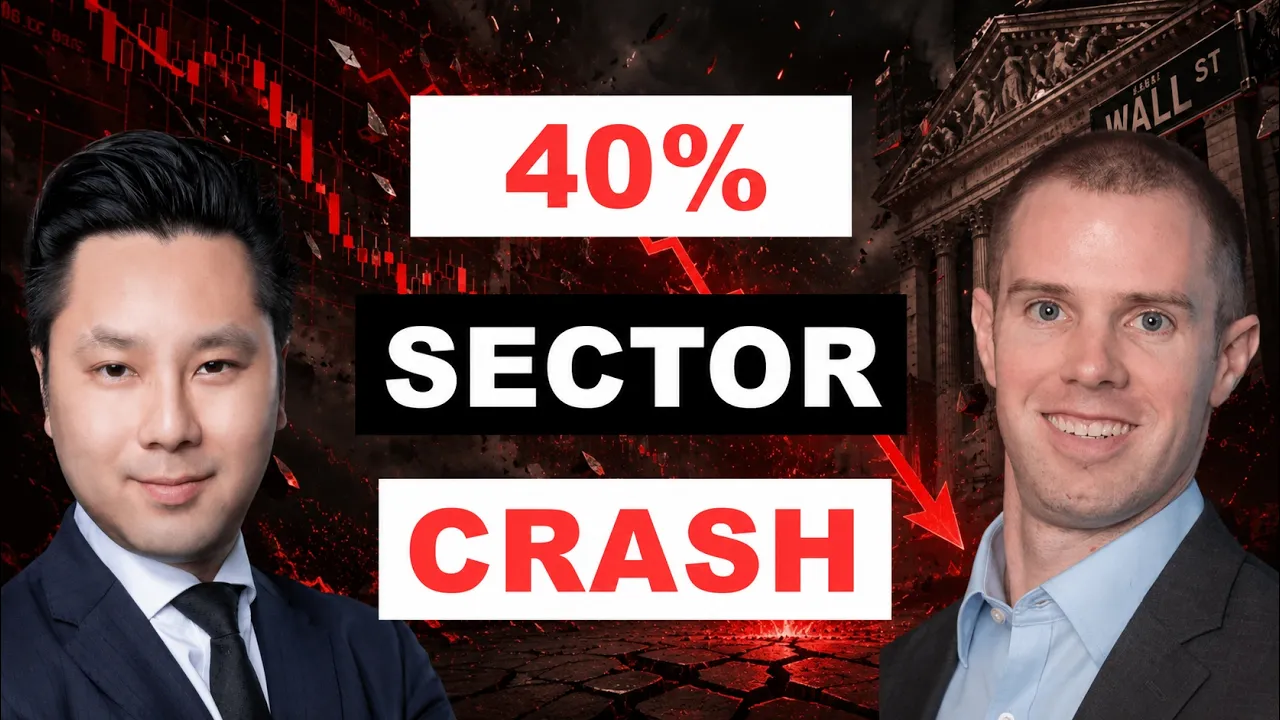
we look at the high quality semiconductors out of all of the the industry about 12 or 15 companies. We would say they're overvalued on average and their projected downside uh in just a typical 20 25% bare market for the index would be 40% downside for the semiconductors from today's prices. And for us, when we're looking to invest in a new stock in our stock portfolio, we want that projected downside to be 20% or less. And so to have something with that much downside, we just don't have much interest in that area unless you saw a really significant drop and a change in in conditions in that industry.
Contexto
"we would say they're overvalued on average" and "we just don't have much interest in that area"
Transcrição Completa
We are looking ahead to 2027 and we do think that there's the potential for a deeper decline next year. The momentum this year has been even crazier than it was in 2025. It just shifted. Precious metals uh had an amazing 2025 that's been unwinding, but uh the whole AI trade and semiconductors specifically that's starting to unwind in the last few weeks. Since 2020, we entered a different structural period uh for long-term bond yields where we think the Treasury yield on the 10 or 30 year is going to be moving higher, which is poor for bond prices. >> I'm pleased to welcome back the show Chance Venukin, CIO of Oxbow Advisors, and we'll be going over Oxbow's stance on the current market conditions and what they're focused on right now. Chance, welcome back to the show. Good to see you. >> Great to see you, David. Thanks for having me back on. what uh you and your firm have been doing have been serving as a good indicator uh is what we should be doing. So let's start with some of the positions that you've rotated in and out of over the last couple of months. I would say last quarter to start and then we'll talk about why. >> Sure. So uh Ted Oakley, our managing partner, talked about this in his quarterly video that we posted in the last couple of weeks. uh really within our high income strategy, it's been starting to rotate back into uh some of our energy positions and our precious metals positions. Those were areas that we had trimmed some of our exposure in the first quarter uh with precious metals. We had trimmed it in January when you saw that spike in gold and silver prices that we thought had gone too far. And then in energy when the oil price really spiked higher uh when the Iran war started, we took some of those positions off. But as the price of oil dropped below $70 a barrel, we've begun to allocate back to that area as well. And then in the stock portfolio, the allocation has been pretty similar throughout the year, staying about 60% allocated to stocks and then keeping 40% liquid and short-term treasuries uh just because we continue to believe the the market is fully valued. But the focus has really been on the unloved areas of the market that are not caught up in the speculative AI craze that was such a driver of the rise in stocks in the second quarter that we're now starting to see unwind in the last 3 weeks. >> What indicators would you look for to I guess make the make the decision or the call to buy more of something that has fallen? And I speak for a lot of assets that topped last year um and have started to fall this year. Precious metals being one of them. Uh Bitcoin being another. I know I know that's not something your firm focuses on. I'm just using that that as an example. And the tech stocks, three of the four uh three of the seven, sorry, three of the seven mag seven stocks that I looked at last week have been down year to date. And so it certainly looks like the markets have at least from a technical perspective topped late last year or early this year for many of the assets. And so the question remains, how do you decide whether or not to get back in on anything that's fallen? >> I think that's the right way to frame it is that the way a lot of I'd say majority of the activity in the market right now is chasing momentum. whether that's retail investors or some quantitative funds out there that are driving the majority of trading activity. They're trying to find whatever the hottest momentum trade is and they sell off anything that doesn't fit within that. And so our strategy uh over the last year, we're sticking to the principles of what we think is the right way to invest, but it's really just trying to take advantage of selloffs in areas that those players are not focused on. So gold and silver, for example, you had the gold price peak at about uh $5,500 an ounce. Silver peaked at 116 an ounce. We always kind of had a range of with gold falling back to about $4,000 would we be where we start to get a lot more interested again and then silver falling back to about $60 an ounce or basically cutting in half is where we would get more interested again. And we're about at those levels. That does not mean that this has to be the bottom. Maybe it goes a bit deeper, but it's now hit a price that we're comfortable adding back to some of those positions, whether it's to gold and silver themselves or to mining and royalty companies that play in that space. >> And by adding, I I suppose you don't mean fully committing to the position, just maybe buying the dip, so to speak. >> Yeah. So if let's say on average over years uh in the high income strategy our average allocation to precious metals uh is about 10% uh and that's pretty evenly split between the gold and silver uh metals themselves and then the companies that operate in that industry. uh it got up to about 15% of the portfolio late last year after such a great move in that industry and we took that down to more of a mid-s singledigit level and now we've been building it back up towards about that average 10% and if prices got even cheaper from here we would incrementally look to add more uh to make it a larger position. >> Okay. Uh let's take a look at some of the slides that uh you've provided here from Oxbow Advisors. This one is pretty key. The stock market has split AI and nonAI. You've got here in the blue bars S&P, X Energy, and AI. And then with everything else, S&P and AI. Um, how would you as an investor interpret this divergence? What does that mean for you? Would would you be uh would you split your portfolio evenly on one side of the divide or another? or is this just an indicator for you to I guess look at certain things that are less overvalued than others? Yeah, when we look at this, we would say that nearly half of the market right now, and it's only about 50 or 60 companies, uh, but it's nearly half of the market cap is viewed as AI beneficiaries. And that's driven almost the entire return in the market this year. And based off the companies we follow within that list, we think by and large they're overvalued. And just taking the semiconductors as an example, we look at the high quality semiconductors out of all of the the industry about 12 or 15 companies. We would say they're overvalued on average and their projected downside uh in just a typical 20 25% bare market for the index would be 40% downside for the semiconductors from today's prices. And for us, when we're looking to invest in a new stock in our stock portfolio, we want that projected downside to be 20% or less. And so to have something with that much downside, we just don't have much interest in that area unless you saw a really significant drop and a change in in conditions in that industry. Right now, it seems like all the optimism is baked into that story and those valuations. You have here a slide earlier showing uh IPOs, hot new IPOs often decline in the first year. Uh I take it you guys didn't buy SpaceX. >> We did not. Uh that was one that uh SpaceX and then Open AI and Anthropic later this year and potentially early next year. Uh we've noticed there's there's a lot of interest whether it's from investors or just people we know in our lives. Uh they've kind of captured uh people's attention. But I thought this was a good table just to show that you have time if you really want to own a company like that. You can usually wait at least a year and you're going to end up getting a cheaper price than where it trades after the first day that it goes public. And SpaceX has been another example of that where I believe it's down 16% from where it closed uh after the first day of trading already. Global critical minerals demand has increased exponentially driven by the clean energy transition, electrification of vehicles, and AI infrastructure buildout. The United States Geological Survey also included silver on the 2025 list of critical minerals in November 2025. But despite booming demand, supply remains highly concentrated. Governments around the world are strategically injecting capital into domestic supply chains to mitigate geopolitical risks. Today's sponsor, Brixton Metals Corp. led by a highly experienced management and technical team is actively exploring for these metals including drilling at its Thorn copper gold project in BC and at its Langus silver project in Ontario. While Langus has produced some of the highest silver drill intercepts ever reported, initial drilling assays from the Thorn project recently also returned very robust results of 14.75 m of 1.25% 25% copper, 1.71 g per ton gold, and 149 g per ton silver. More information on Brixton Metals and its two drilling programs can be found on their website, Brixton Metals.com. The company trades on the TSX Venture Exchange under the symbol BBB and on the OTCQX under the ticker BBBXF. Do your due diligence on Brixton Metals today. Chance, you and I have spoken last in uh I believe November. Let me just double check that. Yeah, you were on the show November 2025. How has the war in Iran changed anything fundamentally for you? >> I think for us it was just trying to be nimble in the portfolio. So going into this year, we had a good exposure to energy positions and other commodities like the agriculture industry. And when the war in Iran started unexpectedly, I don't think anybody had that uh baked into their analysis, you saw the prices of those underlying commodities increase a lot and the companies operating in those spaces increased a lot in their share price. So, we had to be a bit more reactive in trimming those positions uh after having such a substantial move. And now that you've seen a pullback, we're adding back to those positions again to kind of get back to the exposure we had at the start of the year. So, I think when something of that nature happens that was not expected, you really just want to pay attention to the shift in valuations of what's in your portfolio. Uh, and if you're a beneficiary and you get a big move upward, that's great, but it probably need mean means that you need to adjust a little bit, take some off the table, and then be ready to add it back later. >> Does it change some of the major themes that were prevalent last year, including tariffs, inflation expectations, interest rates, um, and of course energy? Well, let's break it down one by one. So, starting with foreign policy and how that's impacted uh trades and investments. So, ever since the Iran war broke out, that's been front and center and that's been the focal point of headlines in regards to foreign policy. Tariffs took a back seat and of course markets don't like tariffs. We saw here the S&P 500 uh decline dramatically at the onset of the war, but then see a very rapid V-shaped recovery. Um, does the Iran war change the narrative for whether or not uh tariffs and um and protectionism overall globally uh will change your calculus for um risk appetite, let's say. >> I think just to pull back, look at it a little bit more broadly. And it's been a trend that we think's been going on for four or six years now. And it touches on all those things you mentioned, whether it's foreign policy, interest rates, inflation. We've entered a new era in the 2020s that's different from what we had in the 2010s where there's just going to be more volatility in terms of geopolitical events, whether it's wars, and right now it's Ukraine and Iran. It could be fluctuation in inflation. The inflation rate on average is higher this decade than what we experienced last decade and it's more volatile. and then what that does to interest rates. And so, uh, that clarifies things if we have that as the underlying backdrop. And one example of that would be looking at long-term bonds. Uh, we think that since 2020, we entered a different structural period uh, for long-term bond yields where we think the Treasury yield on the 10 or 30 year is going to be moving higher, which is poor for bond prices. And that doesn't mean you may not have a 6 or 12-month period where owning a 20 or 30-year Treasury bond does well, but we think on average uh when you're looking out five years, that's not a great place to be because of this increase in uncertainty and inflation and interest rates. Uh so that's usually the backdrop we're looking at. And then when something specific happens like the war in Iran, we're looking at what we own uh both that would be a beneficiary and what would be perceived as uh you know something that would be impacted negatively. Uh so if there's uh oil or gas as a key input to a product of a company that we own, what's the the negative hit that might be to their earnings? Uh and how much downside do we want to risk? Uh you also had something we noticed we owned a few of the the travel companies like booking or Airbnb or Expedia. Those got hit initially when there was concern about what this would do to international travel. So those are the sorts of things that you're watching just to make sure that you don't have too much downside from a new geopolitical event. Uh but often you're trying to keep it within a a range that you think is reasonable. And it's only when something really gets extended like the the price of some of those energy stocks uh that we trimmed at the high that you really want to take any action. >> When the Iran war first broke out in late February and you were reading the headlines for the first time, was there a uh a set of asset classes for one particular asset class that you defaulted to as let's say a war default so to speak? >> We don't usually operate that way just because we're trying to look out three or five years in our analysis. And what we notice with markets is when something unexpected like that happens, the market tends to move so fast that you would miss the big initial move just to start with. So we look at more in terms of just upside and downside, not knowing what could trigger the event, but looking for a good riskreward ratio. And that oil price is a good example where at the start of this year, you still had an oil price that was trading, you know, around $60 give or take. And it was trending higher uh before the war started. But that was a price that we thought was a good riskreward for us to own some energy businesses that would benefit for any reason that you saw the oil price start to accelerate higher. So in this case it was the Ron War that took things from $70 a barrel to over $110 uh and were able to participate in that. So, it's almost like you just want to have a balanced portfolio uh that you think there's an asymmetric upside to downside ratio that you can take advantage of if something happens that's in your favor. >> Let's take a look at uh oil now. It's u the energy sector is something that uh Oxbow follows very closely. At what point did o oil look very overbought to you? I think that that initial spike there was a day Ted and I were trading messages that overnight and there was not a lot of liquidity in the market but I think overnight you got to over $120 a barrel and Brent crude oil and uh and that was just a really unexpected move farther than you would have imagined in a single night. Uh and that kind of tells you that similar to the the January move in gold and silver that uh there's just a lot of speculation because of all the uncertainty in the marketplace and what's happening at that time. uh and we want to make sure that we we adjust things and recalibrate the portfolio uh for a move that's probably not going to stay at that level. Uh and we are still optimistic on oil prices and and holding energy positions for the long term, but when it moves that much that fast, you're probably not going to be able to hang on to those gains. >> Okay. Are you more or less bullish on oil stocks now at $80 a barrel than pre-war $60 a barrel? >> It's probably about the same. Uh, one thing we notice is when you get more geopolitical events like this, we think that does raise the floor on the oil price that there is going to be more of a premium uh on a barrel of oil just because of these this increase in geopolitical activity uh that might reduce the supply u of oil or gas in different parts of the world. And and then that has knock-on effects um in terms of how things get refined into products. And that's really, you know, how we would view it is even though the price is higher than it was at the start of the year, we we think the the stocks are still about as attractive as they were back in January. >> Are you currently long oil? >> We don't do it specifically through oil like we would through gold and silver. Uh we prefer to own it through businesses that are exposed to oil or natural gas. >> Uh meaning the explorers, producers, refiners, all the above. >> It's a mix. it's >> pipelines, could be integrated companies that do have a refining business, uh that's been a real tailwind for them, uh exploration production companies, and then one other area that that Ted's done a great job of adding to uh is oil service businesses because we do think that there'll be parts of the world that will need to be either repaired or see drilling increase uh over the the years to come. And that's an area that's been a newer addition for us in the last year. >> Yeah, let's talk about that. What's the thesis for American oil and gas and pipeline companies uh based in America or North America for that matter? Uh much of the U oil consumed in the US is either produced in the US or imported from Canada or Venezuela. And so it's relatively insulated. The US is relatively insulated from the events in the Middle East. From that front, of course, the changing of the oil price itself would impact valuations and changes for uh all consumers. Uh, but all in all, do you see a fundamental shift in why you would own an American oil and gas or pipeline business from before the war to now? I don't think it's that sort of a a wholesale shift. We were positive about uh owning a good number of American oil and gas companies before the war started. Uh, and it's a similar enthusiasm today. uh as long as you've got a a reasonable oil price, this $70 $80 level, that's perfectly okay to generate a lot of cash flow for these businesses, uh business keeps moving for them. And we think these management teams have gotten a lot smarter from decades past in what they do with that cash flow, whether it's uh paying dividends, increasing the dividend, um things along those lines that uh is good for shareholders. And um let's talk about also what happens when the Federal Reserve raises rates which seems to be uh the expectation for this year. First of all, are you agreeing with the bond markets uh especially in the CM Fed watch tool which tracks the probability of a Fed hike that we do have at least one hike by the end of this year? >> I don't know that we're making a call that there'll be one hike or no hikes. Uh it seems the environment seems a little bit fluid right now because of the war picking back up here in the last couple of weeks. If there was no uh resumption of the war and this memorandum of understanding stayed intact and and the ceasefire stayed intact, you could make a pretty clear case that the inflation rate would reduce back down to about 2% by March or April of next year. And a lot of that is just cycling off of lower oil prices compared to what we saw in March a few months ago. But if the oil price stays higher, then that makes a little bit more tricky for the Fed in terms of the inflation rate being stickier. And that that's where I think it's difficult to make a call because you're trying to forecast what's going to happen to the oil price over the next 3 to 6 months and how much of a driver that is uh for Fed Chairman Worsh whether he wants to do a rate hike uh or try to stand pat and and see if the inflation rate can slowly and steadily come down on its own. >> Right now is the 10-year yield front running potentially rate hikes. You think the fact that it's gone up to about 4 and a.5%. I think the 10-year and the 30-year Treasury are looking more at the increase in geopolitical activity and the potential for the inflation rate staying higher or more volatile for longer. And that's what that is pricing in. The the 2-year yield dropping after that most recent CPI report. I think that's trying to get ahead of uh or or keep in mind that if you did have a a drop in the inflation rate back towards 2% over the next eight or nine months, uh that will be more priced in on the short end of the Treasury curve, say 2 years or less because we do still think that uh the Federal Reserve wants to get to a point where they can cut rates again uh on the short end, but they can't do it until they really see traction on the inflation front. And are you expecting consumer sentiment and consumer strength overall to pick up or decline throughout the rest of the year, which would impact whether or not you stay in the defensives or the cyclicals? >> I think it's been a tough time for the consumer. Uh you just in the last few months got back to the the headwind that we had in 2022 where the inflation rate was higher than than wage growth. So, we do think it's still a difficult time for the consumer and and from the standpoint of a consumer discretionary investment. You really want to make sure that you're choosing businesses that have tailwinds to them uh rather than something that the consumer may decide they can hold off on purchasing that for 6 or 12 or 18 months. >> I want to talk about uh your expectations for how the AI trade unwinds. Um, you have many charts here that I can show about how overstretched the valuations are and um, and of course that's been a driving theme for investors for quite some time, including at Expo Advisors when I talked to you and Ted last. Here we go. AI IPO valuations are extreme. How do you play extreme valuations? Do you sell, stay away, or do you ride the wave? >> We're not ones to ride the wave. Uh not that that can't be a successful strategy for momentum investors, but momentum investors tend to be more short-term. You've got to really flip the portfolio if if things turn the other direction. Uh which isn't a fit for us when we're trying to buy and hold investments for 3 or 5 years at a time. And so for us, we don't short stocks and so we just stay away. If the valuations uh do not look appealing for us and the downside looks too high, uh we'll just wait. And any common stock that you follow, there will be some point in a 5-year period that you get the valuation you want. And so, it's just a matter of being patient. And right now, valuations like what we see in the private marketplace for these three big companies that have everyone's attention, if they're trading at 20 to 70 times revenue, uh, when by comparison, Google went public at 8 and a half times revenue. Uh so that was a more reasonable great IPO to try to invest in during the first year that it became public. These seem more like all of the optimism and the best case scenarios are priced in. Uh which we understand all the enthusiasm around the AI trade, but that doesn't leave a lot of upside left. And uh what we see right now, if you just use the semiconductors as an example, when they've pulled back in the last few weeks and some of these companies are reporting earnings and yet they trade down after stellar earnings reports, uh it's an industry that's as cyclical as semiconductors. The investors are looking out multiple years and this year is fantastic for the AI tribe. Next year's uh numbers will probably be great. But a true cyclical investor that knows this industry is looking out 2 3 4 years at what's the normal earnings level uh after this kind of subsides. And I think that's the debate right now is what's going to be normal earnings for some of these semiconductor businesses that are reporting great growth now, but there's going to be uh an unwind on the other side. >> Speaking of SpaceX, yes, it might be one of the most expensive IPOs ever, but compared to where Elon thinks it's going to go, potentially it's still very cheap. is is how you may look at Elon says his goal for SpaceX is to be worth more than the entire earth. The uh if he achieves his goals, his company will be worth more than the entire earth is his bold prediction, right? He wants to populate the moon. He wants to go to Mars. He wants to build a bunch of data centers in space. And that's just a fraction of what he wants to do with SpaceX. Okay. When you see a statement like this, how does your investor brain work? How do you analyze these kinds of forward guidances, so to speak? Yeah, you could like Warren Buffett would say, you put it in the too hard pile. You know, it's it's not something that we think we have any edge in. Uh I saw Jim Chenos, who's a legendary short seller in the business, uh he had pulled out a a sellside report that was bullish on SpaceX, but the the analyst who wrote the report, admitted that they did not expect any free cash flow from SpaceX until at least 2035. And so for our style, we want businesses that generate free cash flow. uh and then hopefully are returning some of that cash flow to us uh through dividends uh or coupons. And so it's just not something that's really a fit for us. And if anybody else wants to try to to speculate in that uh I hope it works out for them, but it's just not the type of thing that we're looking for. >> Why do you think momentum in markets overall have waned this year versus last year? And I'm not talking about oil and a spike there, but like I mentioned in the introduction, uh gold's run has ended for now. Uh Bitcoin's run ended last last fall. Uh three of the seven mag seven stocks are down year to date and you even have a slide saying how the mag 7 have fallen out of favor and it just looks like overall uh the NASDAQ has been trading sideways and consolidating over the last couple of weeks to months. Is there a reason for why sentiment and risk assets overall is a little more cautious this year versus last year? or is it just simply a matter of pulling back from the momentum that we saw in 2025? >> Well, I could make the case that the momentum this year has been even crazier than it was in 2025. It just shifted. So, the mag 7 was the driver for a couple of years there. Precious Metals uh had an amazing 2025 that's been unwinding. But uh the whole AI trade and semiconductors specifically uh that's the most significant momentum move uh we've seen in the last 30 years relative to lower volatility stocks. Uh and that's starting to unwind in the last few weeks. We'll see if it continues. But what we notice is about 60% of the actual trading done in the market now uh are done by players that are pretty fundamentally momentum players. And so what they do is uh they find a trend that they want to push and they push it for as long as they can. And then when it starts to shift against them, they'll rotate out of that space like they did out of gold and silver or the mag 7 and they find the next area. And so right now it's been semiconductors up until a few weeks ago. Now they're starting to rotate out of that and look for something else. So, uh, for us, that's not really a game that we're trying to play where we're trying to change our portfolio entirely every 3 months, but we can try to take advantage of it when there's something that's just forgotten by those traders uh, and we see prices get breached in uh, in other industries that they're not focusing on that we could buy that might be something that they decide to buy later and we already have the position. um what is the game plan for figuring out what that next thing they're rotating into, investors are rotating into are or is and then maybe getting into that? I know you don't change your stance every 3 months, but uh uh what would be the process there if you had to find out what they're going into outside if they're coming out of uh semiconductors? >> Yeah. Yeah. Well, what we've noticed is there's a lot of investors today that have a mandate uh or just want to if they're retail investors stay fully invested. So, if they're going to sell semiconductors, they have to put the money somewhere. And what we've noticed with that is uh let's say they're selling semiconductors or some of their tech or capital equipment positions. there's been a big rotation into financials, health care, a little bit in utilities, uh other areas of the market, consumer staples, and so when those areas have been getting sold off for the last several months, uh we've just been adding incrementally to names that we like in those areas. Uh and then whenever the momentum players decide to flip, uh that tends to be the area they look to next is whatever they haven't been buying and they need to balance out the portfolios and we're already there with the positions that we want. uh anything that looks very attractive valuations rise. We've talked about AI being the opposite end of that spectrum. What else looks what would look very cheap for you right now? I think we've touched on it a lot, but I think the energy and precious metals space uh look pretty attractive uh just on a pure absolute basis. We like uh those areas really sold off in the second quarter and we think that this is a been a good entry point to uh to have those positions. We're making sure that our clients have full positions in those stocks that we want to own. In terms of the rest of the market, I wouldn't say we've got a good portfolio in our long-term growth stock strategy of highquality businesses that we think are fairly valued. We wouldn't describe it as cheap. Uh but it's not an expensive portfolio. Uh it trades at a better than 5% free cash flow yield. We think the earnings uh of that portfolio can grow about 10% a year. we think it's a reasonable uh allocation to have and then we're just prepared if you do see a more significant selloff at any point in the market that presents better prices then there's plenty of room for us to add more at at cheaper levels. >> And finally, uh on bonds, you talked about this a bit earlier, how you think interest rates are, uh going up, the long end of the curve um is still going to go up. Uh how would that change your stance or outlook on treasuries? I know uh Ted in the past in past years he's been fond of treasuries. Um what about now? >> Yeah, just making the distinction between short-term treasuries versus long-term treasuries. Uh we think the this new environment over the last six years that can stretch for multiple decades. The way that bond cycles and interest rate cycles move. It could be multiple decades that uh long-term bonds are just not a very good place to be outside of a short-term trade. So our focus in our fixed income positions uh has been on treasuries uh investment grade corporate bonds and then if clients need them municipal bonds but all with maturities of about 3 years or less uh so that if the inflation rate and interest rates move higher uh as those treasuries the short-term treasuries mature we're able to then roll them into higher yielding treasuries more quickly. But we think it's a good place to be on that 2 years, 3 years or shorter level. And what we did do in uh the last couple of months, as you saw the 2-year Treasury yield jump back above 4%, uh we locked in more of our clients assets at that 2-year level, just so that we know if if you have a recession, an economic slowdown, uh inflation comes down, any of those reasons that would make the Fed start cutting rates, we've already locked in more at a better than 4% yield for the next couple of years to to drive a better return for our clients. >> Okay. And uh bottom line then, are you expecting uh Rick risk uh risk sentiment to return to the other areas we talked about uh that have fallen or do you expect this rotation to continue for the rest of the year? >> Well, Ted's always said going into this year, these sorts of midterm election years are volatile. And so for the remainder of this year, you know, maybe there is a deeper correction that that has started in these AI names uh that could go further. It would not surprise us if the enthusiasm and and greed around this trend continues and they move higher later into the year, but we are looking ahead to 2027 and we do think that there's a potential for a deeper decline next year mainly because you're going to be cycling through some some high growth, high inflation numbers uh from the first half of this year that when you cycle against that next year, it's going to look like growth is really decelerating. Inflation's coming down. That's not a great environment for for risky assets. >> Okay. Thank you, Chance. Very good to speak with you once more. I hope to have you on again uh very soon. Tell us where we can follow Oxbow Advisors and your work. >> Sure. If you'd like to learn more about our firm, you can look us up at oxbowadvisors.com as well as on our YouTube channel. Search for Oxbow Advisors. >> Okay, good. Thank you very much, Chance. Good to see you again. And uh please do follow Chance in the links down below and follow Oxbow Advisors. See you next time Chance. >> Yeah, definitely. Thanks a lot, David. >> Thank you for watching. Don't forget to like subscribe.

Comentários 0
Entre para participar da discussão.
EntrarAinda não há comentários. Seja o primeiro a compartilhar sua opinião!