I'm leaning my paper money trade is leaning to the bullish side... So, I looked at the August 7th a 2-week spread. 2 weeks, that should show you that you do have a chance to extend duration. Buying August 7th, selling July 24th, 210 220 call diagonal.
Contexto
Kevin Hincks' example trade on Nvidia: "I'm leaning my paper money trade is leaning to the bullish side..." and "buying August 7th, selling July 24th, 210 220 call diagonal."
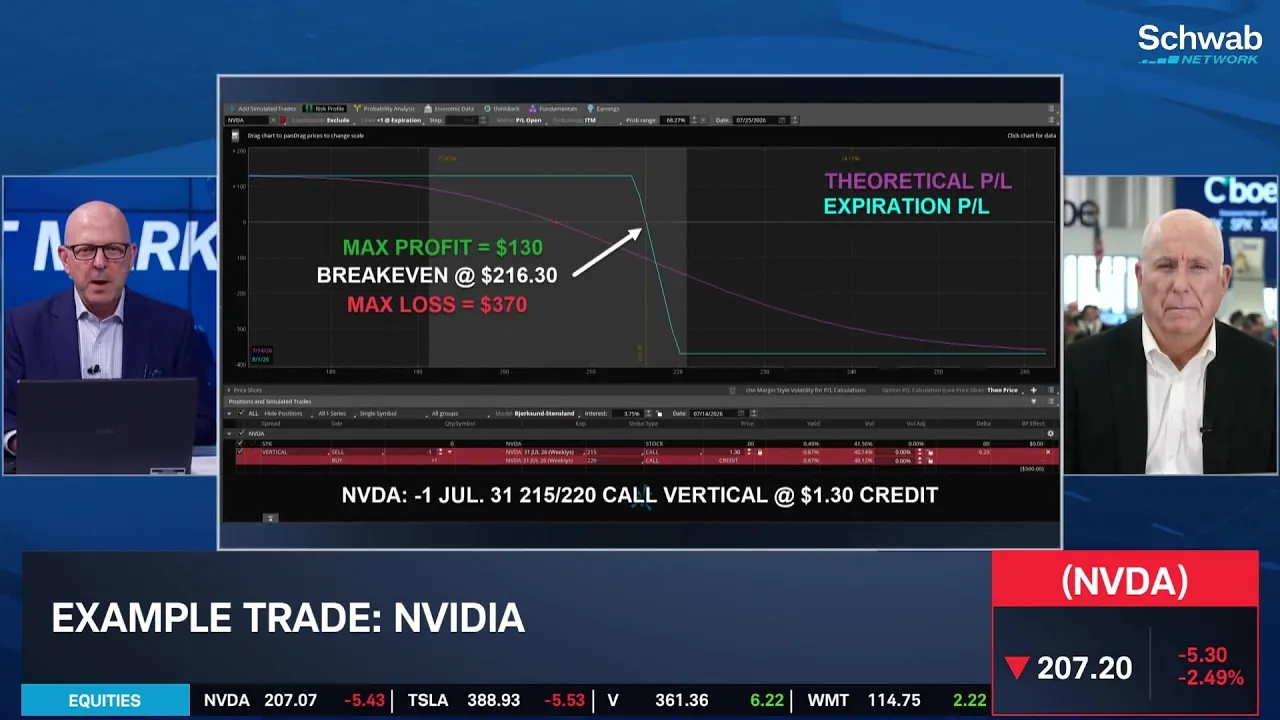
I went out to the July 31st weekly options. So, just about 2 weeks to expiration on this one where I'm going to sell the out of the money 215 strike call and then buy the 220 strike call. So, a short $5 wide neutral to bearish call vertical.
Contexto
Tom White's example trade on Nvidia: "I went out to the July 31st weekly options..." and "sell the out of the money 215 strike call and then buy the 220 strike call."
Transcrição Completa
Welcome back to Fast Market here on Schwab Network. Nvidia is making another big push to expand its footprint, this time in Japan. CEO Jensen Huang unveiling a series of partnerships aimed at helping Japanese companies build systems tailored to the country's language, industries, and workforce. Among its efforts, the chip giant is teaming up with Toyota on next-gen AI-powered vehicles and with Mitsubishi to develop advanced cooling and infrastructure needed for massive AI data centers. Nvidia also now has plans for what it says will be the world's first national AI factory dedicated to physical AI supporting robotics, autonomous machines, and other applications. For investors, it's another sign Nvidia is looking beyond selling chips and to position itself as the backbone for the AI ecosystem globally. All right, time now for the tug-of-war on Nvidia. For that, let's welcome back in our co-host Tom White and Kevin Hincks. Guys, it is bull versus bear time. So, before we get to your example trades, we got to get each of your thoughts on the AI giant. Kevin, I'll start with you. Nvidia shares not seeing this as a positive catalyst today, but look, again, we've got pressure on chips today. The Philly Sox down and just pressure across the board. But, what's your take on Nvidia? >> Taiwan Semi's performance or their earnings and their capex raise should reinforce the confidence in Nvidia. The Vera Rubin chip coming out at the end of the year is going to be GPUs and CPUs. I think Nvidia, every day we wake up, there's more and more deals being made. Jensen Huang expanding his footprint from industry to industry and company to company. I understand what's happening to the market. And I think this is going to figure out to be a pretty strong buying opportunity. When and from where, I have no idea. Well, you know, how long this lasts, but they've got earnings coming up August 26th. It's going to be an interesting next month into that earnings report cuz they're going to start talking about Vera Rubin. They're going to talk about all these things and these new new deals and I think this is just a stock catching its breath, Diana Tom. >> Tom, what's your take? >> Yeah, Jensen Huang on that parade around Japan, you know, announcing those partnerships that you mentioned. I think one of the key ones was that Noetra partnership that they have where they're going to be building out and using the Vera Rubin CPU chip. Remember, they're trying to expand and I think that's probably why we've seen a cap on shares in Nvidia is that as everybody moves from the training models to inference, you know, where is you know, where is Nvidia in that mix? Well, they're expanding. They're innovating to compete better on that side while they still own 90 you know, 90% of the GPU market at this point. I think that's key moving forward and if you look at their stack, their full stack across the board, they continue to to broaden out their CUDA reach where they can just do everything for every customer. So, everybody they think they're still focused on the GPU sales which are eventually going to roll over. Now you have competition on the TPU side. You've got competition from you know, Google Alphabet and Amazon trying to build out their own chips using Broadcom and I think that's the concern that a lot of investors have that they're not going to be able to keep this pace up, but they're just looking at the GPU side. I think they're losing a little bit of luster just due to the fact that they haven't really ramped up the CPU side and the push into inference like maybe some of the other big tech companies are are coming for. But hey, you listen to Jensen Huang, they grew 85% last quarter on a year-over-year basis and they expect that to continue and he's a pretty big proponent of what they're doing and their growth rate, but the stock just hasn't reacted the way it has for some of the other companies. >> All right, let's get into your example trades. Kevin, let's start out with yours. What's your approach today? >> Now, Diane, if you had to guess is Kevin bullish or bearish on Nvidia, what would it be? I'll tell you what it is. It's leaning my paper money trade is leaning to the bullish side. Remember, this stock traded $235 a very short time ago. Do I know where the stock's going? I do not. However, if you think that Nvidia has a chance to rally, this uh diagonal spread is something in the calendar spread family that collects data on a daily basis cuz you're buying further out uh implied volatility and selling shorter-term implied volatility. So, I looked at the August 7th a 2-week spread. 2 weeks, that should show you that you do have a chance to extend duration. Buying August 7th, selling July 24th, 210 220 call diagonal. Put that in about $6.70, trading below $6 now, Diane. So, a chance to buy the 210s, sell the 220s. Do you want to maybe adjust those strikes? You can if you want to, but this call diagonal trading now below $6, Tom. It's targeting that 220 strike and like I said, because it's a 2-week spread, you do have that chance to extend duration into that What is it? August or July 31st spread, Tom. >> Yeah, let's break this one down. Bullish example trade here. Kevin went out to the August 7th weekly options, bought the 210 call, that's about four bucks out of the money to the upside. Then against it in the near term July or July 24th weekly options that expire in eight days, sold the 220 strike call. So, a bullish $10 wide call diagonal. You're paying roughly We've got 670 debit on here trading but to as Kevin mentioned just below six bucks cuz the stock has pulled back. It's now down over 2 and 1/2% on the day, but the debit you pay is going to be your risk. So, you're paying less than the width of this call diagonal. Gives you upside exposure, and you can see here from the risk profile where do you make the most money potentially on this trade is at or near that 220 strike that you sold in this strategy, but you do need some upside on it. If you pay roughly a $6 debit for this thing, anything above maybe 213 214 is going to be potential profitability on that. So, you do need a move to the upside on a percentage basis, not that big of a move. As Kevin mentioned, you know, you can roll or adjust that short option on the 220 call on the July 24th weekly option. You can roll that to another weekly or intra-weekly type of of option series to create credits that lowers your risk. That increases potential profitability, but this is definitely one that needs a move to the upside on this trade to get into that profitability range. And because you're paying less than half the width of or less than the width of this call diagonal, anything above about 213 214 is going to be profitability on this trade. So, looking for some upside exposure taking advantage of the calendar that allows you to potentially roll or adjust that and create credits and increase that potential profitability also on that one. So, there's the bullish side. Kevin, I looked at something a little bit more passive on the neutral to bearish side. I went out to the July 31st weekly options. So, just about 2 weeks to expiration on this one where I'm going to sell the out of the money 215 strike call and then buy the 220 strike call. So, a short $5 wide neutral to bearish call vertical. You're collecting a credit of roughly about a buck 30 on that. You might collect a little bit more than that. It's trading a little bit higher. But, if you collect a buck 30, that's what you can make. 130 bucks per spread with 370 bucks in risk on it, but that's all the way above 220. Your break even 216 30 to the upside. So, I've got a higher probability of success, but I've got a lot more risk than what I could potentially make on it. And those are the trade-offs that we talk about. This is passive. And one of the things I looked at in this example trade is the stock kind of topped out around 213 214 recently. And if it revisits those areas, that's still below that 216 30 break even, Kevin. But, this one's a little bit more passive and better probabilities on this one Kev. >> Yeah, you remember earnings are August 26th. You selling the July 31st call vertical, your your profitable if nothing happens, Tom. If the stock stays right where it is between now and July 31st, this spread is profitable. Mine would not be profitable. I need a move to the upside. Your spread, your short vertical spread is profitable in three of the four scenarios. And so, there's the difference between owning spreads and being short spreads like Tom is here. It's just what happens if nothing happens. Tom's is profitable, mine isn't. >> All right. Good stuff. And yes, Kevin, I'm not surprised with you taking the bullish side of the equation here.

Comentários 0
Entre para participar da discussão.
EntrarAinda não há comentários. Seja o primeiro a compartilhar sua opinião!