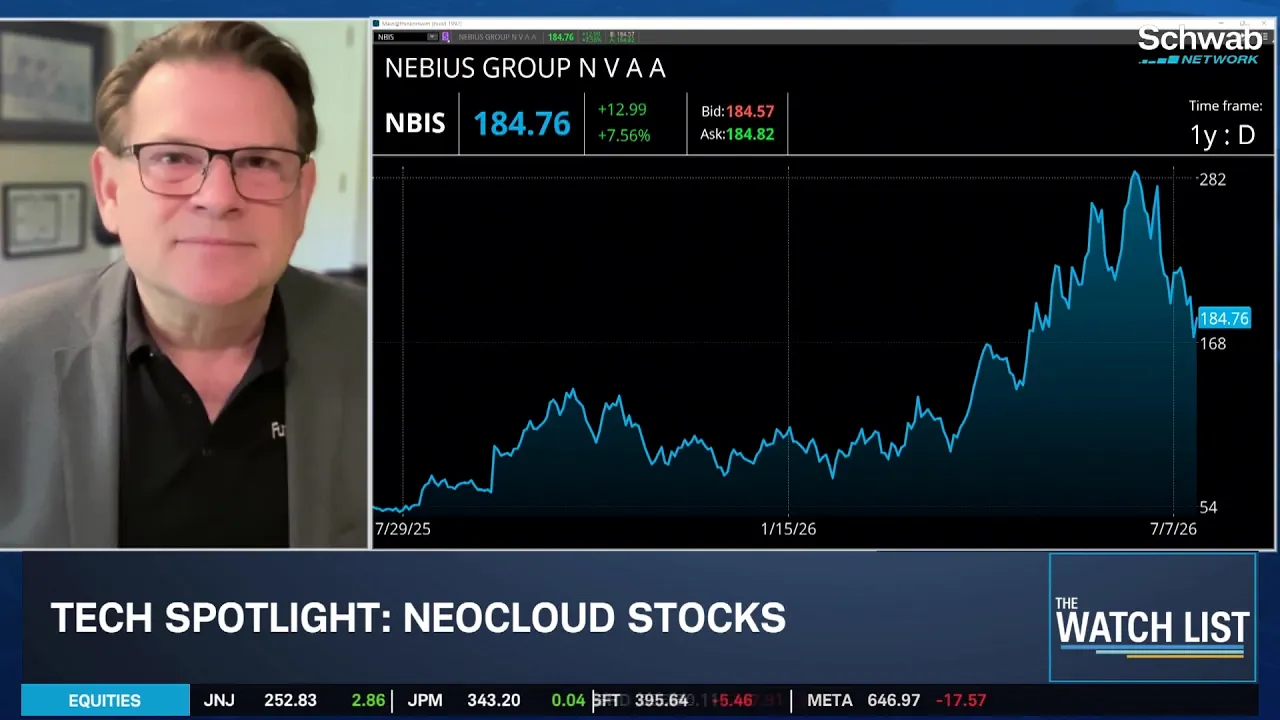
Nicholson: NBIS Best Positioned Against CRWD & APLD, Data Center Risks Remain

- Retorno do vídeo
- +23,23%
- Chamadas
- 1
- Compra / Venda
- 1 0
- Publicado
Recomendações
Entrada é o preço de fechamento do ativo na data de publicação. Atual é o último fechamento registrado.
-
Entrada $177,71 17 jul 2026Atual $182,54 07 ago 2026Resultado +$4,83
I think that nebulous of the three is the best position in terms of value at this point, but we're going to see a lot of ups and downs in the near future.
Transcrição Completa
names. Neo cloud stocks as a whole in our tech spotlight. Joining us now is Dave Nicholson Chief research Officer over at Futurum. Happy Friday Dave. Let's just start with the news. Get that out of the way. Do we worry about this. Do we care. I mean the market's obviously responding well. But it's not the only company we've seen in the business of neo clouds that's been tapping the debt market lately. No. And good to be with you, Sam. A little too much World Cup cheering on my end. So sorry for the voice. I think that this is a natural development at this point in the AI cycle. What we're seeing is kind of on the leading edge. A bit of AI, ROI, skepticism. There is no lack of demand, however. So this is a bit of a kind of a reshuffling of the deck. I wouldn't worry long term. I think that nebulous of the three is the best position in terms of value at this point, but we're going to see a lot of ups and downs in the near future. Why is nebulous the best in terms of value? I think if you look at the ratio of what they actually have booked in terms of real orders compared to the cost of capital and the amount of capital that they've had to raise compared to core, we've they're just not out there investing in as big a dream, which means there's less risk behind it. Okay. Understood. Just as far as the overall performance, though, as we mentioned, I mean, nebulous has had a good run lately, but neo clouds as a whole have been under some pressure recently. What would you say is the biggest driver of that, other than that rotation that you spoke of? I mean, you can look at you can look at some anecdotes when a large consumer of what you sell stands up their own business to essentially sell what you're selling to them. I'm talking about meta in this case, that's not an indication that you have a corner on on a given market. So I think we're going to see more and more of that moving forward with hyperscale, hyperscale cloud providers being able to sell off their excess capacity. Again, we don't we still don't have a demand problem, but there are starting to we're starting to see cracks in the wall there when it comes to unlimited demand. We're not seeing unlimited demand. Got you. What do we make of the moratorium on data centers here in New York state? I think we're just at the beginning stages of that. It's really going to be interesting to see if this if this catches fire as a movement across the US in particular, I can say that some of the concerns around water consumption are just factually not well-founded. But I don't think that matters. I think that the backlash against AI at large, as people are concerned about what AI does to our society, along with the concerns of, you know, resource allocation electrical you know, electric rates for for consumers, there are a lot of well-founded concerns, but most of it is a lot of emotion. But guess what? That emotion can drive markets. It certainly can. I'm interested what you said about some of the environmental impacts. I mean, I've heard that conversation just this week, particularly with respect to obviously, what we've heard around the moratorium, but also with TSMC plans to try to expand in Arizona in a state which some would argue has a water problem as well. Why don't those arguments stack up as far as you're concerned? Well, not to get too deep on it, but when you talk about water consumption, we're largely looking at older data centers that don't have a closed loop. So if you think of your car having a radiator, your car is not consuming water to keep its engine cool. And mostly these large data centers that are being proposed are closed loop systems that consume nearly zero water. In some cases, they use some for an evaporative cooling effect, but mostly that's not a real concern moving forward. Now there's water consumption during construction. Of course, there's the use of the land, and there's this big question of where the power is going to come from. So it's not completely unfounded, but people have a real lack of understanding of what the real constraints are. Okay. What are those real constraints? And I want to couple that with what exactly we can expect to hear from some of these companies come the Q2 reporting season. Yeah, the real constraints are power. So where's the power going to come from? You know, big proposed installation in Utah is talking about tapping into a natural gas pipeline, increasingly with federal legislation prodding folks. You can't build a data center unless you're bringing your own power to the grid, because the grid does not have the power that the power available. So the real question is, how does that affect, you know, mom and pop consumers of electricity? Does it increase rates? Does it decrease demand? What does it do? Or is power supply augmented? Those are those are very, very real concerns. I think water is not the concern that it's being made out to to be okay. And just if I could pick your brains about what we can expect this Q2 earnings season, what are these companies got to say? Yeah, I think I think earnings are going to still be solid. I think that the reaction that's being seen right now that's negative again has to do with this reshuffling of of who is who is the customer and and, and who is the seller in this standpoint. But I don't think we're hitting bubble burst time during this next cycle of earnings. Right. And I just wanted to ask you as well, Dave, while I've got you this news that we got this week about core weave in particular, which I don't know, seemed to be in the pool of the kind of mildly bearish signals we were getting on the memory trade, maybe why we saw a bit of a sell off there. I suppose you know where I'm going with this, that it's exploring the potential of hedging on memory prices. What do we make of that. What does it mean. Is it a concern. Yeah. Anytime there are supply chain constraints that can be a concern. It can be a drag. So it's just good business practice to explore something like that. And it's good business practice on the point, you know, on the on the side of investors to pay attention to these things because it could drag their ability to deliver moving forward. So it is a very serious thing. And supply chains are constrained in that way. All right. Great stuff as always. Thanks so much, Dave. Really appreciate your time. Have a wonderful weekend. Dave Nicholson there from Futurum. Coming up, we'll highlight some char
Comentários 0
Entre para participar da discussão.
EntrarAinda não há comentários. Seja o primeiro a compartilhar sua opinião!