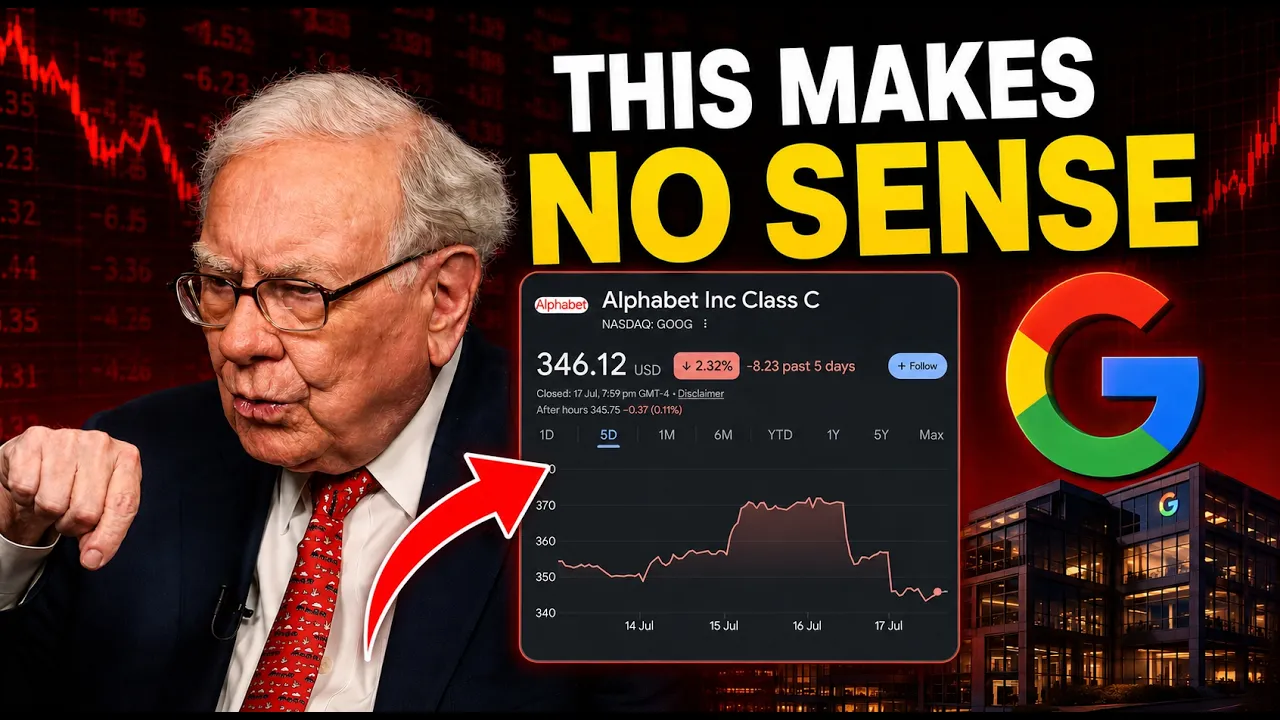
Why Google Stock Crashed Right After Buffett Just Went on CNBC (What Warren Buffett Knows)

- Retorno do vídeo
- +3,17%
- Chamadas
- 2
- Compra / Venda
- 2 0
- Publicado
Recomendações
Entrada é o preço de fechamento do ativo na data de publicação. Atual é o último fechamento registrado.
-
Entrada $346,77 18 jul 2026Atual $357,75 06 ago 2026Resultado +$10,98
In my view, this valuation provides a significant margin of safety for long-term investors.
-
Entrada $346,77 18 jul 2026Atual $357,75 06 ago 2026Resultado +$10,98
The long-term fundamentals suggest that Google is well positioned to remain a dominant force in the global economy for years to come, regardless of minor product delays.
Transcrição Completa
Alphabet is currently trading at a notable discount compared to its mega cap tech peers, but the market is reacting with sheer panic over a temporary product delay. Warren Buffett recently shook the financial world by revealing on national television that he was the mastermind behind Bergkshire Hathaway's massive stake in the search giant. Yet, within 24 hours of his ringing endorsement, Alphabet Stock experienced a sudden 5% plunge. This sudden drop was triggered by a leaked report stating that Google has delayed its highly anticipated next generation artificial intelligence model. The delay of Gemini 3.5 Pro represents a significant hurdle as internal teams struggle with coding performance targets. Investors are now questioning whether the tech giant is losing its grip on the artificial intelligence race or if this drop is simply a classic overreaction. The stock fell from around $373 on Wednesday to just over $353 by Thursday afternoon. This swift drop erased close to $200 billion in market value in a single session, leaving many market participants wondering about the safety of their holdings. We are going to look closely at why even the best businesses do not always see their stock prices go up in a straight line. By analyzing the core financial metrics and the actual impact of this delay, we can determine if the underlying business remains as robust as ever. Let's dive deep into the numbers and explore what is really going on behind the scenes at Google. The saga began with an extraordinary television appearance by the Oracle of Omaha. Warren Buffett went on CNBC to clear up rumors regarding who made the decision to buy billions of dollars of Alphabet stock. Many market participants assumed his successor, Greg Ael, was the one who initiated this multi-billion dollar bet. However, the 95-year-old investor set the record straight by announcing that he personally made the call to build Berkshire Hathaway's $ 31 billion position. Buffett even admitted that he made a huge mistake by not buying the search giant years ago, calling it a wonderful business. In addition to his initial purchase, Buffett actively supported a separate $10 billion private stock purchase just last month. This massive backing has made Alphabet Berkshire's fifth largest holding, representing about 6% of its entire equity portfolio. Having Warren Buffett put his personal stamp of approval on a tech company of this scale is a massive vote of confidence. But here is the part most people miss. Even though Buffett loves Google's business model, he did not shy away from pointing out the massive risks. But here is the part most people miss. Even though Buffett loves Google's business model, he did not shy away from pointing out the massive risks. During his interview, he noted that he does not like Alphabet quite as much as some of his core decades long holdings like American Express or Coca-Cola. His concern revolves around the sheer capital intensity of the current artificial intelligence arms race. Buffett pointed out that Google and its main rivals are laying out hundreds of billions of dollars to build out infrastructure and that represents real hard money. In contrast, the software businesses of the past did not require this level of massive capital expenditure just to stay competitive. He made it clear that while Google is a powerful company, the sheer scale of the cash they have to spend on computer chips and data centers is a massive departure from their historic business model. This candid warning is highly relevant to what we saw next in the markets. It shows that even the most seasoned investor in the world recognizes that the rules of the tech sector are changing rapidly. Now, let's explore how the market reacted right after this high-profile interview concluded. Immediately following Buffett's positive remarks, a major report from Bloomberg sent shock waves through the market. The report revealed that Google has delayed the launch of Gemini 3.5 Pro, its most powerful artificial intelligence model, by several months. At its developer conference in May, the company had promised a public roll out by June, but that deadline has now quietly slipped. According to inside sources, the core issue lies in the model's performance, specifically its ability to understand and write computer code. Coding has become one of the most commercially vital features for artificial intelligence, and Google's model was falling short of its own internal benchmarks. Despite attempts to retrain the model with fresh programming data in late June, the results were reportedly disappointing. This delay sparked immediate panic among investors who fear Google is falling behind its nimble competitors OpenAI and Anthropic. It also highlighted a talent drain as some prominent researchers recently left the company for rival startups. The market reaction was swift and brittle. Alphabet shares dropped by nearly 5% in a single trading session, wiping out approximately $200 billion in market capitalization. This sell-off pushed the stock price down to around $353, erasing the gains from the previous days. This sudden plunge shows how sensitive the market has become to any perceived weakness in artificial intelligence. Investors are so hyperfocused on the artificial intelligence narrative that any delay is treated like a structural disaster. However, we have to look past the immediate price action to see the bigger picture. A product delay does not automatically mean a company's long-term competitive advantages are gone. In fact, taking the extra time to ensure a product works correctly before launch is often the smarter move. But the stock market operates on short-term expectations. And right now, the market is punishing Google for not moving fast enough. To truly understand Google's position, we need to focus on its actual business performance and revenue growth. In the first quarter of 2026, the company's financial results were nothing short of spectacular. Consolidated revenues grew by 22% year-over-year to reach a record 109.9 billion. This performance completely shattered Wall Street expectations and showed that the core advertising business is still highly lucrative. Google's search and other advertising revenues grew by 19% proving that its dominant search engine is not losing its grip on the market. Furthermore, YouTube ad revenues grew by 11% demonstrating that the video platform remains a critical driver of growth. The real star of the show, however, was Google Cloud. Cloud revenues surged by 63% to reach $20 billion for the first time, fueled heavily by enterprise artificial intelligence solutions. This was the fastest growth rate among all major cloud providers, showing that Google is successfully monetizing its technology. The cloud unit's operating margin expanded sharply to a record 32.9% while its total backlog nearly doubled to an incredible $462 billion. In addition, Google's paid monthly active users for Gemini Enterprise grew by 40% quarter over-arter. These figures prove that Google's products are in high demand and that the company is translating its technological advances into real revenue. This is a business that is growing rapidly and generating massive amounts of cash despite what the short-term stock chart might suggest. As the upcoming earnings report approaches next week, many analysts expect this underlying momentum to continue, which could provide a solid foundation for recovery. Now, let's look at the financial health and profitability metrics that attract long-term value investors. Google's net income for the first quarter of 2026 reached an astounding 62.6 billion. Even though a significant portion of this net income came from unrealized gains on equity investments, the core operating profit remained incredibly strong. The company's operating margin expanded to 36.1%, showing excellent cost discipline and operating leverage. Over the trailing 12 months, Google's net profit margins have consistently remained above 30%. This is a level of profitability that very few companies in history have ever achieved. The business has virtually zero debt pressure with a debt to equity ratio of just 0.16. However, the major concern for the market is the massive level of capital expenditures required to sustain this growth. Google guided its 2026 capital expenditures to a range of 180 billion to 190 billion. In the first quarter alone, capital expenditures hit $ 35.7 billion. This represents a massive increase compared to prior years and highlights the heavy capital intensity that Warren Buffett warned about. Google is essentially converting from a capital light software business into a heavy infrastructure utility. The key question for investors is whether these massive investments will yield a high return on capital over time. If Google can maintain its dominant market share and successfully monetize its infrastructure, these capital expenditures will look like a masterclass in long-term planning. But if the competition remains fierce and margins compress, the return on investment may be lower than expected. However, with massive cash reserves, Google has the financial runway to see these long-term bets through to completion. When we examine the valuation metrics, Alphabet looks highly attractive compared to its mega cap peers. The stock currently trades at a forward price to earnings ratio of around 23. This represents a significant discount to competitors like Microsoft, which trades at around 35 times earnings, and Apple, which trades at 32. The company's forward price to operating cash flow is also hovering around historical lows, making it one of the cheapest mega cap tech stocks on the market. In my view, this valuation provides a significant margin of safety for long-term investors. We are looking at a company that has a near monopoly on search, a rapidly growing cloud business, and over 350 million paid subscriptions across YouTube and Google 1. The core lesson here is that a great business does not always guarantee a rising stock price in the short term. The stock market is a voting machine in the short run, driven by emotion and news headlines, but it is a weighing machine in the long run. The delay of Gemini 3.5 Pro is a minor speed bump, not a thesis breaking event. Google's underlying search engine, cloud infrastructure, and global advertising dominance remain completely intact. While the market panics over short-term product cycles, disciplined investors look at the cash flows and the valuation. This is my personal research and opinion, and every investor should do their own due diligence before making any decisions. The long-term fundamentals suggest that Google is well positioned to remain a dominant force in the global economy for years to come, regardless of minor product delays. In conclusion, the 5% drop in Google's stock is a classic case of short-term market noise. While the delay of Gemini 3.5 Pro is disappointing, the company's financial fundamentals remain incredibly strong. Warren Buffett's massive $ 31 billion position highlights the long-term value that Smart Money sees in this business. As we have seen, a good business does not always mean the stock price will rocket immediately. The transition into an AI heavy utility requires patience and steady capital, but Google has the unique advantage of a highly profitable search business funding this future. Hey, thanks for watching. I truly respect every viewer who takes the time to seek objective datadriven analysis.
Comentários 0
Entre para participar da discussão.
EntrarAinda não há comentários. Seja o primeiro a compartilhar sua opinião!