
- Retorno do vídeo
- +3,30%
- Chamadas
- 2
- Compra / Venda
- 2 0
- Publicado
Recomendações
Entrada é o preço de fechamento do ativo na data de publicação. Atual é o último fechamento registrado.
-
Entrada $695,33 18 jul 2026Atual $720,06 07 ago 2026Resultado +$24,73
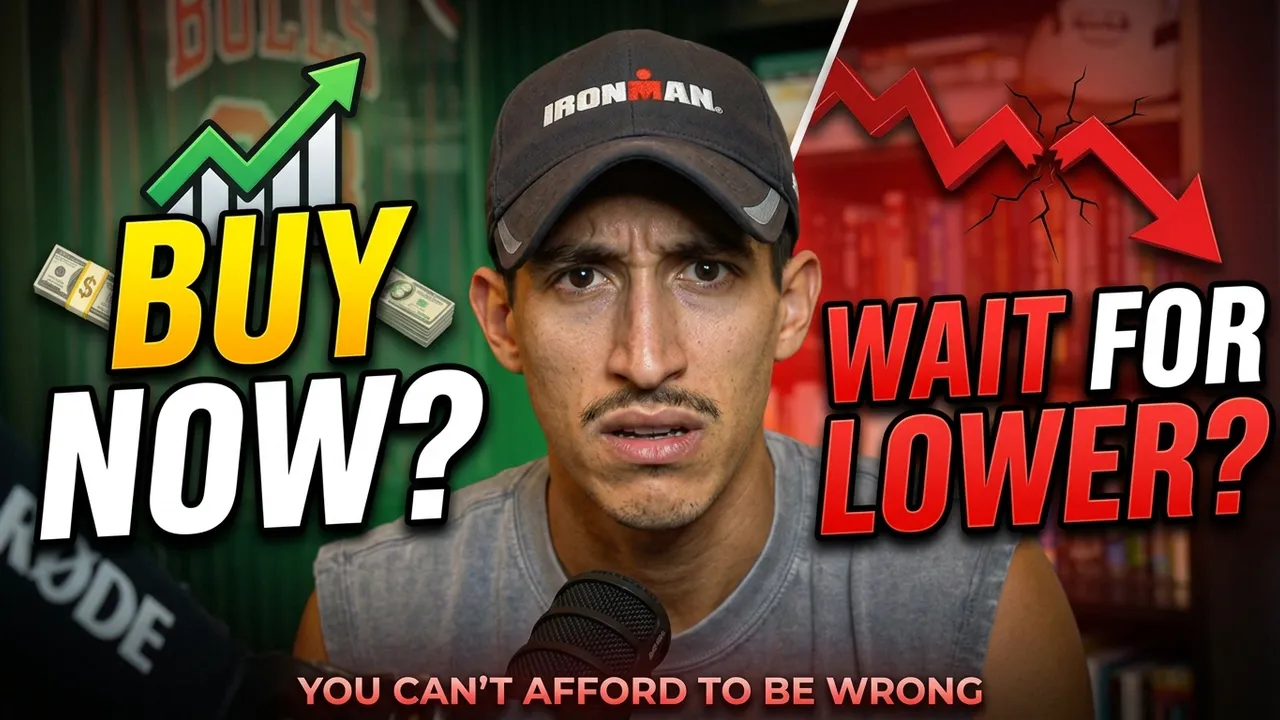
do I want to buy this dip or should I wait because the cheap can always get cheaper
Contexto "do I want to buy this dip or should I wait because the cheap can always get cheaper."
-
Entrada $848,95 18 jul 2026Atual $858,03 07 ago 2026Resultado +$9,08
If you buy Micron right now, it's trading at 830 8.40
Contexto "If you buy Micron right now, it's trading at 830 8.40."
Transcrição Completa
Where are all the market bulls at? What's going on, guys? It's Ricky. Markets pull back 7% from all-time highs and then all of a sudden the sky is falling. I really thought that, you know, market had a little bit more conviction that. But I love what's going on right now because it's really beginning to get people to kind of like secondguess themselves like, do I want to buy this dip or should I wait because the cheap can always get cheaper. I wanted to just think out loud and share some thoughts with you guys. Again, these are just thoughts. These are my opinions. Uh please just take them as just that. Feel free to share your thoughts and opinions down in the comment section. Uh I don't normally film videos like this, but I thought that I could kind of change the uh theme of my videos and um let me know in the comment section what you think and maybe consider dropping a thumbs up and subscribing if you feel like I earned it. So, the first thing that I want to talk about is what the heck's going on with the market, right? What's going on in the Middle East? All of a sudden, the ceasefire is over. Trump is now back to attacking Iran. Things are escalating uh since July 7th. There's been numerous attacks. Oil prices are going back up. Inflation was down in the month of June, but that during that was the ceasefire. So, now that oil's getting propped back up, is inflation going to come in higher in the month of July? Because now that we're seeing higher oil prices? I mean, we'll see, right? There's a lot of uncertainty, but at the core, what everyone is talking about right now is semiconductors and memory chip stocks. The the microns, the SanDisk, some of the best performing stocks of 2026. This is probably why you're watching this video. Is now a good time to buy? Let me save you some time. If you're looking for a direct answer of buy now, you're going to make a ton of money, you're going to become a millionaire, this video just isn't going to be for you. This video is guided uh I want it to be guided for beginners to have enough conviction to motivate you to maybe take your invest your first investment if this is actually a market that you want to partake in. But maybe to stray away those that maybe this market just isn't for you. Right? The thing that's really exciting is that the stock market, unlike many other markets out there, is that you get to invest in American companies that are growing. And hopefully, right, if you're a deal hunter, your whole focus when investing in these companies should be to invest at a good deal. And that's why we're having this conversation because even after an insane rally for Micron and for SanDisk, they're still trading at very low PE ratios. And again, I've read the articles. I've seen what Michael Bur is pointing out that a lot of these type of companies have been cyclical in the past before. Meaning that there cycles where there's huge, you know, catalyst for demand and then it just falls and falls apart. But some of these companies are sold out for the next two to three years. So how is that a cycle? There's infrastructure being built that was not built before. How is that cyclical? So, I'm happy to have this conversation with the idea and the understanding that my tolerance and my opinions are for me, right? And I really hope that you view it as just that. So, what I wanted to shed light on is what are first some of the negative factors that can drive markets lower. That's the first thing that I want to kind of toss at you. When I think about that, I think about where the overall NASDAQ market is right now. pull up your trading charts. Um, you can pull up QQQ or SPY. If you look at it on the day time frame, if I'm remembering correctly, NASDAQ markets, QQQ is down about 7% from its all-time highs. It's not down very much in comparison to a lot of these semiconductors, which have taken hits for the past two to three weeks, right? Micron is down 30%. And I think SanDisk is down over 40%. That's huge. Well, why am I talking about that? Well, if NASDAQ market's only down 7%, look at the larger time frame. Look at the day chart. There's huge gap down potential. If we just sell off, if NASDAQ market just sells off to the same levels that we were at the end of March, that would be a 20% retracement from current levels just for NASDAQ's QQQ. And NASDAQ is like an incubator. If the overall NASDAQ market falls, individual stocks will fall even harder. And yes, the more overhyped one and the more overvalued ones could fall and correct even more. So I think that's where the uncertainty kind of present itself, right? Where did we miss the bull run or can we still get our little piece of the pie? What I want to share is if I was someone that was just getting started as a complete beginner, the first thing that I would say is you're just trying to gain experience, right? If we understand that and we see eye to eye with that, it would be like, "Hey Ricky, if all you're trying to do is like prove it to yourself that this is a market in the future that you want to invest in, there's a common saying in this market that some of the best investors are really good at doing nothing for a long period of time. And it's so much easier said than done because there's so many opinions. There's so many opportunities to get in and get out. But keep it simple. If all you could do was invest in one company, maybe two, what companies would they be? I'm sure many of us right now would say something along the lines of something in an AI space or memory chip space just because they've been so trendy and I don't want to stray you away from that if that's what you want to invest in. You have to understand that they have been hyped up and although fundamentally speaking some of them are not trading at huge premiums like Micron not trading at a crazy P ratio forward P ratio is incredibly low but it's had great price momentum recently so it can correct harder if NASDAQ market and S&P 500 continue to correct and you can't control that I can't control that you can't we don't know what Trump is going to do we don't know what Trump is going to say how things are going to escalate we don't know what the Federal Reserve is going to do, right? The idea that inflation is down today, but maybe up next month due to oil prices. You don't know if they're going to be raising rates instead of cutting rates, that's something fully out of your control. But what is one thing that is in your control? What you decide to invest in and how much? There's an article that was just recently shared in the South Korean markets. I would encourage you. I love sharing this with our LPP team because I feel like so many other people maybe online always just try to share news of, you know, why the market is so great. But I like sharing news of mistakes to avoid. And in the South Korean market right now, um I don't know the exact number, but I think it was over a million traders were overleveraged in the South Korean market and have been liquidated. And it is equivalent to about like 3.4% of the adult population for the South Korean market. Think about that. What is the one mistake that they made during an uncertain time when markets were incredibly bullish? They became overleveraged at overbought levels. We don't know how much more the market's going to sell off. Like I said, and like you understand, it's fully out of your control. But the one thing you can control is what you invested and how much. You're not going to become a millionaire with your first investment. So, let's get that out of your head. The first thing that I would tell Ricky if he was just getting started is pick one or two stocks, learn about it, determine if it's actually fundamentally a good deal and it takes time to figure that out and you believe in this company long term. If so, what if you just buy one share? But Ricky, I'm not going to become a millionaire or make a $100,000 off of one share. You're right. But you will learn so much more, I believe, if you truly want to take this seriously. I think a big mistake in the very beginning are that things are so accessible nowadays. And because of accessibility, it's made the barrier of entry. Anyone can get started. Anyone can do it. Anyone can buy anything. And that's not always a good thing. Accessibility is not always a good thing. The ability to just be able to buy a stock and then sell a stock when your intention was to invest but now you're trading it is not ideal. So again, if it's just one share, even if it's down 5 10% because again, markets can continue to sell off. It's not going to devastate you. If you buy Micron right now, it's trading at 830 8.40. it drops another 10%. Yeah, that sucks. But okay, right out of $830, you lose $83. You know, I would say for most people, they can tolerate that. And if you can't, then maybe you're just not in a position to start investing because this is all just to gain confidence. What I think someone can learn just by buying one share is they can ask themselves the whatifs. Not what if I invested, what if I added more to it and when? because you're going to be able to experience the draw downs and then I want you to do the math. Oh shoot, this stock is down five 10%. What if I did go all in? How would that feel? That $83 loss. If I went in with $10,000, right? Oh, shoot. That would have been an $830 loss. Ah, that would be maybe a little that would be a little tougher, you know, to stomach. Oh, wait. The stock is up 10% from when I bought it. Oh, shoot. I'm up $830 or $83. Do the math. $10,000 invested, 10% return. Wow, I would have made $830. Cool. It's up 20%. I'm up 16 $1,700. I could have been. Okay, this is why people invest. Now I'm excited. Now the next time the markets are down, I know what to do. I know to keep it simple, only use money that I actually have. I know that things can get worse before they get better and to just buy a dollar amount that I could afford. Don't use leverage and don't over complicate it. Understand that things can get worse before they get better and understand the timeline. The reason that that I talk about accessibility is that I don't want the investment to turn into a trade. Unless that's your initial intention, then that's a conversation for another time. But I would say that for many of you, you're probably just looking at the market as something passive, something you want to throw money at over a long period of time and you hope that it grows. Most of you don't want to dedicate the time and also don't want to tolerate the stresses of being and and trading in the market because again it might seem easy but it's really tough to be able to tolerate that stress on red days if you are actively trading and even actively investing if you are in too heavy if your position size or exposure is too leveraged or too big. So again, keep it tasteful. You're just a beginner. You're not going to make it or break it on your first one, and you shouldn't be. But that's the exciting part. You have nothing but time. Prove it to yourself that investing can be a way to make money in your life, but you have to prove it. And I think that is done in simple ways. But like we've said before, it's the simple things in life that people over complicate. This is why I believe when talking about accessibility, although you can open up your own trading application, which I think is great, what I also want you to understand is that would it almost be better for you to have a financial advisor and have kind of like not a payw wall but a barrier where you cannot initiate the trades or the investments. You can't initiate the buys or the sells. That there has to be someone you have to contact to sell or to buy. I think sometimes if you are too impulsive, that is an additional step that you can take while still being invested and doing it in your own way. It just adds an additional step which hopefully encourages you to make less impulsive decisions. I'm trying to think about how I would present this to someone that either wants to be conservative or aggressive. Remember, if you're watching this and you're looking to invest, it's probably because again, you have your own thing going on. You don't want the pressure, the stresses of the market holding you back from your main business. So that is the way that I'm choosing to kind of like share these thoughts just because I've been getting the question so often right now as semiconductor and memory chip stocks pull back. It'd be so easy for me to say if I could predict the future to be like, yeah, hey, Micron is down 30%, it offers 40% of potential recovery. I'm going to go in with $100,000 and maybe two months from now I'll have an additional 20%. I'll make 20 to maybe $40,000, you know, depending on the recovery because markets always go up, right? But we don't know that. We don't know the timeline. We don't know how much worse things can get before they get better. But one thing that we can all do is control what we invest in and with how much. And just with those two simple steps and being intentional and not being impulsive. So again, a few extra things. Um, I feel like you will learn so much more in whatever happens than doing nothing at all or doing too much. If you overlever yourself, you buy and go all in right now and things do get worse. You're going to discourage yourself. You're never going to want to do this again. Or let's say you overlever yourself. It goes in your favor. You make a ton of money, but then at that point, you don't really know how to trade or invest. You just got lucky. Good timing. Markets recovered. At that point, you're only one bad trade away from giving it all back. Because if you don't know how to if you don't understand how to manage or mitigate risk, that's all it's going to take. So again, stepping stones. Even just one share. I believe you can learn a lot just by even initiating one share on one company that you believe in and then being able to do the math backwards of if I did go all in, how much would I be down, how much would I be up, and just follow it. We're currently experiencing enough of a draw down that it could make it attractive enough. But again, choose whatever stock, whatever ETF aligns with you. It doesn't have to be a semiconductor or a memory chip stock. I'm just using those as examples because it's all I've been asked about lately. So again, I do have a series of trading applications that I use that you're more than welcome to check out. They're free and they're US regulated. They're going to be the first and second link in the description down below if you want to learn more about trading. I do trade live every day. But I do want to remind you that if you have your own job, your own business, and that's your main piece of the pie, I don't know if trading is going to be the route you want to take. If you feel like you have the time available and the mindset and the headsp space for it, I'd welcome you, right? It will be the third link in the description down below. I trade live every morning at market open, but again, it's much easier said than done. It takes time and there's a lot of stresses that come with it for me. I enjoy the challenges that it comes with, but there are days that feel very intense. And again, it's a part of it. The last thing is if you want to be able to do more fundamental analysis on the companies that you're choosing to invest or trade, we have investing pro and that's the software that I use to be able to do these fundamental analysis. And that's going to be the fourth link in the description down below. So, I appreciate guys' time. Again, a little change of uh theme with my normal videos, but thought I would change it up and share some open thoughts with you guys. I'm very excited to follow up to see what happens over the weekend. Do things escalate in the Middle East? Are things going to, you know, is a peace deal going to arise? How are markets going to open on Monday? And we'll we'll see, right? It's it's one curveball after another. It's a deal or no deal. So, it's a very exciting time to be paying attention, but it might be a very stressful time if you're overleveraged. Another great reminder, when in doubt, never be afraid to cash out. And if you're just getting started, just don't use leverage. I appreciate you guys' time. I hope that we're in your thumbs up. Please consider subscribing. And like always, let's make sure that we end the year on a green note. Take care, team.
Comentários 0
Entre para participar da discussão.
EntrarAinda não há comentários. Seja o primeiro a compartilhar sua opinião!