Contexto
the recent version one of the tech pairs trade was over the course of the past couple of years sell software stocks to buy chip stocks. Now it’s flipped around to the sell hyperscalers to buy the chip stocks because the hyperscalers free cash flow is going to float from themselves over to the chip companies.
Contexto
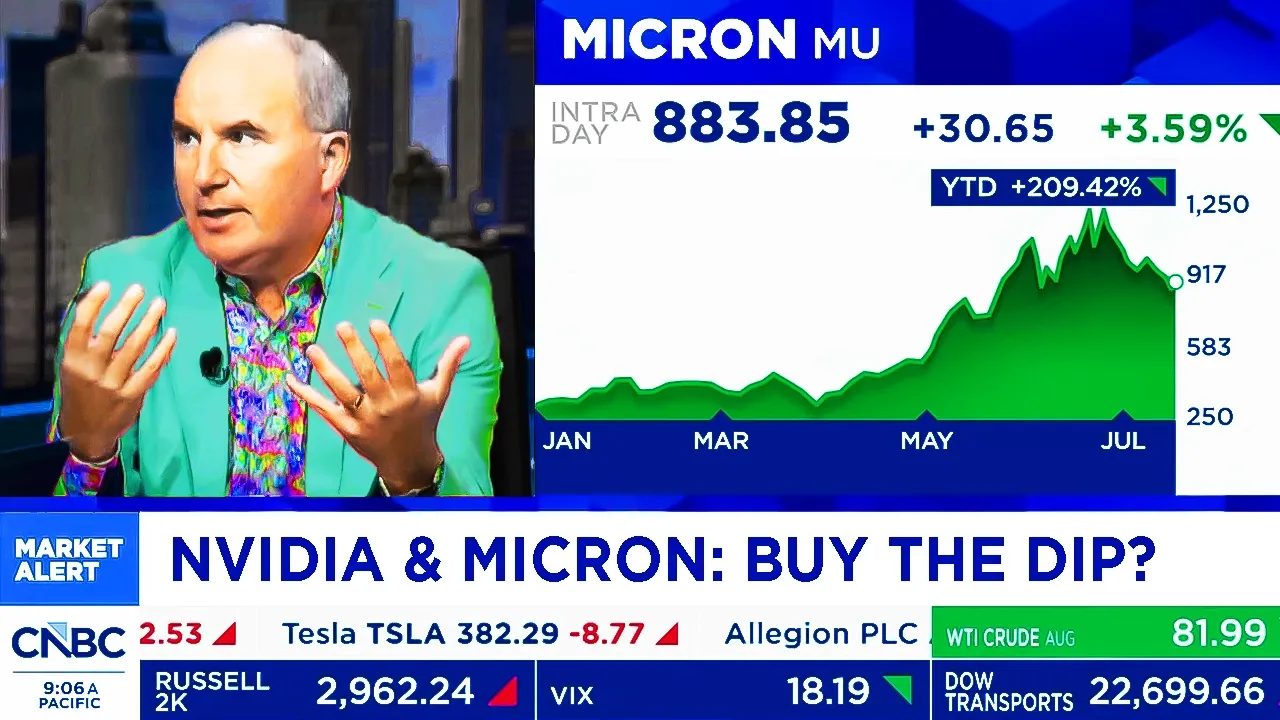
if you didn’t want to pay the multiple or micron a couple months ago when it hit its record high, well, now you can have it down double digits. ... So I think micron below six you know right now with the growth rate they have you’re talking earning at over 20% for the next couple years and revenues over 30%. So I think this the stock is dirt cheap.
Broadcom and um Nvidia those are two names that have huge growth rates
Contexto
I mentioned earlier Broadcom and um Nvidia those are two names that have huge growth rates um into the visibility there is at least for the next 18 months and yet right now Nvidia is below the market PE. The market PE is probably about 20.4 right now and it’s selling at about 20. And the same with Broadcount. That’s at a 24p and they’re massive discounts to their growth rate and the growth rate’s not going to stop in the next 6 months. So I think they’re really overdone here.
Contexto
I mentioned earlier Broadcom and um Nvidia those are two names that have huge growth rates um into the visibility there is at least for the next 18 months and yet right now Nvidia is below the market PE. The market PE is probably about 20.4 right now and it’s selling at about 20. And the same with Broadcount. That’s at a 24p and they’re massive discounts to their growth rate and the growth rate’s not going to stop in the next 6 months. So I think they’re really overdone here.
Contexto
I seriously think that Nvidia still has plenty of runway ahead of it and I think this company will be worth substantially more in future years than it is today.
Transcrição Completa
The global selloff in chipmakers accelerating with a new AI model in China sparking fears of another deepseek moment. Dan Ies in a brand new role as partner and senior managing director at Yorkville Ives writes tech stocks are laser focused on seeing the monetization trend for AI in the second quarter. Hyperscalers will be the standouts and remain foundational to the broader tech spending trends. Dan joins us now for more. Dan, good morning. >> Great to be here. >> New firm. Let's start there for the benefit of our audience. New position. What kind of seat are you speaking from? Yeah. So, uh, again, partner and and really be, uh, you know, on a research perspective, that's going to be my main role at Yorkville Lives. But it's a modern merchant bank. I mean, this is something for me, 25 plus years on Wall Street. It's the evolution. It's the next step. It's something to really build something that I think is going to be special in this market but really focused in terms of sectors AI tech infrastructure energy because where I view the fourth industrial revolution so excited to do this and found just the the best partners to do it with >> these companies are borrowing a lot of money. They're spending a lot of money. The questions we're asking this morning based on developments out of China is whether they're borrowing too much and spending too much. What's your reaction to what we've heard from China? I think this is just a called a white knuckle moment. No different than a a mini deepseek moment to some extent. The reality is like look models you're going to have 10x more models over the next five seven years vertical geographic. The reality is is that it's anthropic and open AI's world and everyone else paying rent relative to the models. Gemini clearly narrowing the gap. China, you're going to continue to see, you know, very good models come out of there. But it's my view when you talk about broader spending, the trillions of dollars spend that you're going to see in AI, it's less about the models. It's about the data. It's about ultimately the buildout. And I think that is something that will get validated to Q earnings. >> But doesn't this show that China is not that behind the United States? They're neck andneck when it comes to AI development. I think for the first time in 30 years it's not even a question that US is ahead of China when it comes to tech. Now when it comes to models in terms of the more of a commodization open source in the way that they're going after it are they ahead when it comes to robotics when it comes to energy yeah but there's one chip in the world fueling the AI revolution godfather of AI Jensen Nvidia and I think what you see from hyperscalers what you see from open AI and anthropic this is going to be an arms race but I don't even think there's a question where the US is relative to China when these moments happen you'll see jitters white knuckles stocks will sell up. >> Why is China able to do it cheaper? >> Because at the end of the day, the open- source model, if you look, whether it's Deepseek or any others, when you compare it to what Anthropic's doing to what Open AI is doing, that's tip of the sphere. In other words, Open AI and Anthropic, they're going after the enterprise market. The models are just really the start of what the broader sort of end-to-end framework is going to be. When you think about where the vast majority of spending is going to be in AI, it's not necessarily in the models. It's in the data, the data center buildouts, the capbacks, the what ultimately is going to be physical AI. I just continue to view commoditization will continue to happen on the models. I don't get as sort of, you know, nervous when moments like this happen >> the spending phase. Can we talk about the end phase? And I know this is really difficult to do. Where do you think the money is ultimately going to be made? The application lay the infrastructure layer. Where do you think the money will be made? >> I think it's it's the application infrastructure layer that's going to really be the hearts and lungs. Cuz if you think about say all the data centers getting built, those data centers are going to it'll be like a a factory for cars. You build out the factory, but now you actually need the lines. What's the operation? The when you look at as more and more companies on the use cases, that's enterprise, that's software, that's use case. you confident the app layer won't become commoditized. >> I would tell you the more and more companies that I talk to that are deploying AI and going down the AI path, I feel that that's become less and less of a risk. There'll be winners and losers, they'll be ones where ultimately they're on the wrong side of it and maybe some of those stocks reflecting some of the nervousness, but the view today is that look, we're still in the third inning of the AI revolution. Now, we start off, we're in the second inning. This is not seventh, eighth inning because of where this is all going in terms of physical AI. Look what Apple's doing. That's just starting the consumer AI revolution where they're essentially a toll booth in the AI highway. >> What's going on with Alphabet and Gemini? Why are they behind? >> I I I view that in terms of everything that they're doing. They'll be behind the points. But the reality is that their endto-end framework from cloud to Gemini to what's happened on search, they could catch up pretty quickly. And I just think they've narrowed the gap much more than anyone would have thought. And it goes back to a year ago, New York City cab drivers bearish in Alphabet. Look where they are today. And maybe >> where are they? Where are they today? >> I say New York City cab driver is still bearish. Maybe they're bearish on Microsoft versus where, you know, >> I think you've got to come up with a new phrase because in my experience with my New York City cab drivers, they they're better on this market than most people I speak to on a daily basis. >> And that's very healthy because of ultimately more and more retail >> long and strong. >> They they they have a big seat at the table. And I know New York City cab drivers now they're driving Bentleys because of this market, >> right? They'll be sent I remember years ago they'd be like, I really like Tesla. I'd be like, what this multiple? That's crazy. And then Tesla just like to the moon up and to the right. And that's why a lot of them are driving Bentonleys today. >> Yeah. >> Or Cybert trucks. >> Or Cyber Trucks. >> I mean, the other side of this is uh that this could be a good time to go out there and look for bargains. I mean, if you didn't want to pay the multiple or micron a couple months ago when it hit its record high, well, now you can have it down double digits. What names do you like here in tech and why? >> Well, I think Micron is is a case in point because the memory demand is, as you know, they've been doing two and three-year contracts. You know their normal contract in the past was measured in months when it's very much a cyclical name but this is really for now a structural secular change you know because demand is real memory chips are in short supply and even that Chinese company going public they've been there all along this is not some new company popping up and capacity is going to take a while it won't be before the end of 27 so it's going to remain constrained and so that I think micron below six you know right now with the growth rate they have you're talking earning at over 20% for the next couple years and revenues over 30%. So I think this the stock is dirt cheap. And then I mentioned earlier Broadcom and um Nvidia those are two names that have huge growth rates um into the visibility there is at least for the next 18 months and yet right now Nvidia is below the market PE. The market PE is probably about 20.4 right now and it's selling at about 20. And the same with Broadcount. That's at a 24p and they're massive discounts to their growth rate and the growth rate's not going to stop in the next 6 months. So I think they're really overdone here. >> We need to talk about Moonshot and Kimmy K3. Um you know the the public markets is where you see the drama. But but what do you what is your interpretation of of that and and why a 20 billion startup from China >> Yes. topping a benchmark and people looking at their economics has caused this reaction. >> Well, I'd start by saying it was an amazing release yesterday. Largest open weights model to ever be released, 2.8 trillion parameters, as you said, really strong initial results. Uh, and they also showed a lot of interesting techniques from an efficiency perspective and how they built that model. That's really impressive. And I think it's great that models like that, models like the one that came out from thinking machines the day prior, continue to give vibrancy to the open source ecosystem, which is an important part of our overall AI economy. At the same time, I think the reaction over the last 24 hours is perhaps a little bit premature. Uh, and I would say, you know, a couple of points. It reminds me a little bit of when the Deep Seek moment happened last year. And when you look at this new Kimmy model, there's maybe a few things, you know, the audience should consider. The first is benchmarks are imperfect, right? It's, you know, you can take a model and make it very very strong at a particular set of benchmarks. I don't think it's until that model's had time to percolate in the real world that we can get a true sense for the trade-offs that the model's incurred and what its real world performance looks like. The second is this whole discussion around cost. I think the discussion misses the point. It's very po focused on token cost. Yes. But we think about things more in terms of task cost. Not every token is equal. And so I'd make two points as it relates to the, you know, cost profile of Kimmy. The first that's actually interesting is Kimmy K3 is much more expensive on a per token basis than Kimmy K2 which is sort of contra to the narrative. >> We do not know what it costs to train Kimmy K3. We have an idea on K2. I just want to put that out there. >> Absolutely. That absolutely correct. So the per token cost is more but even more importantly it's not particularly token efficient. And so what that means is for a given task it actually uses many more tokens than an open AI or anthropic model. And you're seeing that already in the early cost benchmarking. And so I think this conclusion that it's going to lead to price erosion for the frontier is perhaps a bit >> in this case the frontier let's say it's anthropic and open AI right you know some people making the argument well hold on a minute if a $20 billion valuation Chinese startup we don't know the training cost but they're basically saying3 million $3 per million tokens on the input side $15 per million tokens on the output side um if they can do that why are we valuing Anthropic at nearly a trillion dollars like What's the moat that Anthropic has? >> I think both Anthropic and OPI have multiple moes. The first is they have very significant revenues. These are the fastest growing companies in human history. And those revenues are not just on the back of their models and their amazing API businesses, but they're first party products, right? And I think relative to the last time I was on the show, you look at the success that Enthropic has had with cloud code, cloud co-work, more most recently cloud tag. It it and open AR AI are full stack AI companies. >> Can I just say one thing? I think for 2 years and it's been too long since you've been on the show, but we've basically assumed the best model wins. Is it as simple as that? You seem to be saying it's not. >> Well, it depends on how you define the best model, right? And I think I would be I again I'd be careful to jump to the conclusion that Kimmy is now competitive with the best. Certainly on some of the benchmarks that they release, it's competitive with I'd say one generation prior. And of course we, you know, we don't know what's coming out from Enthropic and OpenAI in the coming weeks and coming months, but it's been rumored and reported that there's significant new releases coming out from those models. So we have a particular checkpoint in time that we're comparing it to. I think uh I think we're going to see a lot of really exciting releases in the coming months. But maybe Ed, if I can, I I want to make one one broader point, which is if you just think about the overall size of the token economy and where we're going, right? In 2023, OpenAI's API was processing per day about 30 million tokens. In March of 2026, they announced they were doing 15 billion. So just in less than 3 years, a growth of 50 times. I think when we are talking in 2030, the overall token economy will be two orders of magnitude larger than it is today. And so there's going to be plenty of opportunity for the best leading closed frontier models to grow, for the open source economy to grow, and for the application uh layer to grow. I think the only mistake one can make is underestimating the size of this overall wave. Uh again the central focal point of the trade in technology semiconductors specifically has enough value been erased from the recent highs to make this a more attractive place that people actually want to nibble at right now. >> Yeah I thanks for having me. I mean you never know if this is like the bottom especially with the news coming out of the K3 model coming out of China. Um but I think when you zoom out that yes, we've had a nice rotation and a nice reset from the momentum trade that really carried us prior to July and that momentum has become synonymous with semis and with hardware and so semis and hardware are down along with the momentum factor the first half of July. I mean our base case is that probably last for another couple weeks or so but when you zoom out yeah I think this will be uh perceived as a good buying opportunity. All right. So, that's playing out somewhat today. If you look at the Roundill Memory ETF, ticker DR AM, DR AM started off the day sharply lower and is now still up about 1 and 3/4% in trading today. People did buy the dip. The question is, was it short covering? Was it some fundamental value pickers? It's probably a mix of both. But does this then mean that people are still in this kind of muscle memory buy dip mentality for chip stocks in particular? Yeah, I think that um yes, probably. But we need more than one day. It's it's encouraging to see a reversal like this. I I think that the the release of the open source model, the latest open source model out of China K3 is a uh is is really what's what royled the markets this morning. And so when I look at that, when our team looks at that, we see that it's really potentially and we need to test this model and run it through our own internal benchmarking to know what we're dealing with. But if the reports are correct, then it's really negative for the frontier labs, for the frontier models here in America. And then the counterparties to those labs or the hyperscalers farther down the chain are semis and hardware. So it kind of makes sense, you know, first this morning was a sell everything kind of wave. And it makes sense to see Simmies and some of these memory names come back. Later in the day, they have been beat up a little bit. I I worry when it comes to the index level if the weakness is now just going to rotate over to the hyperscalers. And that's why I say we need more than one day. We need to see if this isn't just a rotation because there's been such a strong push and pull between semis and hardware and into hyperscalers. You sell those and buy the hyperscalers. Are we just unwinding that a bit with this this negative news from this model out of China? You need more than one day to determine that. But I you know all things equal, I like seeing these memory stocks start to rebound late in the day. the the recent version one of the tech pairs trade was over the course of the past couple of years sell software stocks to buy chip stocks. Now it's flipped around to the sell hyperscalers to buy the chip stocks because the hyperscalers free cash flow is going to float from themselves over to the chip companies. How much do you look at this particular moment versus the deepseek moment and say to yourself the bounceback we saw in some chip names some of the producers that weren't named Nvidia actually caught a bid because of that during the last time we saw this happen is something similar going to play out now or is the market and semistructurally different to what it was during the first deepseek moment >> our base case is that we will follow a deepseek like path out of this that is the base case. Um, again, I I think that we're going to have to test the model and I think also we want to watch our our our real-time indicators. So, we watch we track GPU availability following DeepSeek. For instance, our GPU availability data at 314, it plunged and it gave us a lot of conviction to step in and buy that dip. and our base case, even though GPU availability has been low, is that it's going to it's going to go lower after this model release as everybody scrambles to test it. The other thing you want to see is GPU rental rates. Uh how how do they react? And so our again our base cases that they'll be robust and strong as they've been this year. And if that happens, I think that's a really good sign for for semis and for hardware and for the entire overall ecosystem. maybe excluding the labs again, but even with the labs, I don't know that it's a disaster yet for them until we test the model. So, I do expect a deep seed type of move for the for here and now though. You have like all those positioning things we just talked about that have to get worked out by the market. And that's why I think you have to zoom out to see this as a buying opportunity. >> Moonshot's AI model is worsening an already fragile tech trade as it brings up concerns over increased competition, high cost, the possibility of overbuilding, and the financing to get it all done. Joining us now to discuss it is Ben Behar. He's creative strategies CEO. Ben, it's great to have you on. How are you thinking about this as as a step forward, I guess, in terms of the the competition among models and what the likely response is, what it means for the overall ecosystem. >> Yeah. Yeah, I mean I think if anything right it just proves that this is a race, you know, the kind of thing that we've outlined as a competitive dynamic for all models which again just sort of I think doubles down that both open AI and anthropic and others need to continue to invest uh in computing and infrastructure in software in order to to maintain that lead right the mode is the moat right as long as there is one and if there isn't then it becomes hard to maintain so I think they know that that's just going to increase their uh their willpower in spending and building out and you know it's it's interesting too you know we just look at the dynamics of um you know even with anthropic around Fable and others like it's it's very clear that they could do a whole lot more they could train even bigger models more capable models if they had more compute and we hear this across the labs and those at Frontier that that sort of validate that viewpoint that software is just way ahead of of where compute is and so if anything you know at the end of the day it just you know deepens my conviction of this compute buildout um I think there's questions again as to just what the economics of tokens are. I think there's, you know, good points made prior that, you know, not not every work uh task requires a frontier model. Um, but there's a lot of very valuable workloads out there that that enterprises and uh governments and whatnot will pay for and I think that's where you know your your frontier labs from the open anthropic need to continue to compete. A lot of this though assumes and the market moves as if it assumes um that US companies will be able to adopt Chinese open- source models. Is there any concern on your part or thinking that the US could have put up guard rails there? We're so concerned about open AI and anthropic not going out. We're not thinking about what's coming in and it seems like it's only a matter of time before uh the government starts to think in that way. >> I completely agree. In fact, we speak to a lot of CIOS and CTOs. I think they're very hesitant about these models. Um, you know, one of the interesting things about Kim and there's another, you know, startup out there called Thinky Systems that similarly put out very good model weights that were waiting to see us companies build models based on their weights. Um, you know, but with Ky K3, you can actually take the model weights. They release the model weights. So, a US company could train their own model based on their weights and use that if they wanted. That said, I still hear a lot of hesitancy to adopt uh Chinese models inside their enterprises even if they're open source. Um this is where again I think Meta plays an interesting role. We hope that Meta continues to compete. Grock could be another one uh that comes out and and and offers these capabilities that are good enough, right, like you guys said. So I I I don't close the door. I think the shock, right, as you guys pointed out, is that it is an extremely capable if not frontier class model trained that that came out of China. And I think that's again what what people have um sort of responded to. But I completely agree. We think there will be a ton of hesitancy within US companies and Europe to a degree to just hold slot, you know, bring these models into their enterprise at scale. >> Our next guest is demand for AI remains intact despite the recent tech pullback. Patrick Moorehead joins us now. He's the CEO of more insights and strategy. Patrick, great to have you with us. How do you um take uh this Kimmy news? How do you sort of apply that to the AI space? >> Yeah, so I think it's a a minor speed bump and I think your previous guests nailed it when they talked about it being a deepseek moment and if you remember you know the rumor there was that they had created a frontier level model uh with a few thousand uh GPUs and what ended up it ended up being a very very distilled model. I think it's good to have these conversations. I think the markets are overreacting uh because they haven't fully uh pieced through uh what happens uh if um Kimmy is is and previous models are everything that that they're going to be. Uh but I think at the very end of trading if you look at where we ended up I think people had done their research uh their blood pressure had come down and we saw some sanity uh come back into the markets. >> Patrick, it's Karen. Um, thanks for being on. So, return on invested capital, that's sort of the, you know, $7 trillion question. When do you think we will really start to get some clarity from hyperscalers and whoever else uh about what they expect it to be? >> Yeah. So, I think it's I think it's going to be relatable to investors that look at the AI cup half full [snorts] where they see the promise of it. I I don't think we are going to see the big numbers uh that some people might want to see uh for 18 months or longer from now. Right? We went from the hyperscalers going uh uh positive cash flow to pretty much negative cash flow and a lot of debt or instruments to to buy more capex. You know, I look at OpenAI margins uh that are quite significant. In fact, their margins are higher than the hyperscalers. There's a lot of money in there. We haven't even scratched the surface of what people are going to be willing to pay. If you look at uh you know, let's say a a bank that might have 50,000 applications and maybe they have four or five applications or workflows uh that can take advantage of of AI. We're not comprehending that. We're also not comprehending when all of this capability go to the edge in smartphones, in tablets, in PCs, and even in the industrial edge uh like like robotics. So, but I think it just comes down to conviction of what you believe that AI uh will pay off and it it does take um I don't think you're going to see it uh early in the spreadsheets or the models. Patrick, when this is a commoditized business, it will eventually return that way. So that makes all the capex that is spent probably overpaid. So what do you think about my free cash flow as the barometer to success? We've seen the marketplace already reward those growing it or not hurting it as much. >> I think you have a different stance on that. >> Yeah, I do. I mean, uh, FCF is is certainly the ultimate way to look at that. the way we measured a lot of the hyperscalers uh before. Uh and I think that that will pay off albeit uh a few years down the road. I don't think we're going to see immediate uh positive uh FCF. All right, I hope you're all doing well today and staying calm in this market. Friday was a rough day throughout much of the market and especially for tech stocks after China's Moonshot AI released its new Kimmy K3 open model. I've heard many incorrect takes and assumption from the financial press on Friday regarding this news. I'm going to share more details in a moment, but let me just start by saying that I see many similarities in how some market participants are reacting to Kimmy K3 and how they reacted to Deepseek in early 2025. In early 2025, as AI hardware stocks were selling off on misplaced fears about Deep Seeks are one model. I said in multiple videos that deepseek would actually increase compute demand, not decrease it. That turned out to be correct. I expect the same to be true of Kimmy K3, as I'll explain in a moment. Kimmy K3 is potentially bad news for the frontier model makers like OpenAI and Anthropic, but is fantastic for tech hardware companies like Nvidia Micron, SKH Highix and so on. Let's go over some of the details. Kim K3 is a large 2.8 trillion parameter open model developed by China's Moonshot AI that is comparable with leading US models on benchmark. In fact, Kimmy K3 surpasses all American models in front-end coding. Kimmy K3 is the world's first open three trillion class model. Now, really quick, I want to clear up a few things so that we're all on the same page. Many market participants know that sales of Nvidia GPUs in China have been banned for a while and so they see a strong new model release from a Chinese lab and they immediately assume that the model was trained with less compute. It's important to remember that while Nvidia GPUs are not allowed to be sold in China in large quantities, Chinese companies are still able to access Nvidia GPUs in clouds outside of China. And so do not assume that these models aren't being trained on NVIDIA GPUs because they definitely are. Remember back in early 2025 when reports claimed that Deep Seeks R1 model was trained on a budget of less than $6 million? That turned out to be blatantly false. And now I want to point out a couple more important points. First, Chinese labs distilling American models is a very real phenomenon that we need to be mindful of. In fact, back on February 23rd in a piece discussing distillation attacks, Anthropic specifically called out Moonshot AI accusing them of this very thing, saying that Moonshot generated more than 3.4 million claw exchanges through hundreds of fraudulent accounts. I'm not saying that's entirely the reason for Kimmy K3 success. That's not what I'm saying. And so, please don't misunderstand me here. I'm just saying that when we're having discussions about Chinese open models, we need to remember that the improvement of many Chinese open models is partially dependent upon the continued improvement of US frontier models. And so, if frontier model development in the US were to slow down or stop, that would impact the development of Chinese open- source models that distill Frontier US models. And now, let me point out something else that's very important. Kimmy K3 is not necessarily cheaper than all Frontier US models. In fact, it's actually more computationally inefficient than OpenAI's GPT 5.6 Terra. So, I would be careful about rushing to the conclusion that it's more efficient than Frontier US models because that's not exactly accurate. That said, when we're talking about K3 versus Frontier US models, the main point of focus that has grabbed market participants attention is token cost. As I've said previously, it is illogical for someone to point at high token costs as being the reason why they're bearish on Nvidia long-term. High token cost is actually a big reason why there's such strong demand for Nvidia systems. Nvidia drives down token costs by X factors each time they release a new generation architecture. So yes, high token costs are actually a reason to be bullish on Nvidia long-term. But now I want to add to that thought. Listen to me very closely right now because at first it's going to sound like I'm contradicting myself even though that's not the case here. While high token costs are great for Nvidia because it helps drive demand for Nvidia's newest systems. Lower token costs are also great for Nvidia because lower token costs result in greater inference demand which ultimately results in greater compute demand. I know that sounds like a contradiction at first, but stick with me here because I'm going to explain it. There's a fundamental reason why Nvidia is driving down token cost by Xactors each time they release a new generation architecture. Lower token cost drive greater consumption throughout the ecosystem. Greater consumption means greater inference demand and greater inference demand means greater compute demand. This ecosystem flywheel slide from Nvidia's investor presentation spells it out plainly. More models and more efficient models means more AI workloads and AI development that leads to more clouds neoclouds and enterprises which are customers of Nvidia. Nvidia brings customers to the clouds with their full stack performance. Nvidia's platform has the largest install base and therefore the greatest reach. That ultimately leads to more developers choosing to build on Nvidia's platform and the cycle feeds itself. So in other words, high token costs help drive demand for Nvidia's newest systems because Nvidia's newest systems bring down token costs. And as token costs move lower, that allows more developers to build even more. That means more AI workloads and greater inference demand. More AI workloads and inference demand leads to more clouds, neocclouds, and enterprises who buy more compute from Nvidia. Again, I know it sound contradictory at first, but it's actually not. High token costs drive customers to Nvidia's latest systems. Nvidia's latest systems lower token costs. Lower token costs result in greater consumption throughout the ecosystem and ultimately leads to even greater demand for compute. It's really impressive what Nvidia has built here. And so, going back to Moonshot, the assumption that Kimmy K3 will result in less compute demand is false. Just like the market's assumption that Deep Seeks are one model would result in less compute demand proved to be false. In early 2025, as AI hardware stocks were selling off hard on misplaced fears about Deep Seek, I said repeatedly that Deep Seek would actually increase compute demand, not decrease it. That turned out to be correct. I expect the same to happen with Moonshots Kimmy K3. In fact, in Moonshot's own announcement of Kimmy K3, they write, quote, since inference efficiency likewise benefits from larger high bandwidth communication domains. We recommend deploying Kimmy K3 on super node configurations with 64 or more accelerators. In other words, we're going to need more compute. We're going to need a lot more compute. We need to remember that lower token costs drive greater inference demand, which is great for companies like Nvidia, Micron, Skhinix, and most of the AI value chain. Cheaper open source models do put some pressure on the margins of frontier model makers like OpenAI and Anthropic. But it's good news for almost every other company in the AI ecosystem. Also, you better believe that improving Chinese open source models are going to drive OpenAI and Anthropic to innovate even faster as they are determined to compete. And of course, that means more compute demand. AI hardware stands to benefit nicely. Really quick, I want to address some news about Meta and Anthropic. On Friday, the New York Times published a report claiming that Anthropic approached Meta in June about potentially renting compute from Meta's data centers for up to $10 billion over 2 years. The report points out the discussions are still in the early stages and may not produce a completed agreement. As a brief reminder, Meta does not have excess compute as some people continue to incorrectly claim. On July 1st, Bloomberg reported that Meta was in the early stages of developing plans for cloud business. Then about a week later, Zuckerberg clarified to Bloomberg that Meta does not have excess compute. It's just that some of the offers to rent out compute to customers are very attractive right now given the constraints throughout the industry. As I said after Bloomberg's report on July 1st, I think Meta likely saw the favorable compute deals that SpaceX was able to achieve with Google and Anthropic and maybe considering renting out a portion of their compute since they can charge a premium for it. The same day Bloomberg reported Meta was developing plans for cloud business, AWS raised GPU rental prices by 20%. The world is still computed. Therefore, those who can provide compute at scale are able to charge a premium for it. Meta does not have a cloud business like the other major hypers scale companies. Therefore, Meta's buildout is inherently riskier. Meta renting out a portion of their compute could help coma investors nerves while also helping to fund Meta's own AI buildout. Looking ahead to next week, we have the start of hypers scale earnings with Alphabet earnings scheduled for Wednesday, July 22nd. Meta and Microsoft both report earnings on July 29th, and Amazon is scheduled to report earnings on July 30th. Overall, I'm expecting strong capex guidance and commentary from each of the major four hypers scale companies. Let's briefly cover each of them ahead of earnings. As for Meta, I'm expecting them to announce strong capex guidance. I know there was a bunch of hoopla on July 1st after Bloomberg reported that Meta was developing plans for cloud business. Some days after that report, Zuckerberg clarified that they do not have excess compute. It's just that some of the deals are very attractive and Meta could charge a premium if they rented out a portion of their capacity given the constraints throughout the industry. Meta also recently announced they are expanding their Hyperion data center in Louisiana from 2 gawatts up to 5 gawatt. Last earning season, Meta CFO said that they continue to underestimate their compute needs even as they've been ramping capacity significantly. Plus, Meta Super Intelligence Labs just recently launched Muse Image, Muse Video, Muse 1.1, and a new model API. Meta is not dropping out of the AI race anytime soon, and I expect their capex guidance to be strong. As for Alphabet, I think they're also likely to report strong capex guidance. Last earning season, Alphabet CEO said that their compute constrained and would have had higher cloud revenue if they had more supply to meet demand. Also, Alphabet's CFO said on the earnings call, quote, "We expect our 2027 capex to significantly increase compared to 2026." As for Amazon, I'm also expecting strong commentary and guidance regarding capex. Amazon CEO Andy Jasse spoke at length last earnings season about Amazon having very high confidence that they will monetize the capacity they're bringing online. As a reminder, AWS is monetizing new capacity as soon as it comes online. Last earning season, Jasse said, quote, "The faster AWS grows, the more short-term capex will spend." And then on July 1st, AWS raised GPU rental prices by 20%. And they made that decision based on supply and demand. In other words, demand is very strong and outpacing available supply. As Jasse said last earning season, the faster AWS grows, the more they will spend on capex. AWS is clearly growing and so I expect strong capex guidance from Amazon. Now, let's talk about Microsoft because I think this is the most interesting of the four this earning season. I want to remind you of a few things. First, Microsoft will be reporting results for the end of their fiscal year and so they're likely to provide commentary on the earnings call regarding capex over the next 12 months. This is going to be a very important earnings call for the entire AI ecosystem. As a reminder, last earnings call Microsoft guided fiscal Q4 capex at $40 billion. They also told us that for calendar 2026 they expect to spend $190 billion. Again, that's for the calendar year. And so calendar 2026 would include the third and fourth quarters of fiscal 2026 as well as the first two quarters of fiscal 2027. And so if Q3 capex was 31.9 billion and let's just assume Q4 is 40 billion as Microsoft guided that leaves $118.1 billion that Microsoft intends to spend in just the first two quarters of fiscal 2027. That would be an average of roughly $59 billion per quarter, much higher than their capex so far. What's the reason for that increase? There are two reasons. First, Microsoft is investing heavily in additional capacity for their cloud business. And secondly, Microsoft stated earlier this year that they want to have their own state-of-the-art models in-house by 2027, and they're going to need a lot of capacity to do it. As I said repeatedly ahead of Microsoft's last earnings report, I thought their capex guidance was going to be notably higher than what many market participants were expecting. That turned out to be correct. Now, I'll be completely honest, I don't know what they're going to say on the earnings call regarding capex over the next 12 months for fiscal 2027. If I had to guess, given the fact that they need additional capacity to compete on cloud, they need to have enough capacity to train their own state-of-the-art models and also what we're seeing in rising component costs, especially in memory. I think we're likely to get strong next quarter capex guidance. But I just want you to know that market participants main focus as it relates to capex is what Microsoft will say about capex over the next 12 months in fiscal 2027. That is what will likely have an impact on the stocks of companies like Nvidia, Micron, SK, Heinix, the Neoclouds, and many others. There is some important nuance in Microsoft's AI strategy. And so, we need to listen in to the earnings call to get a better understanding of what's going on. If I could only listen to one earnings call from the four major hypers scale companies this earning season, I would choose Microsoft's. What they say about capex over the next 12 months will likely determine how tech hardware stocks trade the next day. Overall, I'm expecting all four of the major hypers scale companies to report strong capex guidance and important commentary regarding AI monetization this earning season. I don't know what's going to happen in the short term, but from a long-term perspective, I am very confident that Nvidia will be worth much more in future years than it is today. When Jensen was on the Lex Freedman podcast not that long ago, he was very seriously raising the possibility of Nvidia becoming a $3 trillion revenue company in the near future. If that happens in the coming years, then it is very plausible that Nvidia could one day be worth tens of trillions of dollars in market cap. That might sound crazy, but that's what Jensen is implying when he raises the possibility of Nvidia becoming a $3 trillion revenue company. I guess the question at that point is what multiple the street will be willing to give Nvidia. I don't know the answer to that question, but I truly do think that Nvidia will be worth much more in future years than it is today based purely on the fundamental growth of the business. Based on everything I'm seeing, the world is still computed and I expect that to continue at least through the first half of calendar 2028. In a computed environment, developers will use whatever viable compute they can get their hands on. Today, there are no GPUs that are sitting dark due to a lack of demand. Like there was fiber sitting dark due to a lack of demand at the height of the dotcom bubble. Back then, companies were laying fiber in the hopes that use cases and demand would eventually show up. Today, we are seeing the complete opposite. As I've said many times, when market participants compare this AI revolution to the do-com bubble, they ignore the fact that the internet is already here this time. This means that mass adoption of the technology and new use case development at scale are immediately possible. We don't have to wait years for it to show up. It's already here. The world is compute constrained which means there is not enough supply to satisfy demand. New capacity is utilized as soon as it comes online. The hyperscalers are monetizing capacity as soon as it comes online. Each of the hyperscalers spoke about being supply constrained on their most recent earnings calls. Alphabet CEO specifically said that they are compute constrained and would have higher cloud revenues if they had more supply. Additionally, many of the clouds are building out into contracted demand. They're not blindly building in the hopes that demand will eventually show up. No, they are building out because they have signed contracts and in some cases significant prepayments from their paying customers. This AI revolution is fundamentally different from the dotcom bubble and 2026 will be a pivotal year for the AI industry thanks to the rapid adoption of agentic AI and the proliferation of agentic systems in the world's leading enterprises. The leading AI labs revenues are surging right now. Agentic coding and the implementation of agentic systems in large enterprises are new use cases that are increasing inference demand significantly that subsequently is increasing compute demand. The rapid adoption of Agenic AI is why we're seeing an inflection in inference demand. It's why we're seeing the leading AI labs revenue surge. I wish both Anthropic and Open AI were public so the public could see the ramp in their revenues. Anthropics ARR has surpassed $47 billion up from $9 billion just at the end of 2025. Open AAI is growing rapidly as well. I think the leading labs surging revenues may be the initial proof point that grabs market participants attention and causes them to realize that there will be a clear ROI on AI infrastructure. I think the leading labs surging revenues will also help assure investors of the longevity of Nvidia's growth since these labs revenues are directly tied to compute. If they had more compute, they would have greater revenues. It really is that simple. Demand is not the problem. The problem is a lack of supply to meet the demand. As I've said previously, I expect the world to be compute constrained at least through the first half of 2028, possibly longer. And so regardless of what happens in the short term, it's important for long-term investors to remain focused on the fundamentals, maintain a long-term perspective, and remember that we are only in the early stages of Agenic systems being adopted at scale. This will increase compute demand significantly. And after that, the next surge in compute demand will likely be fueled by physical AI. We're no longer talking about digital agents performing digital tasks. With physical AI, we're talking about physical AI agents performing physical tasks in the real world. NVIDIA CFO has called physical AI quote a multi-t trillion dollar opportunity and the next leg of growth for NVIDIA. This industry will fundamentally transform society and Nvidia has positioned themselves to benefit massively. NVIDIA sells the hardware for the data centers where the models are trained. They offer omniverse where the models are taught and tested and Nvidia also sells the hardware that allows ondevice real-time inference through Nvidia AGX allowing robots to have intelligent interactions with the real world even when they are not connected to a data center. Notice that Nvidia is taking a holistic platform approach to physical AI and they're embedding themselves as the underlying foundation supporting all of it. Over 2 million developers are already building on the NVIDIA robotic stack and this is not getting enough attention. As for production ramps, Blackwell Ultra has ramped quickly and remains in high demand. Reuben is on track to launch in 2026. Then we're expecting Nvidia Gro 3 LPX in the second half of 2026. Later on, we're expecting the launch of Reuben Ultra in 2027 and Fineman after that in 2028. We have a clear data center product roadmap stretching into 2028. And Jensen believes that AI infrastructure spending will reach 3 to4 trillion annually by the end of the decade. That means Jensen is expecting growing AI demand and an expanding total addressable market underpinning all of this. I don't think we are anywhere near any type of bubble bursting type of event. With all of this in mind, I seriously think that Nvidia still has plenty of runway ahead of it and I think this company will be worth substantially more in future years than it is today. At least that's my view of the situation. Quick note before I wrap up. All of the compilations on this channel are edited by Finn Vid with original structure and commentary. Occasionally, the same edits appear elsewhere on YouTube. If you're looking for the original version, it's always here on this channel. Thanks for watching, Finn Vid. I appreciate your support. Remember to stay calm in this market. Remember to maintain a long-term perspective and do not make any hasty or irrational decisions. With all of that being said, I hope you all have a great rest of the day. And I'm curious to hear your thoughts about Nvidia in the comments below. Please leave a like on this video so more people will see it. And while you're down there, please consider subscribing. It's free and you can always change your mind.

Comentários 0
Entre para participar da discussão.
EntrarAinda não há comentários. Seja o primeiro a compartilhar sua opinião!