if you do not have a position you have what I would call a lowrisk well-defined point of entry here versus these critical supportive moving averages.
Contexto
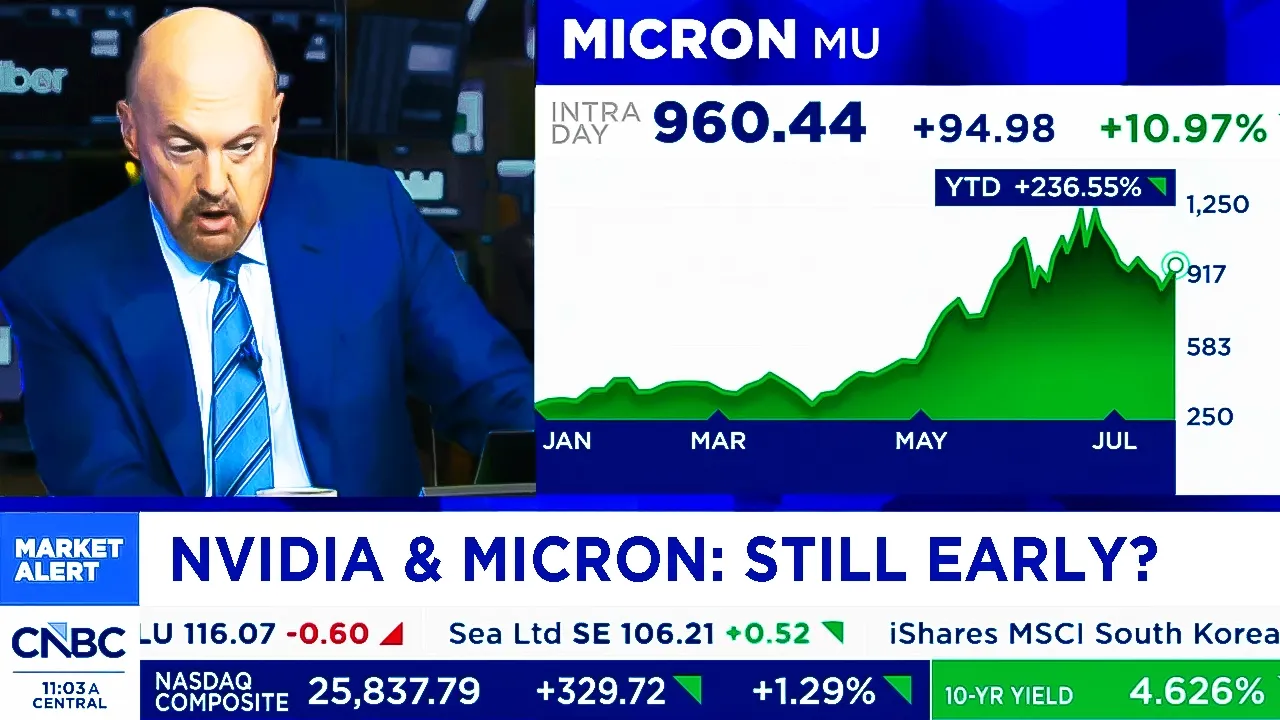
"Micron's up 10% today, right? ... So if you do not have a position you have what I would call a low-risk well-defined point of entry here versus these critical supportive moving averages."
Contexto
"I sold Marll uh because I was up over 100%. Same like I did with Pterodine."
Transcrição Completa
UBS believes that Micron will generate $400 billion in free cash flow through 2028. That's a very large amount of money. What would they do with it? Well, Stuart, they're going to need to build out the continued capex. All that demand is going to mean more memory. You know, I know these stories come each week. Last week, it was the Kimmy K3 story from China that said, "Oh, you know, maybe we don't need so much compute." And then the whole market sells off. And then, you know, the experts come out and say, "Actually, we're going to need a whole lot more compute because of this." Micron's at the very center of this. So, you and I have had probably a dozen conversations over the last year about uh this situation. Micron can command its price. It can drive its margins, but it's going to need to reinvest. And the question is, can they build just enough that they don't create that over uh supply that has historically brought memory down? And I think they're going to be able to do it because the AI cycle is very different than historical memory boom bus cycles. >> However, at $1,000 a share, I mean, it's close to that. I mean, that's a that's a very expensive stock, isn't it? In terms of price earnings. >> Well, in terms of the forward PE, it's trading at under 10 now. So, it really depends what you believe. If you believe that this is a cycle that's going to go bust like they used to in the past when it was related to consumer devices, PCs and smartphones, then yeah, you're going to be paying a lot for it. If you believe that there's going to be $10 trillion plus in capex, which is the number we have at Futurum, 10 trillion with a bullcase of closer to 12 trillion by the end of the decade, cumulative capex, the demand for memory is actually still very early. these margins are are stable and unbelievably they're going to get close to 90%. And what UBS is saying is that basically uh Micron can pile cash, you know, about 10% of the way to the moon between now and and then in that next period. So it's pretty unbelievable and unprecedented, but that doesn't mean it's not real. >> What what's the target? What what's your target price for Micron? Yeah, future equities has a has a target at uh$,550 right now. Um, and we do believe that based on its next quarter, those numbers could continue to go up. Look, we've never seen anything quite like this. And as I said before, Stuart, with each period of time that we continue to come around these deepseek moments, the Kimmy moment, the, you know, this is the end of the demand for compute moment that we hear come out in the media when we find out that we really are still very early in our demand for compute. And I think we're going to see that in this earning cycle, Stuart. I think we're going to see the hyperscalers are going to confirm if not raise capex and we will see that this boom continues. But I will say having some orderly draw downs and having some you know rallies un you know we can't go up and right all the time and so when people see a little selling and they panic I think we need to recognize that the demand is real the capex spend is real the ROI is still being proven that all these companies are going to make money on these trillions of dollars of spend and that we do need an orderly leg up not you know a straight up and to the right all the time. >> Okay. Can you tell me in 30 seconds whether China's AI program is now ahead of United States AI platforms? I mean if you if you don't have IP laws and you can take all the best innovation of the American companies and you can distill it and copy it and then offer it back to the United States at a discount then yeah I'd say they're ahead. uh allstar. No. Uh China still depends on US innovation and US investment, but they are a formidable competitor and I think that we need to know that with their rules and their laws being different than ours, uh we're going to have to continue to invest and continue to innovate and know that China is coming after us. Okay. >> What do you think of this Nikki piece about TSM raising price maybe 5 to 10 next year? Well, I think the the main people main theme is okay, who can pass on the price increase and the street is very bullish and it did save the stock. Thank TSF. The street's very bullish on that the hyperscalers can pass it on. People do not think that Apple could pass it on. I think that's a big mistake. I think Apple's probably the most able to pass it on. Uh but Taiwan Semi is trying to save the group right now. And the one that of course, you know, I follow that Dave's not here to make fun of me about is Nvidia. Uh but Nvidia opens up four and then finishes the day up 32 cents. And I'm so used to that pattern now. It's like all right, wake me up when it gets to 36 cents, you know? >> Yeah. Uh Micron does get added to the BFA US1 list and there's a nice 9% gain. Third third third best on the S&P. >> He has uh here Sanjay Maro has taken the money and he's spending remember he's spending $200 billion to be able to build up our capacity. He's an American hero. He's not self-promotional. He's a remarkable man. But whether between Boise, where I intend to go to, and upper New York State, this man is putting more people to work than any I think and I said to him, I think he's putting more people to work than anyone other than the US government. >> Sanjay Morotra, >> I think he is >> in New York State in Idaho. >> Idaho. >> My daughter was up there the other Jeez, what is this? Is like the biggest boom area. I mean, it's a boom town. >> It's a boom town. Yeah. and it has been now for a while. But I think Sanjay is terrific and he's re he's made it so the company's like the old days where it was the leader but it's now high bandwidth mobile I think it's a ter if you have to own that but again it's parabolic so I it's up to >> yeah I mean I think people I think page one of the the Arizona Republic over the weekend was about TSM in Arizona doing essentially the same thing unemployment and construction. I think that look I I want I want them here because I don't like how close Taiwan is to China and I know there's a lot of glib nature about how the Chinese are trading partners and I just don't think they are. I I do I think they're Russia, the Soviet Union. I think they're closer to the Soviet Union than they are say um uh I'd say Poland. >> Yeah. >> Great. one of our greatest part. I'm just saying there's a great misinterpretation about like the cold war and what cold war countries did with us in terms of trade versus now. We seem to think that somehow we were doing a lot Arman Hammer did a big trade with Russia cuz uh cuz Lenin liked the new economic policy. But after that there was like 70 years where there wasn't a lot of laws and a lot of commerce. And we're acting a lot of our companies are saying you know we can we can save a little money do a little business with China. recently. Steph uh you tweaked your semi exposure. What brought you into the fold here? >> Yeah, sure. So, I sold Marll uh because I was up over 100%. Same like I did with Pterodine. I think you take profits when you can take them. And then I added Micron because the stock is down about 24% from its highs and the fundamentals remain amazingly strong. We all know that. But [snorts] I think it's going to be stronger for longer. when I went through the quarter and I've been going through the quarter uh report in over the last couple of weeks and you know they've signed 16 deals last quarter 14 of which it gives them hundred billion dollars in RPO and that's bookings and I think that that means that the the visibility is just so much better as a result and so I do think the AI trade is certainly not over I think we're in the third or fourth inning at this point in time and we are short memory we are short compute boot and that gives this company a lot of pricing power. I don't know if we're going to see the pricing power that we saw last quarter. I mean, they had 60% average selling prices in DRAM and 80% in NAND, but I do think you're going to see ASPs be stronger uh and just strong in general. And I think this company has about $40 a share in uh earnings power through the cycle. I also added to Nvidia. We started buying that two weeks ago. I just believe that the it's lagged so much It's actually underperforming the group by 53% year to date. It trades at 18 times forward estimates. That's the cheapest it's traded at since 2019. And we know that they dominate the GPU market. I understand there's competition coming, but they will always dominate the GPU market in my mind. Um, and they have new products coming. And this is a company that's growing revenues in the 80s, gross margins in the 70s, and they're going to double their free cash flow between now uh and next year, end of next year. And so I like that visibility as well. And I think there's a good value there. >> Yeah, I saw this interesting stat from OPCO this morning, guys. With Micron and Nvidia are the top two contributors to year-over-year earnings growth for the S&P and Q2. If these two companies were excluded, according to OPCO, the blended earnings growth rate of the S&P for Q2 would fall to 16.8% from 24.7%. That's a 790 basis point improvement. Joe, I know you own these too as well. Are these musthowns just given their impact to earnings growth in Q2? >> Well, look, I think if you have not owned them, the the right perspective to take is you now have a pullback into what is technical support. >> Micron's up 10% today, >> right? And you're you're technically you're still sitting above the 100 day moving average. I think the fundamentals are well known about memory, high bandwidth memory and the universe of AI infrastructure. But we know hyperscalers will continue to spend and they are ultimately going to benefit. I think from a sentiment positioning standpoint they reached an extreme. They went parabolic and you need to work off you needed to work off that overbought type of condition and I think that's in fact what you've done. So if you do not have a position you have what I would call a [clears throat] lowrisk well-defined point of entry here versus these critical supportive moving averages. Um, if they break down below it, then you can make a strong argument that maybe there was a significant inflection point that was traced out several weeks ago. Um, but I hold them from a a core perspective in the ETF. I'm not adding to them here because I do think we've worked off the significant fever and I think overall you've seen the momentum factor come down dramatically this month. Okay, one of the worst months for the momentum factor in the last 10 years. And it seems to me you have a little bit of a handoff and what's saving the market is the performance of the mega cap. It's your Apple, it's your Meta, it's your Amazon, they're performing Nvidia. They're all performing really well in July and I think that handoff might continue. So, I'm a little bit uh muted in terms of how I think about positioning. If you're there, stay there. If you're not there, lowest point of reference. Don't get overly excited about a trade that probably saw its most strongest intensity several weeks ago. >> Well, I guess the key question too, Josh, is whether this is a a factor unwind in terms of momentum and a lot of the AI infrastructure exposure or a fundamental unwind. This is a question that Wells Fargo was asking this morning. And if it is purely factor-based and and positioning based, do you feel like that unwind is is to a point now where it's completely been flushed out? Well, the market it doesn't matter what I think because the market is telling you um that they bought the that they're buying the dip and they think that most of what went on was technical and not fundamental. That's why the entire AI trade is ripping today. Not just the semis, but all the non-technology companies that have been uh caught up in this whole AI capex buildout theme. They're all they're all up. Uh DRAM's up 10% today. the top performing stocks in the S&P, Sienna, SanDisk, um, Western Digital Micron Intel AMD Corning. So, it's all one trade. The trade got washed out this month. Joe made a really good point, I think, and and we we had this handoff underneath the surface of the market that allowed us to not give up too much ground in the in the S&P at at the index level. And uh, the market today is telling you they want to be long these names. Now, why today? This is the thing that nobody's brought up yet. If you're bullish on the Steam, you can't not be in these stocks ahead of Google because what the Google what the Google earnings report does for us every quarter is it serves as this sort of like um come on into the revival tent for uh Brother Love's Traveling Salvation show. It's the affirmation that everybody needs to hear about the state of CAPEX, the forward guide for capex, the fact that all these projects are going ahead, maybe even more projects than we thought about 90 days ago the last time they reported. So like if you if you're bullish, you need to be in ahead of Google, not sitting on the sideline because this is arguably the cleanest AI story in the entire market from the the hyper from a hyperscaler uh perspective. I also think um you know it's a re it's a really healthy tape. The fact that we had these stocks 20 30% draw downs. You would have thought, oh no, now the whole market's going to sell off cuz it lost its leadership. Number one, that didn't happen. And number two, this has been a really helpful reminder for traders. Ain't no such thing as one-way trades. It doesn't exist. the best stocks in the market, the most powerful names, the best earning stories, they're going to have down days, they're going to have down weeks or even a down month on the way toward higher prices. We need to get that reminder. If they just go parabolic every single day the market opens, then you're in for a real crash. And fortunately, this is what keeps the market honest. This unwinds some of the leverage. This gets people to actually hit the sell button on some of these 2x ETFs. like this is what you need for a longer term uptrend. So, I'm really pleased with the way not only these stocks are rebounding, but the way the overall market is processing what's happening and and living through it. >> That's a really good point with regard to Alphabet earnings and the timing. >> I'm very good at this. >> Yeah, [laughter] you got some experience there. Um, also in kind of the fundamental camp of why we're seeing semiconductor stocks move higher today, you've got Taiwan June export orders that were kind of skyrocketing. TSMC reportedly looking to raise prices 10% next year. That's according to Nikk. So I guess the question is given what we've seen in terms of positioning, given some of the fundamental stories that we're digging through today and Josh's point about Alphabet earnings, do you think these moves hold? >> I do. I do and I think all all that's what's transpired thus far this is a matter of positioning from my standpoint obviously the socks or the SMH what whichever index you've been on the semi side have run to to Josh's point I mean they've been parabolic runs that we've seen in the first half and it is healthy to see other sectors participating like healthcare financials industrial starting to move um and I think to Joe's point if you're not in there this is a potential opportunity because to your to your point Leslie at the top of the So, you know, 48% of earnings growth is going to come from the semiconductor index going forward. So, um there's clear visibility on what those profits look like. Capex is not going to slow down. You're going to hear that uh from Google tomorrow. They'll reaffirm and potentially raise. I think you're going to hear that from most of the hyperscalers. So, I think that is not a place to ignore. And this kind of disruption that we've seen over the last couple weeks, I think present an opportunity if you're not there. How should we think about capex and and especially against this backdrop of the the Chinese model competition? How critical is open AI and anthropic in light of that competition to fueling the massive capex buildout? Do do you think it still continues if there is significant open source competition from China that starts to eat away its share of anthropic and and open AI? Is it is it as much of a correlation as you know the broader narrative may think right now? >> So I think it's it's it's an interesting story. is kind of like a mini deepseeek moment that we experienced a little over a year and a half ago. Um, I don't think that slows down that the the all the octane and the fuel in that trade. I think the capex story continues to be a reaffirmed and and move forward. Um, but I do think we might see some discipline in the next few quarters, right? I think I think this is good from a disruption perspective. Listen, it's a China based company. we're not going to be um investing heavily in that direction, but I think it it it [snorts] is a story that maybe changes the dynamics from firms going forward and how they manage this narrative. So, um I don't I but I don't think it changes the capex. >> So, I I don't know that the the memory names or semi semi-equipment names, they want that discipline in capex. >> They want to see the capex continue. I think the capex is really important tomorrow night for Alphabet because it makes you think about two things. If the hyperscalers continue to increase capex, what's the effect on free cash flow? We know the obvious answer to that. Does it look so good? And then what's the effect on buybacks? So, does that story change for the mega caps? Now, to Josh's point, you have the first ex pure example of monetization tomorrow night with Alphabet and it comes in the form of cloud. So consensus said 63% >> growth for cloud. The whisper number is 70% for cloud. I think it's going to be interesting tomorrow night because of the TPUs, tensor processing units. So does that mean that Alphabet benefits from maybe not having to spend as much because they have the internal usage of these chips that maybe some of the hyperscalers aren't. So, I think tomorrow night is really going to be one of the more interesting mega cap earnings reports. It's going to set the stage. It's going to set the tone for memory. It's going to set the tone for semi- equipment, but I think it's also going to set the tone for whether this rotation into the mega caps can extend itself further. >> Jason, what are you expecting tomorrow? >> Yeah. No, I I think the cloud number is very important number to kind of extract there because even last quarter was just a I mean a blowout 60 plus percent um you [clears throat] know um revenue growth number. So that I'm definitely follow I think you know search and ads still are the core bar right I think that's going to be important revenue growth of around 21% we're expected to see um but I I think if we can get close to that whisper number of 70% that's going to be the story as Google cloud continues to get market share in the space right AWS has been the has been the largest player here but they're continuing to get market share and Azure and others so I I like the story I like vertical integration, >> the full stack, full stack. We are back with final trades. Josh, we'll start with you. >> Oh, I I think I just want to uh I think I just want to point out Nvidia is finally starting to act better on down days for tech. I think that's new and we should pay attention. >> So, this brings me sort of to the conundrum and it's a conundrum for all investors to be quite honest with you, particularly mainstream investors, right? Professionals, let's face it, they get paid even when they miss it big. they miss big moves or they lose big money, they still get paid. So for me, I've got an approach that I like to share with individual investors and it it incorporates three pillars. Fundamental, technical, and behavioral analysis. Now, in a perfect world, the waiting would be uh just sort of even across the board. But this is what you have to be concerned about and this is why you need to understand this. This is from an article. One of these kids in Korea, you know, they're going crazy over their stock market. Uh he used a lot of margin, 500% margin, but he was up 15fold. 15fold. Imagine that. Absolutely amazing. And of course, he's losing now. Why? They're unwinding all of that leverage. The leverage has come down tremendously. And that's what's bringing their market down tremendously. Now, the flip side of that, of course, is the fundamentals, right? So, we see what's happening there, but the fundamentals are just phenomenal. So, your DRAM export value up to $12 billion. $12 billion. That's up almost 400% from a year ago. This is just absolutely phenomenal. When you see this, do you think, man, the stock should be down? Absolutely not. Not only that though, this month just reported DRAM prices hit yet another milestone. So again, these aren't things that are associated with markets that are falling apart. It shouldn't be associated with markets falling apart. So again, you think about this fundamentally uh usually that's 65% of my decision- making. Technicals are 25% and then what I call emotions. Emotions are another 10%. That's been completely flipped around in this market. Right now it's all emotions. Here's what's interesting. So we talk about this big news that's been out this Kimmy K3. One column that I use on this chart that we didn't really talk about is how much more demand there will be for semiconductors, right? This is absolutely phenomenal. These things suck up all kinds of energy and power and they have so they need all the resources out there. So the fundamental story has gotten even better. So emotions are driving the market lower. And the question is how do you reverse that? Right? And this is what I'm going to go back to technical analysis for a moment. This is what I'm looking for. So we broke the 50-day moving average on the downside. Uh and listen, almost all the charts look like this. This happens to be the semiconductors. You could look at the NASDAQ 100, the NASDAQ momentum. All of the charts are very similar, all below the 50-day moving average. All of them made a series of lower lows and lower highs. If we can somehow close above this blue line here, folks, right around here, on a closing basis, I think you're going to see the hot money crowd pour into these stocks really, really quickly. Now, of course, here's the thing. If you're a long-term investor, you don't have to worry about it. >> All right. I hope you're all doing well today and staying calm in this market. Today was a positive day throughout much of the market. We saw some red action in some software names, but it was a solid green day from many tech hardware stocks, especially for Micron, as we got multiple pieces of positive memory news, which I'm going to cover in a moment. Today, Nvidia shared that Vera Rubin, backed by 300 partners globally, is ramping up worldwide. Initial systems are already at Core Weeave, Google Cloud, Microsoft, Azure, and Oracle. Coreweave said that on Deep Seek, our one inference, Vera Rubin, produced 10 times more tokens per second per megawatt versus its GB 2000 NVL72 configuration. Google Cloud is already running its Vera Ruben powered A5X systems for ineffable intelligence. Deep Info reported that the Vera CPU supported as many as 1.6 times more concurrent agents and up to 2.2x faster agent orchestration. And in a separate technical blog post today, Nvidia shared some details about the Reuben GPU. Reuben has 336 billion transistors, 288 GB of HBM4, and 22 tabytes per second of memory bandwidth. So, Reuben has the same 288 GB on package capacity as Black Hole Ultra, but nearly 2.8 times the HBM bandwidth thanks mainly to the upgrade from HBM 3 to HBM4. As a reminder, Micron said on their most recent earnings call that they've shipped over $1 billion in HBM4 revenue. Also, on Tuesday, we got multiple pieces of positive memory news. So, let's cover some of those. First, memory was an important topic on GM's earnings call Tuesday morning. As a reminder, Micron recently announced that GM is one of the 16 customers that they've signed a strategic customer agreement with, and that was brought up on GM's earnings call. GM CEO spoke about the company's strong relationship with Micron and Samsung, saying, quote, "We've got a good relationship with both suppliers, and we're going to continue to work with them and align on next generation memory technology, so we can have jointly developed technology roadmaps that I think will enable us to not only enable future product innovation, but also performance improvements as we go forward." Notice that she's talking about long-term multi-year collaboration on new memory technology and jointly developed road maps. As I've said in recent videos, Micron's seas are not the same as the LTAs of past memory cycles. They are fundamentally different. The LTAs of past memory cycles were not contractual purchase obligations. They were essentially flexible supply forecasts that were often renegotiated depending on what was happening in a market with memory spot prices. But now, Micron strategic customer agreements are take or pay, meaning that customers either take the agreed upon supply or they bear the financial consequences for not taking it. These are multi-year contractual purchase obligations with floor pricing and supply locked in. And most of the SCAs extend through the end of 2030. Now, going back to the comments from GM CEO, she is talking about collaborating with Micron and Samsung on next generation technologies. When we're talking about memory demand and trying to figure out how long the memory makers pricing power will last, we need to remember that we're not just talking about generic off-the-shelf memory products. Now, we're talking about next generation technologies that are co-developed to meet customers specific needs and use cases. This is similar to Nvidia's approach with the big three memory makers. Nvidia doesn't ask them what they have for sale. Instead, Nvidia approaches them and tells them what they're trying to build, and the memory makers collaborate with Nvidia to co-develop new technologies. That's very important to remember when we're having the commodity debate and wondering how long the memory makers pricing power will last. We're not just talking about generic general purpose memory. That said, AI demand is pulling production capacity away from conventional memory, which is leading to higher prices for those products as well. On that topic, we got some other positive news from memory makers today after a report indicated that Samsung and SKH are allocating additional or flexible DRAM capacity to server DDR5 and other conventional DRAM while preserving HBM volumes already committed under customer agreements. So, this does not indicate that they're reducing their HBM production, but it does indicate that their incremental capacity may favor DDR5 rather than HBM. That would mean that the conventional server memory shortage is becoming sufficiently profitable to compete internally for wafers. In other words, due to the shortage, margins on some server DDR5 products have apparently been pushed higher close to HBM levels. That is good news for the memory makers. Speaking of Samsung and SKH Heinix, on Tuesday, new data from the Korea Customs Service indicated that South Korea exports in the first 20 days of July were up more than 50% year-over-year, and semiconductor exports were up more than 180% year-over-year. That's an important reason for the positive action we saw in memory stocks on Tuesday. But there's more. In addition to exports being notably higher, export unit value was multiples higher than it was 1 year ago. The increase in export unit value appears to have been driven by price and mix, not by greater volumes. In other words, memory prices were notably higher in the first 20 days of July. That piece of news is a big reason for the positive action we saw in memory stocks on Tuesday. In other news, we learned a NK report on Tuesday saying that TSMC is set to raise prices in 2027 on both advanced and mature processes by 5 to 10% depending on customer and product according to multiple sources. This is not a surprise. It's another indication that demand is strong. Nvidia has plenty of pricing power to maintain their gross margins even if there is a price increase. Looking ahead, we have Hypers Scale earnings starting this week with Alphabet earnings scheduled for Wednesday, July 22nd. Meta and Microsoft both report earnings on July 29th and Amazon is scheduled to report earnings on July 30th. Overall, I'm expecting strong capex guidance and commentary from each of the major four hypers scale companies. Let's briefly cover each of them ahead of earnings. As for Meta, I'm expecting them to announce strong capex guidance. I know there was a bunch of hoopla on July 1st after Bloomberg reported that Meta was developing plans for cloud business. Some days after that report, Zuckerberg clarified that they do not have excess compute. It's just that some of the deals are very attractive and Meta could charge a premium if they rented out a portion of their capacity given the constraints throughout the industry. Meta also recently announced they're expanding their Hyperion data center in Louisiana from 2 GW up to 5 gawatt. Last earning season, Meta CFO said that they continue to underestimate their compute needs even as they've been ramping capacity significantly. Plus, Meta Super Intelligence Labs just recently launched Muse Image, Muse Video, Muse 1.1, and a new model API. Meta is not dropping out of the AI race anytime soon, and I expect their capex guidance to be strong. As for Alphabet, I think they're also likely to report strong capex guidance. Last earning season, Alphabet CEO said that they're compute constrained and would have had higher cloud revenue if they had more supply to meet demand. Also, Alphabet CFO said on the earnings call, quote, "We expect our 2027 capex to significantly increase compared to 2026." As for Amazon, I'm also expecting strong commentary and guidance regarding capex. Amazon CEO Andy Jasse spoke at length last earning season about Amazon having very high confidence that they will monetize the capacity they're bringing online. As a reminder, AWS is monetizing new capacity as soon as it comes online. Last earning season, Jasse said, quote, "The faster AWS grows, the more short-term capex will spend." And then on July 1st, AWS raised GPU rental prices by 20% and they made that decision based on supply and demand. In other words, demand is very strong and outpacing available supply. As Jasse said last earning season, the faster AWS grows, the more they will spend on capex. AWS is clearly growing and so I expect strong capex guidance from Amazon. Now, let's talk about Microsoft because I think this is the most interesting of the four this earning season. I want to remind you of a few things. First, Microsoft will be reporting results for the end of their fiscal year. And so, they're likely to provide commentary on the earnings call regarding capex over the next 12 months. This is going to be a very important earnings call for the entire AI ecosystem. As a reminder, last earnings call, Microsoft guided fiscal Q4 capex at $40 billion. They also told us that for calendar 2026, they expect to spend $190 billion. Again, that's for the calendar year. And so, calendar 2026 would include the third and fourth quarters of fiscal 2026 as well as the first two quarters of fiscal 2027. And so if Q3 capex was 31.9 billion and let's just assume Q4 is $40 billion as Microsoft guided that leaves $118.1 billion that Microsoft intends to spend in just the first two quarters of fiscal 2027. That would be an average of roughly $59 billion per quarter, much higher than their capex so far. What's the reason for that increase? There are two reasons. First, Microsoft is investing heavily in additional capacity for their cloud business. And secondly, Microsoft stated earlier this year that they want to have their own state-of-the-art models inhouse by 2027. and they're going to need a lot of capacity to do it. As I said repeatedly ahead of Microsoft's last earnings report, I thought their capex guidance was going to be notably higher than what many market participants were expecting. That turned out to be correct. Now, I'll be completely honest. I don't know what they're going to say on the earnings call regarding capex over the next 12 months for fiscal 2027. If I had to guess, given the fact that they need additional capacity to compete on cloud, they need to have enough capacity to train their own state-of-the-art models and also what we're seeing in rising component costs, especially in memory. I think we're likely to get strong next quarter capex guidance. But I just want you to know that market participants main focus as it relates to capex is what Microsoft will say about capex over the next 12 months in fiscal 2027. That is what will likely have an impact on the stocks of companies like Nvidia, Micron, SKH Highix, the NeoClouds and many others. There is some important nuance in Microsoft's AI strategy. And so we need to listen in to the earnings call to get a better understanding of what's going on. If I could only listen to one earnings call from the four major hypers scale companies this earning season, I would choose Microsoft's. What they say about capex over the next 12 months will likely determine how tech hardware stocks trade the next day. Overall, I'm expecting all four of the major hypers scale companies to report strong capex guidance and important commentary regarding AI monetization this earnings season. I don't know what's going to happen in the short term, but from a long-term perspective, I am very confident that Nvidia will be worth much more in future years than it is today. When Jensen was on the Lex Freedman podcast not that long ago, he was very seriously raising the possibility of Nvidia becoming a $3 trillion revenue company in the near future. If that happens in the coming years, then it is very plausible that Nvidia could one day be worth tens of trillions of dollars in market cap. That might sound crazy, but that's what Jensen is implying when he raises the possibility of Nvidia becoming a $3 trillion revenue company. I guess the question at that point is what multiple the street will be willing to give Nvidia. I don't know the answer to that question, but I truly do think that Nvidia will be worth much more in future years than it is today based purely on the fundamental growth of the business. Based on everything I'm seeing, the world is still compute constrained and I expect that to continue at least through the first half of calendar 2028. In a computed environment, developers will use whatever viable compute they can get their hands on. Today, there are no GPUs that are sitting dark due to a lack of demand. Like, there was fiber sitting dark due to a lack of demand at the height of the dot bubble. Back then, companies were laying fiber in the hopes that use cases and demand would eventually show up. Today, we are seeing the complete opposite. As I've said many times, when market participants compare this AI revolution to the dotcom bubble, they ignore the fact that the internet is already here this time. This means that mass adoption of the technology and new use case development at scale are immediately possible. We don't have to wait years for it to show up. It's already here. The world is compute constrained, which means there is not enough supply to satisfy demand. New capacity is utilized as soon as it comes online. The hyperscalers are monetizing capacity as soon as it comes online. Each of the hyperscalers spoke about being supply constrained on their most recent earnings calls. Alphabet CEO specifically said that they are compute constrained and would have higher cloud revenues if they had more supply. Additionally, many of the clouds are building out into contracted demand. They're not blindly building in the hopes that demand will eventually show up. No, they're building out because they have signed contracts and in some cases significant prepayments from their paying customers. This AI revolution is fundamentally different from the dotcom bubble and 2026 will be a pivotal year for the AI industry thanks to the rapid adoption of agentic AI and the proliferation of agentic systems in the world's leading enterprises. The leading AI labs revenues are surging right now. Agentic coding and the implementation of agentic systems in large enterprises are new use cases that are increasing inference demand significantly that subsequently is increasing compute demand. The rapid adoption of Aenic AI is why we're seeing an inflection in inference demand. It's why we're seeing the leading AI labs revenue surge. I wish both Anthropic and Open AI were public so the public could see the ramp in their revenues. Anthropic ARR has surpassed 47 billion, up from $9 billion just at the end of 2025. Open AI is growing rapidly as well. I think the leading labs surging revenues may be the initial proof point that grabs market participants attention and causes them to realize that there will be a clear ROI on AI infrastructure. I think the leading labs surging revenues will also help assure investors of the longevity of Nvidia's growth since these labs revenues are directly tied to compute. If they had more compute, they would have greater revenues. It really is that simple. Demand is not the problem. The problem is a lack of supply to meet the demand. As I've said previously, I expect the world to be compute constrained at least through the first half of 2028, possibly longer. And so regardless of what happens in the short term, it's important for long-term investors to remain focused on the fundamentals, maintain a long-term perspective, and remember that we are only in the early stages of Agenic systems being adopted at scale. This will increase compute demand significantly. And after that, the next surge in compute demand will likely be fueled by physical AI. We're no longer talking about digital agents performing digital tasks. With physical AI, we're talking about physical AI agents performing physical tasks in the real world. NVIDIA CFO has called physical AI quote a multi- trillion dollar opportunity and the next leg of growth for NVIDIA. This industry will fundamentally transform society and NVIDIA has positioned themselves to benefit massively. NVIDIA sells the hardware for the data centers where the models are trained. They offer omniverse where the models are taught and tested and Nvidia also sells the hardware that allows ondevice real-time inference through NVIDIA AGX allowing robots to have intelligent interactions with the real world even when they are not connected to a data center. Notice that Nvidia is taking a holistic platform approach to physical AI and they're embedding themselves as the underlying foundation supporting all of it. Over 2 million developers are already building on the Nvidia robotic stack and this is not getting enough attention. As for production ramps, Blackwell Ultra has ramped quickly and remains in high demand. Reuben is on track to launch in 2026. Then we're expecting Nvidia Gro 3 LPX in the second half of 2026. Later on, we're expecting the launch of Reuben Ultra in 2027 and Fineman after that in 2028. We have a clear data center product roadmap stretching into 2028. And Jensen believes that AI infrastructure spending will reach three to$4 trillion annually by the end of the decade. That means Jensen is expecting growing AI demand and an expanding total addressable market underpinning all of this. I don't think we are anywhere near any type of bubble bursting type of event. With all of this in mind, I seriously think that Nvidia still has plenty of runway ahead of it. And I think this company will be worth substantially more in future years than it is today. At least that's my view of the situation. Quick note before I wrap up. All of the compilations on this channel are edited by Finn Vid with original structure and commentary. Occasionally, the same edits appear elsewhere on YouTube. If you're looking for the original version, it's always here on this channel. Thanks for watching Finn Vid. I appreciate your support. Remember to stay calm in this market. Remember to maintain a long-term perspective and do not make any hasty or irrational decisions. With all of that being said, I hope you all have a great rest of the day, and I'm curious to hear your thoughts about Nvidia in the comments below. Please leave a like on this video so more people will see it. And while you're down there, please consider subscribing. It's free and you can always change your mind.

Comentários 0
Entre para participar da discussão.
EntrarAinda não há comentários. Seja o primeiro a compartilhar sua opinião!