Microsoft's definitely going to be the better buy.
Contexto
Microsoft is a much more mature business. And you could argue for the right risk tolerance, Microsoft's definitely going to be the better buy.
Contexto
If you're looking at buying Microsoft, you might as well just look at the S&P 500, the, you know, the VU or even the QQQM.
Transcrição Completa
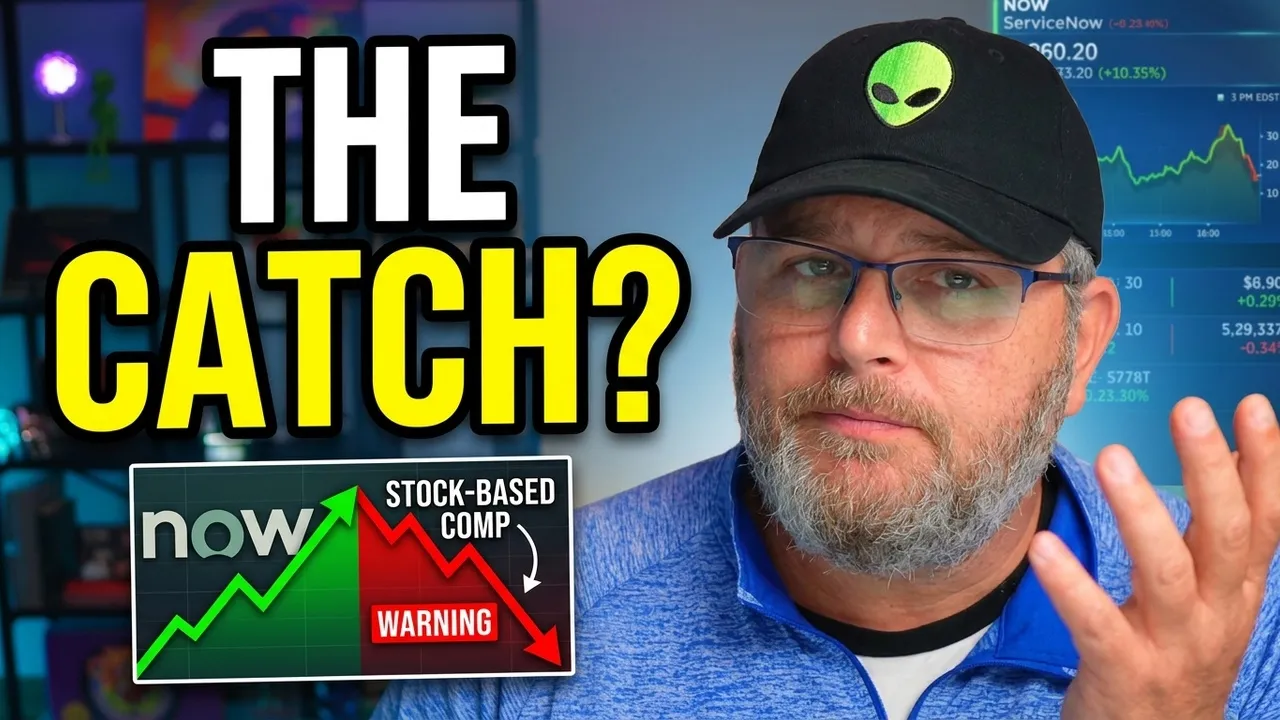
Service Now just dropped solid earnings last night. Beat across the board, strong subscription growth, AI momentum building, cyber security momentum building, and they even raised guidance. The numbers look really good. But before you freak out about the headlines or start piling into the stock and buying it, there are three things you need to understand, not just about Service Now, but SAS stocks, software as a service in general. But you can see Service Now beat by 4 cents on EPS and revenue beat by $50 million, up about 24% year-over-year. The numbers across the board are strong. Subscription revenue, that's trending in the right direction. That's what you want to see. Like a lot of these AI stocks, Service Now has a ton of RPO, a remaining performance obligations. In this case, $13.2 billion. The market doesn't really like this stat because of course it's not guaranteed. When you look at the platform growth, you got 18 of the top 20 deals include eight or more products. And this is what you want to see for these SAS type stocks. We look at things like netbased dollar retention and churn rate. You want to keep customers. You want to keep them happy and you want to continuously expand and have them buy more and more product modules. So you want to keep buying building more modules, selling more modules. Cyber security is going to be a great play for service now to do that. The AI production scale is compounding. So efficiency, pricing and roadmap and cyber security, they really touted this on the call saying, "Hey, Bill McDermott, the CEO, Service Now is already a $1 billion plus cyber security business currently the fastest growing of the top 10 cyber companies in the enterprise." So what he's saying here within enterprise business, cyber security, somebody made a comment on X, did they forget about Palunteer? He's talking about top 10 cyber companies. I understand that a lot of people aren't going to like that stat. A lot of people are going to say that, you know, it's a BS cyber security company. It's not real. But, you know, let's keep an open mind here. Armis is actually in the magic quadrant for CPS protection platforms. And then their other cyber security segment, which is called Vasia, and this is really about identity management, which is going to be huge for Aentic AI. The stock right now trades around a 5.5x EVnt revenue. We're going to talk about this EVnt revenue here in a second, so definitely stay tuned. Now, for context, Service Now's long-term median multi multiple has been 15X and really peaking at 18 to 22X. It doesn't mean it has to go 300% higher to 15X. What it's telling you is that the market has rerated the stock. They want to give it a lower premium. So, the stock is down 50% in the past year from $200 to essentially 100 bucks. And right now, it's trading closer to 95 as I make this video. But, what are those three key things that I mentioned in the intro? The first one is that most people watching this video right now should avoid Service Now and all SAS stocks. If it's software as a service, has recurring revenue, use the EVNCM revenue, you should not buy it if you don't understand the sector and you should stick to industries that you understand and the S&P 500. Now, you hear me say that all the time. Why is that, guys? I'm not saying that you can't. It's your money. You can do whatever you want. I'm saying that most highly casual retail investors, traders should avoid these kind of stocks because they're hard to understand. They're unique and they carry high beta. SAS is really its own animal. You're not going to judge these companies or evaluate these companies the same way as a bank stock or even a magnificent seven stock for that matter. So, we're not going to look at just like a PE ratio. Now, this is a comment I received on Facebook. And I'm going to hide the person's name and picture just for confidentiality, but the person says, "Sorry, but Microsoft is a better buy than now at a similar PE ratio." Now, my reply to that, if you're using only PE to compare these stocks, do yourself a favor and buy the VU. This is why it's essential to understand both portfolio blueprint design that we teach at fired up wealth, how to build a blueprint, how to be a money manager, but also how to value companies appropriately. And every single segment sector is going to be different, unique. Even within semiconductors, if you look at photonics, completely different thing than a fabulous semiconductor company. So, AOI or coherence or lummenum completely different thing from an Nvidia, an AMD or a Qualcomm. A lot of it has to do with margin profiles and so on. But the average investor, he or she will take all stocks, your fraternity buddy, your buddy from college, all stocks on one level playing field and say, "Oh, this stock's cheap because it's a 10p ratio even though it's a value trap." Or, "This stock's expensive because it's a 30p ratio." But if it it's a 30p ratio and it has a 70% revenue growth rate, it's going to grow into that multiple very quickly. understand that growth investing is a combination of quantitative analysis and qualitative analysis. So hard data like PE ratios and those financial metrics, but also the story, the management, where you think this secular trend is going to go. That's stuff that's very hard in terms of tangibility. Now, some stocks will trade just off of stories, like an Olo that has no revenue. That's usually not my cup of tea. I like to combine both both types of fundamentals. 99% of of what my research is is fundamentals, qualitative and quantitative analysis. The last 1% technical analysis. But using a blanket PE ratio is not how you should look at stocks. And Microsoft is one of my highest conviction picks. I did a top 10 high conviction stocks for the next decade. Microsoft's on that video. But this comment is simply not to evaluate especially growth stocks. They're are very different companies. Microsoft is what we'd classify as a DJIF. service now. Well, it's going to be more of a growth to mature growth type company. It's still growing around 24%. So, it's mostly in that growth category. And you have that spectrum we talk about that goes from spec, hyperrowth, growth, mature growth, DJI, DJI, and income. You have to understand not only the sector that the company's in, what the competition is, etc., but also where that business is on that life cycle. And I know my comment's snarky, but it's 100% true. Of course, people will misconrue what I'm saying and they'll think, "Oh, well, you're defending Service Now. Oh, because you got a big bag, which also isn't true, by the way. And of course, full disclosure, full transparency because I believe in that. The three portfolios are over $5 million. There's a main portfolio, a community portfolio, and a dividend portfolio. Service Now is owned in the main portfolio. It's a small position I've had for a while. It's only4% of that main portfolio. The cost basis, you can see here, is $5187, and it is up 82%. So I'm actually not down on service now in the main. I am down however in the community portfolio. It is 3.85% of that account. And you can see the average cost basis here and we're down about 23.5%. Now this total loss right now and it's not a loss till I sell is $6,272 and 6K on a $5,000 portfolio. You can do the math. It's not very big. So I would like to potentially even add more Service Now. I bought some shares today, but I wanted to provide the screenshot so you can see exactly what I own. And of course, you guys are smart, so you can do the math. If you add up what's in the main and the community portfolio, and granted, yes, the main portfolio, it has been a lagger because I've owned that for a while. So, it has not done well. I'm not trying to defend it, but I technically have not lost money if you look at the sum of all parts. And I do plan on owning this long term, and I'm adding more shares. If you want to see where I think the stock could go in the next several years, you can take a look. I I showed you some screenshots earlier. You can go on to Patreon. It's completely free. You just have to sign up with your email and you can take a look at that DD writeup that I did this morning. And you're going to misconrue though and think I'm saying, you know, Service Now is a better buy than Microsoft. Well, it depends on what you're trying to accomplish. What kind of portfolio do you have? Is it a high risk tolerance where you're trying to accumulate wealth? Because Microsoft's a great company, but that's not going to give you massive returns. If you look at Service Now and if you look at this write up that I did on Patreon, it's going to show you some predictions, some mind-blowing numbers of where the stock could be. There's no guarantees. I'll give you a second example. This is a YouTube comment. This person says that they believe in the bull case, but do I have any thoughts on its high and increasing SBC, that's stockbased compensation, low ROIC, that's return on invested capital, and it's decreasing non-GAAP gross margins. Now, if you're like a value investor and you look at mostly quantitative data, this is the kind of thing that's going to confuse you. Especially if you're trying to put something like a PE ratio and every stock is the same. Or if you're trying to analyze Service Now and saying, you know, hey, stockbased compensation's high. Well, wait a minute. Do software stocks generally have higher stockbased compensation? Is this unusual for the type of stock we're talking about? These metrics aren't unusual for a high growth SAS leader like Service Now. High stockbased compensation. I worked in software for a decade. It's a standard. It's the way that these companies attract top engineers and retain that talent. You're not going to get the best engineers if you're not giving them great SBC benefits. Even my wife who works for Guidewire Software gets stockbased compensation. These type of companies are generally trying to scale. They're always investing in the future and that's not going to be for everybody either. So you're going to have margin pressure if they're investing in AI cloud. In this case, they're buying cyber security companies to expand the business footprint. And that goes back to again like we talked in the beginning that churn rate and expanding the footprint within the customer. You're going to have to spend money to make money and to keep the that ball rolling forward. This is a unique model. If you look at cloud SAS, venture capital invented a lot of these metrics. And that's why you can easily tear it apart and say, well, this isn't the right way. Hey, if I've been investing for 40 years, none of this stuff's going to make any sense, right? You know, what the hell is a magic number? What's a rule of 40? Why am I using EV NCM revenue versus a PE ratio and so on? Well, we look at the core cash economics and the free cash flow generation. Both of those are excellent. Service Now is executing with 23% subscription growth, expanding on margins, 31.5% guided. Plus, it has AI momentum. And this is typical sector behavior, not really a warning sign. In fact, these numbers are low compared to a lot of other companies within the software segment. I tell most people for this reason to avoid cloud and SAS stocks. Invest in industries that you understand or the S&P 500. So, to piggyback off of that, number two, if you lack understanding not only about the sector that we just talked about, but you don't really understand risk management, you don't really have a financial background, so a lack of financial education. Now, I learned a lot of this stuff the hard way, but I do have an international business bachelor's degree and I also have a master's of business administration MBA. That doesn't mean that I'm smarter than everybody in the room or anything, but I have deep business understanding and I've studied businesses. So, I can look at them maybe a different way than somebody that is a veterinarian. Nothing wrong with a veterinarian. That's what I wanted to be when I when I grew up. And instead, I'm talking to you and that's okay because I love what I do. But if you lack the education, you don't know how to build a blueprint, what those different types of stocks are and why you would own one stock or the over the other, you know, like dividend stocks. People confuse this all the time. Why would you buy SHD? Would you buy that to accumulate and try to gain wealth over a period of time? No. You're going to try to buy SHDs for passive income to preserve wealth after you've already made that money. So, completely different reasons to own an SHD versus a QQQ in different parts of your life. I look at Microsoft and Service Now. They're both very different, too. Microsoft's going to pay the dividend. Service Now, of course, you're not going to get that. And there are many reasons why they're different companies. Microsoft is a much more mature business. And you could argue for the right risk tolerance, Microsoft's definitely going to be the better buy. I would say for most people, that's the case. And if you're looking at buying Microsoft, you might as well just look at the S&P 500, the, you know, the VU or even the QQQM. But once you learn the blueprint methodology, everything changes for you because you understand. Here's the best analogy I can possibly give you. If you're building a football team, right, football's starting, people are getting excited with fantasy football, NFL football, college football. You're building a professional football team. I'm talking American football, right? Grid iron. You could say that Jamar Chase is one of the best receivers or CD Lamb or JSN or whatever, right? Or you could say that, hey, you know, Christian McAffrey is the best running back. I want a team. So there's 11 players in offense. I want 11 players that are Christian McAffrey. Are you going to do well as an offense if you don't have a quarterback? If you don't have lineman, if you don't have a tight end, right? You need people to block for for those running backs. If you just have 11 running backs out there, it's not going to do really well. Your portfolio own different stocks for different reasons. So you have wide receivers that are maybe like the highf flyers, right? boom bust type thing. You've got your stalwarts like your Lyman. You've got the captain of the ship. So, it could be one of your highest conviction core holdings like an Amazon or a Google or an Nvidia or whatever that might be for you. But you're going to build a team and you're going to have different skill sets that's going to make that team work together to win games. Just like when you build a blueprint or build a portfolio, you're going to have different types of stocks for different reasons. If you have all beta, I used to see people back in, you know, a couple years ago even on X, they'd say, "This is my portfolio." It' be five or 10 SAS stocks and I'd think you need diversification. You can't have like Sam Samsara and Crowdstrike and say, "Well, it's diversified because, you know, one's going to be cyber security and one's more in logistics or whatever." No, you're going to need to have a variety of companies and industries to diversify. And then even if it's a semiconductor company, there are tons of different segments, layers of that onion. seven different layers of that onion that I've taught you on on YouTube and then there are different companies that are in different parts of that life cycle. So if you don't understand all of that and you put everything on the same playing field and you just say well PE we'll use PE for everything. What about all the other hundred tools in the tool belt? Remember that a PE ratio is one tool in a tool belt and you're using not just the financials that quantitative data especially as a growth investor you're also using that qualitative analysis that story. And the third one, guys, and this is a big one. In 2026, sentiment drives roughly 50 to 70% of short-term stock price movements. So, days and months, especially in retail heavy tech or meme names or names where this, you know, if the sentiment's bad, if Service Now, everybody believes that software is going to zero because all these AI stocks is where it's at and AI is going to completely eat the world and you don't need any software stocks anymore. Well, sentiment's bad and that's going to drive that short-term sentiment in the stock action over long horizons, especially over two, three years, but one plus year, this flips with fundamentals now explaining 60 to 80% of returns as sentiment-driven mispricings revert. So, what does that mean exactly? Well, Lucid, if you look at the darlings from the pandemic, you know that back in 2021, that bull market before it came to an end in 2022 is really November 2021. Lucid Group, you know, that stock actually got up all the way up here, guys, to 552. This is saying that it's down 97%. But that's based on $242. So, if you bought the top at 552, you're down 99% plus. It's you need you need a,000% return just to break par, to break even, right? And this is one example of a stock where in the short term, sentiment drove it higher and higher, momentum, but eventually the fundamentals mattered. And when the fundamentals mattered, the stock looks like that. And there are going to be a lot of these hype stocks, these ex favorites and things like that. If you go out 5 years, there are going to be ton of stocks that are popular with retail today that are going to look exactly like this chart. That's just one example. Here's another one we can look at. Upstart. This is down 76% in the past 5 years, but that's based off $116. And this stock got up to 390 bucks. It's now 27. Do the math. You're basically in a lot of trouble if you bought this stock at the top. Even if you bought it down here at 116, you're still down 76%. Another example, Roku. You know, this thing is down 70% in the past five years. And of course, you're going to say, "Well, wait a minute. These are crap companies. The ones that I invested in now, I've done my homework and due diligence, and they're solid fundamentally." So then I can show you something like an Olo that has no profitability, no growth, and no valuation because it has absolutely no earnings, zero revenue. But yet the stock somehow is trading at a $7.74 billion market cap with only I say only 14% in short interest. I'm surprised it's not higher than that. Why? This is going to be 100% a story stock, qualitative analysis. This is about sentiment and where we think the market's going to go. But if it doesn't pan out, you know, these can be spec stocks. You can buy these stocks. We call them spec 10x or zero. You you position size them have very small positions. You know, if it works out, the stock could be potentially worth more in 5 years. And this is not financial advice. I'm not telling you to to buy anything on this video today. I'm giving you information. But what happens if that story doesn't play out? It's probably going to look a little something like one of these charts where it's down big. So, you have to understand, especially in 2026 where there's a lot of retail hype and excitement, you're talking about 50 to 70% of short-term price action is going to rely on sentiment. If the sentiment is next to zero on Service Now, the stock doesn't have to go anywhere. So, you could do all the research and analysis you want and you can project what you think the stock's going to worth and none of it's going to matter until you get sentiment on board. And in order to get that sentiment on board, you're going to have to show that software stocks can survive by themselves, and that's going to take time to prove the market. So, at the end of the day, I added some shares in the community portfolio to the Service Now position today. With that said, I'm saying that most people watching this video right now probably should not own a stock like Service Now unless you understand all the stuff that I talked about today. In the end, it's always your decision because you are your own money manager and you're responsible for your own decisions. So, none of this is financial advice. You have to do your own homework, do your own research, and make your own decisions based on your money, your blueprint, your risk tolerance, and your portfolio. If this video is helpful and you want more content like this, subscribe, like, and comment. Thanks for watching. Have a great rest of your day. Take care.

Comentários 0
Entre para participar da discussão.
EntrarAinda não há comentários. Seja o primeiro a compartilhar sua opinião!