Micron trades less than 10 times earnings. Good lord buy it. Yeah. Buy Micron.
Transcrição Completa
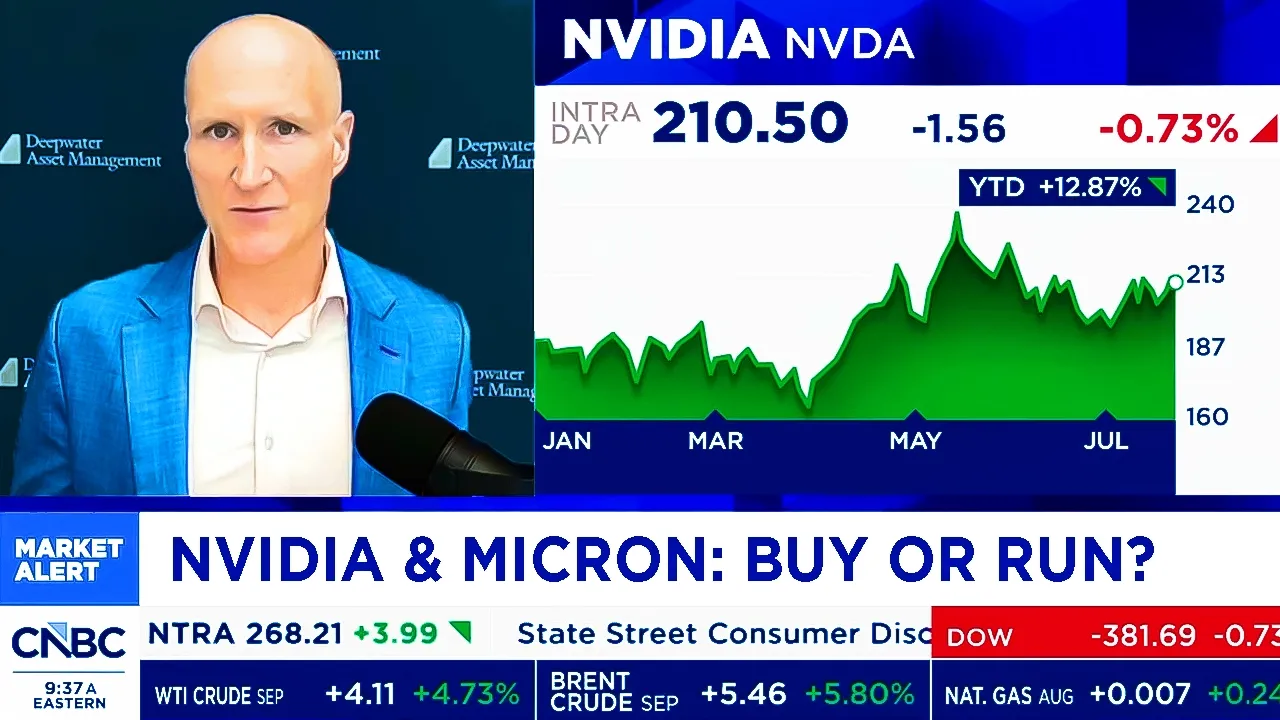
ask you. Oh, Micron, his comments about Micron. At a time where [clears throat] we're seeing all these surging memory prices and the inflationary impacts of that on on capex spending, I thought his comments about the fact that they have a good deal with them were very striking. >> Yeah, right now it's really interesting in the memory market given what you've said. there's a massive shortage of supply which has led to unprecedented price surges. And what you're seeing is a complete change in the memory market where um you're seeing individual companies try to lock in deals with individual vendors over a longer period of time than we've seen in the history of the memory market so far. And that's something that's been almost a competitive advantage for certain companies. those that are able to lock in deals with Micron, with Samsung, with SKH Highix, they're the ones who are able to access that supply and perhaps mitigate some of those supply chain disruptions that other companies are seeing. And clearly uh you see Elon Musk talking about it on the core. that sort of relationship with Micron, the fact they've got access to memory supply that becomes a competitive advantage in a market where you are seeing such shortages of what are very critical components uh not just for the data center as we know but certainly inside cars inside other kinds of devices and no doubt inside Optimus robots as well. So that was a a really interesting comment and I think it shows you how competitive the memory market is right now and how these shortages are causing a complete change in the way this market is functioning. Morgan, >> speaking of all of that, uh, Jensen has been making some limited media rounds. He spoke to Axios about about capex in general. Take a listen to this one. >> The new IT industry, the new software industry, and in the future, every single industry will be capex heavier. Not capex heavy, but capex heavier. Most industries today, most intelligence industries today are capex light. That's just simply going to change. But what you get as a result is incredible intelligence, incredible productivity, incredible growth. >> That's interesting. >> Yes. And he also has been making comments about Chinese models and they're okay. I think they're only okay if they're based here. I want the data kept here and I want tight cyber security generally after uh the hugging face. Hugging face. >> Of course, my wife says with a name like hugging face, don't they deserve it? I said, well, you know, it's not an estate law. n't their fault. >> She was like, "What was that? Who who makes that? Is that But I do think that what you got here is uh Jensen stock yesterday up huge up four and three/4ers. Now number one again, largest company. No new news other than these interviews." >> I know you wrote about it midday saying what's going on. Got to 214 or so, Jim. That would have almost the high since early June. stock was at 202 203 opened down 2 1/2 and then at 1040 it took off with no new news went all the way up about 6 and came back down a little when the last half hour the last 10 minutes the market was bad but that was quite that was like the best day for Nvidia in months >> how about the rest of the uh the the space you think is this capex you think we're hitting an inflection point on the street's patience >> well I cover Google as well I I think the big issue there is that the you know I hear you guys talking about capex, but they they packaged that with a margin width and then they talked kind of down margins going forward. So, you can't really do that because the capex hits DNA and it hits some expenses with regard to data center up uh up, you know, upstart expenses and people don't want margins to to whiff. I think that's the thing that you guys really should be talking about. Um the capex going up was basically in line with expectations. I thought that was positive for the chip cohort and I continue to not like hyperscalers um because why bother? They don't generate any cash. Who cares? Um buy the chip companies. >> Okay. So, are you now buying semi stocks? And if so, which ones? >> Oh, you have to. There are three three good reason. Well, which ones? Basically all of them because they're all down so much. But Micron, Nvidia, Marll are the ones that jump out for me. Oh, look at that. Well done producers getting those names right on there. Um so there are three reasons why you want to own semis right now Stuart. First of all it's where the growth is. These companies are growing 40 50 60%. I mean in the case of Micron it's you know 450%. Nvidia 90%. So number one you're buying growth. Number two a lot of these companies are down 35 to 40% just in the past 4 to 6 weeks. Again all all because of this AI angst. You know it's too much money being spent. It's not sustainable. These chip companies won't keep selling as many chips. They will. Okay. Um so the stocks draw down which means um you're buying in at a good time. And then thirdly valuation uh because of that you know 3540% price decline a lot of these stocks are trading very cheap some cheaper than the S&P 500. Micron trades less than 10 times earnings. Good lord buy it. Yeah. Buy Micron. >> Okay. >> Well I mean okay it's a down day and I get it. Alphabet's down and some people are worried about the capital expenditures. I'm not. Uh I would also point out that as far as down days have gone recently. It's nice to show a little bit of sign of strength in something like Micron some of the memory chips makes sense, right? If capex is going up at Alphabet, if they're not throwing in the towel because of Chinese open- source large language models, then okay, it's game on for spending at Micron, which of course they have those long-term uh contracts in place. Look, I I get it. There are people who are worried that AI is a bubble. I certainly understand that. Um, I'm more in the camp of the CEOs of these hyperscalers, the the Brad Gerson of the world who all feel that at worst we're in the middle innings of this. Um, and yes, I get it. Political blowback against data center construction. Some people don't want them in their backyard. There's enough places to build these things. And clearly from Alphabet, we're going to continue to build them whether we like it or not. So, um, I don't look at this as a bad sign. I look at it as the AI trade is is alive and healthy. >> Yeah. You still think the AI trade is still here? Still here. It's still going to be powerful. >> This is the biggest computing shift of my lifetime, of our lifetimes. This [snorts] is a massive computing wave. Um, we're seeing like unbelievable AIU compute demand with coding agents, reasoning models, and now this coding agent uh mega wave where open AI and Enthropic are going from tens of billions of dollars of AR to hundreds of billions in the next two years. So that I think the chipmaker >> I saw today anthropic I guess last January is a billion then it was big news when it hit 10 billion I saw it today 74 billion 74 billion this is in the blink of an eye >> my contacts I talked to dozens of engineers demand is through the roof we're seeing this exponential demand for tokens and and these coding agent AI models from open AI anthropic and and now Kimmy in China the demand is just through the roof >> where do you come down on the Kimmy controversy should should the the federal government intervene Uh, I don't think the government should regulate. I mean, they tend to overregulate. They don't really know what they're doing. So, I'd rather let the free market decide. And I I still think that OpenAI Anthropic are going to extend their lead in the second half of this year and into next year. There are best models. They have internally even better models and the government really isn't laying them out yet. And now there's this thing called RSI recursive self improvement where I I think their lead and the acceleration of their capabilities is just going to go exponential in the next six nine months. >> So you wrote the book Nvidia way uh you know Nvidia has been a remarkable story stock story everything. You know Jensen has overcome so many things and yet it doesn't seem like it can get out of its own way. Now I don't know if that's his fault though. It feels like they've got everything on the drawing board. They know what they want to do. They know the names of the next chips and the racks and everything. It feels and everyone else seems to be benefiting from it. What do you think about the stock though? I mean, it's acting pretty good. Yesterday had a pretty good intraday reversal, but the stock is stuck and a lot of people are in the stock. >> The stock has underperformed the last six to seven months year to date, right? But I find that as long as they keep putting up the numbers, the stock works itself out. Like last year, everyone complained for a while and the stock closed the year up 40% which is great. And I think over the next two, three quarters as they put up numbers with this Vera Rubin product cycle, Agentic AI demand is through the roof. They dominate the AI server space because they pre-allocate and got this uh allocation of chips they need in the memory and uh wafer side from TSMC. They're just going to do great the next two quarters. And it it's a it's a insane value right now at less than 20 times earnings. They're growing 80%. the market actually thinks that growth is going to peak soon and I don't think that at all like hyperscalers are up 80% in their capex they're going to go up another 40 50% next year and Nvidia is the number one market share they're getting all that money >> so let's talk about Micron for a moment and this notion that hey the spending will stop at some point when do you think the stock should reflect that the market is smart right so the market will peak before the spending peaks is there a time frame in your mind 6 months a year two years because Some of these companies have two or three year visibility. >> It's going to be at a minimum of 2028s. I think we have 2 years of uh continuous pricing power in the mic uh memory suppliers. I don't know if it's going to be 85% gross margins, but we're clearly seeing like even Google their latest iron ironwood TPU. This includes 190 GB of HPM 3 per chip. So that's showing how much amount of premium memory is going to be required across every one of these clusters. And that combined with the billions of tokens every minute that Google's APIs are producing to serve these Gemini models, like that's creating a huge opportunity for HBM suppliers. And Micron has probably the least amount of HBM market share, but that rate of change in that part of their business will be exponential. And that will cause a rerating of the stock because starts from a smaller base and the more and more it gets as AI evolves, the better their fundamentals become. If I'm going to keep hearing big tech come out and they're and and Nadella and Zuck um and Sundar, they're all going to keep spending and spending spending. Is that just mean, okay, you know what, >> full full pedal to the metal on the chips? As a guy, you know, you like Micron, you like Nvidia. >> I don't like all the semic it's there's two types of semis right now. >> There's semis where the valuation implies that the cycle is going to go strong through 2030. That's your AMDs, your Intelss, your optical, your semicap stuff like Cerebrris. You have all these valuations that imply we have at least a 5year cycle. And then you have Micron and Nvidia where their current stock prices imply the cycle's already over. >> So if even if we had just one more year of investment, those stocks are very inexpensive. So that's we're not we're not recommending the whole semis sector. It's very uneven right now. There's a big dislocation between companies that are getting a lot of credit and Micron and Nvidia that are getting no credit. >> Can I on Micron so interesting um Gil because you used to think of that as a boom and bust commodity business. I've had analysts come on and say AI changed that. It may still be cyclical they say but the cycles are longer. Do you agree with that? >> Absolutely. And by the way everything is cyclical. Industrials are cyclical. Financials are cyclical and by the way all of semis are cyclical. CPUs are cyclical and yet AMD is trading at 50 times earnings. Intel's trading at 100 times earnings. Micron seven. >> Yeah. Remarkable, right? >> Same business. I would argue memory is even more important for AI than CPUs are. >> Mhm. How come, Gil? Just elaborate on that's interesting >> because it's not just storing information. It's how AI works. The more memory you have, the better the model. The more memory you have, the faster the model. The more memory you have, the more context you can put in. the bigger request you can put in with more files. >> So right now we're criminally underutilizing memory because it's so expensive, which is to say we need a lot more memory than we have right now. And there's no capacity coming online for the next 18 months. So the price of memory will continue to go up for the foreseeable future. And by the time there is new capacity, we're going to need so much more than that new capacity, the prices will probably continue to go up. So of course it's cyclical. Again, everything's cyclical. It's less cyclical than other semis. Now, >> the big picture here is this is yet another statement about how early we are in AI. And I just want to kind of frame that in is what Intel basically does is they sell accessories to the AI uh infrastructure build. Uh these are CPUs. This is old technology. They've been updating it, but it's still old when it compares to GPUs. And the hottest segment their their best performing segment that data center and AI segment uh is 113th the size of Nvidia's GPU business. It grew at 56%. Nvidia is going to grow their GPU business at 96% in the July quarter. So U Melissa when I just put all this together I'm surprised that the stocks up call it 12% over the past week. Google's down 8% and the NASDAQ's down 1%. It just feels like a gift. and and throw in the fact that Nvidia trades at a fraction of the Ford PE that Intel is trading at right now to add insult to injury. I mean, but Gene, when you when you think about why Intel is not going down on significantly higher capex, I mean, the takeaway here is that investors believe that the dollar spent by Intel is going to have a bigger or faster return than the dollar spent by Alphabet. Do you think that's the correct takeaway? I I think it's the right takeaway that there a dollar spent in capex is going to be a beneficiary. I've been applauding the the rise in capex over the past couple years. I've been puzzled by the market's reaction to what we saw last night from Tesla and Google and just broadly. So I think it is I I don't think these companies should be penalized for this capex spend. and and part of the reason is if you believe like I do that we are still so early in the third inning infrastructure is going to be a competitive advantage. So are they I I I don't have a good answer of why investors are believing that they're going to be a better fiduciary of capex versus uh Google for example but I think the whole concept of more capex for these companies that are leaders and until still is at the little kids table by the way they haven't really graduated to the big boys table big big table the adult table and uh but ne nevertheless I think that this is uh still the right move for them to invest in that capex >> Mel brought it up gene why Why does Nvidia given all the metrics you decided, why is it traded about I mean it trades at less than a market multiple and obviously a lot cheaper than to the extent it even has peers its peers. >> Yep. So to just frame that in on the 2027 numbers, Intel trades at 61 times and you have Nvidia trading at 17 times. AMD as a point of reference trades at 31 times. And guy the reason is is that's at 13x number that I gave that that business is 13 times bigger even though it is growing faster. When you have numbers that are just that staggering, it is almost impossible for investors to get over that we're going to see a big slowdown. At Deep Water, we sold Nvidia a couple months ago, big believers in all they're doing, but we just felt like this was going to be continued beats, but the stock would not be rewarded. And I think you're seeing that in Nvidia shares. And maybe that's what's going on with Intel here is it's still a relatively small business and and directionally has probably more room for upside. That's why you pay that higher multiple. 14A is going to be a big deal. That's a 2028 driver and you can sleep well at night as an Intel investor knowing there's a big catalyst coming a couple years down the road. >> All right, I hope you're all doing well today and staying calm in this market. Today was a red day throughout much of the market as tensions in the Middle East are rising and it was an especially red day for megaap tech. Alphabet and Tesla both traded notably lower after reporting earnings on Wednesday. Both companies spoke about greater capex spending as investors are concerned about margins, cash flows, and the return on investment in AI infrastructure. It was a positive day for Micron though. On Alphabet's earnings call, CEO Sundar Pachai spoke about Alphabet's determination to stay at the frontier and also spoke about the need for larger base models. That is positive from memory makers like Micron. Also on Tesla's earnings call, Elon Musk specifically thanked Micron for giving Tesla memory allocation, saying that Micron has to make some very tough decisions on memory allocation. That speaks to the supply constraints and therefore Micron's pricing power. Elon also said, quote, "We really appreciate Micron making room for Tesla in the years to come." And that quote speaks to the question of the longevity of the memory makaker's pricing power. Elon also mentioned that memory pricing is quote pretty insane these days, which also bodess well for Micron's pricing power. So overall, both Alphabet and Tesla's earnings calls Wednesday night were positive for AI hardware companies and especially for memory makers like Micron. On Thursday, Aker announced a multi-year strategic partnership with Nvidia to develop advanced semiconductor packaging and test technologies for next generation AI and accelerated computing platforms. Under the partnership, Nvidia will provide a prepayment to support the expansion of Amcher's US advanced packaging capacity. The two companies will coordinate future packaging roadmaps involving highdensity interconnects and integration for Nvidia systems. This should help strengthen Nvidia's domestic packaging supply chain and help reduce dependence on packaging capacity concentrated in Asia. In other news, 09 demonstrated a more than 10x acceleration using Nvidia co-op and B200 GPUs. Nvidia co-opted running on B200 GPUs solved a production representative optimization problem containing approximately 30 million variables in 57.4 seconds. That's less than onetenth the time it took a CPUbased solver. This is another example of Nvidia converting traditional enterprise CPU workloads to accelerated computing. Speaking of CPUs, Intel reported earnings Thursday after market close. Intel's data center and AI revenue was up 59% year-over-year. And Intel said on the earnings call that its broader AIdriven businesses grew more than 70% year-over-year and represented approximately 70% of total revenue. Management described customer AI spending as being strong and sustainable with demand still exceeding supply. And now I want to mention some comments Intel leadership made on the earnings call regarding memory. First, they mentioned that the industry is facing one of the most severe supply constraints in history and the shortages will persist for the foreseeable future. They also said they expect PC consumption to be down low double digits percent for all of 2026 due to rising memory prices and constraints. And later in the call, they said they expect client to be softer due to higher ASPs which are related to higher memory costs. So that's bittersweet for the memory makers. Intel is basically saying that they expect some end customer demand destruction due to higher prices. That's not something that you want to see. That said, it does speak to the fact that there's simply not enough supply to meet the demand and the fact that memory makers have very strong pricing power. Overall, I would say the Intel earnings call was positive for the memory makers. It was also positive for Nvidia AI demand and the broader AI ecosystem. Also, on Thursday, AMD announced that their Helios rack scale system is now in full production with shipments scheduled to begin near the end of Q3 and deployments beginning in Q4. As I've said many times in these videos, there's plenty of room in this market for multiple chipmakers to succeed. And this is not zero sum. AMD claims that Helios delivers up to 30% more inference tokens per dollar than Nvidia's Vera Rubin NVL72. That is based on estimates regarding both Helios and Vera Rubin's performance. It's worth mentioning that Nvidia has underpromised and overd delivered in the past. For example, back in February, semi- analysis pointed out that at GTC 2024, Jensen claimed that Blackwell would deliver up to 30x performance on inference compared to H100. But it turns out that Jensen actually underpromised and overd delivered. While Jensen promised up to 30x inference performance for Blackwell versus Hopper, semi- analysis measured as much as 100x at one specific operating point. Separately, the data showed up to 50x greater throughput per megawatt and 35x lower cost per token. And so to be clear regarding AMD's claims about Helios inference tokens per dollar versus Nvidius, Vera, Ruben, NVL72. We need a way for a measured independent comparison of shipping systems. Right now, it's too early to know for certain, but again, this is not zero sum, and there's plenty of room for multiple chip makers to succeed as the world is compute constrained. And on that note, I'm once again going to cover Alphabet's earnings in case you missed Wednesday night's video because we learned some important details as it relates to companies like Nvidia, Micron, and the overall AI buildout. I'm going to rapid fire important points from both the earnings report and the earnings call as it relates to Capex and the AI buildout. Google Cloud revenue grew 82% year-over-year, and operating margin rose to 35.6%, 6% which is up from 20.7% a year ago. Alphabet said they delivered TPUs to customers data centers for the first time in Q2. Cloud backlog was $514 billion which is up more than $50 billion quarter- quarter. Google Cloud is expanding its use of third party capacity in Q3. That means they are still supply constrained and Alphabet's CFO later confirmed that by saying quote we're still in a supply constrained environment regarding compute capacity investments in 2027. Alphabet CEO said quote we are seeing strong demand indicators. Also, while leadership didn't mention memory specifically, Alphabet CEO did say something that is very positive for memory makers as he spoke about Frontier models. He said, quote, "In terms of the Frontier, we are both very committed and very confident of being at the frontier. For the next generation of Frontier, you're going to need much larger base models. We are now training Gemini 4, and we're being very ambitious with it. We will need Gemini 4 as a larger base model to compete at that frontier level. So, we are focused on executing on that." Well, his comments about larger base models are positive from memory makers. And now regarding capex guidance, which is the main focus as it relates to AI hardware stocks, Alphabet raised its full year 2026 capex guidance to the range of 195 to $25 billion, which is up from the previously announced range of 180 to $190 billion. Leadership said that the increase is primarily due to an acceleration in delivery of capacity to meet growing demand. And then Alphabet CFO said, quote, "We continue to expect our capex to increase significantly in 2027." And so make no mistake, this earnings call was positive for companies like Nvidia, Micron, SK, Heinix, and so on. The fundamental thesis remains intact. That said, I need to point out a couple things because I'm sure you're going to hear a lot about it from the financial press in the days ahead. First, while quarterly capex grew 100% year-over-year, free cash flow was down 20% on a trailing 12 months basis. And so, we're going to continue to hear the ROI question from some market participants. That said, it's important to consider that cloud revenue growth of 82% is very strong. and cloud operating margin increased notably compared to a year ago. And so, while the ROI question will continue to circulate among market participants, let's not lose sight of the improving fundamentals because that's what really matters here. I think we're also going to hear some unreasonably pessimistic and ill-informed takes in the days ahead regarding the expansion of Google's TPU offerings, the sale of TPUs to third party customers, and the implications it has for Nvidia. I'm not bearish on Alphabet, so please don't misunderstand me here. As I've said many times on this channel, there's plenty of room in this market for multiple chip makers to succeed. And this is not zero sum. The world is compute constrained. That means there's already enough room in the market for multiple chip makers to succeed. And on top of that, the total addressable market is growing by double digits percentage annually. So there's already enough room for multiple chip makers to succeed. And the TAM is growing at a strong clip. On top of that, the success of the TPU does not mean the demise of Nvidia. Not even close. Nvidia's platform is flexible with the largest install base. As software changes, which it does frequently, Nvidia's platform adapts to whatever's happening in the market. You cannot do that with a custom ASIC in the same way that Nvidia can with their systems. Additionally, developers choose which platforms they build on. The vast majority of developers want to build on Nvidia's platform. Nvidia brings customers to the hyperscalers. Therefore, the hyperscalers, including Alphabet, will continue to purchase Nvidia's latest systems in large quantities. Alphabet leadership even mentioned Nvidia by name on the earnings call by saying that they offer Nvidia's new Vera Rubin platform. And so again, there's plenty of room for multiple chip makers to succeed. This is not zero sum. The world is compute constrained and the TAM is growing at a strong clip. On top of the already constrained conditions throughout the industry, you also have to remember that Google has to deal with many of the same bottlenecks that Nvidia has to deal with. And given the strong demand throughout the industry, there are constraints throughout the supply chain. Alphabet is not immune to those challenges. TPU success is positive for Alphabet. And at the same time, I don't expect Google's TPU to take meaningful market share away from Nvidia anytime soon. Now is not the time for Nvidia investors to be concerned about competitive market share dynamics. The world is compute constrained and the TAM is growing in the double digits annually. Therefore, nearly all viable compute that can be produced will be sold given the constraints throughout the industry. Now is not the time for Nvidia investors to worry about market share. Also, very briefly on the topic of TPUs, I've seen some popular accounts online that incorrectly assume that the majority of Google Cloud revenue came from TPUs during the quarter based on this text from their earnings press release. That assumption is incorrect. It's important to remember that cloud services revenues and cloud product revenues are two separate things. And so, while Google Cloud generates product revenues primarily from the sale of TPU systems, that does not mean that TPU sales represented the majority of total cloud revenue. On the earnings call, leadership clarified that the vast majority of their cloud backlog is from GCP agreements, not from TPU sales. But TPU sales are included in the backlog number. Looking ahead, we have more Hypers scale earnings with Meta and Microsoft earnings scheduled for July 29th and Amazon earnings scheduled for July 30th. Overall, I'm expecting each of the hypers scale companies to provide strong guidance and commentary regarding capex this earning season. As for Meta, I'm expecting them to announce strong capex guidance. I know there was a bunch of hoopla on July 1st after Bloomberg reported that Meta was developing plans for cloud business. Some days after that report, Zuckerberg clarified that they do not have excess compute. It's just that some of the deals are very attractive and Meta could charge a premium if they rented out a portion of their capacity given the constraints throughout the industry. Meta also recently announced they're expanding their Hyperion data center in Louisiana from 2 gawatt up to 5 gawatt. Last earning season, Meta CFO said that they continue to underestimate their compute needs even as they've been ramping capacity significantly. Plus, Meta Super Intelligence Labs just recently launched Muse Image, Muse Video, Muse 1.1, and a new model API. Meta is not dropping out of the AI race anytime soon, and I expect their capex guidance to be strong. As for Amazon, I'm also expecting strong commentary and guidance regarding capex. Amazon CEO Andy Jasse spoke at length last earnings season about Amazon having very high confidence that they will monetize the capacity they're bringing online. As a reminder, AWS is monetizing new capacity as soon as it comes online. Last earning season, Jasse said, quote, "The faster AWS grows, the more short-term capex will spend." And then on July 1st, AWS raised GPU rental prices by 20%. And they made that decision based on supply and demand. In other words, demand is very strong and outpacing available supply. As Jasse said last earning season, the faster AWS grows, the more they will spend on capex. AWS is clearly growing and so I expect strong capex guidance from Amazon. Now, let's talk about Microsoft because I think this is the most interesting of the four this earning season. I want to remind you of a few things. First, Microsoft will be reporting results for the end of their fiscal year. And so, they're likely to provide commentary on the earnings call regarding capex over the next 12 months. This is going to be a very important earnings call for the entire AI ecosystem. As a reminder, last earnings call, Microsoft guided fiscal Q4 capex at $40 billion. They also told us that for calendar 2026, they expect to spend $190 billion. Again, that's for the calendar year. And so calendar 2026 would include the third and fourth quarters of fiscal 2026 as well as the first two quarters of fiscal 2027. And so if Q3 capex was 31.9 billion and let's just assume Q4 is $40 billion as Microsoft guided that leaves $118.1 billion that Microsoft intends to spend in just the first two quarters of fiscal 2027. That would be an average of roughly $59 billion per quarter, much higher than their capex so far. What's the reason for that increase? There are two reasons. First, Microsoft is investing heavily in additional capacity for their cloud business. And secondly, Microsoft stated earlier this year that they want to have their own state-of-the-art models in-house by 2027, and they're going to need a lot of capacity to do it. As I said repeatedly ahead of Microsoft's last earnings report, I thought their capex guidance was going to be notably higher than what many market participants were expecting. That turned out to be correct. Now, I'll be completely honest, I don't know what they're going to say on the earnings call regarding capex over the next 12 months for fiscal 2027. If I had to guess, given the fact that they need additional capacity to compete on cloud, they need to have enough capacity to train their own state-of-the-art models and also what we're seeing in rising component costs, especially in memory. I think we're likely to get strong next quarter capex guidance. But I just want you to know that market participants main focus as it relates to capex is what Microsoft will say about capex over the next 12 months in fiscal 2027. That is what will likely have an impact on the stocks of companies like Nvidia, Micron, SK, Heinix, the Neoclouds, and many others. There's some important nuance in Microsoft's AI strategy. And so, we need to listen in to the earnings call to get a better understanding of what's going on. If I could only listen to one earnings call from the four major hypers scale companies this earning season, I would choose Microsoft's. What they say about capex over the next 12 months will likely determine how tech hardware stocks trade the next day. Overall, I'm expecting all four of the major hypers scale companies to report strong capex guidance and important commentary regarding AI monetization this earning season. I don't know what's going to happen in the short term, but from a long-term perspective, I am very confident that Nvidia will be worth much more in future years than it is today. When Jensen was on the Lex Freedman podcast not that long ago, he was very seriously raising the possibility of Nvidia becoming a $3 trillion revenue company in the near future. If that happens in the coming years, then it is very plausible that Nvidia could one day be worth tens of trillions of dollars in market cap. That might sound crazy, but that's what Jensen is implying when he raises the possibility of Nvidia becoming a $3 trillion revenue company. I guess the question at that point is what multiple the street will be willing to give Nvidia. I don't know the answer to that question, but I truly do think that Nvidia will be worth much more in future years than it is today based purely on the fundamental growth of the business. Based on everything I'm seeing, the world is still compute constrained and I expect that to continue at least through the first half of calendar 2028. In a computed environment, developers will use whatever viable compute they can get their hands on. Today, there are no GPUs that are sitting dark due to a lack of demand. like there was fiber sitting dark due to a lack of demand at the height of the dotcom bubble. Back then, companies were laying fiber in the hopes that use cases and demand would eventually show up. Today, we are seeing the complete opposite. As I've said many times, when market participants compare this AI revolution to the do-com bubble, they ignore the fact that the internet is already here this time. This means that mass adoption of the technology and new use case development at scale are immediately possible. We don't have to wait years for it to show up. It's already here. The world is computed, which means there is not enough supply to satisfy demand. New capacity is utilized as soon as it comes online. The hyperscalers are monetizing capacity as soon as it comes online. Each of the hyperscalers spoke about being supply constrained on their most recent earnings calls. Additionally, many of the clouds are building out into contracted demand. They're not blindly building in the hopes that demand will eventually show up. No, they're building out because they have signed contracts and in some cases significant prepayments from their paying customers. This AI revolution is fundamentally different from the do-com bubble and 2026 will be a pivotal year for the AI industry. Thanks to the rapid adoption of Agentic AI and the proliferation of Agentic systems in the world's leading enterprises, the leading AI labs revenues are surging right now. Agentic coding and the implementation of Agentic systems in large enterprises are new use cases that are increasing inference demand significantly that subsequently is increasing compute demand. The rapid adoption of Agenic AI is why we're seeing an inflection in inference demand. It's why we're seeing the leading AI labs revenue surge. I wish both Anthropic and Open AI were public so the public could see the ramp in their revenues. Anthropic ARR has surpassed 47 billion, up from $9 billion just at the end of 2025. Open AAI is growing rapidly as well. I think the leading labs surging revenues may be the initial proof point that grabs market participants attention and causes them to realize that there will be a clear ROI on AI infrastructure. I think the leading labs surging revenues will also help assure investors of the longevity of Nvidia's growth since these labs revenues are directly tied to compute. If they had more compute, they would have greater revenues. It really is that simple. Demand is not the problem. The problem is a lack of supply to meet the demand. As I've said previously, I expect the world to be compute constrained at least through the first half of 2028, possibly longer. And so regardless of what happens in the short term, it's important for long-term investors to remain focused on the fundamentals, maintain a long-term perspective, and remember that we are only in the early stages of aic systems being adopted at scale. This will increase compute demand significantly. And after that, the next surge in compute demand will likely be fueled by physical AI. We're no longer talking about digital agents performing digital tasks. With physical AI, we're talking about physical AI agents performing physical tasks in the real world. NVIDIA CFO has called physical AI, quote, a multi- trillion dollar opportunity. and the next leg of growth for Nvidia. This industry will fundamentally transform society and Nvidia has positioned themselves to benefit massively. Nvidia sells the hardware for the data centers where the models are trained. They offer omniverse where the models are taught and tested. And Nvidia also sells the hardware that allows ondevice real-time inference through Nvidia AGX allowing robots to have intelligent interactions with the real world even when they are not connected to a data center. Notice that Nvidia is taking a holistic platform approach to physical AI and they're embedding themselves as the underlying foundation supporting all of it. Over 2 million developers are already building on the Nvidia robotic stack and this is not getting enough attention. As for production ramps, Blackwell Ultra has ramped quickly and remains in high demand. Reuben is on track to launch in 2026. Then we're expecting Nvidia Gro 3 LPX in the second half of 2026. Later on, we're expecting the launch of Reuben Ultra in 2027 and Fineman after that in 2028. We have a clear data center product roadmap stretching into 2028 and Jensen believes that AI infrastructure spinning will reach three to 4 trillion annually by the end of the decade. That means Jensen is expecting growing AI demand and an expanding total addressable market underpinning all of this. I don't think we are anywhere near any type of bubble bursting type of event. With all of this in mind, I seriously think that Nvidia still has plenty of runway ahead of it. And I think this company will be worth substantially more in future years than it is today. At least that's my view of the situation. Quick note before I wrap up. All of the compilations on this channel are edited by Finn Vid with original structure and commentary. Occasionally the same edits appear elsewhere on YouTube. If you're looking for the original version, it's always here on this channel. Thanks for watching, Finnvid. I appreciate your support. Remember to stay calm in this market. Remember to maintain a long-term perspective and do not make any hasty or irrational decisions. With all of that being said, I hope you all have a great rest of the day. And I'm curious to hear your thoughts about Nvidia in the comments below. Please leave a like on this video so more people will see it. And while you're down there, please consider subscribing. It's free and you can always change your mind. Thanks for watching and hopefully I'll see you in the next

Comentários 0
Entre para participar da discussão.
EntrarAinda não há comentários. Seja o primeiro a compartilhar sua opinião!