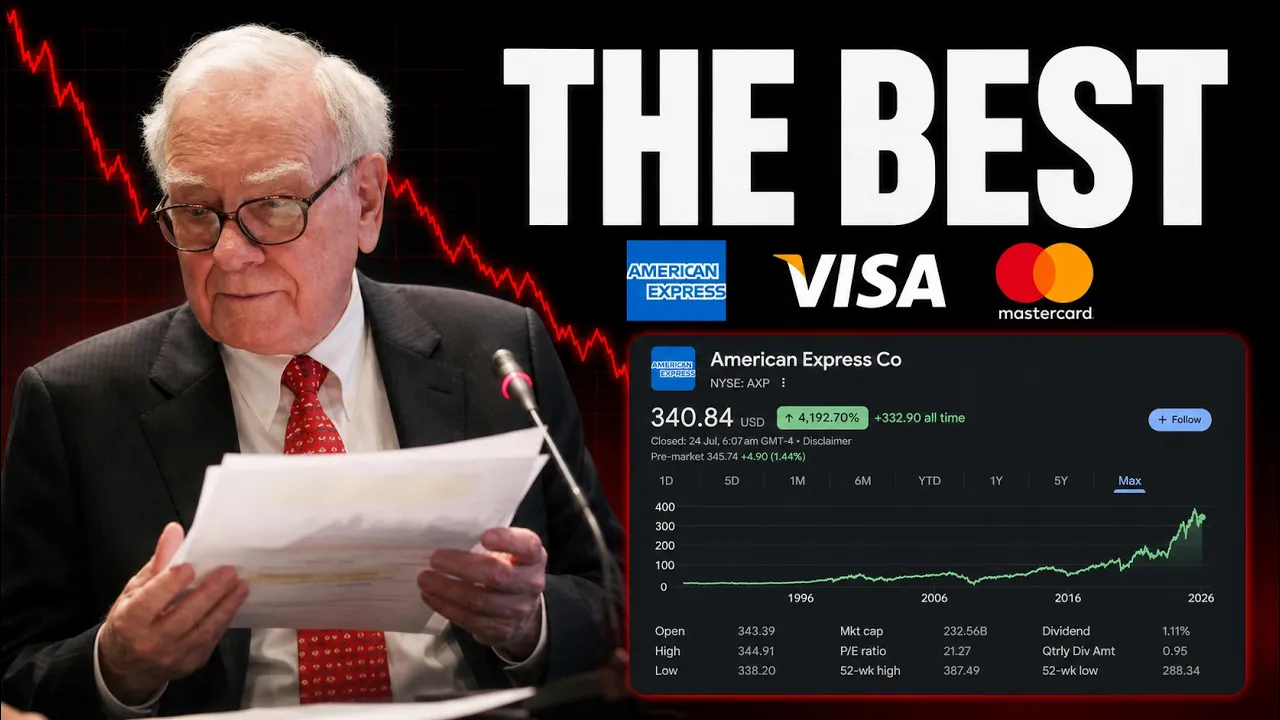
Should You Buy Visa, Mastercard, AMEX Stock If The Market Crashes?

- Retorno do vídeo
- +5,50%
- Chamadas
- 3
- Compra / Venda
- 3 0
- Publicado
Recomendações
Entrada é o preço de fechamento do ativo na data de publicação. Atual é o último fechamento registrado.
-
Entrada $355,74 24 jul 2026Atual $366,43 07 ago 2026Resultado +$10,69
Visa and Mastercard multiples have temporarily contracted toward 20 times earnings, presenting generational buying opportunities for long-term compounders.
-
Entrada $539,66 24 jul 2026Atual $568,61 06 ago 2026Resultado +$28,95
Visa and Mastercard multiples have temporarily contracted toward 20 times earnings, presenting generational buying opportunities for long-term compounders.
-
Entrada $326,17 24 jul 2026Atual $348,99 05 ago 2026Resultado +$22,82
For smart money investors like Warren Buffett, buying American Express at a compressed valuation multiple offers a compelling margin of safety combined with a growing dividend yield.
Transcrição Completa
This closed loop approach gives American Express full ownership of the card holder relationship and allows it to collect significantly higher merchant fees. However, it also means American Express must absorb potential loan losses when card holders default during economic recessions. Despite this credit exposure, Warren Buffett's Bergkshire Hathaway has consistently held American Express as one of its top equity positions. Berkshire owns over 151 million shares of American Express, which accounts for over 17% of its total equity portfolio with a market value near 46 billion. Buffett holds a 22% ownership stake in American Express, generating over $570 million in annual dividend income for Berkshire Hathaway. The primary reason Buffett favors American Express over purely transactional networks comes down to its affluent customer base and incredible brand loyalty. American Express targets high netw worth consumers and business card holders who maintain elevated spending habits even during broad economic slowdowns. Examining the actual financial performance of these three payment giants in 2026 reveals strong revenue trajectory across the board. In the first quarter of 2026, American Express delivered outstanding financial results that surpassed broad market expectations. American Express reported revenue growth of 11% year-over-year, reaching nearly $19 billion for the quarter. Total card member spending or build business increased by 10% to $428 billion, representing the fastest quarterly spending growth in 3 years. Furthermore, American Express saw its net card fees grow 16% on a currency adjusted basis, driven by high retention rates following card fee refreshes and strong premium card demand. Net income for American Express grew 18% year-over-year, delivering earnings per share of $4.28. Visa demonstrated equally impressive operational momentum in its fiscal second quarter of 2026. Visa generated net revenue of 11.2 billion, representing a 17% year-over-year increase. Processed transactions on Visa's global network reached 66.1 billion, reflecting a 9% year-over-year increase, while total payments volume surged to $3.7 trillion. Visa direct transactions expanded by 23% showing rapid adoption of account-to-account real-time payments. Visa's adjusted earnings per share reached $3.31, beating analyst projections by nearly 7%. Mastercard experienced similar expansion across global markets driven by strong crossber travel spending, value added services, and digital tokenization growth. During periods of economic stability, all three payment companies compound topline revenue at double-digit rates. However, when a market crash or severe economic contraction occurs, their revenue trajectories react differently based on their operational setup. Visa and Mastercard rely heavily on gross transaction volume and crossber payment fees. In a recession, overall transaction volume may flatten or slightly decrease as consumers cut back on discretionary purchases. Because Visa and Mastercard do not carry credit card debt on their books, their top line simply scales down modestly while their asset light infrastructure keeps operational cash flows elevated. American Express, on the other hand, faces a dual revenue impact during a market crash. While its merchant discount revenue drops alongside consumer spending, its net interest income can suffer if loan defaults rise and provision for credit losses increases. To evaluate how these stocks perform if the market crashes, we must stress test their business models against realworld economic shocks. Macroeconomic factors in 2026 present a mixed environment for consumer finance. Global interest rates remain elevated compared to historical averages, and regulatory scrutiny regarding credit card interest rates and swipe fees continues to generate market noise. During a sharp equity market crash or economic downturn, consumer confidence drops, leading to decreased travel, dining, and luxury retail spending. For Visa and Mastercard, this environment creates a temporary pause in transaction growth rather than a structural threat. Both Visa and Mastercard act as essential infrastructure for modern global commerce. Whether consumers use physical cards, tap to pay mobile wallets, or e-commerce checkout systems, Visa and Mastercard capture a friction fee on almost every electronic dollar moved globally. Their networks process tens of trillions of dollars annually, meaning they benefit from the long-term secular transition away from physical cash into digital payments. In a market crash, lower transaction volumes reduce fee revenue slightly, but their fixed operating costs allow them to maintain strong positive cash flow throughout the cycle. American Express underos a different stress test during a market crash because of its lending exposure. During financial crisis, credit default rates rise across banking portfolios. However, American Express possesses a unique structural shield that mitigates credit risk better than traditional commercial banks. The card holder profile of American Express is heavily concentrated in highincome individuals and corporate clients. These premium consumers carry higher average bank balances, superior credit scores, and stronger financial liquidity. During past market pullbacks, credit losses at American Express remain significantly lower than industry averages. Furthermore, American Express continues to attract younger, affluent card holders through refreshed premium card offerings. Young professionals in Gen Z and millennial demographics represent a fast growing segment of new card signups, driving long-term customer lifetime value. Profitability metrics and operating cash flow margins illustrate why smart money investors consider payment networks to be among the highest quality businesses in the world. Visa operates with profitability metrics that are rarely matched by any company in the S&P 500 index. Visa regularly maintains operating margins near 67% and free cash flow conversion rates exceeding 50% of total revenue. Because Visa does not operate branches, underwrite consumer loans, or fund credit lines, every incremental transaction added to its network carries near 100% incremental profit margin. Mastercard displays similarly elite profitability with operating margins hovering around 58% and strong cash conversion. These exceptionally high operating margins provide an immense buffer during market crashes. Even if transaction growth turns negative during a deep recession, Visa and Mastercard remain extraordinarily profitable, continuing to generate billions of dollars in free cash flow to support share repurchases and dividend growth. American Express operates with a lower net profit margin of around 15%. primarily because its business includes banking operations, card rewards expenses, and credit loss provisions. However, American Express compensates for lower profit margins by generating an extraordinary return on equity. In the first quarter of 2026, American Express reported a return on equity of 35%. This high return on equity demonstrates the efficiency of its closed loop system where high-spending card holders allow American Express to charge premium merchant fees and reinvest capital at elevated rates of return. While American Express carries credit provisions on its balance sheet, its ability to generate high returns on equity provides substantial financial resilience during market downturns. Valuation analysis plays a crucial role when deciding which stock to buy if the market crashes. In current 2026 market trading, Visa trades at a forward price to earnings ratio of approximately 28 times earnings. Mastercard commands a higher valuation multiple trading around 32 times forward earnings due to its higher international exposure and rapid growth in value added services. American Express trades at a noticeable valuation discount compared to its openloop peers, carrying a forward price to earnings ratio of approximately 20 times earnings. On a price to operating cash flow basis, American Express appears even more attractive to value investors, trading well below Visa and Mastercard. When a broad market crash occurs, equity multiples across all sectors contract sharply. Historically during market panics, Visa and Mastercard multiples have temporarily contracted toward 20 times earnings, presenting generational buying opportunities for long-term compounders. American Express multiples have dropped toward 15 times forward earnings during severe market pullbacks. For smart money investors like Warren Buffett, buying American Express at a compressed valuation multiple offers a compelling margin of safety combined with a growing dividend yield. For investors seeking zero credit risk, Visa and Mastercard at compressed multiples offer unrivaled terminal value safety. In summary, deciding whether to buy Visa, Mastercard, or American Express stock during a market crash depends on your investment strategy and risk tolerance. Visa and Mastercard provide unmatched business stability, elite 60% operating margins, and total immunity from credit default risk, making them premier defensive compounders. American Express offers a unique combination of premium customer spend resilience, higher dividend income, and an attractive valuation discount, explaining why it remains a central pillar of Warren Buffett's portfolio. Hey, thanks for watching. I truly respect every viewer who takes the time to seek objective datadriven analysis.
Comentários 0
Entre para participar da discussão.
EntrarAinda não há comentários. Seja o primeiro a compartilhar sua opinião!